Six Names at Pfullingen
On 10 March 1947 the town of Pfullingen drew up a list of every foreigner registered there between the outbreak of war and the end of it. Under the heading Kroatien, six of the names are Defranceski, and five of the six were born at Crikvenica.
The list is a bureaucratic object — a table of names, birth dates and birthplaces, typed to satisfy an Allied inquiry two years after the fact. But read down the birthplace column and it becomes something else: a village on the Kvarner coast, reassembled a thousand kilometres inland, in a small Swabian town below the Alb.
They were not deported together and they did not all come for the same reason. Petar left in April 1939, five months before the war, of his own accord and to qualify — he was a ship's engineer at Split and wanted the German papers. Ivan entered work in October 1941 at sixteen, six months after Yugoslavia was partitioned. Zdravko's route is the one that stops you: a clerk pencilled it in the margin of his sickness-fund card, and it says he was taken by the Partisans in 1943, held three or four months, and then went straight to Germany.
What they did there was, almost all of them, the same thing. Motor mechanics. Three of the men worked for the same employer, Hermann Sauer of Reutlingen and Pfullingen — a firm repairing vehicles through the war years. On the French camp cards after it, under Profession, the word recurs: auto-mécanicien.
The six, and the two wives
| Name | Born | Birthplace | Trade | What the file says |
|---|---|---|---|---|
| Anton Defranceski | 20 January 1890 | Crikvenica | — | The eldest of the six. Certified by the mayor of Pfullingen in 1950 as having worked for Hermann Sauer at Reutlingen-Süd. |
| Felix Defranceski | 14 January 1908 | Crikvenica | Automechaniker | Single, at Pfullingerlandstraße, Reutlingen. Motor mechanic for Hermann Sauer from July 1941, then a driver for Wilhelm Heim, then back to Sauer. The Reutlingen town list puts him in the town from 15 August 1941 to 8 October 1942. |
| Petar Defranceski | 15 June 1913 | Crikvenica | Auto-mécanicien | Ship's engineer with Jugoslav Lloyd at Split; left for Germany in April 1939 and stayed. Married Luise Salzer at Neuhausen in February 1942. Applied in November 1947 to be resettled in California — and then did not go: by July 1949 he had a house and two cars, and in April 1951 confirmed the family would remain in Germany. |
| Zdravko Defranceski | 1 or 2 April 1921 | Crikvenica | Auto-mécanicien | Taken by the Partisans in 1943, held three or four months, then straight to Germany. Motor mechanic at Reutlingen. Married Ruža of Fužine. Resettled February 1949 — to Australia. Died at Horsham, Victoria, 22 December 1979, aged fifty-eight, buried there as Frank. |
| Ivan Defranceski | 24 or 25 June 1925 | Crikvenica | Hilfsarbeiter | Entered work on 21 October 1941 at sixteen, as an unskilled hand at Licht und Kraft, Reutlingen. Returned to Croatia; the line continues through him. |
| Ruža Defranceski | 1922 | Fužine | — | Zdravko's wife, from the mountain village above the coast. No profession recorded. She outlived him by sixteen years and lies in the same Wimmera ground, South 2-D-23, having died on 1 February 1996. |
| Luise Defranceski née Salzer | 5 October 1919 | Neuhausen, Württemberg | — | Petar's wife, and the only German-born adult in the group. Married Petar in February 1942. |
| Anton Defranceski | 21 August 1944 (1943 on his headstone) | Reutlingen | — | The child entered on the French camp card with the single word enfant written across the fingerprint boxes, and photographed in his mother's arms. He died on 28 June 1999 and is buried at Warrill Park, Willowbank, in the City of Ipswich, Queensland. Named here only because he is no longer living. |
| Two daughters of Petar | dates withheld — both may be living | Urach and Metzingen | — | Born in Württemberg during the war and entered on the camp cards as enfant. They are named on the roster and undated; here they were dated and unnamed — the same rule kept backwards. Between the two pages a reader had both halves, so the years are withheld here too. See Urzula Defranceschi and Renate Defranceschi. |
Three faces
The Fiche Individuelle of the French occupation zone carried a clipped passport photograph and five fingerprints in red ink. These are the only likenesses of the Crikvenica family the archive holds.
Ten years, in the order the paper falls
| When | What | Around it |
|---|---|---|
| 1949–50 | Zdravko, Ruža and Anton reach Australia, not America | The resettlement roll assigned their numbers; the graves say where they went |
| 1890 | Anton born at Crikvenica | Kvarner, Austria-Hungary |
| 1908 | Felix born at Crikvenica | Kvarner, Austria-Hungary |
| 1913 | Petar born at Crikvenica | Nationality at birth, as he wrote it in 1947: Österreich-Ungarn |
| 1921 | Zdravko born at Crikvenica | Kingdom of Serbs, Croats and Slovenes |
| 1925 | Ivan born at Crikvenica | Kingdom of Serbs, Croats and Slovenes |
| 1935 | Petar passes his ship's-engineer examination at Split | |
| 1937 | Petar living at Split, engineer with Jugoslav Lloyd | |
| Oct 1938 | Ivan Dracic of Crikvenica is already living at Reutlingen | The colony predates the war |
| Apr 1939 | Petar leaves Yugoslavia for Germany — voluntarily, to improve himself | Five months before the war |
| Oct 1941 | Ivan, aged sixteen, enters work at Reutlingen | Yugoslavia had been partitioned in April |
| Jul 1941 | Felix begins with Hermann Sauer at Pfullingen | |
| Feb 1942 | Petar marries Luise Salzer | |
| Apr 1942 | Petar begins with Hermann Sauer on vehicle repairs | |
| 1943 | Zdravko taken by the Partisans; three or four months held; then to Germany | Pencilled on the back of his sickness-fund card |
| 2 Mar 1945 | Petar's and Zdravko's employment cards stop | French forces reached Reutlingen in April |
| 10 Mar 1947 | Pfullingen draws up its list of foreigners registered 1939–45 | Six Defranceskis on it |
| 7 Nov 1947 | Petar signs the CM/1 application for resettlement in California | Identity number 148.902 |
| 21 Dec 1947 | Petar's household counted at Reutlingen | |
| 22 Feb 1949 | Zdravko, Ruža and their son on a resettlement roll | IRO numbers 135801, 6/2416 |
| 22 Jul 1949 | Petar tells the resettlement officer he wants to stay in Germany | «a une maison, 2 autos etc.» |
| 28 Feb 1950 | Pfullingen certifies Anton's wartime employment | Signed by the mayor |
| 28 Apr 1951 | Confirms the family will remain | Liste Zone Sud |
| 25 May 1951 | Entered on the list of displaced persons living privately | Still at Kelternstraße 30, Neuhausen |
| 22 Dec 1979 | Zdravko dies at Horsham, Victoria, aged 58 | Buried in the Wimmera as Frank |
| 1 Feb 1996 | Ruža dies; buried at Horsham, South 2-D-23 | |
| 28 Jun 1999 | Anton dies; buried at Willowbank, City of Ipswich, Queensland | An hour from Brisbane |
| 27 Nov 1946 | Luise's DP identity card is issued at Reutlingen, then struck | «pas Personne Déplacée — Allemande de naissance, mariée à un Yougoslave» |
| 21 Dec 1947 | Petar's household registered at Reutlingen | From Friedrichstraße 4, Neuhausen |
| 8 Mar 1949 | Zdravko, Ruža and Anton emigrate to Australia | «Emigré Australie le 8.3.49» — IRO 148.901 |
| 30 Jul 1949 | «Proposons à Mr. Boesch de le mettre Bj» | Eight days after Petar said he was staying |
| 25 May 1951 | Petar's family on the PDR list of people living privately | Kelterstraße 30, Neuhausen |
| 1954–1984 | Tracing case 349.822 stands open on Petar for thirty years | Eight documents, withheld online |
| 15 Dec 1948 | Eligibility verified | «L'éligibilité de l'intéressé a été vérifiée le 15.12.48» |
| 27 May 1949 | «Le Chef de famille et les deux enfants sont classés B, l'épouse BJ» | The IRO director for the French zone, on the case of Defranceski 148.902 |
| — | Petar is screened for Brazil | «Passé au screening — Brésil. Rien à signaler.» |
| 15 Feb 1978 | Anton Mario is naturalised in South Australia | Commonwealth Gazette P8, 25 Oct 1978, p.303 — «7 Calomba Cres, Happy Valley 5159» |
| 21 Jul 1978 | Zdravko and Ruža are naturalised, living at Horsham | Commonwealth Gazette P2, 16 Feb 1979, p.66 — «19 Anderson St, Horsham 3400» |
| 28 Jun 1999 | Anton Mario De Franceski dies in Queensland | Buried at Warrill Park Lawn Cemetery, Willowbank, City of Ipswich |
How long each of them was actually there
The family holds a copy of the Pfullingen list in which the arrival and departure columns are barely legible. The Arolsen original is clear, and it turns six names into six stays of very different length.
| Who | Born | Arrived | Left |
|---|---|---|---|
| Felix | 14.1.08, Crikvenica | 5 July 1941 | 4 August 1941, and a second stay ending 3 March 1945 |
| Ivan | 24.6.25, Crikvenica | 20 October 1941 | 5 September 1942 |
| Anton | 20.1.90, Crikvenica | 1 March 1942 | 13 June 1942 |
| Zdravko | 1.4.21, Crikvenica | 17 June 1944 | 3 March 1945 |
| Ruža | 13.2.22, Fužine | 29 July 1944 | 3 March 1945 |
| Anton the younger | 21.8.44, Reutlingen | — | — |
Two things fall out of those columns. First, Anton — the head of the family, born 1890, and this archive's own great-great-grandfather — was at Pfullingen for only three and a half months, from 1 March to 13 June 1942, and then went home. If the family is right that he died in 1943, he died back on the Kvarner, not in Germany.
Second, look at the date 3 March 1945. Felix leaves on it. Zdravko leaves on it. Ruža leaves on it. Petar's sickness-fund card stops on 2 March 1945. Four members of one family stopped being registered at Pfullingen within twenty-four hours of each other, seven weeks before the French army reached Reutlingen. Whatever that was — evacuation, flight, a works closing — they did it together.
And a third list, which puts them all in one village
Neuhausen an der Erms drew up its own return on 25 March 1947, under General Koenig's Order No. 1792: every foreigner present in the commune, permanently or temporarily, between 2 September 1939 and 25 April 1945. The first seven names on it are one family.
| № | Name | Born | Present | Note |
|---|---|---|---|---|
| 1 | Defranceski, Peter | 15.6.13, Crikvenica | 22 March 1941 – today | Four years earlier than any date the family had for him. |
| 2 | — geb. Salzer, Luise | 5.10.19, Neuhausen | since birth – today | She was born in the village. Petar married into it. |
| 3 | — Ursula | Urach — date withheld, she may be living | since birth – today | — |
| 4 | — Renate | Metzingen — date withheld, she may be living | since birth – today | — |
| 5 | — Zdravko | 1.4.21, Crikvenica | 19 March 1945 – today | — |
| 6 | — geb. Hreljec, Rose | 22.2.22, Fužine / Belnica | 19 March 1945 – today | Her maiden name, and a second place — Belnica. And the one document that disagrees about her birth, outvoted three to one. This list reads 22.2.22; the Arolsen card gives «Fuzinä / Belnica · 02/13/1922», the Australian file NAA A11534, 58–60 gives «Ruza DOB 13 February 1922», and her own Reutlingen certificate of 1950 gives «born 13.2.22 at Fusine». This archive settles her birth at 13 February 1922 and leaves this transcription exactly as the register wrote it — a wrong figure in a real document is evidence about the document, and correcting it silently would destroy the only trace that the clerks disagreed. |
| 7 | — Anton | 21.8.44, Reutlingen | 19 March 1945 – today | — |
Put the three lists side by side and the movement resolves. Petar had been at Neuhausen since 22 March 1941, married to a woman born in the village. Zdravko, Ruža and their baby son were registered at Pfullingen until 3 March 1945 — and appear at Neuhausen on 19 March 1945, sixteen days later. Felix leaves Pfullingen on the same 3 March; Petar's sickness-fund card stops on 2 March. Whatever happened at Pfullingen in the first days of March 1945, the answer for three of them was to go to Petar.
It also gives Ruža her maiden name — HRELJEC — and a second birthplace alongside Fužine: Belnica. Her birth date appears in these papers as 13 February, 2 May and 22 February 1922, which is three clerks and one woman.
Found in 2026, and not in the family's file
The Arolsen Archives hold 79 records under this surname. The family's own copy of file D-1.505 is a fraction of it.
And they were not alone. The Reutlingen town list puts Felix in the town from 15 August 1941 to 8 October 1942 — but look at the names bracketing his. Brozicevic, born Crikvenica 1910, present from March 1939. Car Pavao, born Crikvenica 1911, from February 1939. Anna, Maria and Zdravko Domijan, all born at Crikvenica, from January and June 1939. Dracic Ivan, born Crikvenica 1912, from 17 October 1938 to January 1946.
There was a Crikvenica colony at Reutlingen before the war began. That is why Petar could leave Split in April 1939 and say he was going to improve himself: he was not striking out into nowhere. He was going where people from his own town already were.
The paper itself
Where they actually went
The forms end in 1950 and the paper stops. The graves pick it up.
Zdravko, Ruža and their son did not go to America. They went to Australia — to Horsham, a wheat town in the Wimmera of western Victoria, four hundred kilometres inland from Melbourne and about as far from the Kvarner as a coast-born mechanic could get. Zdravko died there on 22 December 1979, aged fifty-eight, and the headstone calls him Frank. Ruža followed on 1 February 1996 and lies in the same ground.
Their son Anton — the enfant of the camp card, the toddler in Ruža's photograph — died on 28 June 1999 and is buried at Warrill Park, Willowbank, in the City of Ipswich. That is in Queensland, an hour up the highway from Brisbane, where the keeper of this archive lives. Nobody in this family knew.
The French zone files: two brothers, two numbers, two answers
Nineteen cards from the French occupation authorities and the IRO, in the displaced-persons folder DP0758 at Bad Arolsen, carry this family through the six years after the war. They were read in full in September 2026 and they settle several things the archive had only half of — including the day Zdravko, Ruža and Anton left for Australia.
The two households were registered at Reutlingen together and hold consecutive IRO identity numbers: 148.901 for Zdravko's family of three, 148.902 for Petar's family of four. Both are entered in category CB. The brothers went into the same office on the same day and came out with numbers one apart, and then chose opposite hemispheres.
«Emigré Australie le 8.3.49», with a second date of 17.3.49 alongside. The card stands for the household of three — Zdravko, Ruža and the child — and it is the first document to give the day they left. Across the foot is a red stamp: CM/1 destroyed. That is why no IRO care-and-maintenance file survives for them, and why Petar has one and his brother does not.
Nationality Yugoslav; born 15.06.13, and the place written in by hand: Crikvenica. Profession «Auto-Mechaniker». Address Kelterstraße 30, Neuhausen. Married. His five fingerprints are pressed across the card in red ink. The ship's engineer who sat his examination at Split in 1935 finished as a motor mechanic in a Württemberg village — the same trade his younger brother Zdravko had at Reutlingen.
The card the archive had only in part. IRO 148.902; address Kelterstraße 30, Neuhausen, Kreis Reutlingen, as at 1 April 1951; and under «autres membres de la famille», the wife and two children, whose dates are withheld here because both daughters may be living. Three entries under Exposé: «22.7.49 — Veut rester en Allemagne, a une maison, 2 autos etc…»; «28.4.51 — Confirme qu'ils désirent rester en Allemagne (Liste Zone Sud)»; «25.5.51 — Figurent sur liste PDR gens vivant en privé (arrêtée au 1.4.51)». He said it once, then confirmed it, and then the office wrote him down as living privately.
One line: «Proposons à Mr. Boesch de le mettre «Bj».» Eight days after Petar told the counsellor he had a house and two cars and was staying, the office proposed to reclassify him. The index cards then record the change going through — «Tit 1165, 11.8.49, BJ» and «03.Tr.16, «BJ», 23.8.49». What Bj means is answered below, by a letter the family kept and Bad Arolsen does not hold.
Issued by the Commandement en chef français en Allemagne, and carrying a photograph of her with her two small daughters — the first picture of Petar's family this archive has seen. Nationality: Yugoslave. Address: Neuhausen, Kelternstraße 30. Born 5 October 1919 at Neuhausen, in the Reutlingen district — she is a local woman, born four streets from where the card was issued. Height 168, oval face, blue eyes, chestnut hair. And then, written diagonally across the whole top of the card in another hand: «pas Personne Déplacée — Allemande de naissance, mariée à un Yougoslave», with ALLEMANDE in green across the header.
«DEFRANCESKI, Luise 5.10.19 apatr.» Apatride. Stateless. She was German by birth, and in marrying a Yugoslav in February 1942 she took his nationality and lost her own; by 1949 she was neither. The one word in the abbreviation column is the whole of it.
Two daughters are named on the family's cards, born in 1940 and in 1945, each with her own fiche individuelle and the word «enfant» in red crayon across the five empty fingerprint boxes — the same red hand, on the same printed form, as on Anton's card. The younger one's card is annotated «Neuhausen, Friedrichstr. 4 / recensé à Reutlingen 21.12.47 / 1.3.49 à Reutlingen / Devenu Bj. le 10.8.49», and on its reverse: «Siehe auch DEFRANCESKI, PETAR 15.6.1913». Both were born within the last hundred years and no death is recorded for either, so this archive does not name them.
Opened for DEFRANCESKI, PETER born 15.06.1913, reference 06030302.0.349.822. Eight documents, and the dates on the folder run from 1954 to 1984. Somebody was asking the International Tracing Service about Petar for thirty years. The contents are withheld online for data protection; they must be requested from Bad Arolsen directly, and they are the single most promising unread thing this archive knows of.
The care-and-maintenance application, signed «Peter Defranceski», carries small passport photographs of him and of Luise, pasted side by side and numbered A1048 and A1049. It gives the marriage precisely — «14.2.1942 Neuhausen (Reutlingen)» — and the children's birthplaces, Bad Urach and Metzingen. Asked why he left his country, he answered that he quit Yugoslavia in 1939 voluntarily «pour se perfectionner», went back, and returned to Germany so as not to be called up. Asked whether he wished to be repatriated he said yes — «dans 2 ans», in two years, when he had finished. Asked whether he wanted to stay in Germany: «oui, provisoirement». Asked where he wished to be resettled: USA, Californien. Under nationality the clerk wrote Jugoslavien, and at birth Österreich-Ungarn; against Crikvenica he first put Dalmatien and then corrected it to Kroatien. Two years later the same file holds the form that undid it — an IRO «Changements de statut», appendix V, Cercle de Reutlingen, dated 11.8.49 and numbered Tit/CM 1165, the very reference the index card cites. Every box for an actual change is empty. The only thing that changed was the category.
A letter on pink paper in the family's own copy of the file, from A. Poignant, Director of the IRO for the French zone of occupation, to the Chef de Service du Wurtemberg at Ebingen. Subject: «Cas de DEFRANCESKI (148.902)». It says the eligibility of the person concerned was verified on 15 December 1948, and then this: «Le Chef de famille et les deux enfants sont classés B, l'épouse BJ.» — The head of the family and the two children are classified B, the wife BJ. So BJ was not, in the first place, a reclassification off IRO care. It was Luise's own category, given her because she was German-born — the same fact her index card records with the single word apatride. B was the category for the Yugoslavs. What happened on 30 July, and went through the books in August, is that Petar was moved out of his children's category and into his wife's.
A small green slip in the same file, signed by Dr S. Birietaité, Chef de Service de Santé: «M. Defranceski est passé au screening — Brésil», and underneath, in blue, «Rien à signaler». He was screened for Brazil, and the doctor found nothing to report. The archive knew he had applied for the United States in November 1947 and named California. It did not know he had also been put forward for Brazil — the country where, two generations earlier, more of this surname had settled than anywhere else on earth. He passed the medical for it and did not go.
Arolsen's index card for this family is stamped CM/1 destroyed, and their online folder has almost nothing for it. The family kept its own copies, and they are here: Zdravko's fiche individuelle, card 30560, with his photograph and five red fingerprints, «Auto-mecanicien», at Neuhausen, Friedrichstraße 4; Ruža's, card 30561, with a photograph of her holding the baby; Anton's, card 52852, «enfant» in red across the empty fingerprint boxes. Their identity cards were issued on 27 November 1946, the same day as Luise's, and each is annotated later in red pencil: 8/3/1949 Australie. Even the clothing issues are entered — 3 June 1948, shoes; 14 September 1948, a coat, a shirt, trousers and a pair of men's gloves.
Both brothers' families were at Neuhausen on Friedrichstraße — Zdravko's at number 4, and Petar's there too before they moved to Kelterstraße 30. The town certificates of 28 February 1950 put the men in their trades: Zdravko («Strawko», born 1.4.21 at Zvekvenica) with Hermann Sauer at Reutlingen-Süd; Ruža («Rose geb. Hreljac», born 13.2.22 at Fusine/Delnice) with Licht und Kraft at Reutlingen; Ivan, born 24 or 25 June 1925 at Crikvenica, with Licht und Kraft too; Felix, born 14.1.1908, with Hermann Sauer from 15 August 1941 to 8 October 1942.
Read together, the nineteen cards give the shape of the decision. In December 1945 and December 1948 the two households are registered at Reutlingen. In November 1947 Petar applies for California. In March 1949 his brother sails for Australia. In July 1949 Petar tells the counsellor he has a house and two cars. Within a month the French have moved him off their books, and in 1951 he confirms it in writing. One brother took the ship and one bought a second car. And the last of it: the family's own copy of the file settles Ruža's birth date at 13 February 1922 — the Reutlingen card, her identity card and her town certificate all agree, against the single Arolsen index entry that reads 2 May.
And Petar stayed
He never went. A counselling card found in the Arolsen collections in 2026 — not in the file the family holds — carries three lines that end the story. On 22 July 1949: «Veut rester en Allemagne, a une maison, 2 autos etc.» — wants to stay in Germany, has a house, two cars. On 28 April 1951 he confirmed that the family wished to remain. On 25 May 1951 they were entered on the list of displaced persons living privately. The address is the same one he gave in 1947: Kelternstraße 30, Neuhausen.
The ship's engineer who left Split in April 1939 with nothing had, ten years later, a house and two cars in a Swabian village, and decided that was enough. His two daughters, born at Urach in 1940 and Metzingen in 1945, grew up German.
Petar had asked for the United States, and named California, because his aunt Jacomina Alafetić was at San Pedro — the fishing and cannery port south of Los Angeles that drew Dalmatian and Kvarner families for two generations. Ivan went the other way: back to the coast, to Senj, and the line this archive follows runs on through him. See The Spine.
A discrepancy worth naming
The family records Anton, born 1890, as dying in 1943. Yet a certificate about his wartime employment was issued by the mayor of Pfullingen on 28 February 1950. Certificates of that kind were routinely obtained after a man's death, by a son making a claim, so the two need not conflict — but nothing here proves it either way, and it is left open.
On dates that do not agree
Three of the six have two birth dates in these files: Ivan 24 or 25 June 1925, Zdravko 1 or 2 April 1921, Ruža 13 February or 2 May 1922. Nothing sinister — a town clerk copying from a list, a camp officer copying from a man's memory in a second language. Both forms are shown rather than one silently chosen.
Source
All the documents on this page come from the Arolsen Archives, the former International Tracing Service at Bad Arolsen, holder of the Nazi-era and displaced-persons records of some seventeen and a half million people. The file for this family is numbered ITS D-1.505. The copies were obtained by the family and are reproduced here from their own scans.
The ship
This archive has known since the Arolsen file was read that Zdravko, Ruža and Anton left for Australia in the spring of 1949. It has never known what they sailed on. It does now, and the answer came from a volunteer transcription project that has been online for twenty years.
| Departure port | Naples, Italy |
| Departure date | 17 March 1949 |
| Arrival port | Melbourne, Australia |
| Arrival date | 13 April 1949 |
| Operated for | International Refugee Organisation — Group Resettlement to Australia |
| Passengers 0180, 0181, 0182 | DEFRANCESKI Anton · DEFRANCESKI Ruza · DEFRANCESKI Zdravko |
Three consecutive numbers on one manifest. Anton first because the list is alphabetical by forename inside the surname, and he was four years old — born at Reutlingen on 21 August 1944, which the Australian file now confirms to the day.
The USAT General Stewart was a United States Army transport, and the list she carried out of Naples that March is a page of post-war Europe: Ābele, Abeltiņš, Ābols from Latvia; Andrusevičius, Bagdonavičius, Balčiūnas from Lithuania; Andrijczak and Babiarz from Poland; Batrachenko and Beznosenko from Ukraine; a Balogh and a Birli from Hungary. Nine hundred-odd displaced persons of a dozen nationalities, and at 180 to 182 in the alphabet, three Croats out of a house at Klenovica by way of a camp in the French zone.
One thing to reconcile rather than paper over. The family's own account, and this archive's pages, give the sailing as 8 March 1949. The manifest gives departure from Naples on 17 March. Both can be true — 8 March would be the day they left the camp or the transit centre and were entrained for Italy, and 17 March the day the ship cast off. The IRO moved people to the port in staged convoys and the gap is the usual size. But the date on this site should now read: left the camp in early March, sailed from Naples on 17 March, landed at Melbourne on 13 April 1949.
Two other men of the name are on the same project's manifests, on the same programme, and neither is connected to this family. «DE FRANCESCHI Giuseppe, Italian, 3174931» reached Fremantle on the SS Ugolino Vivaldi on 23 February 1950, also an IRO group resettlement to Australia. And «FRANCESCHI Fernando, Italian, 3177692» came in on the SS Castel Bianco on 29 March 1952. Those five- and seven-figure numbers are IRO case references, and the transcribers note what the original manifests hold beside them: date of birth, country and place of birth, IRO status, religion, marital status, passport number, and the date and place the passport was issued, and occupation. The originals are in the National Archives of Australia. That is the next request, and it would give this family the same nine fields for its own three.
Immigrant Ships Transcribers Guild, immigrantships.net — USAT General Stewart, Naples to Melbourne, arrived 13 April 1949, transcribed volume 6; SS Ugolino Vivaldi, Fremantle, 23 February 1950, volume 5; SS Castel Bianco, 29 March 1952, volume 4. Found September 2026 through the site's own search, on a link supplied by the family.
And what Australia wrote down when they landed
The Arolsen file carried this family to the ship. The National Archives of Australia carry them off it. Eight items, found in September 2026 by searching RecordSearch on three spellings of the name, and they settle two things this archive had wrong or open.
National Archives of Australia, RecordSearch — searched on Defranceski, Franceski and De Franceski, 15 September 2026. Eight items. None has been ordered as a copy yet.
The day they became Australians, printed by name
Every Australian naturalisation was published, name by name, in the Commonwealth of Australia Gazette, and the National Library has digitised the whole run. The work list had this down as the free way to confirm the two NAA files without paying to open them. It does that, and it does two things the files were wanted for anyway — it dates the oath and it gives the street they were living in when they took it — and then it hands back a third member of the family who was not being looked for.
Commonwealth of Australia Gazette. Periodic, No. P2, Friday 16 February 1979, page 66, under the single-word heading VICTORIA — an alphabetical list of everyone granted citizenship in the state, running from Abadia to the end of the alphabet, and they are two lines in it between a Deeb and a Deiana.
They were naturalised together on 21 July 1978, and they were living at 19 Anderson Street, Horsham, in the Wimmera. The National Archives entry says only «1978» and «Melbourne» — which is where the file was registered, not where they lived, and this archive had been about to repeat it. Zdravko died the following year. The Gazette's spelling of her is Roza, a sixth form of a name the Germans had already written Rose and HRELJEC. (doc)
The four-year-old who came off the General Stewart in 1949 took the oath on 15 February 1978 — five months before his parents did, in another state, under the spelled-apart form of the name. That is why he was not found with them: no search for Defranceski returns De Franceski, and no search of the Victorian list returns a man in Adelaide.
This archive had him as «Horsham, then Adelaide, then Ipswich», inferred from where his children were born. Now there is an address and a day: 7 Calomba Crescent, Happy Valley, in the southern suburbs of Adelaide. (doc)
Nobody else of this family is in it. Ivan, David's grandfather, is not — under any of the four spellings, in any year. The rest of what the name returns is not people: De Franceschi Bros Pty Limited winding up through the Business Gazette in 1990–92, Defranceschi Brister Australia Pty Ltd in liquidation in 2001–04, and a column of tenders.
Two entries are persons and neither can be placed. «Defranceski, M.» appears in the Unclaimed Moneys Act 1917 register of Avon Products Pty Limited, published in the New South Wales Government Gazette of 18 April 1975 against a balance last claimed in 1967 — the exact family spelling, in the wrong state, a decade too early. And «DeFranceschi Bros, 716 Chappie Lane, Broken Hill», in the NSW Gazette of 17 June 1966. (inf — filed, not claimed)
Trove, National Library of Australia — Commonwealth of Australia Gazette. Periodic, No. P8 of 25 October 1978 and No. P2 of 16 February 1979, read from Trove's corrected text. Searched 17 September 2026 on four spellings across every digitised gazette.
What became of them in Australia
Zdravko, Ruža and their four-year-old landed at Melbourne on 13 April 1949. This is what grew from them — read out of David's own live family tree on 15 September 2026, because it had never been read into this archive before.
Read from David's live MyHeritage tree, family tree 4, on 15 September 2026. Living people are named and placed and never dated, as this archive's rule requires.
The two employers, and what each of them was
Three of the six worked for a man named Hermann Sauer, and one of them also drove for a Wilhelm Heim. This site has carried both names for months as words on a certificate. They have now been traced, and they are not the same kind of thing at all.
The Stadtarchiv Reutlingen's photograph collection catalogues the firm under its own name: «Hermann Sauer, Kraftfahrzeuge, Südbahnhof» — motor vehicles. Also «Eningen – Firma Hermann Sauer, MAN-Vertretung», at Eninger Landstraße 79, with the firm's yard, buildings and garages; and «Tankstelle Rheinpreussen, Marktstraße, Firma Hermann Sauer», a filling station in the town. Behind that, earlier: «Tübinger Straße 98 – Autohaus Sauer», photographed in 1935 with small lorries displayed outside, and a 1937 caption reading «Autohaus Gebr. Sauer» — the Sauer brothers. So it was a garage, workshop and commercial-vehicle dealership holding the MAN agency, on the road running south out of Reutlingen toward Eningen. Pfullingen is two kilometres further along the same corridor, on the tramway. A man billeted at Pfullingen and working at Sauer's Reutlingen-Süd yard is an entirely ordinary arrangement, and the trade matches what the papers say the men did: Automechaniker.
Said carefully. The archive's photographs name «Hermann Sauer» from 1958 and «Autohaus Sauer» from 1935, but this project has not seen a document of 1939–45 that names the firm. That the Sauer of the 1950 Pfullingen mayoral certificate and the 1941 Reutlingen town list is this firm is a strong inference and is published as one. A single page of a wartime Reutlingen street directory would settle it outright.
Firma Wilhelm Heim, Eisen- und Holzwarenfabrik, of Esslingen, took over the halls of the Schickhardt hosiery works on the Wannweiler Straße in Reutlingen-Betzingen in 1938. It made ammunition containers for the Wehrmacht, and then, under strict secrecy, «mit ca. 500 Zwangsarbeitern Tragflächen für die V1» — wings for the V1 flying bomb, with about five hundred forced labourers. The German account of Reutlingen puts it plainly among the town's labour camps: «ein Lager der damaligen Firma Heim im Stadtteil Betzingen, in der Tragflächen und Höhenleitwerke für die V1 produziert wurden». Reutlingen held some 3,950 people in labour camps during the war, about a tenth of its population.
Felix Defranceski, born at Crikvenica on 14 January 1908, motor mechanic for Hermann Sauer from July 1941, then — in the words of the file — a driver for Wilhelm Heim, then back to Sauer. So for some part of 1941 or 1942 he was driving for a plant that ran on forced labour and was building wings for the V1. That is a fact about the place he worked. It is not, by itself, a statement about his own legal position, and the archive keeps the two apart.
The words matter, and the four men are not in one box
Ship's engineer with Jugoslav Lloyd at Split; left for Germany in April 1939, five months before the war and two years before Yugoslavia was invaded. On the face of it he went to work, as thousands did. He should be called a labour migrant unless a document says otherwise, and none does.
Both arrived after the partition of April 1941. Crikvenica lay in the Italian zone of the new Croatian state, and Croatian nationals went to the Reich in 1941–42 largely under a German–Croatian labour agreement that was nominally voluntary and in practice pressed hard by quota and by hunger. The right term at the point of arrival is ausländischer Zivilarbeiter, foreign civilian worker — while noting that by 1942 the freedom to go home had in practice disappeared. This archive will not write «forced labourer» for either of them without a document that says so.
Taken by the Partisans in 1943, held three or four months, then sent to Germany. Being seized and despatched to the Reich is deportation into forced labour. His own IRO file, number 148.901, is the post-war recognition of it. Here the word is right and should be used.
And there is something at Reutlingen that this archive should ask for. The Stadtarchiv holds, in the Näher collection, some thirty-nine units catalogued under «Firma Heim» — including «Betzingen – Firma Heim, Zwangsarbeiter/-innen», ten photographs, 1944; «Betzingen – Firma Heim, Belegschaft, Zwangsarbeiter/innen», thirty-one photographs, 1944; and nine more from 1945. They are individual portraits of the firm's workforce and of the people forced to work in it, made in the last months of the war. The photographs are catalogued as groups, without personal names, so a search on this surname returns nothing and proves nothing. If Felix drove for Heim in 1941 or 1942 he may be in that series, and so may people whose families have been looking for them for eighty years. There is also a single portrait, «Vrolow, b. Fa. Sauer», dated 16 May 1945 — a Slavic name, photographed three weeks after the French took Reutlingen and identified only by his employer. That is the shape of an identity photograph made for a foreign worker, and the studio's day-book would say who he was.
What to do, in order. Buy Christoph Reik's «Fremdarbeiter und Kriegsgefangene in Pfullingen» (Pfullinger Beiträge 12, 2003, five euros, still in print) — it covers exactly Anton's four months and prints a list of the firms. Then write to the Stadtarchiv Reutlingen for the foreigners' card index, the 1943–46 file G 4 a Nr. 207, the post-war lists AdN 1336–1348, and the Firma Heim portrait series. Then ask the Staatsarchiv Sigmaringen whether a denazification file exists for Hermann Sauer: that one document would give the man himself.
Stadtarchiv Reutlingen photograph database (fotoarchiv.reutlingen.de), signatures S 105/4 and S 105/5, read September 2026. On Firma Heim: the Betzingen local-history record citing Werner Früh, and the standard account of Reutlingen's wartime labour camps. The reference study is Karin-Anne Böttcher in «Reutlinger Geschichtsblätter» NF 34 (1995), pp. 29–102. None of the wartime personnel records has yet been seen by this project.
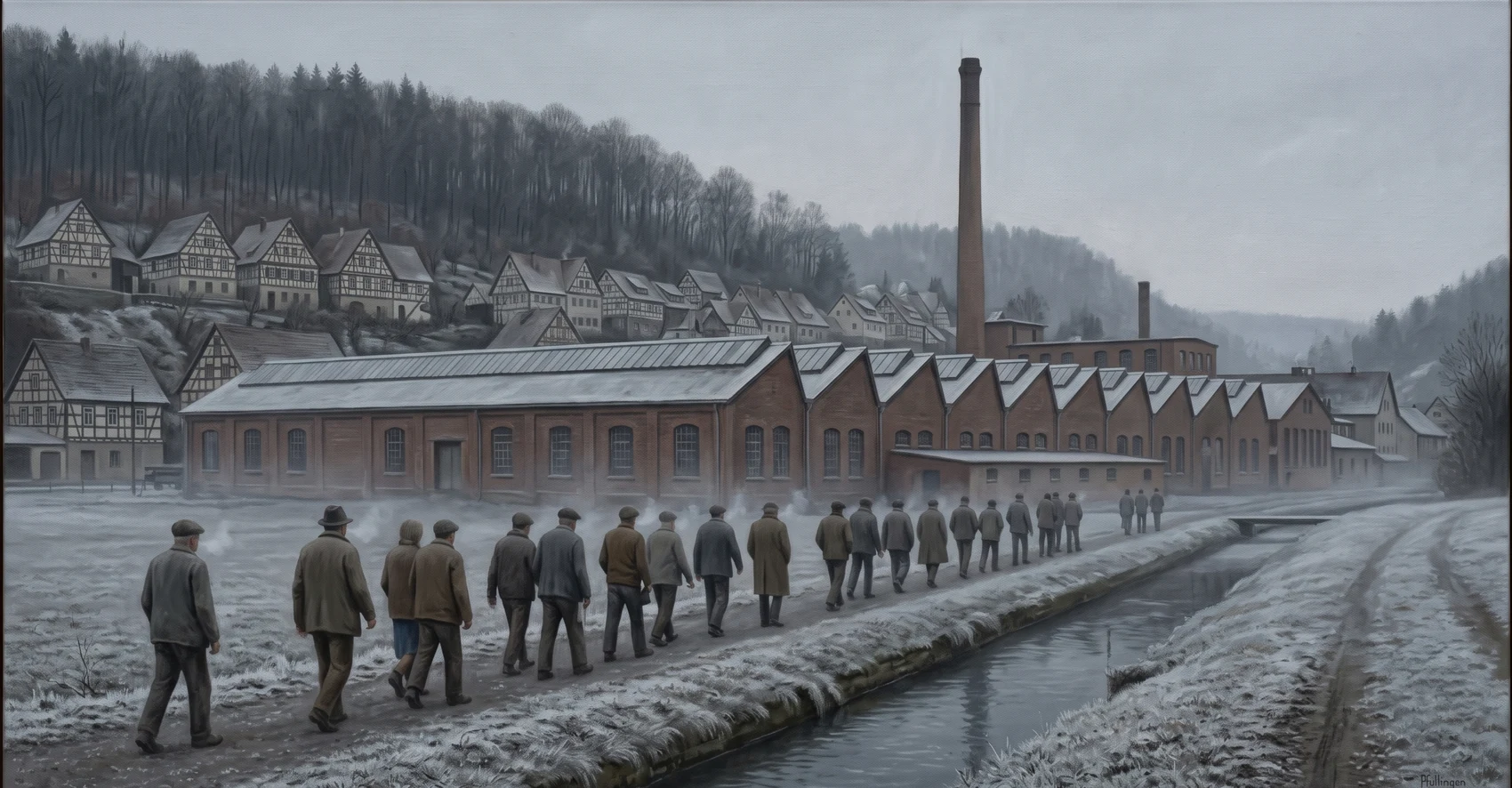
It is drawn as a works and not as a camp, because that is what the papers describe: foreign labour in a Württemberg textile town, billeted and walked to the shift. There is no wire in it, no guard, no insignia and no flag — not to soften anything, but because putting in what the record does not say is how a picture starts lying. What the record does hold is the list of foreigners at Pfullingen in 1947, certified by that town's mayor in 1950, and the Arolsen papers behind it.
The full bibliography, with what each source gave and where it is weak →