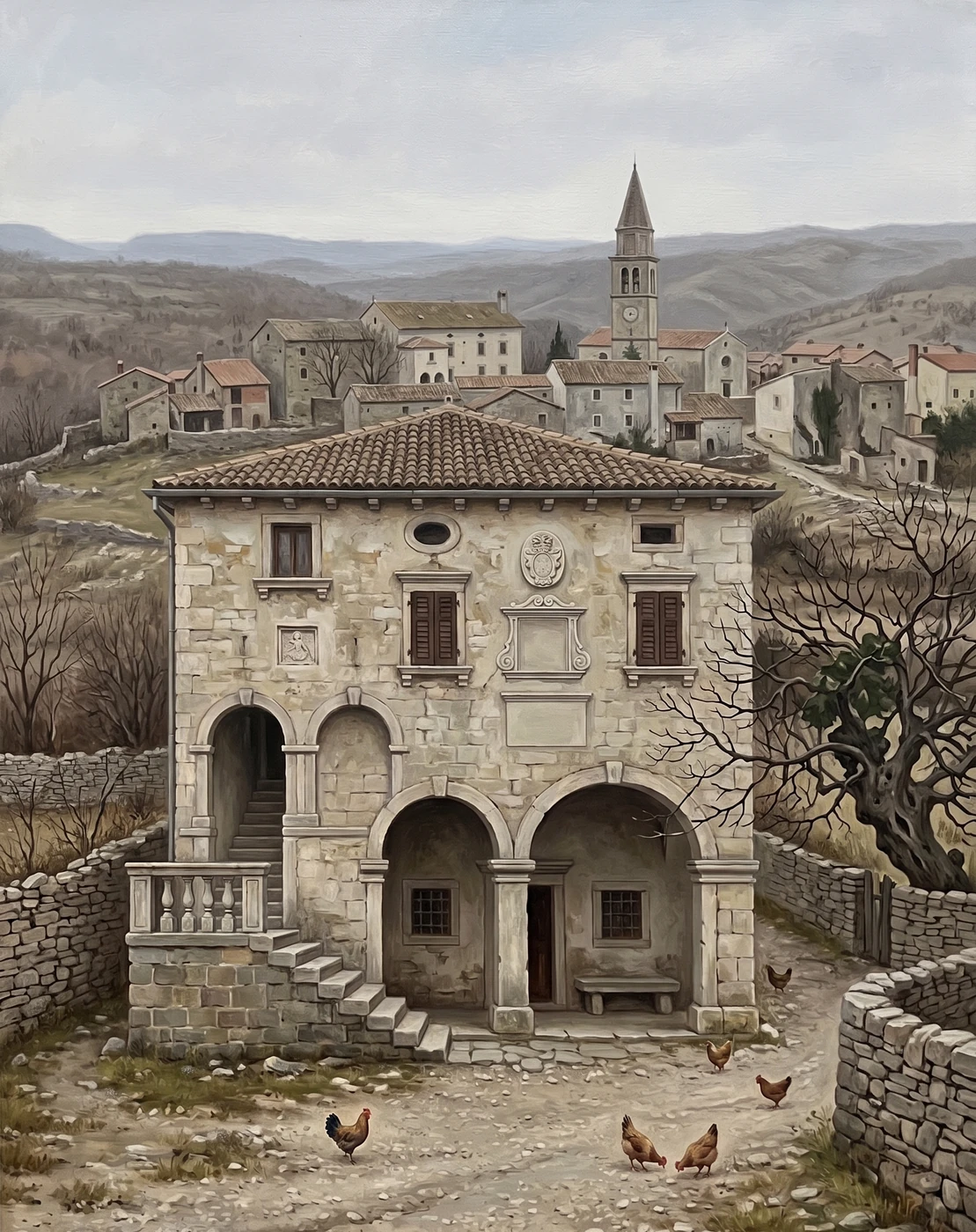
Six generations back, a stonemason on an Istrian hill.
Istria · Kvarner · Carnia · and the diaspora — a family written down under eight sovereigns, in four languages, and spelled at least nine ways.
This archive was built by David Defranceski, born in Johannesburg, living in Brisbane — and it runs backwards from him: to Senj, where his grandfather Ivan is buried; to Crikvenica, where the household came ashore; to Gračišće in Istria, where in 1863 a stonecutter's son called Josephus was baptised; and to the mountains of Carnia, where the family says it began and where the documents run out.
It is a public archive with one rule: a living person is named and nothing more — no dates, no places, no photographs. It used to say they were left out altogether, which stopped being true the day the blood-relatives chart drew the living generation in Brisbane. And a second rule, which is harder: every claim says how well it is known. Documented Inferred Family lore
Where each of them came from, and where each of them went
They are not one family and they never were. They arrive from different directions for different reasons — one for work, one as soldiers paid off in ruined land, one as refugees off a wrecked fleet, and two that the registers hold for generations without ever saying where they came from. And the last of them, drawn dashed at the foot, never came to Istria at all: a fully documented family of the same name that runs from a poor cape in Corsica to the Caribbean, put beside the others so it can be told apart from them.
The seven families, the eight households still unplaced, and which diaspora belongs to whom →
What they were living under, and what they were up against
The ancestral places do not share a past. Gologorica was Habsburg from 1374 and Italian between the wars; Senj was never Italian at all; Mione was Venetian for three hundred and seventy-seven years. Red above the lanes is the people of the name. Ochre below is the wars, plagues, treaties and regime changes they were lived through. Hover or tab any marker and it tells you what it is.
Hover or tab through a marker — red above for this family, ochre below for the world around it.
Recently found
What the last stretch of work turned up. The research log has the rest.
There is no single Defranceschi family
De Franceschi means only ‘of the Franceschi’ — the household of a man called Francesco. The name was therefore invented independently, many times over, wherever an Italian-speaking clerk needed to tell one Francesco's sons from another's. Seven families are followed here and four of them have an origin in documents. A fifth, Svetvinčenat, is Carnian by inference — Kandler’s list and the company its godparents kept, which is not a document of arrival. Two have no origin at all: southern Istria, where the one clue pointing north was tested and discarded, and Vodnjan, which was a number in a 1945 cadastre until its marriage register — indexed nowhere on earth — was read by eye in September 2026 and gave up five generations. Beside them sit eight clusters of real households that must belong to one of the seven and cannot yet be told which — and a great many people who simply share the commonest patronymic in Italy.
That is this archive's organising idea rather than its disappointment. And it means being strict about three different things: a family is an origin; a station — Gologorica, Crikvenica, Senj, Pfullingen — is a stop on one family's road, not a family of its own; and a namesake in Corsica or Brazil is not a relative until a document says so.
Where this family can actually be put
Istria, the Kvarner, Carnia, and the places the name went afterwards. Every dot is a place this archive can put a named person in. The coast and the borders under them are real — Natural Earth, clipped to this frame — which for this archive matters more than most: the whole argument here is which empire held which town, and the borders are drawn.
The line itself, eight generations
The rivers above are seven families, six of them arriving in Istria and one that never did. This is the one this archive descends from — Gologorica to Gračišće and out — with the generation the family chart asserts and no register names marked where it falls.
The joint here will not bear weight. Carried on the family's own descent chart; no register page names this generation yet.
The evidence show ↓ hide ↑
Carried on the family's own descent chart. The Status Animarum entry for his son calls that son Joan. Bapt. Defranceschi, and the next generation is styled q. Joannis — son of the late Giovanni — so a Giovanni stands at the head of the line. The 1750–1829 dates come from the family chart, not yet from a register page. What is no longer in doubt is the place: the Klenovica register of 1890 records Gallignana as this family's zavičaj, its inherited commune, four generations downstream. There is now a candidate for him too, and he is not simply Giovanni: the Joannes Baptista Defranceschi who headed casa 31 at Gologorica, husband of Theresia née Grach, whose son of the same name was baptised on 13 August 1787. If that identification holds, the family chart's Giovanni is a Giovanni Battista, and behind him stands the Leonardus who gives the casa-31 branch its byname «detti Leonardi».
4 children recorded Antonius carries the line show ↓ hide ↑
The evidence show ↓ hide ↑
Status Animarum of the parish of Gallignana, house 5. Name, condition, birth, marriage and death in the ruled columns; wife and four sons beneath him. And a candidate for his baptism has now been read off the Gologorica film: a Joannes Baptista Defranceschi baptised at Gologorica, house 31, on 13 August 1787, son of Joannes Baptista and Theresia née Grach — the same name and the same day. It is an inference, not a proof, and it is set out with its objections on the Gologorica line.
5 children recorded Josephus carries the line show ↓ hide ↑
Brothers and sisters · 3 show ↓ hide ↑
Her line has no archive of its own yet, so the register names her parents and nobody else.
The evidence show ↓ hide ↑
Status Animarum, house 19, with the cross of death before his name. He is styled q. Joannis, which welds this household to house 5. His trade comes from the 1863 baptismal entry for his son, where he is entered as lapicida. His eldest son Antonius, born 6 August 1856, is the man at the head of the chart the American branch printed for its first reunion in 2012 — the same date, to the day. That family's eleven children went to New York, Buenos Aires, Tuscany, Slovenia and Croatia.
5 children recorded Anton Rudolf carries the line show ↓ hide ↑
Brothers and sisters · 4 show ↓ hide ↑
Her line has no archive of its own yet, so the register names her parents and nobody else.
The evidence show ↓ hide ↑
Baptised at Gallignana on 23 March 1863, born the day before, son of Antonius the stonecutter. He is the generation that leaves Istria for the Kvarner coast: his son is born in **1890 at Klenovica**, in the Vinodol — **not at Crikvenica**, which this page said until 17 September 2026 and which the generation below it contradicts in its own evidence. The family identifies his wife as Anna Kalanj, and her own baptism survives — Ledenice register, entry 2 of 1864, daughter of Josephus Kalanj and Rosalia née Perković, at Klenovica house 22, in the Vinodol valley directly above Crikvenica. That is very probably the reason a Gračišće stonecutter's son ended up on that stretch of coast: he married into it. The 1951 death date is the family's. The Crikvenica death register of 1906 gives his trade: «vešti klesar sada tvorničar» — a skilled stonemason, now a factory worker. His father Antonius was a lapicida at Gračišće. The stone came down to the coast with him.
5 children recorded Ivan carries the line show ↓ hide ↑
Brothers and sisters · 4 show ↓ hide ↑
Her line has no archive of its own yet, so the register names her parents and nobody else.
The evidence show ↓ hide ↑
Entry 9 of the Klenovica baptisms for 1890: Anton Rudolf, legitimate, son of «Josip Defranceschi i žena Ana Kalanj rodjena», at house 22 — and in the column for the parents' place of origin, «Gallignana u Istriji». That is the zavičaj, the inherited Austrian commune of legal settlement, and it is the register itself stating that this coastal household's home commune was Gračišće. Fifty-seven years later he is on the Pfullingen list of foreigners, and a certificate of 1950 gives his birth as 20 January 1890 at Crikvenica — the same day, the same man, the coastal parish named by its market town rather than its village.
Brothers and sisters · 4 show ↓ hide ↑
Her line has no archive of its own yet, so the register names her parents and nobody else.
The evidence show ↓ hide ↑
On the Pfullingen list as Iwan, born 24 June 1925 at Crikvenica — but **the card, not the list, is right: 25 June 1925**, ruled by David on 17 September 2026, and the Arolsen indexers preserved the disagreement, carrying him four times over as *Iwan*, *JVAN*, *IWAN* and *JWAN*, twice under each date. His own German sickness-fund card gives 25 June and puts him at Brunnenstraße 7, Pfullingen, entering work on 21 October 1941 as an unskilled hand. He was sixteen. He went home, married Hedviga Blažević, and is buried on his own coast under polished granite cut with a plain cross and the name in Croatian orthography: IVAN DEFRANČESKI, 1925–1995.
The evidence show ↓ hide ↑
Died in 2026. The same name in three languages — Ivan in Croatian, Giovanni in Italian, John in English: one man, three registers. **His birth date is not yet in this archive**, which is the next thing it should hold about him.
The full spine, with the register page under each generation →
The families who married in
Seventy-four surnames married into this one, each routed to the empire that held its town. The marriages, in full →
The Hungarian Littoral7
- Kalanj4
- Bellinich3
- Cosulich3
- Ottochian2
- Sablich / Jablich1
- Kovačina
- Peschle
Austrian Istria — the Küstenland25
- Bergamo17
- Schifich7
- Grach / Grah6
- Orlis / Ortis5
- Buich4
- Skoko4
- Michelcich3
- Michelich3
- Mihecich3
- Vojnić3
- Allacevich2
- Bubich2
and 13 more, all named below
Carnia and Friuli14
- Cerlon12
- Francin8
- Bonassin6
- Dorliguzzo6
- Tamborin6
- Cleva4
- Elegnan3
- Carlutto2
- Ceselin2
- Clagnan2
- Corva2
- Samburin2
and 2 more, all named below
Venice and the Veneto31
- Chersin8
- Malusà8
- Primus7
- Frezza6
- Vellico6
- Franca4
- Martechini4
- Bembo3
- Minio3
- Padovan3
- Patovan3
- Percesino3
and 19 more, all named below
What this archive has established
There is no single Defranceschi family
Seven families carry the name and this archive follows all seven. They are not one family, and the weight of the surname in a parish is not evidence of kinship with any of them. All seven, compared →
Eight sovereigns, four languages, nine spellings
The same people were written down under Venice, Austria, France, Austria again, Italy, Yugoslavia and Croatia. Most of what looks like a different family is a different clerk. The name →
Gračišće, 1863
A stonecutter's son called Josephus baptised on an Istrian hill — the oldest link in this descent that rests on a register rather than on a tree. The line, act by act →
Every number here is a link
165 places, 1,031 people placed and 422 register volumes are reachable from the map, and each figure on this page opens the page that earns it. The atlas →
The archive in numbers
Every one of these is a link to the page that earns it.
What is still missing
36 questions this archive cannot answer — thirty open, six blocked. When Agostino De Franceschi of Gorto lived; whether anything is carved on the 1711 house; whether the Valentino and Giovanni Battista lines are one family; and whether the Dalmatian Franceschi are related to this one at all. The two hundred kilometres between Mione in 1679 and Gologorica in 1711 remain the one thing this archive cannot prove. All of it, with the searches that have already failed, is at Open questions and Searched.
Nothing here is taken on trust because it appears in a family tree. Where a record has been seen, it is cited; where it has not, the claim is marked. See Method.