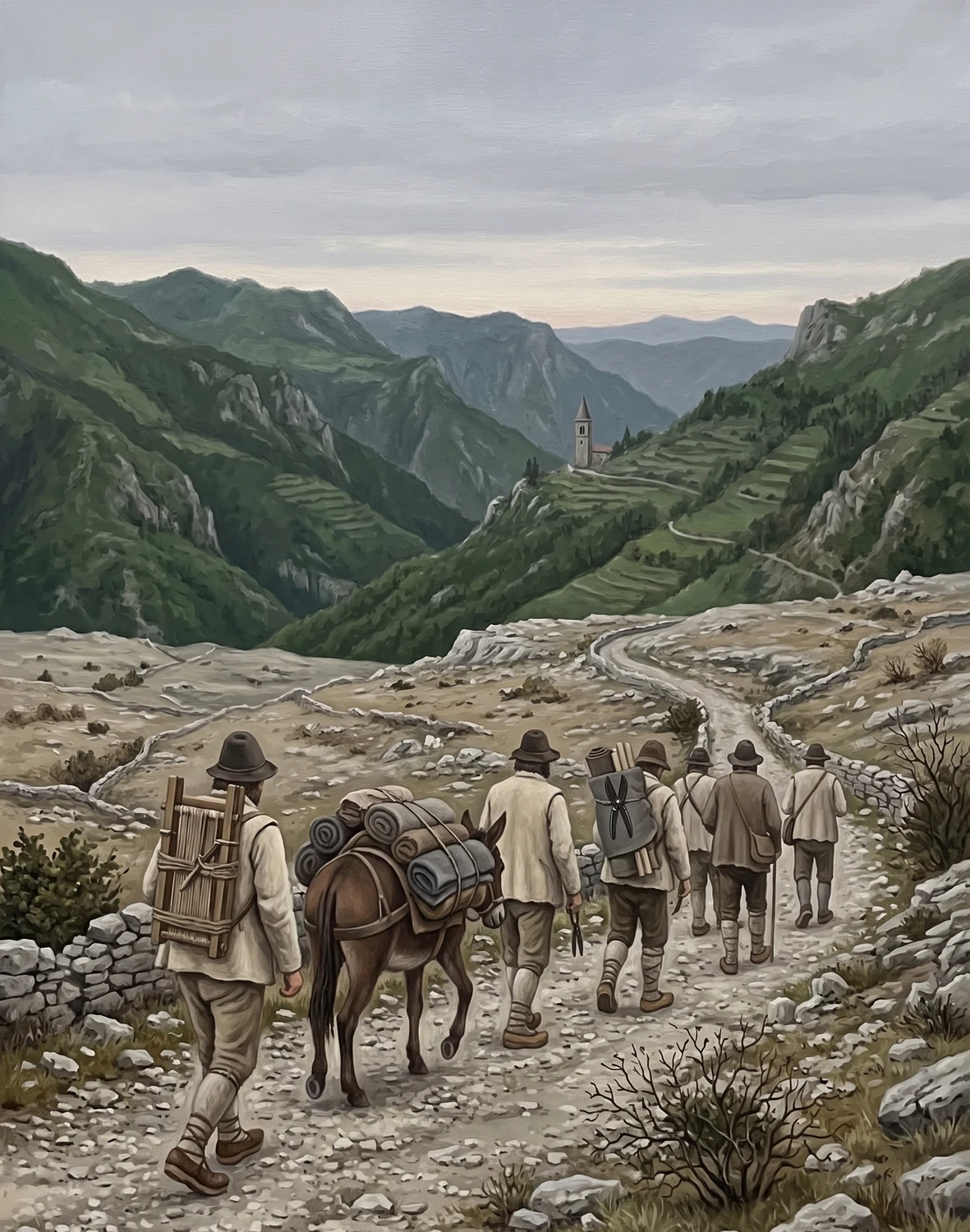
Every account this family gives of itself begins in Carnia, and until now not one De Franceschi could be documented there. Here are twelve, across three villages — and the name is still at Mione in 1939.
This is the archive's oldest open question. Carlo De Franceschi said the family came out of Carnia and settled in Istria intorno al 1700. A headmen's list of 1679 names a Zuane De Franceschi of Mione working in the imperial part of Istria with his son. Carlo added that in his own day, the 1870s, De Franceschi were still living at Mione and Muina.
All of that is testimony. None of it was record. The Ovaro parish registers before 1806 are in no portal, and every sweep this archive ran through the Italian indexes came back with Tuscans, Venetians and Trentini and no Carnians at all.
Searching by place instead of by name changed that.
Where46.4700° N, 12.8500° E
NearestMuina — 652 m ENE·Luint — 1.7 km NNE·Chialina — 2.6 km NNE
Why hereA Zuane De Franceschi of Mione is listed working in the County of Pazin with his son. The only document that shows the journey at all.
NoteMione is a frazione of Ovaro, in the Val Degano — the Canale di Gorto of the 1679 headmen's list. Muina is the next hamlet down the valley.
They still were in 1939. Monsignor Lucio Soravito de Franceschi was born at Mione di Ovaro on 8 December 1939, ordained priest in 1963, professor of pastoral theology at the Udine seminary from 1977 and at the Faculty of Theology of Northern Italy from 1991, archpriest of Udine cathedral from 1999, and Bishop of Adria-Rovigo from 2004 to 2015. He died on 6 July 2019.
Soravito is a Carnian house-name — soravìt, «above Vito's» — of the kind that fuses onto a surname to tell one branch of a village family from another. A Soravito de Franceschi at Mione is a De Franceschi of Mione with the house attached. Two hundred and sixty years after the headmen's list, the name is still in the village.
A bishop is a public figure and his dates are published; this archive names him for that reason and stops there. No claim of descent is made — what the record shows is that the surname persisted in the village the family's own tradition points to, for two hundred and sixty years after the only document that puts it there.
And then the registers of Mione itself
The Archivio di Stato di Udine has digitised the Napoleonic civil registers of the Comune di Mione — fifty-nine volumes — and publishes them openly. Nobody had looked.
The first three lines of the book
Defranceschi. Defranceschi. De Franceschi.
The alphabetical index of births for 1806–1810 opens on three De Franceschi entries, the first three lines of the whole book: Anna-Maria, Anna-Cecilia and Gio: Batta. A few lines below are four Erman entries — the other family named in the 1679 headmen's list, still in the same village a hundred and thirty years later.
The households, as the acts give them
Who
Where
Trade
The child
Act
Osvaldo de Franceschi and Appolonia Galante
Muina
both agricoltori — farmers
Anna Maria, born 30 December 1809 at eleven in the morning Muina is the second village Carlo De Franceschi named in the 1870s when he said the family was still in Carnia.
Nati 1809, act 32
Francesco de' Franceschi, aged about 26, and Margherita née Gortan
Mione
sarto — a tailor
Anna Cecilia, born 14 January 1810 at three in the morning He signs the register in his own hand. Gortan is one of the old surnames of the Canale di Gorto.
Nati 1810, act 1
Osvaldo De Franceschi, aged 26, and Cattarina née Brencis
Mione
fa legname — a carpenter
Giovanni Battista, born 15 October 1810 at ten in the morning He signs too. Whether he is the same man as the Osvaldo of Muina ten months earlier is not clear: the wives differ, the villages differ and the trades differ, so the archive treats them as two households and says so.
Nati 1810, act 21
Pasqua de' Franceschi, wife of Pietro Luchin
Mione
villici — cottagers
named as the mother in act 2 of 1810 A De Franceschi daughter married into the Luchin of Mione.
Nati 1810, act 2
And the 1806 book, which nobody had opened either
The four Mione households already on this page come from the birth registers of 1809 and 1810. The 1806 volume — the first year the Napoleonic registration ran — had not been read. It is three images long and it holds one act.
The act, as it stands on the page
When
Presented Sunday 19 October 1806 at four in the morning; the child born Friday 17 October at half past one
The parents
Paolo di Pietro de Franceschi, of this commune, and Anna, daughter of Pio Batta Berenzi, his lawful wife, both di professione Rurale
The child
A daughter, Mariana(the given name is the least certain word on the page)
Brought by
Brought by the midwife, Maddalena Urban, aged fifty-nine, who could not write and made her mark
Witnesses
Pietro q. Giacomo Bulfon of Regolato, shopkeeper; Matteo di Giacomo Berenzi of this commune, fa legname — a timber man
Signed
Pietro Bulfon, Deputato, aged fifty · Filippo di Zuane Prencis, aged forty · Giovanni Micoli, Secretary and Officer of the Civil State
Reference
Archivio di Stato di Udine · Stato civile napoleonico · Mione · 1806 · Nati · segnatura 12950 · Antenati ark an_ua667570, image 3 of 3
doc — read off the page, 14 September 2026; uncertain words marked
It is a fifth household, and it has a generation the others do not
The four already published are Osvaldo × Appolonia Galante at Muina, Francesco × Margherita Gortan at Mione, Osvaldo × Cattarina Brencis at Mione, and Pasqua married into the Luchin. Paolo di Pietro is none of them — and he carries his father's name with him. Pietro de Franceschi of Mione stands behind this act without appearing in it, which is one generation further back than anything the 1809 and 1810 books gave.
And a second De Franceschi signs it
The midwife could not write, so another man signed for her: Osvaldo de Franceschi, son of the late Osvaldo, «d'anni diciannove circa» — about nineteen.
This archive already has an Osvaldo De Franceschi, aged 26, a carpenter at Mione in 1810. Nineteen in 1806 and twenty-six in 1810 are three years apart and cannot both be right, so they are either the same man with a loosely-given age or two men of one name. What is certain either way is the father: an older Osvaldo, dead before October 1806. The archive had no generation above its two Osvaldos until now.
What it does not do
It does not reach Zuane of 1679, and nothing here joins Mione to Istria. The 1806 book is one act long. The weight of this village sits in the marriage allegati — twenty-eight of them survive for Ovaro — because those attach the parties' own birth and death certificates and reach back before the registers begin.
Three things follow. First, the family is simply there, in the village, in the ordinary registers — not merely listed as working abroad. Second, one of them is a TAILOR, which is exactly the trade of the cramars who walked the road of the Furlans into Istria from the sixteenth century; another is a carpenter and the rest are farmers, which is the ordinary spread of a mountain commune. And third, the name they gave a son born at Mione on 15 October 1810 was GIOVANNI BATTISTA — the name of the man Carlo De Franceschi said built the family's house at Gologorica in 1711, and the name of the farmer of house 5 at Gračišće born in 1787.
The witnesses to these acts are worth reading too. A shoemaker and a tailor of Luint; a household servant; Lupieri Matteo, possidente. The registrar through all of them is Giacomo Micoli — the Micoli of Mione, whose family archive is listed on this archive's research log as holding the Gorto contracts that name the Erman who travelled to Istria with Zuane De Franceschi in 1679. The same dozen surnames run through the village for a hundred and thirty years.
What to do next is now obvious. The same series holds nine volumes of Matrimoni and thirteen of Matrimoni, allegati for Mione. In Napoleonic practice the allegati are the supporting papers filed with a marriage — birth extracts for the bride and groom, and often death extracts for their parents. A single De Franceschi marriage at Mione between 1806 and 1815 would therefore reach back into the middle of the eighteenth century, and possibly to the generation of the Zuane of 1679. Nothing else available to this project can do that.
The allegati deliver what this page said they would
Two paragraphs above, this page said that a single De Franceschi marriage at Mione between 1806 and 1815 «would reach back into the middle of the eighteenth century». It does. The first bundle of the Mione, Matrimoni allegati for 1809 is two baptismal extracts, written out by the same parish priest ten days apart, and one of them is this family's.
The extract, as it stands on the page
When
Certified at Luincis on 4 February 1809, and seen by the civil officer Valentino Lupieri for the Comune di Mione
Who
«Orsola figlia legittima e naturale di Pietro quondam Matteo De Franceschi di Mione e di Maddalena sua moglie»
Born
Born 11 April 1768 — «essa è venuta alla luce li 11 del mese d'Aprile nell'anno 1768, come appare dai pubblici registri dei Battezzati»
Bundled with
The other extract in the bundle: «Giovanni = Pietro = Antonio figlio legittimo e naturale di Pietro cramaro del villaggio di Mione», born 28 April 1752, certified 10 February 1809 — the groom. «Cramaro» is not his surname but his father's trade. The marriage act names the family ERMAN.
The hand
Both written by D. Giovanni Battista Dazio, parish priest of the Pieve Matrice del Canal di Gorto, a parte Luincis
Docket
Docketed by the file's own clerk as «Matrimonj N. 1 · Mione · 1809»
Reference
Archivio di Stato di Udine · Stato civile napoleonico · Mione · Matrimoni, allegati · 1809 · Antenati ark an_ua667530, images 2 and 3 of 39
doc for the two extracts, read off the page at high magnification on 14 September 2026 · inf for the pairing of them, which is taken from the file's own bundling and not from a marriage act
It is a generation above the deepest name on this page
The 1806 act gave Pietro de Franceschi of Mione, who stood behind his son Paolo's name without appearing in the register himself. That was the furthest back the village went.
This extract names Pietro's own father. «Pietro quondam Matteo» — Matteo De Franceschi of Mione, dead before February 1809, and the father of a man whose daughter was born in 1768. A man whose granddaughter was born in 1768 belongs to a generation born around 1700 to 1720 — which is within living memory of the Zuane De Franceschi who left this valley for Istria in 1679.
And she is the earliest-born De Franceschi of Mione with a day and a month
Orsola, 11 April 1768. Every other Mione De Franceschi in this archive is dated from the Napoleonic registers, which begin in 1806. She is dated from the baptismal book of the Pieve di Gorto, thirty-eight years earlier, by the priest who was reading it.
She was forty when these papers were drawn. Her intended was fifty.
A daughter marrying out — and the name she married into
Orsola married Giovanni Pietro Erman, and after 1809 she is an Erman in every record that mentions her. This is exactly how the twenty-six married-out daughters on this archive's open list disappear.
And the name she married into is the other name in the 1679 list. That list of village headmen recorded at Mione: «Zuane De Franceschi con un suo fiolo, Zuane d'Erman: questi tre nell'Istria, luogo imperiale» — a De Franceschi, his son, and an Erman, all three working in Istria.
A hundred and thirty years later the two families are still marrying each other in the same village — and the groom's own mother was Maddalena née de Franceschi, so 1809 is at least the second crossing between them.
What is documented and what is not
All of it is now documented. When this section was first written the pairing of the two extracts was graded inferred, because the marriage act sat in a different volume and had not been read. It has now been read, and it confirms the pairing — while correcting the groom's surname and his birth year. See the act itself below, and the correction.
And in the 1811 file, a priest of the name
The 1811 allegati hold no De Franceschi marriage. They hold something else. Buried in the papers of a bride called Anna Maria Giorgi is a certified copy of her own baptism of 1785, and the priest who performed it carries this surname.
The extract, as it stands on the page
When
Baptism 20 February 1785; the extract certified at Luincis, 20 June 1811, from the register of the Pieve
The priest
«hodie de mea licentia a R. D. Franc.o Ant.o Deffranceschi de Mione … solemniter fuit baptizata» — today, by my licence, by the Reverend Father Francesco Antonio Deffranceschi of Mione, she was solemnly baptised
The child
Anna Maria, lawful daughter of Giovanni Domenico, son of the late Giovanni Battista Giorgi «de Nave», of Mione, and Lucia his wife — born the evening before, after sunset
Godfather
Godfather: D. Valentino Micoli of Ovaro
Where
In the parish church of the Pieve, by licence of the parish priest, who wrote the entry in the first person
Why it is here
Copied out in 1811 because the child of 1785 was marrying
Reference
Archivio di Stato di Udine · Stato civile napoleonico · Mione · Matrimoni, allegati · 1811 · Antenati ark an_ua667534, image 23 of 74
doc — Latin extract read at high magnification, 14 September 2026; the forename abbreviated in the original as «Franc.o Ant.o» and expanded here
The first cleric of this surname this archive has found in Carnia
He is styled «de Mione» — of the village, not merely serving it — and he is a Reverendus Dominus acting with the parish priest's licence in the mother church of the whole valley.
This archive already holds Mattia Defranceschi, parish priest of Gologorica in Istria, named in the diocesan visitation of 1788. Two priests of one surname, three years apart: one in the Carnian valley this family came from, one in the Istrian parish it went to.
No link is claimed between them. What is worth saying is that this is not an isolated oddity — the Istrian encyclopedia entry already transcribed on this page lists a string of De Franceschi clerics who kept working in Carnia long after the crossing: «Filippo, son of Gian Battista, parish priest at Previs; Gian Matteo, son of Gian Pietro, parish priest at Moncalvo, canon of the cathedral of Pedena». A De Franceschi priest at Mione in 1785 is exactly what that list predicts.
How a document from 1785 ends up in a file from 1811
It is the ordinary machinery of the Napoleonic marriage, and it is why these files matter. To marry, the bride had to produce her baptism. The parish priest copied it out of the register and certified the copy, and the copy was filed with the marriage.
So the allegati carry the parish registers forward into the state archive. The 1785 entry survives here whatever became of the book it was copied from — and it survives in a volume catalogued under 1811.
What the rest of the year holds
Seventy-four pages, and no marriage of this family in them. The names that pass through are Gortan, Zorzi, Bassi, Micoli, Bilbiani, Vernier, Crosilla, Sortiza, Varnier, Gaier of Forni Avoltri, and a bride from Cesclans. That is a clean negative for 1811, and it is recorded as one.
1812, and a hamlet with a name
No De Franceschi married at Mione in 1812 either. But the brides and grooms of 1812 had to produce baptisms going back to the 1780s, and a surname turns up in a register long before it turns up in a marriage — standing at the font.
The entry, as it stands on the page
When
Baptism 10 January 1789; extract certified at Luincis, 28 June 1812
The godfather
«ex sacro fonte suscepta fuit a D. Osvaldo DeFranceschi de Nave Mionensis» — lifted from the sacred font by Don Osvaldo DeFranceschi of Nave, of Mione
The child
Anna Maria, lawful daughter of Pietro Pellis of Cella and Sabbata his wife, baptised in danger of death the evening she was born
With
The other godparent: Maria, wife of Giuseppe Pellis of Cella
Alongside
Also in this file: the death extracts of Nicolò quondam Antonio Corva of Muina, died 11 August 1808, and of Jacoba his wife, died 6 February 1801 — both styled «de Nave»
Why it is here
Filed because a child of 1789 was marrying in 1812
Reference
Archivio di Stato di Udine · Stato civile napoleonico · Mione · Matrimoni, allegati · 1812 · Antenati ark an_ua667535, image 30 of 54
doc for the godparent entry, read at high magnification 14 September 2026 · inf for the identification with the elder Osvaldo
It is probably the elder Osvaldo, seen alive
The 1806 birth act gave a young «Osvaldo de Franceschi, son of the late Osvaldo», and this page said of it: «What is certain either way is the father: an older Osvaldo, dead before October 1806.» He was a name with no sighting.
A man standing godfather in January 1789 is an adult. An adult in 1789 who is dead by 1806 is exactly the shape of that father. The identification is inferred, not documented — no document joins the two — but it is the only Osvaldo of this surname the village is known to have had in that generation, and he is here with the honorific «D.», Dominus, which the priest did not give to everybody on the page.
Nave
He is «de Nave» — of Nave, a named place, not of Mione at large. Until today this archive had never recorded the name.
It now has it repeatedly from these files: Giorgi «de Nave» Mionensis (1785), Corva «de Nave» (1785 and 1801), this De Franceschi «de Nave» (1789), «Dominus Joannes Micoli-Toscano de Nave Mionensis» (1794) — and, in the Lenzone file, Fiorenzi «de Nave» Luincis (1778).
That last one matters, because it means Nave is not simply a corner of Mione. The clerks attach it to Mione and to Luincis alike, which makes it a small locality in the Ovaro cluster shared between the two — not a sub-division of either. This archive first wrote «a hamlet of Mione» and has corrected it.
What survives the correction is the important part: the same tiny place holds a De Franceschi household and the Micoli Toscano, whose palace archive keeps the 1679 Gorto contracts naming the Erman who travelled to Istria with Zuane De Franceschi. Not merely the same village — the same handful of houses.
What this changes about how to read these files
Four years of allegati have now produced one marriage of this family and two sightings that are not marriages — a priest in 1785, a godfather in 1789.
That is the lesson. The allegati are not an index of who married; they are a seam of certified extracts copied out of parish registers that no longer have to survive, and the surname appears in them as godparent, as celebrant, as neighbour. Reading them only for the couple would have missed both.
The rest of 1812
Fifty-four pages. The names are Brovedan, Zoran, Spinotti, Fadri, Pellis, Stefani, Corva, Pedri, Martin, Brugia, Manetti, De Stephano, Capedari, Drossi, Cleva, with Brenci, Lupieri, Micoli, Novi and Sallenati of Sutrio as godparents and witnesses. No De Franceschi marriage.
All twelve Mione files, and what the whole run came to
Mione's marriage allegati run from 1806 to 1815 in twelve volumes — not the two this archive first counted. All twelve have now been read. Four are not allegati at all: they are one-sheet covering letters from the Comune to the court at Udine and Passariano, signed by the civil officers Valentino Lupieri and Giacomo Micoli. The other eight hold about fifty marriages in 420 pages.
Volume
What is in it
1806–07
Filed with Muina and the other villages; the Muina file of 1806–07 holds Corva × Fabris and Micoli, and no De Franceschi.
1808
Osvaldo de Franceschi × Appolonia Galante, bundle number one of eleven. The widow's consent, the two baptismal extracts, and the death of Antonio bracketed to fourteen weeks.
1809
Orsola De Franceschi, «figlia di Pietro quondam Matteo», born 11 April 1768 — the generation above the deepest name the village had. Bundled with Giovanni Pietro Antonio Cramaro.
1810
Nothing. Lorenzin × Urai, Larese × Zanier, Fachin × Stefani, Masin × Brovedan, and the Colledan and Desanutti papers.
1811
No marriage — but a baptism of 1785 performed by R. D. Francesco Antonio Deffranceschi de Mione, priest.
1812
No marriage — but D. Osvaldo DeFranceschi de Nave Mionensis standing godfather in 1789.
1813
Nothing of the surname. Della Vedova, Clevo, Crisilla, Erman, Micoli Toscano, Jacotti, Sortan, Gortan, Nigris, Plozzi, Machin.
1814
Nothing. Goin, Micoli, Odorico Micoli, Della Pietra, Marcuzzi, Urban, Rubin — and the Paludi of Verona, resident at Mione, two of whom die here in 1801 and 1805.
1815
Nothing. Novis of Agrons, Lupieri of Liariis, Brenci, Toriano de Nave, Disopra, Gusset, De Quas, Miudaris.
One marriage, two sightings, one new generation
That is the whole yield of 420 pages, and it is worth being precise about it. One marriage of this family in ten years — and the family was not large. Two appearances that are not marriages at all — a priest and a godfather — which only a page-by-page reading could have found. And one new generation, Matteo, reached not through a De Franceschi marriage but through a daughter's.
The lesson for the rest of this valley is plain: read the allegati for the surname wherever it falls, not for the couple on the docket.
Galante, settled
The 1808 papers left an open question: the notary wrote the bride's surname Galante, the priest and the docket wrote Salante.
Two documents closed it. A witness to a Mione notarial act of 1813 signs himself, in his own hand and a plain lower-case g, «pietro galante fui presente testimonio» — so Galante is a real surname in this village. And the marriage register itself, read on 14 September 2026, gives «Appolonia Galante … figlia di Antonio Galante».
Four hands for Galante, two for Salante, and the register among the four. This archive has changed the name throughout and logged the correction.
Nave, and who lived there
The hamlet Nave was unknown to this archive this morning. These files name four households in it: Giorgi de Nave (1785), Corva de Nave (1785, 1801), De Franceschi de Nave (1789) — and «Dominus Joannes Micoli-Toscano de Nave Mionensis», godfather in 1794.
That is the Micoli Toscano, whose palace at Mione holds the 1679 Gorto contracts this archive has been trying to reach for months — the ones that name the Erman who travelled to Istria with Zuane De Franceschi. They were not merely in the same village as this family. They were in the same hamlet.
And one man who went the other way
Among the 1815 papers the parish priest swears «per scienza indubitabile» that Valentino, son of the late Giambattista Disopra, of his parish, «mancò di vita nel giorno 20 Xbre anno 1797 … nella Istria Superiore» — died in Upper Istria in December 1797, and that word of it came back to the valley by letter. (The place-name after it is not legible and the priest's geography that follows is confused, so only the province is reported here.)
He is nobody's relation here. He is the road itself, certified: a Carnian who died in Istria, and a home parish that knew.
The same file carries another kind of death — Giovanni di Domenico de Stefano, forty, drowned in the Degano on 5 May 1779 «in conductione lignorum», working the timber rafts, his body found the next day. The trade that built this valley, and the river that took him.
Archivio di Stato di Udine · Stato civile napoleonico · Comune di Mione · Matrimoni, allegati 1806–1815 · Antenati arks an_ua667527 to an_ua667538, twelve volumes, 420 images, all read 14 September 2026.
Two Istrian marriages, filed in Carnia
The Ovaro allegati are not only about Ovaro. Twice in 1807 the papers for a marriage in this valley were made in Istria, and the Istrian officials' certificates came back up the mountain to be bound into a Carnian file. Neither marriage involves this family. They are published because this archive has spent years arguing that the road from the Val di Gorto to Istria was open and busy, and here it is, in two documents, with both ends of the paperwork in one folder.
Capodistria, May 1807
In the Ovaro file. «L'Ufficiale dello Stato Civile di Capodistria all'Ufficiale dello Stato Civile d'Ovaro. Capodistria li 28 Maggio 1807» — certifying that on Sundays 17 and 24 May, at eleven in the morning, the banns were cried in that city. The consent was taken at Ovaro before the notary Giacomo Machin quondam Pietro from Michiele quondam Domenico Cleva and his wife Domenica quondam Cristoffolo Bolfar; a further act was drawn at Capodistria itself on 28 May before a notary of that city, and authenticated by Giovanni Manzini, Deputato Notariale.
San Lorenzo, July 1807
In the Lenzone file, and it reaches further in. «Dipartimento d'Istria, Distretto di Capodistria, Cantone di Pirano, Comune di S. Lorenzo, li 16 sedici Luglio mille ottocento e sette» — the civil officer of San Lorenzo, today Sveti Lovreč, certifying the two Sunday publications of a promise of marriage, for a couple whose file was kept at Lenzone above Ovaro.
Sveti Lovreč is inland Istria, twenty kilometres from Poreč — the same country as Svetvinčenat, where this archive found its 1628 baptism.
What this is worth, stated carefully. It is not evidence about any De Franceschi. It is evidence about the route: that in 1807 a Carnian commune and an Istrian one exchanged marriage paperwork as a matter of routine, in both directions, and that the officials at each end knew how to do it.
The argument this archive makes about 1679 — that a Zuane De Franceschi went from this valley to Istria — has always rested on a contract and an inference. It still does. But the traffic it assumes was real, and these two files are the ordinary administrative residue of it, a hundred and thirty years later.
Eighteen comuni, and the name is in two of them
doc for the counts — each is the Antenati name index's own facet, read 27 September 2026 · inf for what the distribution means
This page has argued Agrons from a letter, from an encyclopedia, from a scholar's unpublished notes and from the family standing in the cemetery. None of that is a distribution.On 27 September the Antenati name index was asked a different question — not «where is this family» but «where, in the whole of Carnia, does this surname occur at all».Eighteen comuni. The name is in two.
The name is present
Paluzza and Ovaro — and nowhere else in Carnia's indexed civil registers. Agrons, Mione and Muina are all frazioni of Ovaro, so Ovaro's rows are this family's rows.
Indexed, and holding none of it
Thirteen comuni — Comeglians, Forni Avoltri, Sutrio, Arta Terme, Socchieve, Raveo, Villa Santina, Zuglio, Paularo, Prato Carnico, Rigolato, Tolmezzo, Cercivento.These are real negatives, not silence.
Not in the index at all
Ampezzo, Enemonzo, Treppo Carnico.Unknown, and honestly so.
How the negatives were made trustworthy, because this is the part that nearly went wrong.A nil from a surname search has two meanings — nobody of that name lived there, or the index does not cover the place — and publishing the first when the truth is the second puts a statement about a catalogue into an archive where it reads as a statement about a family.The instinct is to test with a common surname, and it is a bad instinct:«Rossi» returns nothing anywhere in Carnia, because Rossi is a name of the plains; Carnic surnames did better and still left eleven comuni undetermined, because no three surnames cover a valley.The answer is to stop asking about names and ask the index about the place — ?localita=X with no surname at all — which answers the only question that matters and answered all eighteen in one pass.
What this does NOT say, stated before anyone reads it as more.The Napoleonic civil registers run 1806–1815. This is a map of where the name stood in those nine years — not in 1742, when a Svetvinčenat clerk first wrote «ex Cargn.» against a Defranceschi, and not in 1502, when a «gismanus de Carnia» appears.Two comuni in 1810 is a lead towards the Carnic homeland, not a finding about it.What it does do is set the Agrons argument on a second kind of evidence: not the family's own account of where it came from, but the distribution of the surname across a whole region's civil registration — and the distribution puts it in the comune Agrons belongs to.The parish registers that would speak to the 1740s are a different body of paper and have not been opened.
Portale Antenati (Direzione generale Archivi), name index for the Napoleonic and Restoration civil registration of the province of Udine — locality-only and surname queries across eighteen Carnia comuni, run 27 September 2026. Agrons confirmed a frazione of Ovaro.
The other fourteen files, and a clean negative
Beyond Mione, the Comune of Ovaro filed marriage allegati for its other villages. Fourteen volumes, 296 images, now read. There is no De Franceschi in any of them. That is worth publishing as plainly as a discovery, because it bounds the search: between 1806 and 1815 this family married once in the whole Ovaro district, and it married at Muina.
File
What is in it
Luint 1806
1 image. A marriage contract: Michiele quondam Gio: Batta de Corte of Ovasta × Maria, daughter of Valentino Lupieri of Luint.
Lenzone 1806
6 images. Natale Fiorenzi of Luint × Catterina Vidale of Lenzone. The groom's baptism of 1778 styles him «Fiorenzi de Nave Luincis» — the entry that corrected this archive's reading of Nave.
Lenzone 1807
10 images. Istrian — see below.
Cludinico 1807
12 images. Before the notary Giacomo Machin; witnesses Valentino Condor and Pietro Scarsini; a baptism of 1766 for a daughter of Leonardo Del Fabro.
Ovaro 1806 (unlabelled)
26 images. Istrian — see below. Otherwise Conan of Lenzone, Caneva, Cadervarius of Chialina, Schivas of Ovaro.
Entrampo 1807
16 images. Pasqua, daughter of Francesco Berton of Entrampo, born 19 October 1780, marrying Cristoforo di Giacomo Cavallari — banns at Cesariis, 18 October 1807.
Ovaro 1807
7 images. Istrian — see below.
Ovaro 1808
27 images. Missana, Mazzolini, and a baptism of 1785 for a son of Giovanni Battista Del Missier «de Nave Mion» — a sixth household in that small place — with Donna Giovanna, wife of Giovanni Micoli-Toscano, as godmother.
Ovaro 1810
13 images. Biliani of Sublacu, Schivas of Ovaro, and a letter from the Comune of Cesclans of 29 December 1809.
Ovaro 1811
56 images. Dell'Ost and Delle Corte of Cludinico, Mazzolini, Novis, Colledan, Valle di Ovaro, Calderani; registry receipts from the office at Amaro.
Ovaro 1812
27 images. Del Osol of Liariis, Lenna, and banns at Lestizza in August 1812.
Ovaro 1813
78 images — the largest file in the whole run. Lauco, Cavarnis of Chiolas, Vidal, Cortidas of Liariis, and a Mione certificate of 20 September 1813 filed here rather than at Mione.
Ovaro 1814
6 images. Gio: Batta Delle Corte, born 29 June 1777, × Pasqua Agarinis del fu Valentino, of Cludinico.
Ovaro 1815
11 images. Gio: Batta Fedele, negoziante of Clavais, × Catterina Solari, born 6 June 1787.
The method, and its limit
How these were read, stated plainly. Every short certificate and every baptismal or death extract was read — those are the documents that name people and parentage, and they are where a surname surfaces. The long notarial consents were read from their opening lines, which name the parties, the village and the notary. The very long files were not transcribed line by line, and this archive says so rather than implying a completeness it did not achieve. If the surname is hiding in the middle of a sixty-line consent as a neighbour or a boundary, it is still hiding.
Archivio di Stato di Udine · Stato civile napoleonico · Comune di Ovaro · Matrimoni, allegati for Ovaro, Lenzone, Luint, Cludinico and Entrampo, 1806–1815 · Antenati arks an_ua630302, an_ua634664, an_ua643929, an_ua659679, an_ua659680, an_ua661481 and an_ua679993 to an_ua680000 · fourteen volumes, 296 images, read 14 September 2026.
The act itself, read at last
The allegati are the paperwork. This is the marriage. Act number one of the Mione register for 1809, and it settles the pairing this page had graded inferred — while correcting two things this archive had published about the groom.
The act, as it stands on the page
When
Monday 13 February 1809, at half past eleven in the morning, before the Officer of the Civil State of the Comune di Mione, Giacomo Micoli
The groom
«Erman de Franceschi Gio: Pietro», aged fifty-six, agricoltore, of Mione — widower of the late Cattarina née Carlevaris — son of the late Pietro Erman and Maddalena née de Franceschi
The bride
«Orsola de Franceschi», aged forty, villica, of the same village — daughter of the late Pietro de Franceschi and Maddalena née Fedeli
Births read in
His birth act, read into the record: born 28 April 1752 at Mione. Hers: born 11 April 1768, the date the baptismal extract gave.
Witnesses
Valentino Lupieri, 39 · Matteo Lupieri, 21, his brother · Giovanni Colledan, 58, tailor · Antonio Bressan, 26, servant — all of Luint
Signed
«Gio: Pietro Erman de Franceschi — per me e per Orsola de Franceschi mia moglie che non sa scrivere.» He signed for them both.
Reference
Archivio di Stato di Udine · Stato civile napoleonico · Mione · Matrimoni · 1809 · segnatura 12983-series · Antenati ark an_ua667518, image 3 of 9
doc — Mione, Matrimoni 1809, act N. 1, read at high magnification 14 September 2026
Two corrections, and the better story underneath
This archive published, hours earlier, that the groom was «Giovanni Pietro Antonio Cramaro», born 28 April 1758. Both halves were wrong.
His surname is Erman. His birth year is 1752 — the act says fifty-six in February 1809, and reads his birth act as 28 April 1752; the last digit of the year had been cropped out of the zoom used on the extract, and was guessed.
And «cramaro» was never a surname. The priest wrote «figlio di Pietro cramaro del villaggio di Mione» — Pietro the cramar, the Carnian pedlar who walked the passes into Austria and down into Istria. This page had called the Cramaro name «the road this family walked» and graded it as a surname. It was the road. It was just never a name.
She could not write, and he wrote for her
«per me e per Orsola de Franceschi mia moglie che non sa scrivere.»
Orsola was forty years old, the daughter of a household that this archive can now follow back to her grandfather Matteo, and she could not sign her own marriage. Her husband signed for her.
It is the same hand-to-mouth literacy the Muina papers showed the year before, where Maria Corva and Galante could not write and their children could. Here the woman is on the wrong side of that line, and her husband on the right one.
Three more of the family in the same nine pages
Reading the whole register rather than the one act found three more:
Osvaldo de Franceschi, aged 22, falegname, standing witness on 9 August 1809. This matters: the archive has flagged that «nineteen in 1806 and twenty-six in 1810 are three years apart and cannot both be right». Twenty-two in August 1809 puts him with the nineteen — born about 1787 — and leaves the «twenty-six» of 1810 as the odd reading.
Francesco de Franceschi, aged 25, witness on 21 September 1809 — born about 1784, and almost certainly the Francesco the tailor who married Margherita Gortan.
Pasqua née de Franceschi, named as the living mother of a bride: Maddalena Luchini, born 23 January 1789 at Luincis, daughter of Pietro Luchini and Pasqua nata de Franceschi. The archive had Pasqua «married into the Luchin» as a household. Here she is, dated, with a daughter of her own marrying.
What this says about method
The allegati gave the surname. The register gave the truth about it. A file of loose supporting papers is written by several hands in several places and copies what it is told; the marriage act is written once, by the registrar, with both parties in front of him and the documents on the table.
Read the allegati to find the marriage. Read the register to believe it.
And the 1806 register, which holds a wedding the allegati had only half-told
The Mione marriage register opens in August 1806 with a De Franceschi wedding — and it is the marriage whose allegato this archive read earlier today, when a first transcription of «Giovanna, daughter of Giacomo q. Gio: Batta, born 1785» had to be corrected on the page to Giacoma, Osvaldo, 1789. Here is the act that allegato belonged to.
The act, as it stands on the page
When
August 1806, at nine in the morning, Comune di Mione, Cantone di Forni, Dipartimento di Passariano
The groom
«Ignazio di Zuato», negoziante — a merchant — aged twenty-eight, of Chialina, born 13 December 1777, son of the late Gio: Giacomo di Zuato and Cattarina née Cneva
The bride
«Giacoma de Franceschi», daughter of the late Osvaldo de Franceschi and Cattarina née Gobbi — the mother's surname is new to this archive
Consents
Her father's written consent of 7 September 1805, and the groom's mother's of 8 September 1805 — both parents of the couple consenting by letter a year before the wedding
Witnesses
Batta Brenci, Gio: Batta del Missier, Giuseppe del q. Michiel, Pietro Ruspil — all four signing in their own hands
Signed
«Giacoma de Franceschi q.m Osualdo affermo» — she signs her own name. The registrar is Giovanni Micoli-Toscano, with Batta Micoli-Toscano as deputy.
Reference
Archivio di Stato di Udine · Stato civile napoleonico · Mione · Matrimoni · 1806 · Antenati ark an_ua667516, image 3 of 3
doc — Mione, Matrimoni 1806, act N. 1, read 14 September 2026. The bride's stated age and the birth year read into the act differ by a year; both readings are given and neither is forced.
Osvaldo the elder, bracketed to the month
This archive has spent months with «an older Osvaldo, dead before October 1806» as a name with no sighting. Today has given him three.
He stood godfather in January 1789 (the 1812 allegati). He consented in writing to his daughter's marriage on 7 September 1805. And by August 1806 he is «il fu Osvaldo» — dead.
Alive in September 1805, dead by August 1806. That is a twelve-month window, from two documents, for a man who had no date at all this morning.
She could write, and Orsola could not
«Giacoma de Franceschi q.m Osualdo affermo m.p.» — manu propria, in her own hand.
Three years later her kinswoman Orsola, aged forty, could not sign her own marriage and her husband signed for her. Giacoma, at eighteen, could.
Two De Franceschi women, one village, three years apart, on opposite sides of the line. This archive will not pretend to know why, but it is the kind of thing that is only visible because both acts were read rather than indexed.
A merchant, and the road again
Giacoma married a negoziante — a merchant — of Chialina, the next village. Orsola married into the Erman, who had been in Istria in 1679. The Muina bride of 1808 married a farmer.
The De Franceschi daughters of this valley married trade as often as land, and trade is what took this family out of the mountains.
The registrar is the palace
The act is signed by Giovanni Micoli-Toscano, Ufficiale dello Stato Civile, with Batta Micoli-Toscano deputising.
The Micoli Toscano palace at Mione holds the 1679 Gorto contracts — the ones naming the Erman who went to Istria with Zuane De Franceschi. In 1806 that same family is registering this family's marriages, and in 1794 one of them stood godfather at Nave. They are not a lead to chase; they are the neighbours.
A child of five, and a household nobody had
The death registers were opened next, on the reasoning that a death act states an age, and an age back-dates a birth into the years before civil registration began. The first one read produced a household this archive did not have — and a fact about how this family married.
The act, as it stands on the page
When
30 April 1808, at five in the afternoon, at Mione. Registered the same day by Valentino Lupieri, who went to the house on being notified
Who died
«il cadavere di Francesc'Antonio de Franceschi … nell'età d'anni cinque» — a boy of five, so born about 1803, before any register that survives
His parents
His parents, as the witnesses declared them: Antonio de Franceschi, by trade «sartore» — a tailor — and Giovanna, «pure de Franceschi», «economa di casa», both living at Mione
The phrase
«pure de Franceschi» — also a de Franceschi. Both parents carry the surname
Witnesses
Gio: Pietro Erman de Franceschi, «dell'età d'anni cinquantacinque in circa», farmer — and Agostino Brencis, 32, carpenter
Registrar
Valentino Lupieri, Officer of the Civil State
Reference
Archivio di Stato di Udine · Stato civile napoleonico · Mione · Morti · 1808 · Antenati ark an_ua667555, image 6 of 11
doc — Mione, Morti 1808, read at high magnification 14 September 2026
The family married itself
«da Antonio de Franceschi, e da Giovanna pure de Franceschi giugali» — from Antonio de Franceschi and Giovanna, also a de Franceschi, married.
This archive has been tracing De Franceschi daughters marrying out — into the Erman, the di Zuato, the Luchin. Here is a couple where both sides are the surname, in the same village, and the registrar thought it worth the word pure to make clear he had not written the name twice by mistake.
In a village of this size that is what you would expect and it is still worth recording: by 1803 there were enough De Franceschi households at Mione for two of them to marry each other.
A fifth trade, and a second tailor
Antonio is a sartore. This archive already has Francesco de Franceschi, tailor, married to Margherita Gortan at Mione — and has made something of it, because the tailor is the cramar trade that walked into Istria.
Antonio is a second one. Two tailors of this surname in one village in the same decade, and neither is the other: Francesco's wife is a Gortan, Antonio's is a de Franceschi.
The household is new to this archive. It joins the four from the birth registers and the fifth from 1806.
And the 1809 groom, a year before his wedding
The first witness is Gio: Pietro Erman de Franceschi, about fifty-five, a farmer of Mione. Ten months later the same man — fifty-six, farmer, of Mione — marries Orsola de Franceschi.
He is here in April 1808 as a widower, standing at a neighbour's dead child. The marriage act of 1809 records that he had buried a wife, Cattarina née Carlevaris. This is the man in the year between.
And a month-old girl, whose birth this archive already had
Morti 1810, act N. 1 — 25 January 1810, eight in the evening, Mione. The registrar Giacomo Micoli views the body of «De Franceschi Anna Cecilia», «in età di un mese» — one month old.
The witnesses declare her born at Mione «da Francesco de Franceschi, e Margherita nata Gortan jugali, di professione sarto il primo, agricoltrice la seconda». Witnesses Antonio Bressan, 26, servant, and Matteo Lupieri, 22, possidente, both of Luint.
This archive already had her birth. The Mione birth index for 1806–1810 «opens on three De Franceschi entries, the first three lines of the whole book: Anna-Maria, Anna-Cecilia and Gio: Batta». Here is the other end of the shortest of those three lives — born 14 January 1810, dead on 25 January 1810 — eleven days.This archive first read the act as 28 January and, from its «un mese circa», put her birth in December 1809. Both were wrong: the act is dated «li 25 Venticinque Gennajo», figures and words agreeing, and the birth register has her born on the 14th.
It also confirms, from a second act, that Francesco the tailor's wife was Margherita Gortan — and Francesco is one of the two brothers of the act three weeks earlier.
Why the death registers are the right place to be looking
A marriage act gives ages for two people. A death act gives an age for anyone, at any age, including the people who were already old when the registers opened.
Francesc'Antonio was born about 1803 — three years before the first Napoleonic register at Mione. He exists nowhere else. Every death act in these nine volumes is a person reaching back before the series, and that is where the generation of Matteo and the elder Osvaldo will be found, if they are found at all.
«Francesco ed Osvaldo fratelli de Franceschi»
The 1809 death register opens on a neighbour's funeral, and the two men who came to identify the body are the single most useful sentence this archive has found in the Mione series. They are named as brothers.
The act, as it stands on the page
When
14 January 1809, Mione. The registrar Valentino Lupieri viewing the body of Maria della Vecchia, aged thirty, wife of Giuseppe Pol, born at Mielis in the Comune di Comeglians
The sentence
«Presenti alla ricognizione furono Francesco ed Osvaldo fratelli de Franceschi» — present at the identification were Francesco and Osvaldo, brothers, de Franceschi
The elder
Francesco, aged twenty-four, by trade «sarte» — a tailor
The younger
Osvaldo, aged twenty-two, by trade «falegname» — a carpenter
Why they were there
«l'uno e l'altro di Mione, non parenti della defunta» — both of Mione, and no relation to the dead woman. They were there as neighbours, which is why the register bothered to say how they were related to each other
Signed
Both sign in their own hands: «Francesco de Franceschi» and «Osvaldo Ant.o de Franceschi»
Reference
Archivio di Stato di Udine · Stato civile napoleonico · Mione · Morti · 1809 · act N. 1 · Antenati ark an_ua667556, image 3 of 9
doc for the brotherhood, the ages and the trades · inf for the parentage, which is argued from three other acts and not stated in this one
Two of the four households are one household
This archive has carried Francesco, a tailor, and Margherita Gortan of Mione and Osvaldo, a carpenter, and Cattarina Brencis of Mione as two of the four Mione households, side by side in a table, with nothing joining them.
They are brothers. One sentence in a stranger's death act says so, and both men signed underneath it.
The village had fewer De Franceschi families than the register index suggested. It had more De Franceschi brothers.
And probably a third sibling, and a father
Three other acts now line up behind that sentence.
The 1806 birth act has «Osvaldo de Franceschi, son of the late Osvaldo», about nineteen. The 1806 marriage act has Giacoma de Franceschi, «q.m Osualdo», daughter of the late Osvaldo and Cattarina née Gobbi. And the elder Osvaldo consented to that marriage in writing on 7 September 1805 and was dead by August 1806.
If the Osvaldo of 1806 is the Osvaldo of 1809 — and the ages agree — then Francesco, Osvaldo Antonio and Giacoma are three children of the elder Osvaldo and Cattarina née Gobbi. The four households of the birth registers collapse toward one family with a dead father.
This is inference, and it is labelled as such. No document says the three are siblings of each other. What the documents say is that two of them are brothers, that two of them had a dead father called Osvaldo, and that all of it happens in one small village inside three years.
What the ages are worth, and what they are not
Osvaldo's declared age now exists four times: nineteen in October 1806, twenty-two in January 1809, twenty-two in August 1809, and twenty-six in 1810.
Three of the four agree on a birth around 1786–87. The fourth does not, and this page has already noted that «nineteen in 1806 and twenty-six in 1810 cannot both be right».
They still cannot. But it is now three against one, and the odd reading is the 1810 one. Declared ages in these acts are what a neighbour said on a doorstep, not what a register held — and this is a clean demonstration of how far they can drift.
Both brothers could write
«Francesco de Franceschi» and «Osvaldo Ant.o de Franceschi», in their own hands, at the foot of the act.
A tailor and a carpenter, twenty-four and twenty-two, in a mountain village in 1809, both signing. Their kinswoman Orsola, forty years old, could not sign her own marriage six weeks later and her husband signed for her.
The literacy in this family is not a line drawn by generation. It is drawn by sex, and this archive should stop being surprised by it.
Anna, wife of Paolo, dead at forty-four — and the table that found her
Three more death registers were opened, and the third of them gave up something the first two had hidden in plain sight. From 1813 the volumes end with a «Tavola Alfabetica» — a ruled table listing every death of the year by surname, with the village, the date, the act number and the folio. It turns a volume of faded handwriting into a single page that can be scanned in one look. The 1813 table carries seventeen names and not one of them is ours. The 1815 table carries twenty-two, and the second row reads «De Franceschi Anna — Mione — 11 9bre».
The act, as it stands on the page
When
Saturday 11 November 1815, Mione. Matteo Lupieri, Officer of the Civil State, went to the house on being notified. The act gives the death as «jeri» — the day before — at two in the morning
Who died
«il Cadavere di Anna de Franceschi … in età d'anni quarantaquattro» — forty-four years old, so born about 1771
Whose house
«nel Villaggio di Mione in casa di de Franceschi Paolo» — the house is named by its head, and the head is a Paolo de Franceschi this archive did not have
The phrase
«maritata col suddetto Paolo de Franceschi» — married to that same Paolo. She carries the surname on the page, and so does her husband
Where she was born
«è nata in quell'istesso Villaggio di Mione» — born in that same village, on the witnesses' own knowledge. The witnesses are Fabris Osvaldo di Giuseppe and Fabris Giuseppe, forty-four, tailor, both of Mione and no relation
Registrar
Matteo Lupieri, Officer of the Civil State
Reference
Archivio di Stato di Udine · Stato civile napoleonico · Mione · Morti · 1815 · act N. 23, folio 5 · Antenati ark an_ua667562, image 12 of 13; the alphabetical table is image 13
doc for the act · the reading of «jeri» for the day of death is the one word in it I would not stake much on
A birth in about 1771 — a generation deeper than any register here reaches
Civil registration at Mione begins in 1806, and the death series begins in November 1806. Everything this page has built on the Mione family sits inside ten years of paper.
Anna's age puts her birth at about 1771, and the act says she was born at Mione. That is thirty-five years before the earliest surviving civil register, and it is the reason the death books were opened at all: a death act states an age, and an age back-dates a birth.
Her baptism can only be in the Pieve di Gorto books at Luincis. She is now the fourth named person this archive is waiting on that one collection for.
Either the family married itself twice, or the clerk used her husband's name
The page gives her as «Anna de Franceschi», married to «Paolo de Franceschi». There are two honest readings and this archive is not going to pick one without a second document.
The first is that she was born a de Franceschi. That is not a strange thing to propose here: the 1808 death act says in as many words that Antonio de Franceschi's wife was «Giovanna, pure de Franceschi» — also a de Franceschi — and the registrar wrote pure precisely so nobody would read it as a slip of the pen. Two De Franceschi couples in seven years, in a village of a few dozen houses, is what endogamy looks like.
The second is that Matteo Lupieri simply entered a married woman under her husband's surname. He does not do it elsewhere in this volume — the other women are given as «nata» somebody — which argues against it, but a single volume is thin evidence about a clerk's habits.
What is not in doubt is Paolo.
Paolo is a fifth household
The Mione De Franceschi households this archive can name now stand at five:
Francesco the tailor, husband of Margherita Gortan · Osvaldo Antonio the carpenter, husband of Cattarina Brencis — and the 1809 death register says those two are brothers · Antonio the tailor, husband of Giovanna «pure de Franceschi» · Gio: Pietro Erman de Franceschi, the fifty-five-year-old widower of 1808 who remarries Orsola in 1809 · and now Paolo, whose wife dies in his house in November 1815.
Paolo appears nowhere in the 1806–1812 births, marriages or deaths already read. He is a new name, and at a guess an older man — his wife was forty-four.
What the tables cost, and what they save
This is a method note, and it is worth writing down because it changes what is affordable.
Reading a Mione register act by act at a magnification where the hand is legible takes three or four screen-fulls per page, and the volumes run eleven to fifteen pages. The 1813 volume took seventeen passes to establish a negative.
The Tavola Alfabetica at the back of each volume from 1813 answers the same question in three. The 1815 table gave the surname, the village, the day, the month, the act number and the folio — enough to open the right leaf first time.
1812 and earlier have no table. Those still have to be read the slow way, and 1812 is half-read.
1813, read and clean
For the record, since a negative result is a result: the 1813 death register (ark an_ua667560, eleven images, acts on the rectos only) was read through, and then its alphabetical table was read as a check on the reading.
Seventeen deaths in the comune that year, across Mione, Muina, Luint, Luincis, Ovasta, Agrons, Liariis and Entrampo. The surnames are Bulfon, Della Pietra, Senni, Pol, Rossi, Raffael, Tolson, Steffani, Nino, Fortin, Duminj, Urban, Vernier and one «infante maschio non battezzato» at Agrons.
No De Franceschi, in any role — not as the dead, not as a parent, not as a witness. One near miss that cost two screenfuls: the witness at act 14 is an «Osvald'Antonio», which is exactly our carpenter's name, and he turned out to be a Tolson.
Two De Franceschi men sign the same page, 18 August 1812
The 1812 death register has no alphabetical table either, so it was swept leaf by leaf. The surname appears once — and when it appears it appears twice in the same act, on the same line, and both men write their own names at the foot of it.
The act, as it stands on the page
When
Monday 18 August 1812, at eight in the morning, Comune di Mione. Matteo Lupieri, Officer of the Civil State
Who died
«il Cadavere di Ottaviani Valentino» — died the previous day at five in the morning, aged twenty-five, by trade «Sartore», a tailor, of Mione. Not of this family
First witness
«Presenti alla ricognizione furono Erman de' Franceschi Gio: Pietro d'anni cinquantanove, Possidente» — fifty-nine, and a landowner
Second witness
«e de' Franceschi Paolo d'anni quarantadue» — forty-two, so born about 1770. Both domiciled at Mione
The signatures
Both sign. The block reads «Erman de' Franceschi Gio: Pietro» and, under it in a smaller, less practised hand, «paolo de Franceschi» — with a lower-case p
Registrar
Matteo Lupieri, Officer of the Civil State
Reference
Archivio di Stato di Udine · Stato civile napoleonico · Mione · Morti · 1812 · Antenati ark an_ua667559, image 8 of 15
doc — Mione, Morti 1812, read at high magnification 14 September 2026. The age discrepancy of one year is noted and not smoothed away
Paolo, three years before his wife's funeral
Paolo de Franceschi entered this archive an hour ago as a house: the address in the 1815 act where Anna died, «in casa di de Franceschi Paolo». Here he is himself, alive, three years earlier, standing in a neighbour's house and signing his name.
Forty-two in August 1812 means born about 1770. Anna was forty-four in November 1815, so born about 1771. Husband and wife born within a year of each other, both at Mione, both — on the face of the register — carrying the same surname.
He is the fifth Mione household and he is no longer only a doorway.
And the Erman man, four years on and a class up
Gio: Pietro Erman de Franceschi is already the best-documented adult male of the surname in this valley, and this is his fourth appearance:
April 1808 — witness at a child's death, «d'anni cinquantacinque in circa», agricoltore · 21 August 1808 — brings a newborn to the office, fifty-eight, agricoltore · 13 February 1809 — bridegroom, fifty-six, agricoltore, widower of Cattarina Carlevaris, marrying Orsola de Franceschi; born 28 April 1752 · 9 July 1809 — witness at a Muina birth, fifty-four circa, and already «possidente» · August 1812 — witness here, fifty-nine, «Possidente»
The trade changes, and the birth registers date the change much more tightly than the death register could. Through 1808 and into February 1809 he works the land. By 9 July 1809 — five months after the wedding — the register calls him a landowner, and he is one still in 1812.
A man of fifty-six who marries a woman of forty and is styled possidente within half a year has, on the ordinary reading, married property. Ordinary reading, not proof: a man can buy land in five months, and the word may simply be a different clerk's habit.
The one thing that does not fit is arithmetic. Born 28 April 1752, he was sixty on 18 August 1812, and the act says fifty-nine. A year's slack in a register age is unremarkable — the earlier acts are just as loose — but it is recorded here rather than quietly rounded.
«Erman de' Franceschi» is how the family writes itself
This matters beyond one act. The 1679 list of village headmen names «Zuane De Franceschi con un suo fiolo, Zuane d'Erman» — and this archive has spent months treating De Franceschi and Erman as two families who happened to travel to Istria together.
In 1809 and again in 1812, a man signs himself «Erman de' Franceschi» — byname first, surname second, in his own hand, twice, four years apart. That is not a clerk's compound. It is what the man called himself.
So Erman at Mione is a branch-name inside the surname, not a separate surname — which changes how the 1679 line should be read, and it means every «Erman» entry in the Mione indexes is a candidate for this family rather than a neighbour's.
What the 1812 volume is worth as a negative
Fifteen images, no alphabetical table, swept page by page at a magnification that shows signature blocks clearly. The surname appears on image 8 and nowhere else.
The other signatures in the volume are Colledan, Fabris, Nino, Steffani, Pol, Gortan, Coluss, Sudretto and Ottaviani. As with 1814, a De Franceschi buried inside the body of another act as a parent could have escaped this pass. The 1813 and 1815 negatives, which have tables behind them, are stronger.
«Osvaldo de Franceschi», signed twice at Muina in 1814
The 1814 death register has no alphabetical table — those begin in 1813 and 1814 skipped one — so it had to be swept leaf by leaf. The surname appears on two of the eleven images, and on both it is not the registrar writing a name for an illiterate witness. It is a signature, in a large confident upright hand, twice.
The two acts, as they stand on the page
The first
Act N. 12 — «Agenzia Comunale di Mione, li 10 dieci Settembre» 1814. The registrar goes to Muina and views Spinotti Candido, born at Muina, son of Giuseppe detto Candido Spinotti and Giovanna nata Paoletti
The second
Act N. 13 — «Agenzia Comunale di Mione, li 26 ventisei Novembre dell'anno mille ottocento quattordici, giorno di Sabbato». Again «di Muina, frazione di quest'Agenzia», and again the same two men come to identify the body
The witness
«Testimonj alla ricognizione furono Osvaldo de Franceschi d'anni 27 ventisette, Servitore» — twenty-seven years old, and a servant
The other one
With him both times: Fabris Giovanni, forty-one, «pur Servitore» — also a servant. The pair are described as «non parenti, ma vicini del Defunto» — no relation, but neighbours
The signature
«Osvaldo de Franceschi», written out in full, in a hand plainly not the clerk's — large, upright, an open looped capital O and a two-loop capital F. The same signature stands at the foot of both acts
Registrar
Valentino Lupieri, Officer of the Civil State, delegate. Act 12 carries a later visa in the margin: «Palazzo li 6 9bre 1814»
Reference
Archivio di Stato di Udine · Stato civile napoleonico · Mione · Morti · 1814 · acts N. 12 and N. 13 · Antenati ark an_ua667561, images 8 and 9 of 11
doc for both acts, for the age and for the fact that he signed · inf, and openly contested, for the identification with the carpenter of Mione
Four ages against one, and the outlier loses
This archive has been carrying an argument about when Osvaldo was born, because the registers disagree with themselves. The count now stands like this:
October 1806 — about nineteen · 14 January 1809 — twenty-two · August 1809 — twenty-two · 1810 — twenty-six · 10 September and 26 November 1814 — twenty-seven
Twenty-seven in late 1814 means born 1786 or 1787, which is what the 1806 and both 1809 readings say. The 1810 act, which would put him at 1784, is now four documents against one and can be set aside as a clerk's estimate.
That is worth more than it looks. An ancestor with a birth year pinned to a two-year window is a person a parish book can be searched for; an ancestor with a five-year window is not.
But a servant, and at Muina — so is this the same man?
This is the part this archive will not smooth over, because smoothing it over is exactly the mistake that had to be retracted from the DNA page this month.
In January 1809 Osvaldo Antonio de Franceschi is «falegname» — a carpenter — and «di Mione». In September and November 1814 Osvaldo de Franceschi is «Servitore» — a servant — and a neighbour of two dead people at Muina.
For one man: the ages line up exactly (22 in January 1809 → 27 in autumn 1814); Mione and Muina are seven hundred and eighty-four metres apart across the Degano, which is not a migration, it is a walk; and the surname is not common enough in this comune for two men of the same forename to be casually assumed.
For two men: the trade is different and the place is different, and «vicini del Defunto» reads as a man who lives at Muina, not one who happened to be there. Muina is also where this archive's other Carnian strand sits — so a second Osvaldo there is not an idle possibility, it is the possibility that would matter most.
Unresolved. The 1814 acts are recorded here under both readings, and the Mione household table is not being rewritten on the strength of them.
The one test that could settle it — and how far it gets
Osvaldo signs his own name. So does the Osvaldo of 1809. The two signatures can be laid side by side, and they have been: an_ua667556 image 3 against an_ua667561 images 8 and 9.
To my eye they are the same hand — the same oversized open O, the same -ald- ligature, the same double-looped capital F, the same absence of slant. The 1809 signature adds «Ant.o» and capitalises «De»; the 1814 one does neither.
I am not a document examiner and this is not a finding. It is a reason to lean one way, offered with the image references so that anyone who knows more than I do can look at the same two lines and disagree. What it is not is permission to merge the two men in the tables.
What the rest of 1814 is worth
A negative result is only as good as the method that produced it, so: the 1813 negative is strong and the 1814 negative is weaker.
1813 was read act by act and checked against the volume's own alphabetical table. 1814 has no table. It was swept page by page at a magnification that shows signature blocks clearly but not every name inside every act, and read closely only where the surname surfaced.
So the honest statement is: the surname appears on images 8 and 9 of the 1814 volume, and a page-level sweep found it nowhere else. If a De Franceschi is buried inside the body of one of the other acts as a parent, this pass could have missed them.
Paolo has a son — and a series nobody had opened
Hunting for the birth registers, I mis-identified a run of nine volumes and opened one of them by accident. It is not a birth register. It is the «pubblicazioni di matrimonio» — the banns, read aloud in the square and nailed to the door of the town hall — and a Napoleonic banns notice names the parents of both parties. There is one such volume for every year from 1806 to 1815, and this archive had never opened a page of any of them.
The notice, as it stands on the page
When
Sunday 4 June 1815, at ten in the morning, Agenzia Comunale di Mione. Matteo Lupieri, Officer of the Civil State, reads the promise «ad alta voce» and has it posted on the doors of the town hall at the same hour
The groom
«de' Franceschi Felice Santo, di professione Sartore, nativo e domiciliato nella Frazione di Mione» — a tailor, born and living at Mione
His parents
«figlio di de' Franceschi Paolo e di Anna nata Brunis giugali» — son of Paolo de Franceschi and Anna née Brunis, married
The bride
The bride: «de' Canova Lucia Santa, figlia del fu Osvaldo Antonio e Lucia nata Pellia…», possidente, born and living at Liariis, agenzia d'Ovaro
Which reading
This is the second publication — «prosseguendo ad altra una volta la promessa di Matrimonio». The first stands earlier in the same volume
Registrar
Matteo Lupieri, Officer of the Civil State
Reference
Archivio di Stato di Udine · Stato civile napoleonico · Mione · Pubblicazioni di matrimonio · 1815 · Antenati ark an_ua667552, image 6 of 7
doc — Mione, «Pubblicazioni di matrimonio» 1815, read at high magnification 15 September 2026. The bride's mother's surname is not legible at any magnification this reading could reach
Anna was not born a de Franceschi — and that corrects me
Yesterday this page set out two readings of the 1815 death act and refused to choose between them. The act called the dead woman «Anna de Franceschi» and her husband «Paolo de Franceschi», and I wrote that either she was born to the surname — which the 1808 «Giovanna pure de Franceschi» shows is possible here — or the clerk had entered a wife under her husband's name.
Five months before she died, the banns name her «Anna nata Brunis». She married into the surname. The second reading was right and I should say so plainly.
The reasoning that pointed the other way was not wrong, only outweighed: the 1808 act really does go out of its way to write pure, and that couple really were both De Franceschi. One endogamous marriage at Mione, not two.
On the surname itself: the hand gives Brunis. Brencis — a family already documented in this village, and the surname of Osvaldo the carpenter's wife — cannot be excluded at this resolution, and the marriage allegati would settle it.
A sixth man, and the fourth tailor
Felice Santo de' Franceschi is new. He is Paolo's son, he is a sartore, and in June 1815 he is old enough to marry.
The trade keeps returning. Francesco is a tailor (1806–1810). Antonio is a tailor (1808). The young man whose body Paolo and Gio: Pietro identify in 1812 is a tailor. And now Felice Santo. In a comune whose other men are agricoltori, falegnami and possidenti, the De Franceschi of Mione are needleworkers, repeatedly — and the tailor is the cramar trade this archive has argued walked over the mountains into Istria.
His mother dies five months after these banns, aged forty-four.
The marriage itself is almost certainly at Ovaro, not here
The bride is of Liariis, in the agenzia d'Ovaro. Under the Napoleonic code the banns are published in both communes and the marriage is celebrated in the bride's.
The Mione Matrimoni volume for 1815 runs to five images and does not contain this marriage. The act should be in Ovaro's 1815 marriage register — a body this archive has never read, although it has read all twenty-six volumes of Ovaro's allegati.
That also means the allegati for this marriage are Ovaro's, and allegati carry baptismal extracts. Felice Santo's extract would come out of the Pieve di Gorto books and would give Paolo and Anna's own generation a date.
Nine volumes, none of them read
The banns series for Mione runs 1806, 1808, 1809, 1810, 1811, 1812, 1813, 1814, 1815 — Antenati arks an_ua667544 to an_ua667552 — between fifty and sixty images in all.
They are worth more per page than the marriage registers, because a banns notice does in four lines what a marriage act does in two pages: it names both parties, their trades, their villages, and the names of all four parents, with «del fu» marking which of them were already dead.
This was found by mistake, while looking for the birth registers — which are still not located.
Ottavia — and the oldest couple the civil registers name
The banns volume for 1812 was opened next, and it went deeper than anything the death registers reached. A banns notice names not only the couple but their parents — and their parents' parents where a grandfather has to be identified. This one reaches a De Franceschi couple who were already dead in 1812 and who are named nowhere else in the whole Mione series.
The notice, as it stands on the page
When
Act N. 4 — Sunday 9 August 1812, ten in the morning, read aloud at the outer door of the town hall of Mione, and published a second time on Sunday 16 August
The groom
The promise of marriage of Zanelli Giambattista, «d'anni trentadue compiti» — thirty-two exactly, so born about 1780 — by trade Sarto, living in the village of Ovasta, a frazione of this comune
His parents
«figlio delli viventi Zanelli Francesco delli fu Pietro e Isola nata Valle, e di Ottavia nata de' Franceschi» — son of the living Francesco Zanelli and Ottavia, born a de' Franceschi
Her parents
«figlia delli fu Batta de' Franceschi, e Maria nata Brenis, giugali» — and Ottavia is the daughter of Batta de' Franceschi and Maria née Brenis, both already dead
The bride
The bride is Roder Lucia, twenty-one, villica, of the same village of Ovasta, daughter of the living Roder Giovanni and Domenica née Della Pietra
Registrar
The Officer of the Civil State of the Comune di Mione
Reference
Archivio di Stato di Udine · Stato civile napoleonico · Mione · Pubblicazioni di matrimonio · 1812 · act N. 4 · Antenati ark an_ua667549, images 5 and 6 of 9
doc for the notice and every name in it · the mother's surname is Brenis here and Brunis in the 1815 notice, and the hand does not separate e from u cleanly
Batta and Maria are below the floor of every register here
Civil registration at Mione starts in 1806. Everything this page has built on the Mione family stands on ten years of paper, and the one earlier fixed point is the 1679 headmen's list — a gap of a hundred and twenty-seven years with three names in it.
Batta de' Franceschi and Maria née Brenis put a married couple into that gap. Their daughter Ottavia was old enough to bear a son in about 1780, so Ottavia was born around 1750–1760, and her parents married before that — born, most likely, in the 1720s or 1730s.
They are dead by August 1812 and they appear in no other act of the Mione civil registers: not as parents in the births, not in the marriages, not in the deaths 1806–1815, all of which have now been read. The only reason this archive has them at all is that a Napoleonic clerk had to say whose daughter the groom's mother was.
They are the deepest named De Franceschi couple this project holds from Carnia outside the 1679 list.
A married-out daughter, and a name for the pattern
Ottavia married a Zanelli of Ovasta and vanished into that surname — which is precisely the disappearance this archive has been tracking under the heading of the married-out daughters. She is only visible because her son's banns had to name her.
The list already holds Giacoma marrying a merchant of Chialina in 1806, the Muina bride of 1808, and Orsola marrying Erman de Franceschi in 1809. Ottavia is a generation older than all three and comes from the other direction: not from a marriage act, but from a grandchild's.
That is the method, stated: where a daughter's own marriage is missing, her children's banns will name her — with her maiden surname and her father's.
Brenis, twice, and what it does for Anna
Yesterday's correction rested on a single word read once: Paolo's wife «Anna nata Brunis» in the 1815 banns.
Here the same surname stands again, three years earlier and in the same register series, as «Maria nata Brenis». Two women of that name marry De Franceschi men a generation apart.
And the family is already in these books under a third spelling: the entire 1806 death register of Mione consists of one act, for a Brenci child. Osvaldo the carpenter's wife is Cattarina Brencis; the second witness at the 1808 child's death is Agostino Brencis.
Brenci · Brencis · Brenis · Brunis — and the 1808 birth register adds Prencis, with an unmistakable capital P.
I first wrote this as «one Mione family, four spellings». That is firmer than the evidence allows, and it is loosened here rather than left standing:B and P are not letters this hand confuses, so Prencis/Brencis — the carpenter's wife — and Brenis/Brunis — Ottavia's mother and Paolo's wife — are two clusters that may join, not one settled name.
The correction to Anna does not depend on it: what that turned on was «nata» followed by a surname of any spelling.
And the marriage act should be here, not at Ovaro
Unlike the 1815 banns, this one does not send the act away. Both parties live at Ovasta, which is a frazione of the Comune di Mione, so the marriage itself belongs to Mione's own Matrimoni register for 1812 — ark an_ua667521, eleven images, not yet read.
That act would give Giambattista Zanelli's age again, name all four parents again, and — if it follows the pattern of the 1809 marriage — carry allegati: baptismal extracts copied out of the Pieve di Gorto books, which is the only place Batta and Maria can be found alive.
The 1808 banns, and which Osvaldo stood at Muina in 1814
The banns volume for 1808 opens on this family, and it does something the marriage act could not: it fixes an age on a stated day for a man this archive has been struggling to tell apart from his namesake. Read against yesterday's Muina finding, it changes the answer.
The notice, as it stands on the page
When
Act N. 1 — Sunday 17 January 1808, ten in the morning, read aloud «nel luogo ove si pubblicano gli ordini Governativi» and posted there the same hour
The groom
«la promessa di matrimonio di Osvaldo de Franceschi, d'anni venti, domiciliato nel villaggio di Muina, di professione agricoltore»
His parents
«figlio di Antonio de Franceschi, di professione pure agricoltore, e di Maria nata Corva, economa di casa, domiciliati in Muina»
The bride
«con Appolonia Galante dell'età d'anni venticinque e mezzo … figlia di Antonio Galante e di Speranza Micoli, dimoranti in Muina, rustici di professione»
And the date set
The Avviso below it adds the thing a marriage act never states in advance: «il matrimonio sarà celebrato li vent'otto Gennajo corrente nel Villaggio di Muina» — and it was
Registrar
Valentino Lupieri, Officer of the Civil State
Reference
Archivio di Stato di Udine · Stato civile napoleonico · Mione · Pubblicazioni di matrimonio · 1808 · act N. 1 · Antenati ark an_ua667545, image 3 of 13
doc for the notice · inf, and now a strong lean rather than an open question, for the identification of the 1814 witness
Yesterday's open question now has an answer, and it is the other man
Yesterday this page published two acts of 1814 in which an «Osvaldo de Franceschi d'anni ventisette, Servitore» identifies the dead at Muina and signs his own name. I set out two readings — the carpenter of Mione, or a second Osvaldo at Muina — refused to merge anything, and wrote that «a second Osvaldo there is not an idle possibility, it is the possibility that would matter most.»
This archive already held that second Osvaldo and I did not put him in the frame. He is Osvaldo de Franceschi of Muina, born 14 March 1788, son of Antonio q.m Leonardo and Maria née Corva, who married Appolonia Galante on 28 January 1808 and whose daughter Anna Maria was born at Muina in December 1809.
Three things now point at him rather than at the carpenter:
The village. The 1814 witnesses are «vicini del Defunto» — neighbours — at Muina. The Muina Osvaldo lives at Muina. The carpenter is «di Mione» in every act that names him.
The trade.Agricoltore to servitore is a small step; falegname to servitore is not.
And the arithmetic, which is the part that convinced me. Born 14 March 1788, he was nineteen years and ten months on 17 January 1808 and the banns call him twenty. He was twenty-six and a half on 10 September 1814 and twenty-six and eight months on 26 November, and both acts call him twenty-seven. The same rounding, six years apart, producing the recorded figure exactly both times.
And the signature comparison should be withdrawn
Yesterday I laid the 1809 signature of the Mione carpenter beside the 1814 signatures at Muina and wrote that to my eye they were the same hand — the same oversized O, the same -ald- ligature, the same double-looped F — while saying plainly that I am not a document examiner and that it was «a reason to lean one way», not a finding.
The lean was in the wrong direction, and I should retire the observation rather than defend it. If the 1814 man is the Muina Osvaldo, then what I was looking at is two men who learned to write in the same valley from the same kind of teacher — which is exactly what period handwriting looks like, and exactly the trap I flagged and walked into anyway.
The hedge did its job. The observation did not.
Galante, a fifth and sixth time, in a clear looped G
The bride's surname is written Galante twice on this leaf — once in the act and once in the Avviso — in the same clear looped capital the notary used.
This archive published Salante, corrected it to Galante on the strength of four hands against two, and renamed sixteen occurrences. The count is now six against two, from a document that was not part of the original argument.
The two dissenters remain what they were: the parish priest writing the baptismal extract, and the clerk who docketed the file. Both were copying from the baptismal book, so Salante is what stands in the Pieve di Gorto register — which is worth knowing when that book is finally read.
What a banns notice does that a marriage act cannot
Two things, and both are visible here.
It states the wedding before it happens.«Il matrimonio sarà celebrato li vent'otto Gennajo corrente nel Villaggio di Muina» — eleven days ahead, with the village named. Where a marriage act is missing or filed in another comune, the banns still say when and where to look.
And it gives an age on a fixed day. Ages in these registers drift; an age attached to a stated Sunday, checked against a baptismal date the allegati already supply, turns the drift into a measurable habit — which is what let this page tell two Osvaldos apart.
Appolonia is given as «d'anni venticinque e mezzo» — twenty-five and a half, an oddly exact figure for a clerk. Born 3 May 1782, she was twenty-five years and eight months. He was rounding down for her and up for the groom, on the same line.
The whole banns series, swept: nine volumes, four notices
The Mione «pubblicazioni di matrimonio» have now been read end to end — nine volumes, ninety-one images, 1806 to 1815 — and this is the whole of what they hold for this surname. Four notices. Two of them restate marriages this archive already had; two of them were new, and one of those reached a generation no other Mione record touches.
Year
Volume
What it holds
1806
an_ua667544 · 3 images
The series opens thin: a title leaf, a blank, and a single notice. No De Franceschi.
1808
an_ua667545 · 13 images
Act N. 1, Sunday 17 January.Osvaldo de Franceschi, twenty, of Muina, agricoltore, son of Antonio de Franceschi and Maria nata Corva, with Appolonia Galante, twenty-five and a half, daughter of Antonio Galante and Speranza Micoli. The notice names the wedding day in advance — 28 January, at Muina — and spells Galante twice in a clear looped G.
1809
an_ua667546 · 11 images
Act N. 1, Sunday 29 January, published «sulla piazza comunale». Erman de' Franceschi Gio: Pietro, fifty-six, agricoltore, son of the late Erman Pietro and Maddalena nata de' Franceschi — furono villici, peasants, who had lived in that same village — with Orsola de' Franceschi, forty, villica, daughter of the late Pietro de Franceschi and Maddalena nata Fedeli. Fifteen days before the wedding of 13 February.
Act N. 4, Sunday 9 August, published again on the 16th.Zanelli Giambattista, thirty-two exactly, tailor of Ovasta, son of the living Francesco Zanelli and Ottavia nata de' Franceschi, she the daughter of the late Batta de' Franceschi and Maria nata Brenis. The deepest couple in the whole Mione civil series.
1813
an_ua667550 · 15 images
Nothing — and the volume's own alphabetical table agrees: five marriages, none of them ours. Del Fabro, Erman of Agrons, Fabris, Gortan, Micoli Toscano.
The notice of Sunday 4 June, second publication. de' Franceschi Felice Santo, Sartore, of Mione, son of de' Franceschi Paolo and Anna nata Brunis, with de' Canova Lucia Santa of Liariis. The act itself belongs to Ovaro.
What the series was worth
Ninety-one images for four notices is a poor hit rate by volume and an excellent one by content, because of what a banns notice contains that a marriage act does not.
It gave this archive a son for Paolo, a maiden name for Anna that overturned a published reading, a married-out daughter nobody had, her parents — a couple born in the 1720s or 1730s who appear in no other act — and an age on a stated Sunday that told two Osvaldos apart.
That is five things the Mione births, marriages and deaths, all read, could not supply.
And what the negatives are worth, honestly
Five of the nine volumes returned nothing. Those were read page by page at a magnification that shows a name of that length clearly — the method that found the 1812 notice on a first pass.
But it is a sweep, not a transcription. A De Franceschi buried mid-sentence as a grandparent, in a faint hand, could have escaped it. The 1813 negative is the strongest of the five because the volume's own alphabetical table confirms it independently; the other four rest on the sweep alone.
Recorded that way rather than as nine clean volumes.
A promise published twice, and a wedding that is not in the book
Ottavia's name came out of a banns notice for her son's marriage, published at Mione on 9 and 16 August 1812. The obvious next step was the marriage act itself: both parties lived at Ovasta, a frazione of the Comune di Mione, so under the Code the wedding belonged to this comune and its register. It is not there.
The register, as it stands
The volume
Matrimoni 1812 — Antenati ark an_ua667521, eleven images, six marriages, closed by the registrar on «li 31 trent'uno del mese di Decembre anno mille ottocento dodeci»
Read closely
Act N. 4 — 22 July · Act N. 5 — Thursday 17 September, Steffani, a shoemaker of Luincis, thirty, with Osvalda Corva of Muina · Act N. 6 — Monday 28 December, Steffani Lorenzo, twenty-nine, villico of Ovasta, son of Steffani Gio: Batta and Domenica
Read at page level
Acts N. 1, 2 and 3 were read at page level only. The surnames on them are Bressan, Poli, Nino, Vidoni, Fabris, Roder, Gortan, Della Pietra and Micoli
What is absent
No Zanelli, and no marriage of a Roder Lucia — in a volume whose latest act is 28 December and which the registrar then declares closed
And after
Nor is the couple in the alphabetical tables of 1813 (five marriages: Del Fabro, Erman of Agrons, Fabris, Gortan, Micoli Toscano) or 1814 (four marriages, at Chialina, Muina, Entrampo and Luint)
Registrar
Valentino Lupieri, Officer of the Civil State
Reference
Archivio di Stato di Udine · Stato civile napoleonico · Mione · Matrimoni · 1812 · Antenati ark an_ua667521 · with the 1813 and 1814 tables at an_ua667522 and an_ua667523
doc for the register's contents and its closing statement · the negative is a page-level sweep with three of the six acts not transcribed, and it is worth exactly that much
The series is called «Pubblicazioni ed opposizioni»
The title leaf of the 1806 volume gives the series its full name: «Registro per l'esposizione delle pubblicazioni matrimoniali, e per le opposizioni» — publications, and oppositions.
A banns notice is not a record of a marriage. It is a notice inviting the world to object, posted where the government's orders are posted, and read aloud twice on successive Sundays precisely so that anyone with an impediment has time to say so. Most of them are followed by a wedding. Some are not, and the register was designed with that in mind.
So the honest reading of the August 1812 notices is: a marriage was promised, announced twice, and does not appear in the register of the comune it belonged to, that year or in the two years after. Whether it was stopped, delayed beyond this archive's reach, or celebrated somewhere I have not looked, this page does not know.
What it does not touch
The Ottavia finding is unaffected. She and her parents are named in the notices themselves, which were read aloud and posted by a public official who had to get the filiation right — that is the whole point of the document.
Batta de Franceschi and Maria née Brenis stand. So does Ottavia's marriage to Francesco Zanelli, who is alive in 1812 and named as such. What is in doubt is only whether their son married Lucia Roder that autumn.
And how much the negative is worth
Less than it looks, and that is worth saying.
Three of the volume's six acts were read closely; three were swept at page level only, at a magnification that shows surnames in signature blocks and marginal notes but not every name inside a paragraph.
The 1813 and 1814 checks are stronger, because both volumes carry their own alphabetical tables listing every marriage of the year by surname — but the 1814 table's left column is partly lost in the binding shadow, and I read it in a crop that clipped the first letters of two rows.
So: probably not married at Mione in 1812–14, and not certainly. The next thing to read is the three untranscribed acts.
«Suo fratello Osvaldo» — a sister nobody had, and a child nobody had
The Mione birth registers were finally located — they are not where I first looked, and they stop in 1810 — and the 1808 volume was opened. Act sixteen is four lines long and it does two things at once: it names a child this archive did not have, and it names a sister.
The act, as it stands on the page
When
Sunday 10 July 1808, Comune di Mione. The registrar Valentino Lupieri
Who came
«Si è presentata … de' Franceschi Margherita, dell'età d'anni ventidue, domiciliata nel villaggio di Mione, villica di professione, portando seco un Infante di sesso femmineo» — a woman of twenty-two, carrying a baby into the office herself
The child
The child was born that same morning at eight o'clock, at Mione, «a cui fu imposto il nome di Cattarina»
The sentence
«La suddetta Margherita ha pure dichiarato, che la neonata è figlia di suo fratello Osvaldo de' Franceschi di professione Fallegname, e di Cattarina nata Prencis di lui consorte» — the newborn is the daughter of her brother Osvaldo, the carpenter, and his wife Cattarina
Witnesses
Micoli-Toscano Gio: Batta, twenty-one, of Mione, and Lupieri Valentino, thirty, of Luint
Signed
«Notificante de' Franceschi Margherita per non saper scrivere fa la croce ✝»
Reference
Archivio di Stato di Udine · Stato civile napoleonico · Mione · Nati · 1808 · act N. 16 · Antenati ark an_ua667571, image 7 of 13
doc — Mione, Nati 1808, act N. 16, read at high magnification 15 September 2026
A fourth sibling, and this one is documented rather than argued
This archive has been building a sibling group out of inference. The 1809 death register calls Francesco and Osvaldo«fratelli de Franceschi» in as many words — that part was always documented. Giacoma was added to them by argument: she is «q.m Osualdo», and so are they, probably.
Margherita needs no argument. She stands in front of the registrar and says the child is her brother's. «Suo fratello Osvaldo de' Franceschi, di professione Fallegname» — the trade matches the carpenter exactly, the village matches, and the wife's name matches.
Twenty-two in July 1808 means born about 1786 — between Francesco (about 1784–85) and Osvaldo (about 1786–87), which is where a sister belongs. The group is now Francesco, Osvaldo Antonio, Margherita documented, and Giacoma still inferred.
And a granddaughter for the dead Osvaldo
Cattarina de' Franceschi, born 10 July 1808 at eight in the morning, is new. The carpenter's household had one known child — Giovanni Battista, born 15 October 1810 — and now it has an elder daughter.
She is also the earliest-born child in the Mione household table with an hour attached to her, and she was registered the same day she was born, which is unusual in this register: most acts come a day or two late.
She could not write, and that is now a pattern with four points
«per non saper scrivere fa la croce» — she made her mark.
Six months later her brothers Francesco and Osvaldo both sign their own names at the foot of a death act. Three years before, their kinswoman Giacoma signed hers — «Giacoma de Franceschi q.m Osualdo affermo m.p.», manu propria, at eighteen. And in February 1809 Orsola, aged forty, could not sign her marriage and her husband signed for her.
So the line is not simply drawn by sex after all: Giacoma could write and Margherita could not, and they are the same generation in the same village. This archive has said twice that literacy here is «drawn by sex, not by generation». On four data points that is too neat, and the honest statement is that it varied household by household.
Prencis, with a P — and a surname that will not hold still
The wife's surname here is written Prencis, with an unmistakable capital P. This page first said the 1810 act writes her Brencis; reading that act directly gives Crencis, and the capital is neither of the other two.
Yesterday, on the strength of Brenci (1806), Brencis (1808 and 1810), Brenis (1812) and Brunis (1815), I wrote that these were «one Mione family, four spellings in ten years of the same clerks' handwriting».
With a clear P in front of one of them, that is firmer than the evidence allows.B and P are not letters this hand confuses. It may still be one family — Friulian surnames drift hard — but Prencis/Brencis (the carpenter's wife) and Brenis/Brunis (Ottavia's mother, and Paolo's wife) should be treated as two clusters that may join, not as one settled name. The Anna correction does not depend on it: what that turned on was «nata» plus a surname of any spelling.
Where the births stop
The Mione Nati on Antenati are 1806, 1808, 1809 and 1810 — arks an_ua667570 to an_ua667573 — and then nothing. The ark space above 667573 is empty, checked twice.
The other series run to 1815: marriages, marriage allegati, banns and deaths all do. Only the births stop, and they stop in 1810.
So Giovanni Battista, born 15 October 1810, is the last De Franceschi birth the civil registers of this comune can give this archive. Any child born to Francesco and Margherita Gortan, to Osvaldo and Cattarina, or to Paolo and Anna between 1811 and 1815 is invisible here — and can only be in the Pieve di Gorto.
Gio: Pietro carries a baby to the office, and his own age wanders
Six acts further into the same 1808 birth register stands the other De Franceschi entry of the year, and the man who brings the child in is the best-documented adult of the surname in this valley. It adds a person, a household and a small piece of self-criticism.
The act, as it stands on the page
When
Sunday 21 August 1808, Comune di Mione. Registrar Valentino Lupieri
Who came
«Si è presentato al sottoscritto Ufficiale dello Stato Erman de' Franceschi G. Pietro, d'anni cinquanta otto, domiciliato in Mione, di professione agricoltore, portando seco un infante di sesso mascolino»
The child
Born the day before — 20 August 1808, at three in the afternoon, at Mione, and named Gio: Batta Benedetto
His parents
«ha pure dichiarato esser il neonato figlio di Pietro Ermanni, e di Orsola nata Crosilla jugali», farmers of Mione — a household this archive did not have
Witnesses
Lupieri Gio: Batta, thirty-two, «medico di professione» — a physician — and Lupieri Valentino, thirty, both of Luint
Signed
«Gio: Pietro Erman De Franceschi», in his own hand — the third time he signs in this archive, after 1809 and 1812
Reference
Archivio di Stato di Udine · Stato civile napoleonico · Mione · Nati · 1808 · act N. 22 · Antenati ark an_ua667571, image 9 of 13
doc for the act, the child and the signature · inf for the relationship, which the act does not state
Whose child is it?
The act does not say — which is exactly what makes act 16 six pages earlier so valuable, because that one did: «suo fratello Osvaldo».
What can be said: a man of fifty-six does not carry a stranger's newborn to the town hall. And Gio: Pietro Erman de Franceschi is the son of a dead Pietro Erman — so a living Pietro Ermanni at Mione in 1808, married and with a first child, is most naturally his own son, named for his grandfather. The alternative is a brother.
Inferred, and labelled so. What is documented is the household itself: Pietro Ermanni × Orsola née Crosilla, agricoltori of Mione, and their son Gio: Batta Benedetto, born 20 August 1808 at three in the afternoon.
One more detail worth keeping: the father is entered as plain «Ermanni» while the older man signs «Erman De Franceschi». The compound name is the elder's; the son is written short.
And here is where I have to mark my own argument down
Yesterday I settled which Osvaldo stood at Muina in 1814 partly on age arithmetic — the Muina man's recorded ages rounding the same way in 1808 and 1814 — and I called that «the part that convinced me».
Set Gio: Pietro's recorded ages beside his documented birth of 28 April 1752 and the method looks weaker:
April 1808 — «cinquantacinque in circa», when he was 55 turning 56 · 21 August 1808 — fifty-eight, when he was 56 · 13 February 1809 — fifty-six, when he was 56 · 9 July 1809 — «cinquantaquattro circa», when he was 57 · August 1812 — fifty-nine, when he was 60
A spread of fifty-four to fifty-nine for a man who was fifty-six to sixty — in the same commune, in the same registers, sometimes months apart. Four months after being called fifty-five he is called fifty-eight; eleven months after that, fifty-four.
The Osvaldo identification does not fall — it rested on the village and the trade as much as the age, and those still point one way. But the age leg of it is now worth less than I said, and saying so is cheaper than being caught by it later.
A doctor at Luint
«Lupieri Gio: Batta, d'anni trentadue, medico di professione» — a thirty-two-year-old physician, standing as a witness at a farm birth.
The Lupieri run through every act of this comune: Valentino Lupieri is the registrar and a witness by turns, Matteo Lupieri succeeds him, another Lupieri is thirty and attinato. This one is a doctor, and he is at Luint — the village whose men also show up at Mione weddings as tailors.
It is a small correction to the picture of an isolated alpine commune. There was a physician a mile up the valley in 1808, and he could write.
Matteo the shoemaker, and a daughter who was «illetterata»
The 1809 birth register opens a household this archive did not have, headed by a man carrying the deepest name in the whole Mione file. It also puts one blunt Latin-derived word on the page that the archive should not soften.
The act, as it stands on the page
When
Thursday 2 March 1809, Comune di Mione. Registrar Valentino Lupieri
Who came
«Si è presentato al sottoscritto Ufficiale dello Stato Civile Maria figlia di Matteo de Franceschi, d'anni dieci otto circa, domiciliata nel Villaggio di Mione, villica di condizione, portando seco un Infante di sesso femminile» — a girl of about eighteen, carrying the baby herself
The child
Born that same day at two in the morning at Mione, and given two names: Giovanna-Maddalena
Her parents
«La suddetta Maria de Franceschi ha pure dichiarato essere la neonata figlia di Matteo de Franceschi di professione Calzolajo, e di Anna nata Fasiol sua moglie» — a shoemaker and his wife, both of Mione
Witnesses
Valentino Lupieri, thirty-one, possidente, and Gio: Battista Roter, twenty-four, also a Calzolajo, both of Luint
Signed
«Notificante de Deffranceschi Maria illetterata fa il segno di croce ✝»
Reference
Archivio di Stato di Udine · Stato civile napoleonico · Mione · Nati · 1809 · act N. 4 · Antenati ark an_ua667572, image 4 of 15
doc — Mione, Nati 1809, act N. 4, read at high magnification 15 September 2026
There are two Matteos, and this is the younger
Matteo has stood at the bottom of this family's Mione pedigree as a patronymic and nothing else: Orsola's baptismal extract of 1809 calls her «figlia legittima e naturale di Pietro quondam Matteo De Franceschi di Mione» — daughter of Pietro, son of the late Matteo. Orsola was born in 1768, so that Matteo belongs to a generation born around the 1710s and was dead before 1809.
This Matteo is alive in March 1809, works as a shoemaker, has a daughter of eighteen and a newborn. He was born somewhere around 1765–75.
They are not the same man, and this archive will not weld them. What it does show is the thing the burial ground at Gorto already suggested: the names come round again. An elder Matteo, a grandson or nephew given his name, two generations apart in one village of a few dozen houses.
And it is a fifth trade for the surname here — after the tailors, the carpenter, the farmers and the landowner, a calzolajo.
«Illetterata» — the register's own word
The registrar did not write «per non saper scrivere», which is the ordinary formula and the one used for Margherita eight months earlier. He wrote «de Deffranceschi Maria illetterata fa il segno di croce».
Unlettered. It is a harsher word and it is the clerk's, not this archive's, and it is quoted rather than paraphrased for that reason.
She was about eighteen, and she had walked her newborn sister to the town hall at an hour of the morning when the child was a few hours old. Giacoma de Franceschi signed her own marriage at eighteen in 1806. Maria could not sign a birth act at eighteen in 1809, in the same village. That is the second pair this week that breaks the neat rule, and the rule should stay broken.
Two shoemakers and a landowner
The witnesses are Valentino Lupieri, thirty-one, possidente — the registrar's own kinsman, here as a private man — and Gio: Battista Roter, twenty-four, calzolajo, both of Luint.
A shoemaker's child is witnessed by another shoemaker. The 1806 marriage of Giacoma was witnessed by four tailors. The 1808 birth of Cattarina was witnessed by a Micoli-Toscano of the palace family and a Lupieri.
The witness lists are a trade directory. They are also the part of these acts this archive read past for months while collecting parents, and they are where the village actually shows itself.
And the count of births is wrong, in this archive's favour
This page has said that the alphabetical index of births for 1806–1810 «opens on three De Franceschi entries … Anna-Maria, Anna-Cecilia and Gio: Batta».
Those were the first three lines, not the whole of it. Two more are now read straight off the registers: Cattarina, 10 July 1808, and Giovanna-Maddalena, 2 March 1809. The true figure for De Franceschi births at Mione in those five years is at least five, and the birth index itself has not yet been located on Antenati — the three-page tables at arks an_ua667540 and an_ua667566 turn out to be the marriage and death indexes for the same span.
The last two births, and a man who signs his name two ways
The 1810 birth register is the last one the civil series has — the Mione Nati stop here while the marriages, banns and deaths run on to 1815. It holds two De Franceschi acts, and between them they close a household, open a question about a surname, and demolish an argument I made two days ago.
The two acts, as they stand on the page
January
Act N. 1 — Sunday 14 January 1810.«Si è presentato … Francesco de' Franceschi, d'anni ventisei circa, di professione Sarto, portando seco un infante di sesso feminile nato il giorno d'oggi alle ore tre antimeridiane … a cui furono imposti i nomi di Anna Cecilia»
Her household
The child is «sua figlia … dalla Margherita nata Gortan sua consorte». Witnesses Antonio Bressan, twenty-six, domestico, and Matteo Lupieri, possidente, of Luint. Francesco signs his own name. Anna Cecilia is dead eleven days later, on 25 January 1810 — the death act guesses her age as «un mese circa» and is wrong by its own birth register
October
Act N. 21 — Thursday 15 October 1810.«… de Franceschi Osvaldo, d'anni ventisei, di professione fa legname, portando seco un infante di sesso maschile nato il giorno d'oggi alle ore dieci antimeridiane … a cui fu imposto il nome di Gio: Batta»
His household
«essere il neonato suo figlio, e di Cattarina nata Crencis sua consorte, di professione fa legname il primo, agricoltrice la seconda»
Witnesses
Roter Gio: Batta, twenty-four, calzolajo, and Brovedan Pietro, twenty-seven, sarto, both of Luint
Signed
«de franceski osualdo» — in his own hand, lower-case, rough
Reference
Archivio di Stato di Udine · Stato civile napoleonico · Mione · Nati · 1810 · acts N. 1 and N. 21 · Antenati ark an_ua667573, images 3 and 12 of 15
doc for both acts · the wife's surname is not settled and this page stops pretending it is
The same man, twenty-one months apart, in two different hands
In January 1809 Osvaldo signs a death act «Osvaldo Ant.o De Franceschi» — upright, confident, capitals on both parts of the surname, the Ant.o abbreviated in the way a practised writer abbreviates.
In October 1810 the same man signs his own son's birth «de franceski osualdo». Lower-case throughout. Surname first. Franceschi spelled franceski. His own forename spelled osualdo.
Two days ago I laid two signatures side by side and said they looked like one hand. I hedged it — «I am not a document examiner and this is not a finding» — and then withdrew it a day later when the 1808 banns pointed at a different man.
Here is the proof that the withdrawal was right, and it comes from the man himself. One person, twenty-one months, two hands so different that if I had found them in separate parishes I would have called them separate people. Signature comparison at this magnification, in this valley, in this century, is worth nothing, and this page will not do it again.
And the wife's surname is written differently every single time
This archive has now read the same woman's maiden name in five registers, and got a different first letter in most of them:
Brenci — the single act of the 1806 death register · Prencis — the 1808 birth of her daughter Cattarina, a clear P · Crencis — this act, October 1810, and the capital is neither of the first two · Brencis — what this archive recorded from the 1810 act before I read it myself · Brenis — Ottavia's mother in the 1812 banns · Brunis — Paolo's wife Anna in the 1815 banns
I have tried three times to decide what this surname is, and each attempt has been overtaken by the next act.The honest position is that the clerks of Mione could not spell it either, and that B, P and C are not distinguishable in this hand at the head of this word.
So the name is recorded here as «Brenci / Prencis / Crencis» with the act each spelling comes from, and no preferred form. The two women — the carpenter's wife and Paolo's — may or may not be of one family; the spelling cannot decide it, and neither can I.
Where the 1810 outlier came from
The age of Osvaldo the carpenter has been argued on this page for days. He is about nineteen in October 1806, twenty-two in January 1809, twenty-two again in August 1809 — and twenty-six in one act of 1810, which the archive called an outlier and set aside.
This is that act, read directly rather than at second hand: «de Franceschi Osvaldo, d'anni ventisei». The outlier is real and it is his own son's birth, reported by him in person.
Which, set beside Gio: Pietro Erman being recorded 55, 58, 56, 54 and 59 across five acts for an actual 56 to 60, says the plain thing: ages in these registers are worth about three years either way, even when the man himself is standing at the desk.
Luint again, and the trades again
Both 1810 acts are witnessed by men of Luint — the next village — and both pairs are tradesmen: Antonio Bressan a domestico and Matteo Lupieri a possidente in January; Roter Gio: Batta a shoemaker and Brovedan Pietro a tailor in October.
Roter the shoemaker is the same man who witnessed Matteo the shoemaker's child in March 1809, aged twenty-four then and twenty-four now. A shoemaker stands for a shoemaker, a tailor for a tailor. These witness lists are the village's trade directory, and they are the part of a birth act this archive spent months reading past.
And with Gio: Batta, 15 October 1810, the civil births stop. Any child born to these households between 1811 and 1815 is in the Pieve di Gorto or nowhere.
«Di professione tessitore» — a weaver, in the family, in 1815
The Mione banns of 4 June sent this archive to Ovaro: the bride was of Liariis, and under the Code a marriage belongs to the bride's comune. The act is there — «Registro Matrimonj, Anno 1815, Comune di Ovaro», ark an_ua679991, five leaves. It gives the wedding, the ages, all four parents, four witnesses with their fathers' names — and one word that reaches back a hundred and thirty-six years.
The act, as it stands on the page
When
Thursday 15 June 1815, at five in the afternoon, before the Officer of the Civil State of the Agenzia d'Ovaro. The banns had been read on two Sundays, 28 May and 4 June — the second is the notice this archive found at Mione
The groom
«Felice Santo de Franceschi, di professione tessitore, d'anni ventidue compiti, nato, e domiciliato in Mione» — a weaver, twenty-two years completed, so born about 1792–93
His parents
«figlio di Paolo de Franceschi di professione falegname …, e di Anna nata Brencis di condizione villica» — Paolo is a carpenter; a second trade follows the word and I cannot read it
The bride
The bride: «Lucia Santa de Canova, d'anni ventitré», of Liariis
Witnesses
Giovanni del fu Giacomo Crisilla, sixty-nine, possidente · Daniele del fu Osvaldo de Canova, forty-nine, possidente · Giacomo del fu Nicolò Crisilla, sixty-nine, falegname · Giovanni di Nicolò Sabina, twenty-seven — «tutti quattro domiciliati nella frazione di Liariis … non parenti, né affini degli Sposi»
Signed
«Felice Santo de Franceschi», in his own hand — «a riserva della Sposa che dichiara essere illetterata». The bride could not write and did not sign
Reference
Archivio di Stato di Udine · Stato civile napoleonico · Ovaro · Matrimoni · 1815 · Antenati ark an_ua679991, images 3 and 4 of 5. Registered at Tolmezzo, folio 41, no. 35, thirty-four centesimi
doc — Ovaro, Matrimoni 1815, read at high magnification 15 September 2026. Paolo's second trade is a word I cannot read and it is left unread rather than guessed
A weaver — which is the trade the whole archive starts from
The document that opens this family's story is the 1679 return of village headmen, and it is a return of one trade. Giorgio Ferigo's text is explicit: «nel dato dai merighi, compaiono soltanto i tessitori recatisi nella contea di Pisino» — in the headmen's return appear only the weavers who had gone into the County of Pisino. And in that list: «da Mione «Zuane De Franceschi con un suo fiolo, Zuane d'Erman: questi tre nell'Istria, luogo imperiale».
This archive has never held a De Franceschi weaver. It has held tailors — Francesco, Antonio, and the cramar argument built on them — and a carpenter, farmers, a landowner, a shoemaker. The road into Istria has been argued from sartori, on the reasoning that the needle trades were the ones that travelled.
«Felice Santo de Franceschi, di professione tessitore.» A weaver of this surname, in this village, a hundred and thirty-six years after three men of it walked to Istria as weavers. It proves no descent and it is not offered as one. What it does is put the 1679 trade back in the family's own hands, in a register, rather than in an argument.
And eleven days earlier the same man was a tailor
The Mione banns of 4 June call him «di professione Sartore». The Ovaro act of 15 June calls him «tessitore». Two clerks, eleven days, two trades.
They are adjacent crafts — the loom and the needle, cloth made and cloth cut — and in a village of a few dozen houses a man may well have done both. But the honest reading is the uncomfortable one: these clerks used cloth-trade words loosely, and this archive has leaned on «sartore» as though it were precise.
That cuts both ways and should be said plainly: it weakens the tailor argument and it weakens the weaver finding. What survives is that the family worked cloth, which is what the 1679 list says about it too.
Anna is a Brencis, and the two clusters probably join
The Ovaro clerk writes the groom's mother «Anna nata Brencis».
This page has been through this surname three times and given up on it twice: Brenci (1806), Prencis (1808), Crencis (1810), Brenis (1812), Brunis (1815 banns) — and I wrote that the carpenter's wife and Paolo's wife were «two clusters that may join, not one settled name».
Here they join. Anna, read at Mione as Brunis, is written Brencis at Ovaro by a different clerk in a different comune — and Brencis is the form this archive already had for Cattarina, the carpenter's wife. It is one surname, and the six spellings are six clerks.
The caution was right and the conclusion it reached was too weak. A second comune was what it needed.
What the act settles, and what it opens
Settled. Felice Santo born about 1792–93 — so Paolo and Anna were married by 1792, and Anna, dead at forty-four in November 1815, bore him at about twenty-one. Paolo is a falegname, which is a fourth trade in this family and the same one Osvaldo the carpenter had. The marriage is 15 June 1815; his mother had five months to live.
Opened. The witnesses are all of Liariis and all named with their fathers — del fu Giacomo Crisilla, del fu Osvaldo de Canova, del fu Nicolò Crisilla. And Daniele del fu Osvaldo de Canova, forty-nine, stands beside a bride who is «figlia del fu Osvaldo Antonio» de Canova — while the act insists all four witnesses are «non parenti, né affini». Either there are two dead Osvaldo de Canova at Liariis, or the formula is boilerplate. This archive does not know which, and the marriage allegati for Ovaro 1815 would say.
Mione's deaths for 1810: four of the surname in one year, and a man who signs himself Erman De Franceschi
The first of the nine Mione death registers read end to end. It was opened looking for a Pietro De Franceschi old enough to be the Pietro named in the 1792 baptismal extract. He is not in it. What is in it is four deaths of the surname in a single year in a village of a few hundred people, a De Franceschi in minor orders, and a signature that undoes a distinction this archive has been making for a fortnight.
The volume, and what stands in it
Where
Mione, Morti 1810 — Antenati ark an_ua667557, nine images, acts N. 1 to N. 13
The four
Act N. 1, 25 January — «de Franceschi Anna Cecilia morta questo giorno alle ore otto pomeridiane in età di un Mese c.a» · Act N. 10 — «de' Franceschi Sebbastiano morto il giorno di jeri … di condizione iniziato al Chiericato» · Act N. 11 — «de' Franceschi Maddalena» · Act N. 12, 17 September — «Marianna di Franceschi morta questo giorno alle ore dieci pomeridiane in età d'anni uno circa»
Sebastiano
Sebastiano is «nato nel luogo di Mione da … Antonio, e Giovanna nata de' Franceschi jugali, di professione agricoltori, domiciliati attualmente in Mione» — both parents living, and the mother a De Franceschi by birth
Maddalena
Maddalena is «nata nel Villaggio di Mione … dalli morti de' Franceschi Sebbastiano, e Lucia nata Brencis jugali» — a second Sebastiano, dead, and a fourth woman of the Prences house
Witnesses
On both acts the same man stands: «de' Franceschi Erman Gio: Pietro, d'anni cinquantanove, di professione agricoltore» — and he signs «Erman De Franceschi Gio: Pietro» in his own hand. With him: Rovis Mattia, twenty-eight, a tailor, and Giorgis Giovanni
Signed
Valentino Lupieri, Officer of the Civil State · «Li 13 Ottobre 1810, Rigolato. Visitato, e registrato. G. Capellari Giudice di Pace»
Reference
Archivio di Stato di Udine · Stato civile napoleonico · Mione · Morti · 1810 · Antenati ark an_ua667557
doc for every name, age and date read off the page · inf for what «Erman De Franceschi» means — the reading that Erman is a by-name on a De Franceschi is the plainest one, but one signature is not a genealogy
«Erman De Franceschi» — and this archive already knew why, which I had forgotten
On both acts the clerk writes «de' Franceschi Erman Gio: Pietro» and the man signs «Erman De Franceschi Gio: Pietro». Reading that this afternoon I wrote that the archive had been wrong to treat Erman and De Franceschi as two families, and that the plainest reading was a by-name on a De Franceschi house.
It already had a better answer, documented, on this same page. His marriage act of 1809 gives him as «son of the late Pietro Erman and Maddalena née de Franceschi». The compound is his two parents: an Erman father and a De Franceschi mother, carried together — which is ordinary Carnian practice and needs no by-name at all.
So the 1810 signature is not a discovery. It is the fourth and fifth confirmation of something the 1809 act had already settled, and its value is that he writes it himself rather than having it written for him. The 1679 list naming «De Franceschi … Erman» side by side still names two families; a generation later they married.
Logged as a correction. Reading a volume end to end is no protection against forgetting what the archive already holds.
A De Franceschi in minor orders, and a De Franceschi who married a De Franceschi
Sebastiano is «di condizione iniziato al Chiericato» — entered into the clergy, in minor orders, and dead young enough that both his parents are still alive and still farming at Mione.
A tonsured son is not a peasant family's ordinary choice. It costs Latin, it costs a patron, and it takes a working man out of the fields. This is the first sign in the Mione records of a household with something behind it.
And his mother is «Giovanna nata de' Franceschi», married to Antonio de' Franceschi. Two De Franceschi lines at Mione, marrying each other — which is what a surname does when it has been in one village long enough to be several families.
Four in a year, and what that says about the size of the name at Mione
Anna Cecilia, eleven days old. Marianna, about one. Sebastiano, a young cleric. Maddalena, an orphan of two dead parents. Four burials of the surname in twelve months in one comune.
The 1806 household list already ran to fifteen De Franceschi households. This is the other side of that number: the name was not a family at Mione, it was a population — which is exactly why a single De Franceschi in an Istrian register proves nothing on its own, and why this archive keeps refusing to bridge Mione and Gologorica on a surname.
And the one thing it was opened for is not there
No Pietro De Franceschi died at Mione in 1810. The 1792 baptismal extract names Felice Santo's grandfather as «Pauli filii Petri De Franceschi mionensis», and a Pietro of that generation should be dying somewhere between 1806 and 1815.
Eight death volumes remain, and from 1813 each ends with a «Tavola Alfabetica» that makes the search a page rather than a volume. The negative is recorded because a negative in a register that has been read properly is worth keeping.
Mione's first allegato, and a grandfather above a grandfather: Gio: Batta, Osvaldo, Giacoma
The thirteen Mione «Matrimoni, allegati» went to the top of the work list this afternoon because one of them had already produced a grandfather and another had produced Istria. The first one opened — 1806, ark an_ua667526, six images, one marriage — produced two generations in a single sheet.«Certifico io sottoscritto Parroco della Pieve Matrice di Gorto a parte Luvincis, come Giacoma figlia legitima, e naturale di Osvaldo quondam Gio: Batta De' Franceschi di Mione, e di Cattarina sua moglie, essa è nata li 25 del mese di Maggio nell'anno 1789, come consta dal Libro dei Battezzi.»
The file, and the chain of hands on it
Where
Mione, «Matrimoni, allegati» 1806 — Antenati ark an_ua667526. The marriage of Ignazio di Prato of Chialina and Giacoma De' Franceschi of Mione
The bride
Giacoma De' Franceschi, born 25 May 1789 — daughter of Osvaldo, himself son of the late Gio: Batta De' Franceschi of Mione, and of Cattarina his wife
The groom
Ignazio di Prato, baptised 13 December 1777 at Chialina, «natus hac nocte praeterita» — born the night before. Son of «D. Iacobi filii olim Leonardi de Prato ex Rure Chialinæ» and of Cattarina. Godparents Gio: Batta de Prato and Marianna daughter of Antonio Durigussi; signed D. Io: Bapta de Benedictis, Vicarius
Her father
The banns letter to the civil officer of Mione names her «Giacoma figlia del quondam Osvaldo de Franceschi domiciliata in Mione» — her father was already dead in 1806
His mother
The groom's mother, «Cattarina moglie relitta del q.m Gio: Giacomo di Prato di questa villa», unable to attend the contract the day before, appeared before the notary at Chialina on 8 September 1806 to give her consent
Certified
«Da Luvincis li 5 del mese d'Agosto 1806. D. Gio: Batta Dario R.do, manu propria sigillo munivi» — the paper seal is still on the sheet — and under it, «Mione 30 Agosto sudd.o — che la premessa Fede Battesimale sia scritta, e sottoscritta dal sud.to R.ndo Dario Piev.o certifica il Sindaco»
Reference
Archivio di Stato di Udine · Stato civile napoleonico · Mione · Matrimoni, allegati · 1806 · Antenati ark an_ua667526
doc — a baptismal extract copied from the Pieve di Gorto's own «Libro dei Battezzi» by the priest who held it, sealed, countersigned by the mayor of Mione, and bound into the civil marriage file · the identification of this Osvaldo is the danger, and it is handled below
Two generations, from a register that is not online and may not survive
«Osvaldo quondam Gio: Batta De' Franceschi» does in six words what this archive has been trying to do with letters: it names a man and his father, at Mione, before civil registration existed.
Gio: Batta De' Franceschi — dead before 1789, since Osvaldo is already «quondam Gio: Batta» when Giacoma is baptised.
Osvaldo De' Franceschi — his son, married to a Cattarina, dead before 1806.
Giacoma — born 25 May 1789, married Ignazio di Prato at Mione in 1806.
Every word of it is copied out of the Pieve di Gorto's own baptismal register by Don Gio: Batta Dario, the priest who held the book — the same man who, nine years later, copied out Felice Santo's. That is now two pages of a book nobody has been able to open, delivered by the Napoleonic bureaucracy.
And the trap: this is NOT the Osvaldo this archive already holds
This page carries Osvaldo de Franceschi, «fa legname» — a carpenter of Mione, twenty-six in October 1810, married to a Cattarina, alive and signing his own name through 1810. A man born about 1784.
He cannot be Giacoma's father. Giacoma was born in 1789, when he was five, and her father was dead by 1806, when he was twenty-two and had not yet married.
So Mione held two men called Osvaldo De' Franceschi, both married to a Cattarina, one dead before 1806 and one alive after 1810. This archive has already published the wrong thing once this week by letting a name do the work of a document, and been caught merging two men called Ivan before that. They are recorded as two, and no link between them is asserted — though a grandson named for a grandfather is the commonest thing in these valleys, and it would be the first place to look.
What it says about the other twelve
Three allegati have now been read — 1806 and 1815 at Mione, 1807 at Ovaro — and each has given up something the register alone could not: a grandfather, a great-grandfather's name, and a file that came up from Capodistria.
Twelve Mione volumes remain, and seven at Ovaro. On this evidence the series is not a supplement to the marriage registers. It is the best thing in the archive, because it is the only place where the lost parish book speaks.
It also puts a date on somebody the family tree already knew
The roster has carried a Giacoma Defranceschi (di Prato) of Mione for months, out of David's MyHeritage tree, with no source and no dates.
She is now documented: born 25 May 1789, daughter of Osvaldo and Cattarina, married to Ignazio di Prato of Chialina in 1806. A tree entry became a record. That is the whole purpose of this archive stated in one line.
Ovaro, 1807: a marriage file that came up from Istria, and what it means for the thirteen unread ones
The cheapest item on the work list, opened first: Ovaro's «Matrimoni, allegati» for 1807 — ark an_ua679993, seven images. It was opened on the chance that a Mione couple's papers had been filed at Ovaro, because Mione's own 1807 volume is lost.
No De Franceschi. But the file is not a Carnian file at all. It came up from Capodistria.
What is in the file
Where
1807, Comune d'Ovaro, Cantone di Gorto, Distretto della Carnia, Dipartimento di Passariano — «Regno d'Italia», seven images, one marriage
The banns
The banns were published at Capodistria and at Covedo, in Istria, «nelli giorni 17, e 24 Maggio corrente alle ore undici antemeridiane», for a groom «di Professione Sarto» — a tailor
At Capodistria
The groom's mother gave her consent at Capodistria on 28 May 1807, before a notary in his own study: a widow, «di professione Agricoltrice», appearing «come Madre» so that «esso suo Figlio possa accompagnarsi in Legittimo Matrimonio»
At Ovaro
A second consent was notarised at Ovaro by «Osvaldo Machin quondam Pietro, Notaio residente nel Comune d'Osais», for the bride, given by her father and mother
Witnesses
Witnesses at Ovaro: a man of sixty-one, and a tailor of forty-four. The Ovaro copy is certified by «Giovanni Manzini Pubblico Delegato Notarile»
And the cover
And the seventh image is the letter itself, still folded — addressed «All'Ufficiale dello Stato Civile della Comune d'Ovaro» and endorsed, on the diagonal, «L'Ufficiale dello Stato Civile di Capodistria»
Reference
Archivio di Stato di Udine · Stato civile napoleonico · Ovaro · Matrimoni, allegati · 1807 · Antenati ark an_ua679993
doc for the documents' existence, their dates, places and trades — all read off the page · the surnames are not asserted: the hand is difficult and this archive would rather leave a name blank than invent one · inf for what the file implies about where Istrian evidence might be hiding
Istrian paper, inside a Carnian marriage file
This archive's founding argument is a road: men went down from the Val di Gorto into Istria and some of them stayed. Everything it has held for that road has been Istrian-side — a 1679 list of Mione weavers quoted in a book, a surname in a Gračišće register, a Buzet property deed.
Here is the road running the other way, on paper, in 1807. A civil officer at Capodistria writing to a civil officer at Ovaro; banns read out in two provinces of the same Napoleonic kingdom for one wedding; a widowed mother in Istria notarising her consent so that her son can marry into Carnia. The two ends of this family's story are two offices corresponding.
And the groom is a sarto. This page has now recorded a tailor, a weaver, a carpenter, a shoemaker and a landowner of the surname; the trade that keeps recurring on this road is cloth.
What it does to the thirteen unread Mione allegati
An allegato is where the out-of-town paper ends up. A marriage act names two people and a village; the allegati behind it carry whatever had to be fetched from wherever either of them came from — a baptismal extract copied from a parish register, a consent notarised in another department, a letter from another civil office.
Mione has thirteen volumes of allegati and not one has been read. They are now the highest-value shelf in the archive, and the reason has changed: not only because they quote the Pieve di Gorto's lost baptismal register, but because a Mione man who had gone down to Istria and came home to marry would leave his paperwork in exactly this series.
Why no surnames are given above
The hand is a fast notarial cursive and the film is a photograph of a photograph. The groom's surname reads plausibly as Sorj or Sorsi, the bride's as Ellero — a Friulian name — with her father Michiel and her mother a Dolfen. The Ovaro act calls her Anna Lucia; the Capodistria letter calls her Lucia.
None of that is firm enough to publish as a name. This archive has been caught once already this week reading a surname six ways and asserting it as one, and the correct response to a difficult hand is to record what is certain — the dates, the places, the trades, the offices — and leave the rest open until somebody reads it better.
What the file is worth does not depend on the names. It is the two offices, the two provinces, and the year.
The Ovaro allegati, and a grandfather nobody had: Pietro De Franceschi of Mione
Eleven images sit behind the Ovaro «Matrimoni, allegati» for 1815 — ark an_ua680000 — and three of them belong to Felice Santo's wedding. One is his own baptismal extract, and it does something no act on this page has done before: it names his grandfather.«Sanctus = Felix filius leg. ac naturalis Pauli filii Petri De Franceschi mionensis, et Annae, jugalium.»
The extract, as the priest copied it
When
2 November 1792, in the parish church of the Pieve — «hodie solemniter baptizatus fuit a me Joannem Baptistam Darium», having come into the world «heri», the day before. Certified at Luincis, 14 June 1815
The child
Santo Felice — the extract puts the saint's name first, the civil act puts it second — «filius legitimus ac naturalis» of Paolo, and Paolo is given as «filii Petri De Franceschi mionensis»
The finding
Pietro De Franceschi of Mione — a generation this archive did not have. Paolo's father, Felice Santo's grandfather
The mother
The mother is simply «Annae», no surname at all. The Ovaro marriage act eleven days later writes her «Anna nata Brencis»
Godparents
Godparents: «Domino Joanne quondam Floreani Micoli = Toscano» — a Micoli Toscano, the family whose palace at Mione holds the 1679 weavers' contracts — and «Domina Magdalena filia quondam Joannis Prencis», «ambobus de Mione»
Signed
Gio: Batta Dario, parish priest · the copy certified by the Pieve at Luincis
Reference
Archivio di Stato di Udine · Stato civile napoleonico · Ovaro · Matrimoni, allegati · 1815 · Antenati ark an_ua680000, image 7 of 11
doc — a baptismal extract copied from the Pieve's own register by the priest who held it, certified at Luincis on 14 June 1815 and bound into the civil marriage file the next week · inf that Pietro is the same Pietro who appears in the 1806 household list, which is not yet tested
Why a grandfather in a marriage file is worth more than a grandfather in a tree
Under the Napoleonic Code a couple had to produce proof of birth before the registrar would marry them, and a village with no civil registers before 1806 could only produce it one way: the parish priest copied the baptism out of his own book and certified the copy.
So this is not hearsay at a wedding. It is the Pieve di Santa Maria di Gorto's own baptismal register, quoted verbatim in 1815 by the man who held it — and the register itself is the book this archive has been trying to get at for two days. A page of it has now come to us, inside a civil file, because the state demanded paperwork.
Pietro De Franceschi of Mione is therefore documentary, at one remove: a certified extract rather than the original leaf.
A Micoli Toscano stood godfather
The 1679 return that opens this archive — the one naming «Zuane De Franceschi con un suo fiolo» among the Mione weavers gone down to the county of Pisino — survives in the Micoli Toscano family archive at Mione. The palace is in the photographs on this page.
A hundred and thirteen years later, Giovanni Micoli-Toscano carried Paolo's son to the font. That proves no relationship and is not offered as one. It is a measure of the distance between the two families in a village of a few hundred people: close enough to stand godfather.
Prencis, with a P, in a priest's Latin
The godmother is «Magdalena filia quondam Joannis Prencis … de Mione».
This archive has spent three attempts on whether Brenci, Prencis, Crencis, Brenis, Brunis and Brencis are one surname. Here is the form written by a parish priest, in Latin, in 1792, about a Mione family — and it is Prencis, matching the Friulian house-name «in cjasa da Prences».
It does not prove the six civil spellings are one name. It does put the P-form in the earliest and most careful hand of the six, which is the opposite of what the 1806 «Brenci» suggested. See the six spellings.
And the other eight images
The file is shared. Images 1 to 4 are the allegati of Gio: Batta Fedele, negoziante of Clavais, marrying Catterina del fu Giovanni Solari on 18 June 1815 — including a 1769 baptism at Clavais and a 1787 one, both certified in the same fortnight.
Image 6 is Lucia Santa de Canova's own baptismal extract: born 12 May 1793 at the fourteenth hour, daughter of «S.r Egregio Osvaldo Antonio De Caneva» and «D.a Lucia Colinassio», baptised at S. Vigilio by Don Antonio Colinassi. Image 8 is her consent act of 14 June 1815, made before her widowed mother Lucia Colinassi — and it calls Paolo «il vivente Paolo de Franceschi», alive in June 1815, and «possidente», where the marriage act calls him a carpenter.
Her age does not quite fit. Born 12 May 1793 she was twenty-two at the wedding; the act says twenty-three. One more for the pile of ages that are worth about three years either way.
1807 is missing from Mione and survives at Ovaro, and the births stop at 1810
Two holes in the Mione civil registers decide what this archive can and cannot do next. One is a year that is missing from every Mione series. The other is a series that stops five years early. Both were established by fetching each ark's own catalogue page — seventy-four of them — and reading what the Archivio di Stato di Udine says is there.
This section said something stronger for about an hour. It said 1807 was absent from both comuni. Ovaro has it.
What the inventory actually holds
Where
1806–1815, Comune di Mione, Stato civile napoleonico, Archivio di Stato di Udine
The marriages
Matrimoni — 9 volumes: 1806, 1808, 1809, 1810, 1811, 1812, 1813, 1814, 1815 · Pubblicazioni — 9 volumes, the same years · Matrimoni allegati — 13 volumes across those years, two each for 1808–1811 · Matrimoni indici — 3 only: 1806–1810, 1811, 1812, and then nothing
The births
Nati — 4 volumes: 1806, 1808, 1809, 1810. The births stop while everything else runs on to 1815
The hole
1807 is in no Mione series — not the marriages, not the banns, not the allegati, not the deaths, not the births
And yet
But Ovaro's marriage register for 1807 survives (ark an_ua679983), and Ovaro's marriages run 1806–1815 unbroken. And Mione's own marriage index for 1806–1810 carries «Prencis Valentina con Defranceschi Osualdo — di Mione — 6 Agosto 1807». The year was registered. Mione's volume is lost
Reference
Antenati · Archivio di Stato di Udine · Stato civile napoleonico · Mione arks an_ua667510–667573 · Ovaro arks an_ua679982–680003
doc — the absence is the portal's own inventory, checked ark by ark on 15 September 2026 · doc for the index entry that proves the year happened
What the two holes cost, exactly
Every De Franceschi born at Mione, Muina or Agrons between 1811 and 1815 is invisible to this archive. Gio: Batta, born 15 October 1810, is the last birth it can name. Felice Santo married in 1815 and Osvaldo was still a working carpenter; children in those five years are near-certain and none of them can be reached.
And 1807 takes a wedding with it. The index says Osvaldo married Valentina Prencis on 6 August 1807. Without the act there are no parents, no ages, no trades, no witnesses and no signature — the five things every other act on this page has given up.
Where they both go: the Pieve di Gorto
Mione had no parish of its own for these purposes. The whole Val di Gorto — Mione, Muina, Agrons, Ovasta, Luint, Cella, Liariis — baptised, married and buried at the Pieve di Santa Maria di Gorto at Luincis above Ovaro.
The church kept its own registers before the French came and went on keeping them afterwards. Anything the civil registers do not have, Gorto may. That includes the generation above Paolo and Osvaldo — the one that would have to meet the weavers' list of 1679 for this line to close.
The family has stood in that churchyard and photographed the stones. Nobody has yet asked for the register inside, and the errand is now written.
A missing volume is not a missing year, and Ovaro proves it
It would be easy to write that «1807 is a gap» and leave it. The neighbouring comune makes that impossible.
Ovaro's marriages run 1806, 1807, 1808 … 1815 with no hole at all. The registrars of the Val di Gorto kept 1807 the way they kept every other year; the system did not fail that year. Mione's volume existed and is not in the archive — and Mione's own index, compiled in 1810, quotes an act out of it with a date and two names.
That changes the question from «did anyone marry at Mione in 1807» — they did — to «where is the book», which is a question an archivist can be asked. It also raises a cheaper possibility: the Ovaro 1807 allegati survive (an_ua679993), and a Mione couple marrying at Ovaro would leave their papers there.
Prences: one house, six spellings, three women and an argument I have lost twice
This archive has tried three times to settle what the wives of the Mione De Franceschi were called, and changed its mind twice. The surname is written six different ways across five acts and two comuni, and every one of them is a clerk's ear against a Friulian name he did not hold. This section stops arguing and lists them.
The six spellings, and where each one stands
Across
1806–1815, across the Mione and Ovaro civil registers and the Mione marriage index
The forms
Brenci — Mione, Morti 1806 · Prencis — Mione, Nati 1808, a clear initial P, and the same form in the marriage index for 1807 · Crencis — Mione, Nati 1810 · Brenis — Mione, Pubblicazioni 1812 · Brunis — Mione, Pubblicazioni 1815 · Brencis — Ovaro, Matrimoni 1815
The women
Three women, not one: Anna, wife of Paolo the carpenter and mother of Felice Santo the weaver · Valentina, or Cattarina, wife of Osvaldo fa legname and mother of Gio: Batta · and Giovanna, wife of a Paolo De Franceschi in the Ginut house file
The house
«In cjasa da Prences» — the by-name of the house Francesco was born in, recorded in Friulian in the Ginut village file. It is hers
Signed
Not one of the six forms is a signature. Every woman of this surname in these acts is illiterate or absent
Reference
Archivio di Stato di Udine · Stato civile napoleonico · Mione and Ovaro · and the Ginut house file
doc for every spelling listed — each is read off its own act · inf for the claim that they are one surname · the house by-name is doc, from the Ginut file, and it is the only form written by somebody who spoke the language
The Friulian form is the one that explains the other six
«In cjasa da Prences» is not a clerk writing. It is the village's own name for the house, in the village's own language, and it is the only rendering in this whole dossier produced by somebody who spoke Friulian rather than transcribing it into Italian.
Set the six official forms against it and they stop looking like six surnames: Prences → Prencis (the vowel Italianised) → Brencis (initial P heard as B) → Brenci and Brenis (the s and the c falling out) → Brunis (the vowel gone too) → Crencis (P heard as C). Every one is a single consonant or vowel away from the Friulian.
That is an argument from the shape of the name and nothing more. It is offered as inf, not doc.
What made this archive change its mind, twice
First it asserted flatly that all the forms were one family. Then, on finding Prencis with an unmistakable P in 1808 against Brenci in 1806, it retreated to «two clusters that may join» — a P-family and a B-family.
Ovaro closed it. The marriage act of 15 June 1815 writes Felice Santo's mother as «Anna nata Brencis» — a B with the -encis ending of the P-form. A second comune, a second clerk, and a spelling that sits across the line the archive had just drawn. The two clusters were one cluster and the line was mine, not the records'.
Three women, and the archive has been sloppier than the clerks
The clerks at least kept the forenames apart. This archive has not always.
Anna is Paolo's wife, at Mione and again at Ovaro in 1815. Giovanna is the wife of a Paolo De Franceschi in the Ginut file, whose house carries the by-name. Valentina is what the marriage index calls Osvaldo's wife on 6 August 1807; Cattarina is what the birth act calls her on 15 October 1810.
Valentina and Cattarina may be one woman renamed or two women married in turn, and the archive holds both readings open under the form «Valentina, or Cattarina». Anna and Giovanna are separate people. What the six spellings cannot do is tell them apart — only the forenames do that, which is why the surname is now recorded with its act and never on its own.
1807 is missing from the volumes but not from the index
The marriage index for 1806–1810 carries «Prencis Valentina con Defranceschi Osualdo — di Mione — 6 Agosto 1807». There is no 1807 marriage volume, at Mione or at Ovaro; the year is absent from every series in both comuni.
So the index records a wedding whose act is not in the archive. That is worth holding on to: the 1807 gap is a gap in the books, not in the year. Things happened in 1807 and were written down; what is missing is the volume they were written in.
The house at Muina, four generations deep
Where46.4720° N, 12.8580° E
NearestMione di Ovaro — 652 m WSW·Luint — 1.5 km N·Chialina — 2.2 km NNE
Why hereOsvaldo de Franceschi, farmer, born 14 March 1788, son of Antonio, son of the late Leonardo.
NoteSeven hundred and eighty-four metres from Mione, across the Degano — Carlo De Franceschi named the two villages in one breath in the 1870s, and they are barely a village apart.
Seven photographs of the valley — Muina, Mione and Agrons — harvested from Wikimedia Commons in September 2026 and held here under their own licences, with the photographer named above each plate. None of them is a De Franceschi house: this archive has not identified one, and would say so if it had. They are here because the page has spent twenty thousand words on ground nobody reading it has seen. The one that matters most is the Micoli Toscano palace at Mione, whose family archive holds the 1679 contracts.
The marriage register goes further than the births. Napoleonic marriage acts read the couple's birth certificates into the record, and birth certificates name the grandparents. One act at Mione therefore reaches further back into Carnia than anything else this project has found.
Generation 1
Leonardo de Franceschi
Dead before 1808, and dead before 14 March 1785 — on that day his son marries at Svetvinčenat and is already styled «Antonio q. Leonardo», the late Leonardo. That pushes his death back twenty-three years from where this chain had it. Named only ever in his son's style. The guess this entry used to carry has been paid off: it read «if his grandson was born in 1788 and his son was of age to marry by about 1785», and the son's marriage has now been found, on 14 March 1785 — the year the guess named. Leonardo belongs to a generation born somewhere between about 1710 and 1740.
Generation 2
Antonio de Franceschi, son of the late Leonardo, and Maria née Corva — married 14 March 1785
⚠ THE MARRIAGE IS FOUND, AND IT IS NOT IN CARNIA. IT IS IN ISTRIA, AND HE IS STYLED «OF GOLOGORICA».Svetvinčenat marriages, film 005497886, frame 98, carta 55 — read 30 September 2026:
> Anno Dni 1785 Die 14 Martii.Antonio q. Leonardo de Franceschida Gollogorizza Diocesi di Pedenacontrasse li primi sponsali per verba de presenti, con Maria figlia q. Giacomo Corvada Muina Diocesi d'Udine, soggetta però alla mia cura spirituale…Three things this gives that the chain did not have.
· A date for the marriage — 14 March 1785, where this page had «about 1785» as an inference off a grandson's birth year.
· Maria's father: GIACOMO CORVA. She was «Maria née Corva» here and nothing more; her own father is now named, and he too was dead by 1785.
· And Antonio is «da Gollogorizza, Diocesi di Pedena».Gologorica, in the diocese of Pedena — this archive's own origin parish in Istria.A man this page has always called a farmer of Muina is described, at his own wedding, as being of Gologorica.The identification with this household is inference, and it is a strong one. The name matches, the patronymic «q. Leonardo» matches, the wife is a Corva of Muina and this household's wife is Maria née Corva of Muina, and their son Osvaldo is born at Muina in 1788, three years after. (doc for the entry as written; inf, firmly held, for its being this Antonio.)What would settle it is Osvaldo's own baptism at Muina in 1788 naming his mother's father.What was already here, and still stands. Farmers of Muina. Antonio was dead before his son's wedding. His written consent is dated 25 October 1807, but by 28 January 1808 the notary styles his son «Osvaldo del fu Antonio de Franceschi» and takes a second, separate consent from «Donna Maria nata Corva, vedova del fu Antonio de Franceschi» — the widow. Under the Napoleonic Code the mother's consent was required only when the father was dead, so the second act is the procedural proof of the first fact. Between those two documents lies a death nobody recorded here: Antonio died between 25 October 1807 and 28 January 1808, a window of fourteen weeks. Maria could not write; the notary noted it. So her marriage and her widowhood are now both documented, twenty-two years apart.
Generation 3
Osvaldo de Franceschi and Appolonia Galante
He was born at Muina on 14 March 1788 — the date given twice, by the marriage act and, independently, by the parish priest's certified extract of 21 January 1808 — and was twenty when he married on 28 January 1808; a farmer, and he signs his own name. His full baptismal name was Osvaldo Antonio, for the father who would be dead before he married. She was born at Muina on 3 May 1782, daughter of Antonio, son of the late Pietro Galante, and Speranza née Micoli.
Generation 4
Anna Maria de Franceschi
Born at Muina at eleven in the morning on 30 December 1809, and presented to the registrar by the midwife Speranza Galante — who was, by the marriage act, her own maternal grandmother.
The name in the chain
Antonio, son of the late Leonardo
One name in that chain is worth stopping on. Carlo De Franceschi, writing to Kobler about 1873, said the house at Gologorica was built in 1711 by his trisavolo «Giambattista del fu Leonardo» — Giovanni Battista, son of the late Leonardo. And here, in the Carnian village Carlo said the family came from, is an «Antonio qm. Leonardo de Franceschi». The generations do not line up for the two Leonardos to be the same man: Carlo's Leonardo was the father of someone building a house in 1711, while this one is the grandfather of a boy born in 1788, three generations later. What it shows is that Leonardo was a name this family used, in this village — and that is the first time any name from Carlo's account of his own ancestry has turned up in a Carnian De Franceschi household in a register.
⚠ 30 September 2026 — and the Svetvinčenat entry changes what this paragraph can say.It argued that Leonardo «was a name this family used, in this village» — Muina. The marriage act says his son was of Gologorica, the very parish Carlo De Franceschi named as the family's, and the village whose house Carlo said a «Giambattista del fu Leonardo» built in 1711.The generations still do not line up for the two Leonardos to be one man.But the name is no longer only Carnian: on 14 March 1785 a «q. Leonardo de Franceschi» is standing in an Istrian church being called a man of Gologorica, and marrying a woman of Muina.That is one document with both places in it, which is what this whole page has been short of.
Inferred, and weakly This is a name recurring in a family, not a link between two families. It is set out here because it is the kind of thing that later turns out to matter, and because saying it plainly is better than either suppressing it or overselling it.
The four witnesses were Angelo Micoli, fifty-seven; Floriano Micoli, forty; Giuseppe Varnier, forty-eight; and Odorico Micoli, twenty-three — all farmers of Muina. The registrar was Valentino Lupieri. Micoli, Lupieri, Gortan, Brencis, Galante, Corva, Varnier: the same dozen surnames run through every document in this village.
The papers behind the wedding
The marriage act is a summary. The allegati are the documents it summarises — the loose sheets the couple actually carried to the registrar, bound afterwards into the year's file and digitised by the Archivio di Stato di Udine as Mione, Matrimoni allegati, 1808. Five of its seventy-eight pages are this marriage, and they say things the register does not.
The father's consent is missing, and that is the point
The register recites a paternal consent of 25 October 1807. The file does not contain it. What it contains instead is a maternal consent, taken on 28 January 1808 by the notary Giacomo Micoli del fu Francesco in his study at Muina, from «Donna Maria nata Corva, vedova del fu Antonio de Franceschi», «ad istanza fattale da suo figlio Osvaldo» — at the request of her son. A widow's consent is what the Code required when the father had died. Antonio was alive in October and dead in January.
The bride's father consents separately
The same notary, the same day, takes the consent of Antonio Galante del fu Pietro of Muina for his daughter Appolonia. Both acts carry the same two witnesses — Angelo Micoli and Zuane Fabris, farmers of Muina.
Two baptismal extracts, written out by the priest
Both are certified at Luincis on 21 January 1808 by D. Giovanni Battista Dazio, parish priest of the Pieve Matrice di Gorto, and authenticated at Mione on 28 January by the civil officer Valentino Lupieri. The groom's reads «Osvaldo — Antonio figlio legittimo e naturale di Antonio quondam Leonardo Deffranceschi e di Maria sua moglie di Muina, egli è venuto alla luce li 14 del mese di Marzo dell'anno 1788, come rilevo dal Libro dei Battezzati». The bride's gives Appolonia, daughter of Antonio quondam Pietro Galante, born 3 May 1782.
That is the register's own dates confirmed from a second hand — and it names the book they came out of. The baptisms of this family are in the Pieve di Gorto, in the Luincis section. The Pieve is the mother church of the whole Val di Gorto, and it is the next thing to ask for.
Galante, and the priest who wrote it Salante
The notary writes the bride's surname Galante, in a clear looped G, in both of his acts. The parish priest, in the baptismal extract, writes Salante with a plain S; so does the clerk who docketed the file «De Franceschi Osvaldo / Salante Appolonia».
The marriage register settles it: Galante. The act of 28 January 1808 gives «Appolonia Galante … figlia di Antonio Galante e di Speranza nata Micoli» — twice, in the same looped G as the notary's. Add Pietro Galante, who signed his own name at Mione in 1813 in a plain lower-case g, and the count is four independent hands for Galante against two for Salante — one of them the man's own signature.
This archive had it the other way round for months, and corrected it on 14 September 2026. The priest's Salante is kept on the record as what he actually wrote, because he was copying from the baptismal book and that is where the variant lives.
Who could write
Neither parent could sign. The notary records that Maria Corva «non sa scrivere» and that Galante likewise could not. Their children both signed the marriage act in their own hands. The literacy arrives in one generation, and these five sheets are where it can be watched happening.
None of this was found by searching. It was found by paging past the first page of a search result — the file had been counted as read on the strength of a listing that showed ten rows of a set that has twenty-six.
Every De Franceschi household at Mione and Muina, 1806–1815
Put every act together — births, marriages, deaths and now the banns, all of them read — and the village stops being a name in a tradition and becomes a set of families with trades, wives, in-laws and children. Eleven households in ten years of one small commune's registers, and two of them reach back into the century before the registers begin.
The table is ordered oldest first. Where a couple is dated by inference rather than by a document, it says so.
Household
Where
Trade
What names them
Matteo de Franceschi
Mione
—
The deepest individual name in the whole Mione civil series, and he is in it only as a patronymic: Orsola's baptismal extract of 1809 calls her «figlia legittima e naturale di Pietro quondam Matteo De Franceschi di Mione». His wife is not named and no date attaches to him. Orsola was born in 1768, so Matteo belongs to a generation born around the 1710s.
Batta de Franceschi and Maria née Brenis
Mione or thereabouts
—
The deepest named couple. Both «delli fu» — already dead — in the banns of 9 August 1812, which name them as the parents of Ottavia. Ottavia bore a son about 1780, so she was born about 1750–60 and her parents about the 1720s or 1730s. Inferred from a grandson's stated age, which is softer than Orsola's documented 1768 baptism — but it reaches a decade further back. They appear in no other act of the Mione registers.
Pietro de Franceschi, son of the late Matteo, and Maddalena née Fedeli
Mione
villici — peasants
Both «estinti» by January 1809, when their daughter Orsola marries. She was born 11 April 1768, by the parish priest's own certified extract out of the Pieve di Gorto — so this couple married by 1767 and belong to a generation born about 1735–45.
Pietro Erman and Maddalena née de Franceschi
Mione
villici — peasants
Both dead by 1809. The banns of 29 January 1809 add what the marriage act does not: they were «furono villici di professione, già domiciliati nello stesso villaggio». Their son Gio: Pietro was born 28 April 1752. The mother is a de Franceschi and the father an Erman — which is where the compound surname their son signs comes from.
Osvaldo de Franceschi († between September 1805 and August 1806) and Catterina née Fabris
Cantone di Gorto
—
Named in their daughter's marriage act of 7 August 1806. Giacoma, born 25 May 1789, seventeen years two months and twelve days old, married Ignazio di Prato, a merchant of Chialina. She signs herself «Giacoma de Franceschi q.m Osualdo» in her own hand. Her father had given written consent on 7 September 1805, so he died between then and the wedding.
Antonio de Franceschi, son of the late Leonardo, and Maria née Corva
Muina
agricoltori — farmers
Named in their son's marriage act of 28 January 1808 and again in the banns of 17 January, with Antonio's written consent of 25 October 1807. Leonardo, Antonio's father, was already dead — and so, by the wedding day, was Antonio: the allegati take the consent from his widow instead.
Ottavia de Franceschi and Francesco Zanelli
Ovasta
—
A married-out daughter, recovered from her son's banns rather than her own marriage. Their son Giambattista Zanelli, «d'anni trentadue compiti» and a tailor, publishes his own marriage to Roder Lucia on 9 and 16 August 1812; Francesco is alive, and the notice names Ottavia's dead parents. She is a generation older than the other married-out daughters on this list.
Paolo de Franceschi (b. about 1770) and Anna née Brunis (b. about 1771, † 10 or 11 November 1815)
Mione
—
Paolo is forty-two and signing his own name — «paolo de Franceschi», lower-case p — as a witness on 18 August 1812. Anna dies in his house at Mione, aged forty-four, on the night of 10–11 November 1815; the death act calls her «Anna de Franceschi», but the banns of the previous June give her maiden name. Born at Mione, on the witnesses' own knowledge.
Felice Santo de Franceschi (b. about 1792–93), son of Paolo and Anna, and Lucia Santa de' Canova (b. about 1792)
Mione; she of Liariis, agenzia d'Ovaro
tessitore — a weaver, in the Ovaro act; sartore, a tailor, in the Mione banns eleven days earlier
Banns published at Mione 4 June 1815 and at Ovaro on 28 May and 4 June. Married at Ovaro on Thursday 15 June 1815 at five in the afternoon — the act is in Ovaro's register, not Mione's, because the bride was of Liariis. He signed; «la Sposa … dichiara essere illetterata». The Ovaro act calls him a weaver, which is the trade of the 1679 headmen's list that opens this archive.
Osvaldo de Franceschi (b. 14 March 1788) and Appolonia Galante (b. 3 May 1782)
Muina
agricoltore, later servitore; she villica
Married 28 January 1808, the date announced in advance by the banns of the 17th. Daughter Anna Maria born 30 December 1809, presented by the midwife Speranza Galante — Appolonia's own mother. He is most probably the «Osvaldo de Franceschi d'anni ventisette, Servitore» who identifies two bodies at Muina in 1814 and signs his own name: the village fits, and his recorded ages round the same way in 1808 and 1814. Inferred.
Osvaldo Antonio de Franceschi (b. about 1786–87) and Cattarina, or Valentina, née Brenci / Prencis / Crencis
Mione
falegname — a carpenter
Married 6 August 1807 (marriage index). Daughter Cattarina born 10 July 1808 at eight in the morning, brought to the office the same day by Margherita de' Franceschi, his sister. Son Giovanni Battista born 15 October 1810, born 15 October 1810 at ten in the morning, brought in by Osvaldo himself, who signs «de franceski osualdo». The mother's surname is written differently in every act that names her — Brenci, Prencis, Crencis — and this archive no longer prefers one form. The 1809 death register calls him and Francesco brothers, and both sign in their own hands.
Francesco de' Franceschi (b. about 1784–85) and Margherita née Gortan
Mione
sarto — a tailor
Brother of Osvaldo Antonio, by the death act of 14 January 1809, where the two are named together as «fratelli de Franceschi». Daughter Anna Cecilia born 14 January 1810 and dead at one month on 28 January. He signs the register himself.
Margherita de' Franceschi (b. about 1786)
Mione
villica
Sister of Osvaldo the carpenter, and documented as such rather than inferred. She carries his newborn daughter into the registrar's office on 10 July 1808 and declares the child is «figlia di suo fratello Osvaldo de' Franceschi». Twenty-two years old, and she signs with a cross: «per non saper scrivere fa la croce». No marriage of hers has been found in the Mione registers.
Matteo de Franceschi (b. about 1765–75) and Anna née Fasiol
Mione
calzolajo — a shoemaker; she villica
Named in the birth act of their daughter Giovanna-Maddalena, born 2 March 1809 at two in the morning, which was brought to the registrar by their elder daughter Maria, about eighteen — recorded as illetterata, and making her mark. Not the Matteo who stands behind Orsola: that one was dead before 1809 and born around the 1710s. The name is being reused a generation and a half later.
Antonio de Franceschi and Giovanna, «pure de Franceschi»
Mione
sartore — a tailor; she economa di casa
Named in the death act of their son Francesc'Antonio, aged five, on 30 April 1808 — so the boy was born about 1803, before any surviving register. The registrar wrote pure — also a de Franceschi — so that nobody would read it as a slip. This is the one endogamous marriage on the list that survives scrutiny.
Gio: Pietro Erman de Franceschi (b. 28 April 1752) and, first, Cattarina née Carlevaris; then Orsola de Franceschi (b. 11 April 1768)
Mione
agricoltore in 1808–09, possidente by 1812
A widower standing at a neighbour's dead child in April 1808; banns 29 January 1809; married 13 February 1809. He signed for them both — «per me e per Orsola de Franceschi mia moglie che non sa scrivere». By August 1812 he is styled a landowner, with his second marriage in between.
Pasqua de' Franceschi, wife of Pietro Luchin
Mione
villici — cottagers
Named as the mother in act 2 of 1810. Another daughter married out of the surname.
Look at who witnessed Giacoma's wedding in 1806: Gio: Battà Prencis, thirty-six, tailor; Gio: Battà del Missier, fifty-four, tailor; Giuseppe Pol, thirty-four, tailor; Pietro Rupil of Ovasta, thirty-six, tailor. Four tailors standing up at a merchant's wedding in an alpine village of a few hundred people. That is the cramar economy in a single line — the needle trades of the Canale di Gorto that sent men down the road of the Furlans into Istria every autumn from the sixteenth century. Francesco de' Franceschi of Mione was one of them in 1810.
And the registrar in 1806 is Giovanni Micoli-Toscano, with Battà Micoli-Toscano as secretary. The Micoli Toscano family archive at Mione is already on this project's research log as the place that holds the Gorto contracts naming the Erman who travelled to Istria with Zuane De Franceschi in 1679. In 1806 they are running the commune.
And eight deaths in the same five years
The register of the dead for the Comune di Mione, 1806–1810, carries eight De Franceschi entries. Read with the births, they turn a set of names into a family that was living and dying in one village.
Name
Where
Died
Act
Note
Maria Defranceschi
Mione
3 April 1807
2
—
Lucia Defranceschi
Mione
20 January 1808
3
—
Francesco Antonio Defranceschi
Mione
30 April 1808
14
—
Leonarda Defranceschi
Mione
29 October 1808
26
Leonarda is the feminine of Leonardo — the name that stands at the head of the Muina chain.
Anna Cecilia Defranceschi
Mione
25 January 1810
1
Born 14 January 1810 to Francesco the tailor and Margherita Gortan. She lived eleven days.
Sebastiano Defranceschi, chierico
Mione
24 July 1810
10
A cleric — chierico, a man in minor orders. The only one of the name in these registers.
Maddalena Defranceschi
Mione
20 August 1810
11
—
Mariana Defranceschi
Mione
21 September 1810
12
—
Two of these change what was already written on this page. Anna Cecilia, whose birth act was quoted above as evidence that a De Franceschi tailor lived at Mione in 1810, died eleven days after she was born; her father had carried her to the town hall at three in the morning and was back within a fortnight. And there is a Leonarda in 1808 and a Sebastiano in minor orders in 1810 — a family big enough to put a son into the church and to keep reusing its own names. The same index also records Corva and Erman deaths: Osvaldo Corva of Agrons in 1807, Teresa Corva of Muina the same year, and three Erman.
The allegati, and the deepest name of all
Napoleonic marriage files carry allegati — the supporting papers. Giacoma's file at Mione holds two, and one of them is a parish certificate written out by hand, sealed, and stamped with a two-and-sixpence revenue stamp of the Kingdom of Italy.
“Certifico io sottoscritto Parroco della Pieve Matrice di Gorto a parte Luvincis, come Giacoma figlia legitima e naturale di Osualdo quondam Gio: Batta de' Franceschi di Mione, e di Cattarina sua moglie, essa è nata li 25 del mese di Maggio nell'anno 1789, come consta dal Libro dei Battezzi.”
I, the undersigned parish priest of the mother church of Gorto at Luincis, certify that Giacoma, lawful and natural daughter of Osvaldo, son of the late GIOVANNI BATTISTA de' Franceschi of Mione, and of Cattarina his wife, was born on the 25th of May in the year 1789, as appears from the Book of Baptisms.
That pushes the Mione family back one more generation, to a GIOVANNI BATTISTA DE' FRANCESCHI who was already dead by 1789. And it means that both of the names Carlo De Franceschi gave for his own ancestors — Giambattista, and the Leonardo who was Giambattista's father — occur in the eighteenth-century De Franceschi of Mione: a Giovanni Battista dead before 1789, and an Antonio son of the late Leonardo. Carlo said the family came from Carnia. In the village he named, the two names he used are the two names in the register.
This is still not a descent. Giovanni Battista and Leonardo were among the commonest names in Friuli, the generations do not align, and no document yet connects any Mione household to any Istrian one. What has changed is that the claim now has a place, a parish, a set of households and two matching names — instead of a single line in a list of headmen.
And it names the book. The certificate also names the record that would settle it: the LIBRO DEI BATTEZZI of the Pieve Matrice di Gorto at Luincis, which in 1806 still held baptisms back beyond 1789. That book, and the parish's marriage and death books, are the next thing to ask for — from the parish itself or from the Archivio Storico Diocesano at Udine. Ask for De Franceschi at Mione and Muina between 1650 and 1800.
A 1920 state act names a de Franceschi born at Luincis in 1626
On 5 October 2026, walking the Gologorica baptism register, this archive found a typewritten slip pasted across two entries of July 1871. It is the only typewriting in a book of handwriting, and what it says belongs on this page rather than that one. The film photographed that opening twice — once with the slip down and once with it folded back — so the baptism underneath is readable too:«[domus] 7 · VICTOR RICHARDUS die 15. Junii natus», of «Defranceschi, possidens» and «Clotilde nata Ortis», with «vide … sub 30 protocoll.» written in the margin as a cross-reference to the ruling. The act is about Victor Richardus Defranceschi, born 15 June 1871, who was forty-nine in 1920.
“Giusta lettera del Commissariato Gen. Civ. per la Venezia Giulia dd 10/12 1920 N. 1x-4411/563 la grafia originale del cognome di questo battezzato è “de Franceschi”, ciò che risulta dalla fede di nascita del suo proavo Leonardo de Franceschi nato a Luincio dd. 23/6 1626. D’Ordine del Commissariato Gen. Civ. — Avv. Melone”
By letter of the General Civil Commissariat for Venezia Giulia of 10 December 1920, no. 1x-4411/563, the original spelling of this baptised person’s surname is “de Franceschi”, as appears from the birth certificate of his forefather LEONARDO DE FRANCESCHI, born at LUINCIO on 23 June 1626. By order of the General Civil Commissariat — Avv. Melone. (doc — DAPA microfilmZM34K-214, M01069151, folio 142.)
This is the deepest name this archive has ever been handed, and it is handed from the right parish.The chain on this page begins with aLeonardo de Franceschidead before 1785 and known only from the way his son styles himself; its deepest document is the certificate of 1808 reaching back to aGiovanni Battistadead by 1789. That certificate was written«a parte Luvincis»by the parish priest of thePieve Matrice di Gorto. The 1920 ruling cites the same parish’s Book of Baptisms, a hundred and sixty-three years earlier.An Italian official in 1920 was reading the Gorto register for 1626 — which means that in 1920 the volume existed.
⚠ What it is not.It is a1920 ruling, not a 1626 record: this archive has not seen the fede di nascita and cannot check it.«Proavo» is loose — it means great-grandfather, and 1626 to 1871 is seven or eight generations.And the office had a motive: a body regularising surnames after annexation wants a spelling settled, and a settled spelling is not a proved descent. Nothing here shows the official traced the line; it shows he accepted it.No generation is added to the chain above on the strength of it, and none will be until the book is read.
Two addresses instead of a hope. The act itself — Commissariato Generale Civile per la Venezia Giulia, 10 December 1920, N. 1x-4411/563 — is a numbered, dated act of a named office, and its records are state records. The register it cites is the baptisms of the Pieve di Gorto at Luincis for 1626. Worklist 179 carries both, with where to look first.
Paluzza, in the Val Bût
Where46.5297° N, 12.9967° E
NearestNaunina — 1.9 km ENE·Liariis — 10.2 km WSW·Chialina — 10.9 km WSW
Why hereDe Franceschi in the registers from the 1780s.
NoteOver the shoulder of the mountain from Mione — a different valley, and on this archive's evidence a different household of the name.
Twenty-five kilometres east of Mione, over the shoulder of the mountain. A De Franceschi family documented from the eighteenth century into the nineteenth.
Who
Born
Married
What the entries give
Zuanne De Franceschi
—
Maria Delli Zotti
The earliest of them. Zuanne is the Venetian form of Giovanni — the same name the 1679 list gives the man of Mione.
Daniele De Franceschi
1782, at Paluzza
Maria Silverio, daughter of Gasparo Silverio and Orsola Moser
Son of Zuanne.
Maria Anna De Franceschi
9 November 1810, at Paluzza
—
Daughter of Daniele and Maria Silverio.
Francesco De Franceschi
—
Domenica Englaro
Their sons Francesco, born 14 December 1807 at Naunina in Paluzza, and Pietro Antonio, born 5 June 1810.
Francesco De Franceschi
—
Cattarina Delli Zotti
Their daughter Cattarina, born 22 December 1811.
Daniele De Franceschi
—
Maria Pittino
Their son Pietro, born 1851 at Paluzza, married Maria Lazzaro — and dead at forty-four in the civic hospital at San Daniele del Friuli on 30 March 1895, entered in the register as a mason.
Costantino De Franceschi
—
Giovanna Lazzara
Their daughter Maria, born 1865 at Paluzza.
Cattarina De Franceschi
—
Simon Tassotti
Married out; their son Giovanni Daniele born at Paluzza in 1810.
Maria De Franceschi
—
Giacomo Tassotti
Married out; their daughter Maria Maddalena born at Paluzza in 1810.
Orsola De Franceschi
—
Giovanni Battista Scarsini
Married out; their son Giuseppe born at Tolmezzo in 1817.
Two things in that table are worth stopping on.
The first is Zuanne. It is the Venetian form of Giovanni, it stands at the head of the Paluzza family, and it is the given name of the man the 1679 list puts at Mione. That is not evidence of anything — Zuanne was among the commonest names in the region — but it is the name the archive keeps meeting.
The second is Pietro, born at Paluzza in 1851. His death certificate has been in this family's own folder all along, unidentified: a muratore, a mason, dead at forty-four in the civic hospital at San Daniele del Friuli on 30 March 1895. He now has parents — Daniele De Franceschi and Maria Pittino — a wife, Maria Lazzaro, and a birthplace in Carnia. See the register of the dead, where he lies four years and one bed away from Edoardo of Zara.
And the trade recurs. Antonius of Gračišće is a lapicida in 1863; Pietro of Paluzza is a muratore in 1895. Stone, in both countries.
Ovaro, and the compound name
Who
Born
Married
What the entries give
Sebastiano Soravito De Franceschi
—
Giacoma Gortani
Their son Egidio, at Ovaro. Gortani is one of the old surnames of the Canale di Gorto.
Battista De Franceschi
1879, at Ovaro
—
Named with an Antonio, an Angelica, a Carlo and a Pasqualina.
Mione is a frazione of Ovaro, and Ovaro is the parish. These are the first entries this archive has been able to put in that parish under this surname — and one of them carries the house-name that the bishop born there in 1939 also carries.
The dal Ginut household at Mione
Until now the Carnia page could show that the surname existed at Mione — in a headmen's list of 1679, in the Napoleonic registers of 1806–10, in a bishop born there in 1939 — but not a single household in the round. Two Geneanet pages held in the family's own files give one: five generations of De Franceschi at Mione, with their trades, their house-names and their Friulian, published by a member who signs himself «carnia».
It matters for three reasons. The house-name «dal Ginut» is how a Carnian village actually identifies a family, and this archive has never had one for a De Franceschi. The trade of the head of the house in the nineteenth century is «tessitore contadino» — peasant weaver — which is precisely the trade Carlo De Franceschi's own book says sent the men of the Ovaro parishes down the road of the Furlans into Istria as cramars. And in the wife's ancestry stands the surname ERMAN — the family named alongside Zuane De Franceschi in the 1679 list of men working in the imperial part of Istria.
Generation 1
Paolo De Franceschi
with Giovanna Prencis
Dates unrecorded. The by-name of the house Francesco was born in — «in cjasa da Prences» — is hers.
Generation 2
Santo Feliciano De Franceschi
with Lucia De Caneva
Dates unrecorded.
Generation 3
GioBatta De Franceschi
with Anna Lucia Giorgis
Born at Mione 16 June 1816, died there in August 1906 — ninety years in one village. His wife, born at Mione 20 November 1820, died on 3 December 1852, four months after bearing the son below. Her own line runs back through Giovanni Battista Giorgis (1781–1828) and Giovanni Pietro Giorgis (1749–1828) to Maddalena ERMAN, daughter of Benedetto Erman.
Generation 4
Francesco Arcangelo De Franceschi, called Checo dal Ginut
with Maria Giuseppina Fedele
Born at Mione 5 August 1852 «in cjasa da Prences»; died at Mione 9 June 1939 «in cjasa dal Ginut». Trade: tessitore contadino — tiessitôr contadin, a peasant weaver. Married 23 April 1887 Maria Giuseppina Fedele of Clavais, born 3 February 1856, died at Mione 25 February 1934.
Generation 5
Leopoldo Eugenio De Franceschi, called Poldo dal Ginut
with Giacomina Gortana
Born at Mione 15 September 1900 «dal Ginut». Trade: marangon boscador — carpenter and woodsman. Married 4 March 1931 in the church of St Peter at Givigliana, Giacomina Gortana, born there 20 October 1912, died at Tolmezzo 7 September 1983. He died at Udine 30 September 1973 and was buried at Ovaro the next day, «alla Pieve di Gorto». Two photographs of him survive, of 1920 and 1939.
The seven children of Checo and Maria, 1888–1900
Who
Born
Died
Leopoldo Ciro
13 March 1888
17 March 1888
Four days.
Lucia Antonia
17 January 1890
October 1970, at Ovaro
Anna Erminia Maddalena
27 October 1891
12 May 1945, at Raveo
Died four days after the war in Europe ended.
Santa Maddalena
1 November 1893
19 December 1921, at Mione
Twenty-eight.
Giacoma Gisella
4 May 1895
15 March 1990, at Mione
Ninety-four years, born and died in the same village.
Marianna Maddalena
16 August 1896
25 November 1896
Three months.
Leopoldo Eugenio
15 September 1900
30 September 1973, at Udine
The line above.
What the family says about itself, in Friulian
The Geneanet notes are not in Italian. They are in Carnian Friulian, written by somebody who had the story from the people in it, and they explain how a weaver came to hold the house he died in.
Checo al va a sta in cuc dal Ginut, dula ca steva Maria in cjasa di URBAN Leopoldo e la so femina CLEVA (so agna?) e il fradi di Leopoldo, Eugenio.
Checo went to live up at the Ginut, where Maria was living, in the house of Urban Leopoldo and his wife Cleva — her aunt? — and Leopoldo's brother Eugenio.
Dal Ginut a era l'ostaria butada ju dal 1900, no vin frutz a lasin la roba a Checo e Maria.
At the Ginut there was the inn, pulled down in 1900. They had no children, so they left the property to Checo and Maria.
Maridâs ta glesio di St Pieari a Gjviano e las a sta i Mion dal GINUT, in cjasa di Checo e Maria.
Married in the church of St Peter at Givigliana, and went to live at Mione at the Ginut, in the house of Checo and Maria.
Nascût a Mion in cjasa da Prences … A Mion in cjasa dal Ginut.
Born at Mione in the Prences house … [died] at Mione in the Ginut house. The two ends of one life, each fixed by the name of a house rather than a street or a number.
No descent is claimed and none is available. This household cannot be joined to the Istrian line, and nothing here says it should be. What it does is turn the Carnia argument from a list of stray entries into a family that can be looked at: weavers and woodsmen at Mione for five generations, holding a house they inherited from an innkeeper who had no children, marrying Fedele of Clavais and Gortana of Givigliana and carrying Erman blood — the same surname that stands beside a De Franceschi of Mione in the one document that shows the movement into Istria at all.
The best contact this archive has
The Geneanet member who published this signs himself «carnia» and has clearly worked the Ovaro registers directly. He is the single most useful contact this archive has identified: he can say whether GioBatta's line goes back past Paolo, and whether any De Franceschi of Mione left for Istria.
What this changes, and what it does not
It does not connect anybody to anybody. There is still no page joining a Carnian De Franceschi to the Istrian family, and the 1679 list remains the only document that shows the movement at all.
What it changes is that Carnia stops being an assertion. There were De Franceschi at Paluzza in the eighteenth century and at Ovaro in the nineteenth, they married Delli Zotti and Silverio and Pittino and Gortani and Lazzara — Carnian names, all of them — and they worked stone. The family that Carlo said was still at Mione and Muina in the 1870s was still there in 1939.
And one thing found by reading Carlo himself. His published history of Istria — 524 pages, 1879 — never makes the Carnia claim. The word appears twice in the whole book, neither time about his family, and there is no mention of Mione, Muina or Ovaro anywhere in it. He said it privately, in his memoirs and in the letter this archive holds, and chose not to say it in the book that carries his name as a historian. That does not make it false; it does mean the testimony rests on one man speaking in one register, and it should be weighed that way. See Carlo's Book.
A second document, found in 2026
This page has said since it was written that the headmen's list of 1679 is the only document showing the movement from Carnia into Istria at all. That is no longer true. Giovanni Kobler, going through the civic records of Fiume in the 1870s, wrote out for Carlo De Franceschi the Defranceschi households of that city — and his second entry reads: «Valentino Defranceschi, venuto dalla Carnia, fu fatto Cittadino nel 1739.» Come from Carnia; made a citizen in 1739. With his wife Elena he had ten sons and four daughters, a house in the Capuchins' quarter and a vineyard at Plase; in 1764 he built the Chapel of St Helen; he made himself a tomb in the cathedral with an epigraph in 1785, and died that year.
It connects nobody to this family — Carlo himself first thought the Fiume harbour-master descended from this Valentino, and then withdrew it. What it does is turn the mechanism from tradition into record. Carnians of this surname demonstrably came down into the Kvarner in the eighteenth century, and one of them left a chapel and a tomb that can still be looked for.
Jakov Jelinčić's edition of Kobler's letters, Vjesnik historijskih arhiva u Rijeci i Pazinu, open access on Hrčak.
What to ask for next
The Ovaro parish registers before 1806, which are in no portal and must be requested from the parish, and the Archivio Storico Diocesano at Udine, which may hold duplicates. Ask for baptisms and marriages at Mione and Muina between 1650 and 1720, looking for a Zuane with a son of working age in 1679. Separately, the Micoli Toscano family archive at Mione holds Gorto contracts, including ones naming the Erman who travelled with Zuane. See the open questions.
The road these people were on
From the sixteenth century the villages of the parishes of Ovaro and Luincis sent weavers down what was called the road of the Furlans, into Istria. It began as seasonal work: out in the autumn, home in late spring. The 1679 entry catches exactly that, a father and a son wintering in the County of Pazin. Some of them stopped coming home. The section below sets out the documents behind that sentence, which this archive had been asserting before it could show them.
What the 1679 list was a list of
This archive has leaned on one line from a headmen's return of 1679 — a Zuane De Franceschi of Mione, at work in the Habsburg County of Pazin — and has been arguing from it that the family came down into Istria as weavers. Giorgio Ferigo, the historian of the Carnian population, quotes that return in full in «Le cifre, le anime», and the argument turns out not to need making. The list is a list of weavers. It says so.
“…nell'elenco stilato dai merighi, compaiono soltanto i tessitori recatisi nella contea di Pisino: così da Agrons e Cella «Mathio Ruvis con doi fioli, Gio-Batta et Pietro da Ruvis: questi tre nell'Istria, luogo imperiale»; da Mione «Zuane De Franceschi con un suo fiolo, Zuane d'Erman: questi tre nell'Istria, luogo imperiale»; da Luint «Anzolo del Fabro, mogliato nell'Istria, luogo imperiale».”
…in the list drawn up by the headmen there appear only the weavers who had gone into the County of Pisino: so from Agrons and Cella, «Mathio Ruvis with two sons, Gio-Batta and Pietro da Ruvis: these three in Istria, imperial territory»; from Mione, «Zuane De Franceschi with a son of his, Zuane d'Erman: these three in Istria, imperial territory»; from Luint, «Anzolo del Fabro, married in Istria, imperial territory».
The trade is stated, not inferred
«soltanto i tessitori» — only the weavers. The return was made to a question about the County of Pisino, and the men enumerated in it are tessitori. Everything this archive had built as a convergence — the peasant weaver at the head of the Mione household, Leonardo De Franceschi the one trained weaver at Gologorica — now sits on top of a source that says the word.
Zuane had a son with him
«con un suo fiolo» — with a son of his. The line this archive has been quoting for months names two Defranceschi in Istria in 1679, not one, travelling together with a third man, Zuane d'Erman. Three from Mione.
And the numbers are an undercount
Ferigo is explicit that the return covers only the imperial county, because that is all the question asked about. Venetian Istria — where, he says, the great majority of these villages' men documentably went — is simply not in the answer. Whatever the 1679 list shows of Carnian weavers in Istria is a floor, not a ceiling.
The road they took, and how old it was
January 1511
One Michele del Canal di Gorto — «più che probabilmente di Ovaro» — buys a «partem botege textorie», a share in a weaver's shop, at Montona in Istria. The deed is in the protocols of the notaries Daniele and Nicolò de Vidonis of Cella, in the Biblioteca Civica of Udine. It is the earliest of the line.
10 October 1540
Jacobo Carlavariis of Luincis dictates his will at Pedena in Istria. Pedena is the cathedral town of the diocese this family's own two parishes belonged to. A Carnian weaver from the next village to Mione was dying there a hundred and forty years before the 1679 list.
1458–1470
Further back and further south, a «Petrus de Cargna, magister textor qm. magistri Christophori» is living at Sissano near Pola. Ferigo notes honestly that it is not known whether he came from the lower Gorto or was an isolated case.
The road itself
«la strada dei furlani» — the Friulians' road, running from the parishes of Ovaro and Luincis into Istria. Ferigo's summary of the documents: relatively rare in the sixteenth century, thick in the seventeenth, thickest in the eighteenth. The family's own crossing, somewhere around 1700, sits in the thickest part of it.
And the destinations were specific. «i Timeus, i Misdariis, i Zanus, i Lupieri, i Micoli, gli Spinotti, i Dell'Oste, i Candriella da Ovasta, Luint, Mione, Cella, Muina, Cludinico si portano a Verteneglio, Sissano, Buje, Città Nova, San Pietro in Selve a esercitare la tessitura» — named families from named villages, Mione among them, going to named places in Istria to weave. They bought or built a house and a smallholding or a vineyard, and sent oil and the sharp wine of the Karst back up to the people who had stayed.
One sentence of Ferigo's is worth the whole section: «onde dire cargnel in Istria equivaleva a dire tessitore» — so that to say cargnel, Carnian, in Istria was the same as saying weaver. That is what the family would have been called when it arrived.
A footnote to the trade, because it says what kind of men these were. For fifty years between the late seventeenth century and the mid-eighteenth the linen-merchants of Udine fought the Carnian weavers in the courts. The merchants' complaint: the weavers, «cui è saltato un verme nella testa di voler a pretesto di devozione erigere una scuola» — in whose heads a worm has jumped, wanting to erect a guild under pretext of devotion — are not content with the profit they already draw from the freedom to practise the craft in the city, and take everything home «dove soggiornano per lo più le loro famiglie ed essi si trasferiscono più mesi all'anno», where their families mostly live and to which they themselves return for several months of the year. Seasonal men with families in the mountains, organising, and being resented for it.
Archivio di Stato di Udine · Notarile antico · B. 2979
And a place to look next, with a shelfmark
The inventory of Ovaro sources in the Archivio di Stato di Udine, printed in «Ovaro: itinerari e ricerche» (1995), lists the old notarial archive by notarial seat. Under «Sede notarile: Mione» stands: «B. 2979 Franceschi Gio. Batta — 2 protocolli istrumenti 1737–1783, 1 minutario 1757–1783». A notary of the family's own surname held the seat at Mione for forty-six years, and his deeds survive. Two boxes further on: «B. 2985 Soravito Franceschi Antonio — 2 protocolli istrumenti e testamenti 1800–1805».
Every contract and will drawn at Mione between 1737 and 1783 passed through the hands of a Giovanni Battista Franceschi and is in one box in Udine. That period covers exactly the years in which a Valentino Defranceschi «venuto dalla Carnia» was made a citizen of Fiume — 1739 — and the generations Carlo says came over. It is the most specific unopened door this archive has on the Carnian side, and it needs a letter, not a search box.
Giorgio Ferigo, «Le cifre, le anime. Scritti di storia della popolazione e della mobilità in Carnia» (Udine, 2010) — read from the copy at the Internet Archive, September 2026; the 1679 passage is at page 100, in the chapter «Le stagioni dei migranti». «Ovaro: itinerari e ricerche» (Quaderni del Centro regionale di Catalogazione e Restauro, 1995), the section «Fonti ovaresi nell'Archivio di Stato di Udine» by Luana Pasut, likewise. Both are free.
The road of the Furlans, 1679. A constructed illustration, made for this archive by an image model
working from a written brief. It is illustration and not evidence: no picture of these men exists, and none of the
figures has a face, which is deliberate — an invented face captioned with a real name would be a forgery.
What it shows is what the record says. In 1679 the headmen of the parishes of Ovaro and Luincis in Carnia drew up a
return of the men who had gone to Istria, and from Mione it names «Zuane De Franceschi con un suo fiolo, Zuane
d’Erman: questi tre nell’Istria, luogo imperiale» — Zuane De Franceschi with a son of his, and Zuane d’Erman:
these three in Istria, in the imperial place. Giorgio Ferigo, who printed the return in full, notes that the list is a
list of weavers. So the burden here is a trade, carried: a loom frame, shears, bolts of coarse cloth on a
pack mule. They are walking out of the green Carnian valleys, which are behind them, onto the white karst, which is
ahead — and both landscapes are in the frame because that is the whole of what this journey was.
The bare caption band and the model’s signature were cropped off before publication. Nothing else has been altered,
and the unaltered original is in this project’s source library.
There is a whole scholarly literature on this migration, and the family is in it
Dorotea Brhan, «Emigrazione dalla Carnia verso l'Istria (XVI–XIX sec.)», in the «Atti» of Rovigno, volume 34 of 2004, pages 473–494. Twenty-two pages on precisely the movement this family made, built from the parish and notarial books in the state archive at Pazin. Until this week the archive was arguing the Carnian crossing from one line of a headmen's list. It turns out to be a documented phenomenon with its own name, its own sociology and its own bibliography.
What they were called and what they did
Cargnelli — the Carnian mountain men — «da secoli costretti a spostarsi, almeno stagionalmente, in cerca di migliori condizioni di vita», forced for centuries to move, at least seasonally, north into the German lands, south to Istria and the upper Adriatic, west into the Veneto. Some were cramars, pedlars with their crassigne packs, crossing Istria in every direction. Others «erano semplicemente tesseri, tessitori a domicilio» — were simply weavers, weaving at home. Quirino Ermacora's line on them: «emigrano d'inverno e travagliano giorno e notte per procacciarsi con la fatica e coll'industria sussidi per la loro vecchiaia» — they go out in winter and work night and day to earn, by toil and industry, a provision for their old age.
They were a third thing in the village
Tommasini, writing in the seventeenth century of Sanvincenti: «tra essi si trovano molte famiglie di cargnelli, ch'attendono alla mercantia et alcune poche persone civili che vestono all'Italiana» — among them are many families of cargnelli, who attend to trade, and a few civil persons who dress in the Italian way. Brhan draws the conclusion: the Cargnelli were seen as a group apart from both the Croats of the countryside and the Italians of the castle, bilingual because their business made them so. That is the position a family arriving from Mione would have occupied.
And then they bought land and became Dominus
«Nel Settecento molti Cargnelli investivano i soldi guadagnati con l'industria comprando beni immobili dalle popolazioni locali» — in the eighteenth century many of them put the money they had earned by their trade into property bought from the local people, most often vineyards, the most profitable crop inland. «Nelle fonti vengono indicati con l'indicazione D.no, domino, ovvero proprietario terriero, chiaro segno di una stratificazione sociale già in atto non riscontrabile nei secoli precedenti» — in the sources they are then marked D.no, domino, landowner: a clear sign of a social stratification now under way that the earlier centuries do not show.
Among them, a De Franceschi
«Gran parte dei Carnici di Sanvincenti, nella seconda metà del XVIII secolo, risulta tra i proprietari terrieri come ad esempio D.no Vittorio De Franceschi, D.no Valentin Lupieri, D.no Antonio Fabris.» A Dominus Vittorio De Franceschi at Sanvincenti in the later eighteenth century, listed among the Carnian landholders — beside a Lupieri, which is the name of the notary who held the seat at Luint, the next village to Mione, from 1699 to 1724. The purchases are in the protocols of the Sanvincenti notary Alvise Davia, 1787–1789, in the state archive at Pazin.
Another Mione family, and where it ended up
Brhan compares the eighteenth-century archives with Roberto Starec's survey of 1945 and finds the descendants still in place: «i discendenti di Gio. Batta Giorgis di Mione vivevano ancora a San Pietro in Selve, quelli di Pietro Antonio Rodella di Ovaro a Torre e quelli di Gio. Batta Candriella di Claudinico a Visignano». A second family out of Mione — the Giorgis, who also appear in the Mione papers in the Udine archive — still at San Pietro in Selve in 1945, which is twenty kilometres from Gologorica.
They rose
Carnians became zuppani, village headmen: Gio. Batta Rabas at Visignano in 1768, from a family three generations in the place; Giacomo Cadore in 1750 and 1769; Francesco Dell'Osto as early as 1678. And the mistri got the good commissions — Gio. Maria Rabassi «de Cargna, perito nell'arte di muraro» built the marble altar of St Quirinus in the parish church at Visignano in 1736.
Set this beside the Gologorica registers and the shape of the family's first century in Istria stops being mysterious. A «Dominus Josephus Defranceschi» stands godparent there through the 1760s and 1770s; a «Sig.r Piero De Franceschi da Gollogorizza» marries a noble Bembo at Valle in 1795. Brhan's article says exactly what that title meant for a Carnian family in Istria in that decade: not old standing, but a weaver's or pedlar's earnings turned into a vineyard, and the notary writing D.no in front of the name for the first time. The family did not arrive as gentry. It bought its way to the word.
Dorotea Brhan, «Emigrazione dalla Carnia verso l'Istria (XVI–XIX sec.)», Atti del Centro di ricerche storiche di Rovigno, vol. XXXIV (2004), pp. 473–494 — read from the copy at the Internet Archive, September 2026. Her sources are the parish and notarial books in the Državni arhiv u Pazinu, which is also where this archive's own Gologorica registers are.
Santa Maria di Gorto: the other end of the road
Everything on this page until now has been read at a distance — a headmen's list of 1679 quoted in a book, a notary's box number in an inventory, a surname in an index. Then the family drove up the Val Degano and walked into the graveyard at the Pieve di Santa Maria di Gorto, above Ovaro, and photographed what was on the stones. There are more De Franceschi in that one cemetery than this archive has found in the whole of Istria.
The Pieve di Santa Maria di Gorto
At Luincis above Ovaro: the mother church of the whole Val di Gorto, to which Mione, Muina, Agrons, Cella, Ovasta, Luint and the rest were subject, and the churchyard the valley's dead go to. The provincial panel at its door: «una delle undici antiche pievi della Carnia, risale probabilmente al secolo VIII» — one of the eleven ancient pievi of Carnia, probably eighth-century. It burned, and in 1431 was rebuilt by «maestro Stefano quondam Simone di Mena»; the present building is eighteenth-century and keeps fragments of what came before. Three naves, four arcades a side on three piers, a square apse facing east. In the apse survive Romanesque fresco fragments of the Parable of the Wise and Foolish Virgins, the figures set inside a thin painted architecture of twisted columns and finely decorated arches. The organ is of 1778, by Giovanni Battista de Corte of Ovasta — in Friulian, Zuan Batiste de Cort de Davaste. There is a small museum inside. If any one place on earth is the origin of this line, on the evidence assembled here, it is the parish that buries in this ground.
The Chiesa di Sant'Antonio at Mione
The village church itself, and the provincial sign at its door dates it to the fifteenth century. The apse carries what the sign calls the finest fresco cycle by the painter Pietro Fuluto, painted about 1510 — the Annunciation, God the Father and the Evangelists in the vault; on the walls the Nativity, the Presentation, the Flight into Egypt, the Slaughter of the Innocents and the Resurrection; Apostles in the lower band of the apse. The influence of Gianfrancesco da Tolmezzo is noted as remarkable. On the counter-façade stands a wooden ancona of 1538 by Simone di Paolo of Udine: three tiers, with St Maurice, St Anthony and St Bovo below, St Vincent, the Madonna and Child and St Florian in the middle, and Christ Resurrected above between painted panels of the Madonna and the Angel of the Annunciation.
And this archive has met that painter already
«Ovaro: itinerari e ricerche», the 1995 survey read here in September, records the same man as «Pietro Fuluto (Mione, ante 1514; Liariis 1515 e Luincis 1519)» — frescoing Mione before 1514, Liariis in 1515, Luincis in 1519. The cycle in the family's own village church is the earliest of the three. A Zuane De Franceschi walking out of Mione for Istria in 1679 had grown up under those walls.
Eleven stones carrying the name
Name
Dates
On the stone
Agostino De Franceschi
b. 2[2 or 8] July 18[??], d. 1[1 or 5] September 18[??]
The oldest De Franceschi stone in the ground, and the archive has now failed twice to read it. The inscription was cut, then effaced when the stone was reused, and FRANCESCO DE FRANCESCHI 1887–1945 and LIDUINA CECCONI 1897–1977 were applied over it in metal letters. What is certain: «Qui giace / AGOSTINO DE FRANCESCHI / Nato 2? Luglio 18?? / Morto 1? Settembre 18?? / Moglie e [figli] / posero». A man buried by his wife and children, and the months July and September. Two readings of the same photographs have given 26 July 1822 and 22 July 1853 for the birth, 11 September and 15 September for the death. Enlarged, the birth day is a 2 followed by a 2 or an 8; the death day a 1 followed by a 1 or a 5; and the years are inside a blown highlight that no amount of processing recovers — pushed hard, the stone's own crystal texture starts producing digits that are not there. This entry now says what the stone says and no more. It wants one photograph in raking light, and the Ovaro civil death register would settle it outright.
Antonio De Franceschi
1860–1942
With MARTA ANZOLA 1875–1964, «figli e figlie». An oval photograph of the couple is set into the stone.
Gio: Batta De Franceschi
1880–1963
With TERESA COMUZZI 1886–1963, «i figli». Husband and wife died in the same year; two portraits flank a carved Madonna and Child.
Umberto De Franceschi
1892–1988
With CORVA MARIANNA 1896–1979. He lived to ninety-six.
Sebastiano Soravito De Franceschi
1852–1936
With MARIA ROIA in SORAVITO DE FRANCESCHI 1856–1930, «i figli dolenti posero», and GIACOMINA SORAVITO 1886–1967 added below.
Sebastiano Soravito De Franceschi
1889–1958
A second stone and a second man of the name, a generation later. With ANNA CROSILLA ved. SORAVITO DE FRANCESCHI, d. 1990.
Maddalena De Franceschi
1875–1951
Twice: on her own worn stone with LUIGI GIORGIS 1875–1950, «i figli dolenti posero», and again on the later FAM. GIORGIS monument with Lodovico, Serafino, Caterina Micoli, Annamaria Giorgis 1933–1997 and Lucia Garettini 1933–2023.
Amalia De Franceschi
1886–1964
On the ROVIS wall plaque, with FAUSTINO ROVIS 1874–1956; above them GIO. BATTA ROVIS 1841–1892 and CATERINA GIORGIS 1840–1919, and below ROVIS GUIDO 1907–1975. Three photographs.
Eufemia De Franceschi
1889–1960
With PUSTETTO FRANCESCO 1891–1978. On the same stone their sons AUGUSTO 1921–1943 and GIOBATTA 1922–1945, dead at twenty-two and twenty-three; CIMENTI PIETRO 1914–1990, photographed in clerical dress; and PUSTETTO MARIA MADDALENA 1926–2015, in a habit.
Aurelia De Franceschi
1905–1986
On the FAM. FELICE monument with GIUSEPPE FELICE 1900–1982, ELIO 1934–2017, ISIDORO FELICE 1940–2023 and DANTE FELICE 1933–2024.
Giulia De Franceschi
—
With ROBERTO PUCHER, on a marble tablet with a single oval photograph of the two of them, and the line «A RICORDO LA CUGINA NENA» — in memory, from cousin Nena.
Lice Adami De Franceschi
1914–2002
A twelfth stone, on polished granite with a framed photographic portrait: «DE FRANCESCHI — LICE ADAMI — 1914–2002». Adami is on the Muina war memorial too.
Isabella Dell'Oste, widow De Franceschi
dates not legible
A low kerbed grave, read at a distance and not yet square-on: «ISABELLA DELL'O[STE] — VED. DE FRA[NCESCHI]». Dell'Oste is one of the families Ferigo names as walking the road of the Furlans into Istria. If the reading holds it is a marriage between two of them.
Francesco De Franc[eschi]
18[..]
A plaque with applied metal letters on a badly eroded older stone; the tail of the surname is behind a plant and the great stone behind it will not give up its lettering in flat light. It is very likely the Agostino stone of 1822 with a later addition. Wanted: raking light, early or late.
Count the eleven. Six of them are a De Franceschi woman under her husband's name — Felice, Giorgis, Rovis, Pucher, Pustetto, Soravito. At Mione the name survives as much through daughters marrying into the valley's other houses as through sons keeping it. That is what a small mountain parish looks like after three centuries of the same forty families.
And look at who they are buried among. Giorgis. Micoli. Fabris. Timeus. Spinotti. Crosilla. Corva. Gardel. Beorchia. Menegon. Those are not random Friulian names. Giorgis is the family whose descendants Dorotea Brhan traced to San Pietro in Selve in Istria and still there in 1945, and whose house at San Pietro in Selve gave Kandler lunch in 1849. Fabris is a Dominus among the Carnian landowners of Sanvincenti. Timeus, Spinotti and Micoli are on Giorgio Ferigo's list of the families that walked the road of the Furlans into Istria. Crosilla is the name of a notary at Mione. Corva is the name in the 1808 Napoleonic act at Muina — «Antonio qm. Leonardo De Franceschi and Maria nata Corva». The people in the ground at Gorto are the same families as the people in the Istrian records. This graveyard is the other end of the road.
And one that runs the other way. On a loculus plaque in the same cemetery: «INS. MARIO FURLANI — ALBONA 1912 — OVARO 1978» — a schoolteacher born at Albona in Istria in 1912 and buried at Ovaro in Carnia in 1978. Every argument on this page is about people going south from these valleys into Istria. Here is a man who came north, and died in the parish they left.
Two of the family's photographs are not of stones. One is taken from the air over Ovaro: the Degano running grey and braided down the valley floor, the lower village strung along the road, a hamlet high on the shoulder opposite with its own church tower, and the walled cemetery on its own terrace at the bottom right of the frame, apart from the houses. The other is the cemetery itself from the gate — wall-graves let into the enclosure on three sides, the standing stones in gravel between them, and behind and above it the octagonal stone campanile of the pieve with its conical spire and the white church beside it, with the cloud down on the ridges. The archive has had the name of this place for a year. It has not had the shape of it until now: a burial ground on a shelf of grass, walled, with the mother church of the valley standing over it.
And three war memorials with the name on them
The valley put up its dead three times over, and a De Franceschi is on each.
Muina, inaugurated 22 August 1920
«IN MEMORIA DEI CADUTI IN GUERRA», placed by «i compagni di Muina». Sixteen names of the First World War: Lieutenant Micoli Umberto, Corporal-Major Svander Giuseppe, Corporal Spinotti Giovanni, and then the privates — DE FRANCESCHI VITTORIO and DE FRANCESCHI ISIDORO, Stefani Aristide, Riccardo and Giacomo, Fabris Antonio, Micoli Riccardo, Beorchia Osvaldo, Menegon Leonardo, Lorenzini Giacomo and Michele, Corporal Stefani Antonio, Adami Giovanni.
Mione, on the road by the cemetery, set 19 September 1954
«GUERRA 1940–1945», in two columns. Among the soldiers, two Spinotti dead and four DISPERSI — missing — the first of them DE FRANCESCHI ISIDORO, with Macuglia Donato, Menegon Aniceto and Micoli Sisto. And then the second column, headed «CIVILI CADUTI 1 E 2.XI.1944»: Stradiotto Angelina, DE FRANCESCHI EGIDIO, Fabris geom. Giovanni, Fabris Tullio, Felice Guido, Gallo Ettore, Micoli Elio.
And in the cemetery itself
A second stone, «NOVEMBRE 1944 — MAGGIO 1945», carrying fourteen names with De Franceschi Egidio at the head of them, the same seven civilians of the first two days of November and seven more who died in the seven months that followed: Not Antonio, Not Lino, Not Secondo, Palma Eligio, Piemonte Paolino, Timeus Guerrino, Marin Antonio.
Seven civilians of one small village killed on the first and second of November 1944, and seven more before the war ended. Carnia in the autumn of 1944 had just had its partisan republic — the Repubblica libera della Carnia — and the German and Cossack sweep that put an end to it came through these valleys in exactly those days. This archive does not have the local account of what happened at Mione on 1 and 2 November and will not guess at it. What the two stones establish is the shape of it: a civilian killing, on a named date, in the village this family came from, with a De Franceschi among the dead.
One name to keep straight. A DE FRANCESCHI ISIDORO is on the Muina memorial of 1920, dead in the First World War, and a DE FRANCESCHI ISIDORO is on the Mione memorial as missing in the Second. They cannot be the same man. The second was almost certainly named for the first — which is how these valleys carried their dead forward, and how a family archive gets caught if it is not careful.
What the photographs cannot give: the ages, the parents and the house numbers. Those are in the Ovaro civil registers and in the Pieve's own books. But a name and two years on a stone is enough to order a certificate, and there are now eleven of them.
«In partibus Carsi et Istriae» — the study that puts this family in its migration
Dean Brhan's «L'emigrazione dalla Carnia verso l'Istria (XVI–XIX secolo)», in the Atti of Rovigno for 2004, is the study of the movement this whole page is about. It was read in full in September 2026, and it names this family twice — once in a sentence that states plainly what this archive has spent months trying to establish.
The sentence
Listing the Istrian villages whose very names betray a Carnian root — Declevi, Cleva, Nadali, Danielisi, Cramari, Rovisi, Spinottia, Stanzia Lupieri, Lorenzini, Prenzi, Valenti — Brhan ends: «…e Grobenicco dei Carnelli, tra Moncalvo (luogo natio dei De Franceschi) e Valdarsa.» Grobenicco of the Carnians, between Moncalvo — the native place of the De Franceschi — and the Valdarsa. Moncalvo is Gologorica. In the standard study of the Carnian migration into Istria, this family's village is named as their «luogo natio» and they are counted among the immigrants without argument, as a thing everybody in that literature knows.
Why the movement left almost no records
Brhan's argument is that this migration was continuous, long, individual and spontaneous — driven by economics, not organised by the state as the Morlach resettlements were. Because nobody organised it, nobody filed it. «The primary sources are therefore parish registers and local notarial acts, not government files.» That is exactly why this archive has spent its time in baptism books and notarial boxes rather than in state papers, and it is why the question has been so hard.
The phrase that gives the study its title
A Venetian enquiry of 1769 recorded fifty-four Carnians in Istria — and the Carnian parish registers at the other end mark their absentees «in partibus Carsi et Istriae», in the parts of the Carso and Istria. The two ends of the road, each keeping half the record.
What they were, and what they did with the money
They were craftsmen and traders — the «cramars» with their pedlar's crassigne — and they filled a total vacuum of artisan labour in a Slav-farming interior. They preferred the interior to the coast. They reinvested craft and trade profits in land bought from the local population; they kept property and kin in Carnia across generations; and they assimilated fast, often by the second generation, to whichever community was dominant locally. Weavers came especially from the Quartiere di Socchieve, and the majority of the Istrian Carnians from the Quartiere di Gorto and the Val Pesarina. Gorto is the pieve this page began at.
Kandler's own list, and a Stanza De Franceschi
Brhan prints Pietro Kandler's mid-nineteenth-century list of the families of Carnian origin at Sanvincenti: «Lupieri, Fiorencis, Defranceschi, Fabris, Vernier, Gonano, Vorano, Zuliani, Crosilla, Sandri, Corva, Spinotti e altre». And among the farmsteads around the castle, most of them Carnian-owned, «Stanza Lupieri, Stanza Spinotto, Stanza De Franceschi». Antonio De Colle counted a hundred and eighteen surnames of Carnian-Friulian origin in the commune of Visignano alone, and Defranceschi is on that list too.
And four named eighteenth-century De Franceschi at Sanvincenti
«D.no Vittorio De Franceschi» among the landed proprietors. And a marriage: Zuanne Volpe of Bergamasque origin married «Maria Zanco vedova di Gasparo De Franceschi, carnico pure lui» — widow of Gasparo De Franceschi, himself a Carnian — and came into his capital; her will leaves it, should their children die, to her first husband's kinswomen «Pasqua e Antonia De Franceschi». Four people, and an explicit statement that Gasparo was Carnian. Brhan takes this from an unpublished private study, so the archive records it as a lead needing the Pisino registers behind it — but a Carnian De Franceschi at Sanvincenti in the eighteenth century is a fact of the right shape.
A documented Mione line, though not of this surname
«I discendenti di Gio. Batta Giorgis di Mione vivevano ancora a San Pietro in Selve, quelli di Pietro Antonio Rodella di Ovaro a Torre e quelli di Gio. Batta Candriella di Claudinico a Visignano.» The descendants of Gio. Batta Giorgis of Mione were still at San Pietro in Selve; those of Pietro Antonio Rodella of Ovaro at Torre. Named men from Mione and Ovaro, traced to named Istrian villages, still there in 1945. Not this surname — but Giorgis is on the Gorto stones this page transcribes, married to a Maddalena De Franceschi.
And Carlo, of Carnian descent, on the Carnians
«Nell'Ottocento, in pieno clima nazionalistico e patriotico, Carlo De Franceschi si espresse criticamente sui Cargnelli di Lindaro perché “imbastarditisi sposando donne slave, giunsero a … parlare fra loro a preferenza lo slavo”.» In the nineteenth century, in a fully nationalist climate, Carlo De Franceschi spoke critically of the Carnians of Lindar because, having bastardised themselves by marrying Slav women, they came to speak Slav among themselves by preference. Carlo is the great-great-grandson of Carnian immigrants. He is describing the ordinary fate of families like his own, in the ugliest available word, because by 1860 it had become a political matter. It is the sharpest thing this archive has found about what he was, and it is not flattering.
Dean Brhan, «“In partibus Carsi et Istriae”: l'emigrazione dalla Carnia verso l'Istria (XVI–XIX secolo)», Atti del Centro di ricerche storiche di Rovigno XXXIV (2004), pp. 473–494, open access. Read in full September 2026 and held in this project's source library.
Agrons — and the question this archive was built to ask is answered
For months this site has said that the family came from Carnia and could not say from where. On 7 September 2026 three independent sources arrived within an hour of each other and gave the same answer, and the family had already driven to the place and photographed its graveyard without knowing that was what it was.
First, Carlo himself, in a letter this archive already owned
“Anche i miei derivano dalla Carnia, ma si stabilirono in Istria intorno al 1700. Il mio trisavolo fabbricò la nostra casa nel 1711 come da relativa iscrizione. … A quanto mi narrava il suddetto Corrado, per tradizioni o scritti conservati nella sua famiglia, i nostri in origine erano da Bergamo, poi venuti in Carnia, dove avevano castelli, poi fortemente decaduti si dispersero. Ma ve n'ha tuttodì a Mione e Muina della Carnia. Noi abbiamo stemma: nella parte superiore dello scudo una croce greca attraversata da due freccie, nell'inferiore un melagrano; sovra lo scudo elmo piumato.”
Mine too come from Carnia, but they settled in Istria around 1700. My great-great-grandfather built our house in 1711, as the inscription on it says. … According to what the said Corrado told me, from traditions or writings kept in his family, ours were originally from Bergamo, then came into Carnia, where they had castles, then fell badly and scattered. But there are still some today at Mione and Muina in Carnia. We have arms: in the upper part of the shield a Greek cross crossed by two arrows, in the lower a pomegranate; above the shield a plumed helm.
Parenzo, 10 November 1876, to Giovanni Kobler. Every clause of it can now be checked against stone. The house at Gologorica carries ANNO DOMNI 1711 and this archive photographed it this week. The arms he describes from memory — cross, two arrows, pomegranate, plumed helm — are exactly what is carved on the cartouche above that inscription, on both tablets of his tomb, and on the urn beside it. And he names two villages: Mione and Muina. The family drove up the Val Degano this autumn and walked the graveyards of both.
Second, the Istarska Enciklopedija, which names the castle
Miroslav Bertoša's entry for the surname: «predci gologoričkih rodova potječu iz Karnije, od tzv. gismanija, ministerijala akvilejskoga patrijarha» — the ancestors of the Gologorica line come from Carnia, of the so-called gismani, ministerials of the patriarch of Aquileia. The same word Carlo used. Then: «I De Franceschi possedevano il castello Agrons vicino al fiume Degano.» The De Franceschi possessed the castle of Agrons by the river Degano. — On which see the correction further down this page: the castle was rubble by 1400 and belonged to a different family, and what the Francisci held at Agrons was a ministerial fief. Charters of 1467 and 1471 record the investiture of a Leonardus Francisci by the governor of Friuli; a document of 1502 names «ser Leonardus Christoforus Francisci quondam Johannis gismanus de Carnia»; and the archives of the first half of the sixteenth century mention a de Franciscus «nel villaggio di Mione, sopra di Ovaro, nelle vicinanze del castello di Agrons» — in the village of Mione, above Ovaro, near the castle of Agrons.
Third, Brhan, who states it flatly and draws the line the archive most needed
«I De Franceschi di Moncalvo erano originari di Agrons e i loro consanguinei abitavano nelle villa di Mione. Non sono da confondere con i numerosi De Franceschi carnici presenti in Istria in altre località o con i De Franceschi di Umago che hanno un origine completamente diversa.» The De Franceschi of Moncalvo were originally from Agrons and their kinsmen lived in the village of Mione. They are not to be confused with the many Carnian De Franceschi present in Istria in other places, or with the De Franceschi of Umago, who have a completely different origin. That last clause is the one this archive has been circling for weeks, and a scholar of the migration says it without being asked.
And the family had already been there
Agrons is one of the four places the family photographed this autumn — Ovaro, Mione, Muina, Agrons — and its cemetery is in the files. The provincial interpretation panel at Santa Maria di Gorto, transcribed on this page above, describes the castle without knowing whose it was: «The Agrons Castle was close to the parish church of St. Mary; what remains visible nowadays is the bell tower only… During the Middle Ages, documents mention noblemen who were the feudal lords of the castle: Varnero and Vecello di Agrons in 1274, Pantaleone di Agrons in 1329. By 1400, the castle was already reduced to rubble and its stones were used to renovate the ancient church.» So the castle was already rubble when Leonardus Francisci was invested in 1467, and its stones are in the walls of the church this family's graves surround.
The line, as it now stands
Agrons, by the Degano, where they held a castle already ruined by 1400 and were invested in 1467 and 1471 — Mione, above Ovaro, in the first half of the sixteenth century — and Moncalvo di Pisino, where the surname first appears in the baptismal register in 1661 and where Gian Battista, «il vecchio stipite del ramo dei De Franceschi», died in November 1686. Then the house of 1711. Three villages and two hundred and fifty years, and the first two are twenty minutes' walk apart.
Why the name splits three ways
Carlo, in the same letter, explains it: «Il nostro nome originario è veramente De Franceschi… Ma venuti negli stati austriaci sembrò alle autorità che volessero arrogarsi il titolo di nobiltà, non sapendo questi che il de in Italia aggiunto al nome esprime il casato, e non titolo nobiliare, onde essi nei decreti scrivevano Defranceschi, e così avvenne che taluni per timore della multa comminata a chi s'arrogava… titolo di nobiltà, s'indussero a firmarsi Defranceschi, altri adottarono il De Franceschi, qualcuno perfino Franceschi.» Our original name is truly De Franceschi. But once in the Austrian lands the authorities took the «de» for a claim of nobility, not knowing that in Italy it means the house and not a title; so they wrote Defranceschi in their decrees, and some, fearing the fine laid on anyone who claimed nobility he could not prove, brought themselves to sign Defranceschi, others took De Franceschi, and a few even Franceschi. This site's title carries a fourth form, Defranceski, and the reason is the same clerk in a different century.
And one shoemaker, by name, going the other way
Brhan's appendix transcribes the register of emigrants kept at Mione: «De Franceschi Matteo di Antonio e Maria, “Gracutta”, nato il 10 agosto 1756, calzolaio. Morto da qualche anno nell'Istria.» Matteo De Franceschi, son of Antonio and Maria, byname Gracutta, born 10 August 1756, shoemaker. Died some years ago in Istria. One man of this name, from this village, with a birth date, walking the road this page is about.
And the join with the section below is now obvious, though this archive published both halves without seeing it. The headmen's return of 1679, which Ferigo prints in full, lists the weavers gone into the County of Pazin village by village: from «Agrons e Cella» the Ruvis, and from «Mione» — «Zuane De Franceschi con un suo fiolo». Agrons is where the family held the castle in the fifteenth century. Mione is where the archives put them in the sixteenth. And in 1679 a Zuane De Franceschi of Mione is on the road to the imperial county with his son. Two villages a mile apart in one parish, two hundred years apart in the documents, and the same road out of both.
What is and is not established. That the family of Gologorica came from Carnia is now stated by Carlo himself in 1876, by the Istarska Enciklopedija in 2005 and by Brhan, and it is not seriously in doubt. That they came specifically from Agrons and Mione rests on Bertoša and Brhan, who both cite Friulian charters this archive has not seen — the investitures of 1467 and 1471 and the document of 1502. Those are the papers to get, and they are in Udine. The Bergamo before Carnia is Carlo repeating what a cousin told him from family tradition, and this archive publishes it as exactly that. And the «gismani» are worth their own reading: the ministerials of the patriarch of Aquileia, a service nobility, which is a quite specific thing to claim.
Carlo De Franceschi to Giovanni Kobler, Parenzo, 10 November 1876, in «Lettere di Carlo De Franceschi a Giovanni Kobler», Fiume, rivista semestrale della Società di Studi Fiumani VI (1928), pp. 158–159 — held in this project's source library. Miroslav Bertoša, «De Franceschi», Istarska enciklopedija (2005), from istrianet.org. Dean Brhan, «L'emigrazione dalla Carnia verso l'Istria», in the Atti of Rovigno and in the extended version on istrianet.org. The Agrons castle history is from the provincial panel at Santa Maria di Gorto, photographed by the family, autumn 2026.
What the family did once it was there, from the Istrian encyclopedia
Bertoša's entry, written out of Camillo De Franceschi's own researches, gives the Gologorica family a shape this archive had only in pieces. It also settles an argument published on this site this morning.
1661 — and the first man has a name and a trade
«La prima menzione del cognome (mistro Zuanne de Franceschi) è del 1661.» The first mention of the surname — master Zuanne de Franceschi — is of 1661. Not just a year in a register: a name, and «mistro», the title of a master craftsman. The Croatian text has «mistro» and the Italian «ministro», and mistro is plainly the right reading for a man in a village of weavers. Zuanne is Venetian for Giovanni. Eighteen years later, in 1679, a Zuane De Franceschi of Mione is entered on the headmen's list of weavers gone into that same county.
November 1686 — the old stock dies
«In novembre del 1686 muore a Montecalvo Gian Battista, che nel documento dell'archivio parrocchiale viene nominato il vecchio stipite del ramo dei De Franceschi.» In November 1686 Gian Battista died at Moncalvo, called in the parish document the old stock of the De Franceschi branch. Twenty-five years after the surname first appears there, the parish priest is already calling one of them the founder of the line.
1712 — a De Franceschi in the castle prison at Pazin
«Le fonti del 1712 menzionano Gian Battista, il parrocco a Montecalvo di Pisino, che ha preso le difese dei contadini nella rivolta contro le imposte del luogotenente del feudatario, per la quale ragione è stato arrestato e rinchiuso nel castello di Pisino, finché non lo ha liberato il signore di Montecalvo, il marchese de Prié.» Gian Battista, parish priest of Moncalvo, took the peasants' side in the revolt against the taxes of the fief-holder's lieutenant, and was arrested and shut in the castle of Pazin until the lord of Moncalvo, the Marquis de Prié, had him let out. A year after the house was built, a man of this name was in prison for defending the village against its landlord's agent — and was released by the landlord himself.
And a Belgian thread that keeps recurring
The Marquis de Prié is a name from the Austrian Netherlands, and this site already records that Gologorica became in the eighteenth century the fief of Charles Antoine Biotz, «a Belgian from the diocese of Liège». Two Netherlandish lords of one Istrian village within a generation. That is not a coincidence but a fact about how Charles VI's court disposed of Istrian fiefs, and it is worth a page of its own.
What they were, in the eighteenth century
Sebastian and his son Gian Battista, public notaries at Buzet and in Carnia. Francesco, doctor of medicine of Padua, practising at Montona, in other Istrian places, and in Carnia. Cosmo Damiano, surgeon, also of Padua. Filippo, son of Gian Battista, parish priest at Previs. Gian Matteo, son of Gian Pietro, parish priest at Moncalvo, canon of the cathedral of Pedena and apostolic protonotary. Note how many of them were still working in Carnia: the road stayed open in both directions for a century and a half after the crossing.
And it settles the Bribir argument
This site published, this morning, a disagreement between Carlo and Kobler about who was castellan of Bribir. Carlo said his great-uncle Giovanni Battista, meant for the priesthood, took the sword instead, volunteered in Maria Theresa's army and was made castellan of Bribir. Kobler, from the Fiume registers, had a Giovanni son of Giovanni who died there in 1807. The encyclopedia gives: «Gian Battista II, figlio di secondo letto di Gian Battista, tenente, combatteva nella Guerra dei sette anni, e per i meriti ottenuti Maria Teresia gli ha affidato il controllo della difesa del castello di Bribir (1752–71).» A lieutenant in the Seven Years' War, given charge of the defence of Bribir by Maria Theresa, 1752 to 1771. That is Carlo's man, with dates, and a son of Gian Battista's second marriage. Kobler's Giovanni who died at Bribir in 1807 is a different and later man of the Fiume stock. Both were right and they were talking about two people.
One more thing off the same page, and it is an acquisition target. The entry's bibliography lists «Carlo De Franceschi, Uspomene, Pula i Rijeka 1989» — a Croatian translation of the «Memorie autobiografiche», published in 1989. This archive obtained the Italian original this morning from Trieste. A Croatian edition of it, made by Istrian scholars fifty years after the fact, will carry an apparatus the 1926 edition does not.
Miroslav Bertoša, «De Franceschi», in «Istarska enciklopedija», Leksikografski zavod Miroslav Krleža, Zagreb 2005, in Italian and Croatian in parallel, from istrianet.org. Its stated bibliography: Camillo De Franceschi, «Storia documentata della Contea di Pisino», AMSI 1963, vols 10–12; C. Pagnini, «In morte di Carlo De Franceschi», AMSI 1972–73; M. Bertoša, «Etos i etnos zavičaja», Pula and Rijeka 1985; Carlo De Franceschi, «Uspomene», Pula and Rijeka 1989. The charters of 1467, 1471 and 1502 are attributed by Bertoša to Camillo's own research, and are being traced.
The gismani — what the family actually was in Carnia, and a correction
The three charters have been traced. They cannot be read online and probably cannot be read anywhere except one private house and one box in Trieste. But tracing them turned up the Friulian scholarship on what these people were, and it is more specific — and less romantic — than «they had castles».
A gismano is not a nobleman with a castle. It is a member of a corporation
The gismani were the ministerials of the Patriarch of Aquileia in Carnia, and they formed a recognised body — the third universitas of Carnia, standing beside the Quartieri and the town of Tolmezzo. They held their goods «jure recti et legalis feudi», by right of true and lawful fief; they were justiciable only before the Luogotenente's tribunal and not by the local courts; and they are described in the sources as «possessori delli beni di Gismania obbligati al servizio Militare». Patriarch Giovanni di Moravia's privilege of 9 August 1392 exempted them from watches, from guarding the passes and from the infantry levy — but not from the mounted militia owed to the Church of Aquileia. So the «obligation of military service» in the charters of 1467 and 1471 is the taglia di un cavallo armato, the tax of one armed horse.
Which makes those charters routine, and that is useful
The Gorto gismani sought confirmation of their investitures collectively and repeatedly — in 1511 they appointed a procurator expressly «per ottenere conferma delle proprie investiture», and in 1525 they were still litigating the horse-tax. Charters of 1467 and 1471 four years apart are almost certainly two confirmations in that long series rather than two grants of a lordship. That is a smaller thing than it first sounded and a much more findable one.
And the correction, which matters
This page said, a few hours ago, that the family «held a castle at Agrons». That overstates it and this archive should not have written it that way. The castle of Agrons was rubble by 1400 and belonged to a line called di Agrons — Werniero and Wecellio, sons of Giovanni da Agrons, in 1274. The Francisci appear at Agrons only from the fifteenth century, as gismani living in a village whose castle had already gone, and their surname comes from a man called Francesco, not from the place. There is no evidence connecting them to the di Agrons lords, and any descent from them should be treated as unsupported. What the family held at Agrons was a ministerial fief, which is a real and documented thing, and enough.
Friulian scholarship names them, without ever having heard of Gologorica
Gabriele Siciliani's chapter «Jure recti et legalis feudi: la Carnia, Agrons e i gismani», in «Agrons. Storia di una comunità carnica dal Medio Evo all'Età Austriaca» (Società Filologica Friulana, Udine 2015), lists the gismanial families of the Canale di Gorto, and «de' Franceschi di Mione e Agrons» is among them. That is independent confirmation of Bertoša's claim from the Friulian end, in a book written by people with no interest in Istria at all.
And there are printed acts of the family, older than the charters
The same 2015 volume prints 273 documents of Agrons between 1270 and 1843, with regests and archival references. It does not contain the 1467, 1471 or 1502 charters. It contains these, which are in some ways better.
6 August 1457, at Luincis
«Pietro di Antonio Raineri da Agrons vende … a Leonardo del fu Francesco da Agrons, agente a nome del figlio Nicolò…» Peter, son of Antonio Raineri of Agrons, sells to Leonardo, son of the late Francesco, of Agrons, acting in the name of his son Nicolò. That is Leonardus quondam Francisci de Agrons — the man of the 1467 charter — ten years earlier, buying a rent-charge and already acting for a son.
1512
Cristoforo, called Pizul, and Nicolò, sons of the late Giacomo di Francesco da Mione, resident at Agrons, sell a rent charged on their share of the tithe of Mione. A share of a tithe is a feudal right, and it is held by men described as of Mione and living at Agrons.
1533
The testament of Gregorio, son of the late Leonardo Francisci of Mione, resident at Agrons, asking to be buried in the Pieve di Gorto «nella tomba dei suoi antenati» — in the tomb of his ancestors. The family drove to that church this autumn and photographed the graveyard around it.
1596
Pietro, son of the late Leonardo De Franceschi of Mione. By now the surname is written the way Carlo would insist in 1876 was the original form.
And where the name itself may come from
Giovanni Gortani, «Le vecchie famiglie di Gorto» (Tolmezzo 1898): «Nel 1443 Francesco q. Tomaso, o Timeo, d'Ovasta era passato a Mione» — in 1443 Francesco, son of the late Tomaso or Timeo, of Ovasta, had moved to Mione. A man called Francesco arriving at Mione in 1443, and by 1457 a Leonardo «del fu Francesco». A patronymic hardening into a surname, in one generation, in one village. This archive marks it as inference: it is the right shape and the right dates, and it is not proved. Gortani also has «un de Franceschi vivente nel 1421» at Luint.
So the three charters sit at the end of a chain that runs: Bertoša 2005, citing Camillo De Franceschi, who never published a line on Carnia or on his own family. The citation is therefore in Camillo's working papers, and the Trieste inventory says where. Cartolare 30, «Genealogia e storia», holds his «Regesti di pergamene carniche dell'archivio Magrini di Luint» — his own summaries of Carnian parchments in a private house at Luint, the hamlet next to Mione and Agrons — together with his research correspondence of 1889–1901, his son Carlo's correspondence with Udine and Venice in 1935–37, copies of the Gorto parish acts, and a dossier of «documenti comprovanti il possesso dello stemma, i diritti feudali e la civiltà della famiglia de Franceschi di Moncalvo», 1935–36. Proving feudal rights is exactly what a fifteenth-century investiture is for. On the evidence, the words Bertoša was paraphrasing are Camillo's regests, and the surviving copy of them is in one box at via Crispi 5 in Trieste.
Two negatives worth recording. The archive of the Luogotenente della Patria del Friuli is not at Udine at all — the «Guida generale degli Archivi di Stato» says plainly that «l'archivio del Luogotenente è nell'AS Venezia» — so the obvious hypothesis was wrong and is abandoned. And Camillo's «Storia documentata della Contea di Pisino», AMSI vols 62–64, 1962–64, pp. 7–490, is not digitised anywhere, so whether he printed these documents there could not be checked. Only the pre-1918 volumes of the Atti are online.
Giuliana Lucchini and Paolo Roseano (eds.), «Agrons. Storia di una comunità carnica dal Medio Evo all'Età Austriaca», Società Filologica Friulana, Udine 2015, 629 pp. — especially Gabriele Siciliani's chapter on the gismani and the 273 documents of its second part. Giovanni Gortani, «Le vecchie famiglie di Gorto», Tolmezzo 1898. Gilberto Dell'Oste, «Carte del vicariato foraneo di Gorto in Carnia (1270–1497)», Tolmezzo 1999. Mauro Bacci, «I Ministeriali del Patriarcato di Aquileia», Padua 2003. The inventory of the Archivio Camillo De Franceschi e famiglia, SIASP Trieste. None of these is yet held by this project; all are in print and obtainable.
Svetvinčenat — a third Carnian household of the name, and this archive had never looked
This page has followed the family from Agrons to Mione to Moncalvo. There was a third place, forty kilometres south, and four separate scholars have written about it while this archive was looking elsewhere. It came up because a search of the record indexes was rebuilt after being caught out, and Svetvinčenat came back second only to Rijeka.
1734 — the household book of Svetvinčenat
Danijela Doblanović, working the parish registers, isolates the surnames that appear in the «Status animarum» of 1734 in the town of Svetvinčenat itself and not in the surrounding villages: «Većinom je riječ o stanovnicima koji su došli s prostora Karnije… (prezimena De Franceschi, Crosila, Bergamo, Moro, Fiorencis i tako dalje)» — mostly inhabitants who came from the area of Carnia; the surnames De Franceschi, Crosila, Bergamo, Moro, Fiorencis and so on. And she adds what they did: «Krnjeli/Karnjeli su se uglavnom bavili trgovinom» — the Carnians were mainly engaged in trade.
And a second historian says the same
Angelo Ciuffardi, on eighteenth-century Svetvinčenat: about three hundred and thirty inhabitants, «većinom venetskog ili karnijskog podrijetla» — mostly of Venetian or Carnian origin — and his list from the notarial records runs «Monti, Galante, Comin, Vorano, Volpi, Marani, Vernier, Manzin, Fiorencis, Zanetin, Lupieri, Defranceschi, Fabris, Bortolini, Manzoni, Bergamo, Zuliani». Lupieri and Fiorencis are Val di Gorto surnames. It is the same cohort, named twice by different scholars from different sources.
1820 — and they were burghers, not peasants
The house-owner protocol of the Franciscan cadastre for Svetvinčenat, transcribed by Altić and Kliman Grabar, gives three of the town's seventy-three houses to this surname: «Antonio de Franceschi (14/4)», «Pietro Antonio de Franceschi (29/51)» and «casa Antonio de Franceschi (30)». The authors note that «casa» marks the more important houses of the more prominent families. And the status column: only Grimani is a Ritter, a nobleman; a named group including de Franceschi is marked «Burgeri», citizens; and the majority are «Bauer», peasants.
Which is what Kandler and Brhan already said
Pietro Kandler's mid-nineteenth-century list of the Carnian-origin families of Sanvincenti, printed by Brhan, has «Lupieri, Fiorencis, Defranceschi, Fabris, Vernier, Gonano, Vorano, Zuliani, Crosilla, Sandri, Corva, Spinotti e altre». And Brhan's own eighteenth-century notarial material gives «D.no Vittorio De Franceschi» among the landed proprietors, and a «Gasparo De Franceschi, carnico pure lui» — himself a Carnian — whose widow Maria Zanco left his capital, should their children die, to his kinswomen Pasqua and Antonia De Franceschi.
So: not one Carnian settlement in Istria, but at least three
Gologorica in the Habsburg county of Pazin, where a Gian Battista is «il vecchio stipite» dead in November 1686 and where his descendant cut ANNO · DOMNI · 1711 over the door. Gračišće — Gallignana — the next parish east, where the same stock is in the baptism book by 1679 and where the direct line of this archive is still holding houses 5 and 19 into the nineteenth century: Joannes Baptista the farmer born 1787, Antonius the «lapidarius» born 1825, Josephus born 1863. And Svetvinčenat, over the border in Venetian Istria — a different state, a different landlord, a different set of parish books — with a household of the name established by 1734 and still holding three houses in 1820. Gologorica and Gračišće are four kilometres apart and share their people; Svetvinčenat is forty kilometres south and shares only the valley it came from. Whether that is one family arriving twice or two households out of the same Carnian valleys taking different roads is not answerable from anything this archive holds. What can be said is that the second one was there, that it was Carnian, that it traded rather than farmed, and that it ranked as citizens in a village of peasants.
And by 1945 it was one household
The Yugoslav cadastre of 1945 counts a single «De Franceschi» family at Svetvinčenat. The «Stanza De Franceschi» farmstead that Brhan names among the holdings around the castle is gone from the map: the surviving stancija names are Grimani's and Stancovich's. Two hundred years, three houses, and then one.
And then the name kept going
None of these three places is where the family is now. From Gračišće the direct line went down to Crikvenica on the Kvarner coast, and from there — by way of a labour camp at Pfullingen and a displaced-persons office — to Zimbabwe and to South Africa and to Australia. The wider surname went further and earlier: the largest cluster of all is in Rio Grande do Sul in Brazil from the 1880s, with names at Arroio do Tigre, Candelária and Porto Alegre; there is a thinner Argentine one from the same decade; the United States indexes carry forty-nine graves and a hundred and twenty-seven vital records, among them Basilio and Dario Defranceschi «born 26 September 1937 in GALLIGNANA, Austria» — the only American entry so far that names Gračišće outright. Australia holds fifteen graves and begins in 1949, with the post-war displacements. Which is the ordinary shape of it: a mountain valley empties into a province, the province empties into a coast, and the coast empties into four continents inside three generations.
Brhan, listing the buildings of the Comune censuario di Sanvincenti in the Catasto franceschino of 1820, notes that of the seventy-three the last five by number were the stanzie just outside the town — and that by 1820 some were no longer in Carnian hands, «come la Stanzia Spinotti o la Stanzia De Franceschi». So there was a Stanzia De Franceschi at Svetvinčenat: a named farmstead, on the cadastral map, that the family had held and had already lost by the time the Austrians measured it. That is a great deal more than a scatter of register entries, and it is the strongest reason yet to treat this cluster as a Carnian household of substance rather than a coincidence of surname.
A note for the southern lane
The same paper puts Defranceschi among the Carnian families scattered through the contrade of Barbana — Agostinis, Cleva, Defranceschi, Valle, Fornasar, Zuliani, Bordon, Ventin. And it quotes the Austrian report of 1816 on Barban: «vi sono tre tessitori, due fabbri, due sarti e quattro muratori, tutti però foresti che annualmente si portano nella loro patria in Carnia» — three weavers, two smiths, two tailors and four masons, all of them outsiders who go home to Carnia every year. This archive's fourth line has Barban in it, and has always read it as part of the southern-Istrian cluster out of Pula. It may instead be Carnian and seasonal. Left as a flag on the Lines page rather than a rearrangement.
And the two towns describe the same business
Doblanović's paper on the seasonality of conception at Svetvinčenat, read in full in September 2026, adds a detail her better-known sentence does not. The Carnian surnames — De Franceschi, Crosila, Bergamo, Moro, Fiorencis — appear in the Status animarum of 1734 only inside the castello, and not in the villages and stancije around it. They were town people. And she says what they did: «Krnjeli/Karnjeli su se uglavnom bavili trgovinom» — the Carnians were mainly in trade — and specifically that their work as «prekupci i preprodavači», buyers-up and resellers, was busiest when there was most produce to buy.
Set that beside the finding aid of this family's own archive at Rijeka, which describes the Gologorica house growing rich through the eighteenth century by «lending money and buying up debts» as far as Kastav, Mošćenice, Labin and Carniola. Two scholars, two towns forty kilometres apart, one trade. The Carnians who came to Istria were not labourers who prospered; they were the people who bought the crop and lent against it.
Where to look. The Svetvinčenat parish registers and the Status animarum of 1732 and 1734 are in the state archive at Pazin; the estate papers are in the Grimani archive at Venice and in DAPA's «Feudalna uprava Svetvinčenat». And Danijela Doblanović's «Žrvanj života. Stanovništvo Savičente od početka 17. do početka 19. stoljeća» (Zagreb 2017) is built directly on those registers — it is not open access anywhere, and it is where Gasparo, Vittorio, Pasqua and Antonia will be found.
Danijela Doblanović, «Sezonska kretanja začeća/rođenja župe Svetvinčenat u 18. stoljeću», Povijesni prilozi 43 (2012), pp. 217–233; Angelo Ciuffardi, «Svetvinčenat: kratka povijest», Vjesnik istarskog arhiva 6–7 (1996–97), pp. 67–80; Mirela Slukan Altić and Aldo Kliman Grabar, «Na kunfinu: povijest prostornoga razvoja Svetvinčenta», Histria 10 (2020), pp. 11–32; Dean Brhan (2004) for Kandler's list and the notarial material. All open access on Hrčak and at crsrv.org, read September 2026.
And a claim this archive has to contest
Petar Puhmajer's monograph on the Seget house, which this site already uses and admires, states in one sentence that the Gologorica and the Seget families are two branches of one family. This archive believes that is wrong, and the reasons are worth setting out, because the same assumption will be made again by anyone who meets the surname twice.
Venieri su prodali Seget 1720. obitelji de Franceschi koja je u Istru došla izbjegavši s Krete nakon Kandijskog rata 1669. godine. … Postojale su dvije grane obitelji u Istri, jedna sa sjedištem u Gologorici, a druga u Umagu i Segetu.
The Venier sold Seget in 1720 to the de Franceschi family, which had come to Istria having fled from Crete after the Cretan War of 1669. … There were two branches of the family in Istria, one seated at Gologorica, the other at Umag and Seget.
The two accounts of origin are incompatible
The Seget family is said by its own tradition to have come from Crete after 1669, by way of Rome. The Gologorica family is recorded at Moncalvo from 1661 — eight years before the fall of Candia — and every scholar who has looked at where it came from says Carnia. Those are not two branches of one story. They are two stories.
A specialist says so explicitly
Dean Brhan, writing on the Carnian migration and listing the families it brought: «I De Franceschi di Moncalvo erano originari di Agrons e i loro consanguinei abitavano nelle villa di Mione. Non sono da confondere con i numerosi De Franceschi carnici presenti in Istria in altre località o con i De Franceschi di Umago che hanno un origine completamente diversa» — not to be confused with the De Franceschi of Umago, who have a completely different origin. He says it unprompted, in a study that has no interest in the question.
The carvings do not match
Gologorica bears a cross crossed by two arrows above a pomegranate, under a plumed helm — the blazon Carlo described from memory in 1876, and the one cut on the house, on both tomb tablets and on the urn. The Umag ironwork of 1890 bears a lion rampant and a five-pointed star under a coronet, and the Seget pediment a beast on a lined field. Two families, two coats.
And the archives are two fonds
The state archive at Rijeka holds «Obitelj de Franceschi iz Šegeta» as a discrete named fond. The Zagreb librarians who catalogued the Gologorica papers state that in the Rijeka boxes «došlo do spajanja fondova dviju obitelji De Franceschi koje zajedno nemaju ništa osim istarskog zavičaja i prezimena» — the fonds of two De Franceschi families were merged, families which have nothing in common but an Istrian homeland and a surname. The archivists who handled the papers reached the same conclusion this archive has.
Said fairly
Puhmajer's book is a careful architectural study and this site relies on it for Seget. The two-branch sentence is one line, unfootnoted, resting on a gazetteer, in a work about a building; and the word Carnia never appears in it. It is the kind of thing anyone writes when a surname turns up twice in one province. This archive has published both families for months and kept them apart, and now has three independent reasons to go on doing so.
⭐⭐ And there is a way to settle it — part of it is already settled
Camillo De Franceschi — Carlo's son, of the Gologorica family — published «Il Consiglio nobile di Parenzo e i profughi di Creta» in the «Atti e memorie della Società istriana di archeologia e storia patria», new series volume 2, in 1952. It is a study of exactly the migration the Seget family's tradition claims: the refugees who came out of Crete when Candia fell in 1669, and how the noble council of Poreč received them. If a De Franceschi family arrived from Crete and settled in Venetian Istria, that paper is where it would be named — and the man who wrote it was a professional archivist who knew his own family's papers better than anyone alive. This archive has not read it. It is still not digitised — confirmed 12 October 2026 against the Internet Archive (seventeen AMSI volumes, all old series, latest 1933), Openstarts (112 items, 1886–1940, no nuova serie) and HathiTrust (full view to 1921) — and no library within reach holds the 1952 volume, so it stays on the acquisition list.
⚠ But the claim that this left the question unreachable was wrong, and it has been corrected.The Venetian Senate deliberations Camillo built the paper from were printed in the Atti e memorie's own OLD series, which is free.«Senato Rettori: cose dell'Istria» parte quarta, AMSI vol. XX (1904), pp. 1–45, covers 1670–1676 — and on 26 October 1673 it records the Provveditore alla Sanità being praised for settling the quarrel between the citizens of Parenzo and the Cretans «nell'ammissione di questi a quel Consiglio».The question in Camillo's title is answered in the printed regest. What his paper will add is the names.Read it on the Seget page →
Petar Puhmajer, «Stancija de Franceschi u Segetu kod Umaga», Mala biblioteka Godišnjaka zaštite spomenika kulture Hrvatske 20 (Zagreb 2019), section 2.2, p. 9 — open access at min-kulture.gov.hr and held in this project's library. Against it: Brhan (2004); the carvings photographed by the family in 2026; and Marin, Jurišić and Matijaca, Arhivski vjesnik 67 (2024).
Three more papers by the one scholar who has actually studied this migration
This archive has leaned on Dean Brhan's «In partibus Carsi et Istriae» for a year. A full-text sweep of the whole open-access run of the Centro di ricerche storiche at Rovinj — 1,303 articles, every one downloaded and read by machine — turned up three more of his papers that this project had never seen. They name this family four times, and one of the notes is the plainest statement about it that any specialist has published.
Brhan's own verdict, in a footnote
«Un caso a parte era sicuramente la famiglia De Franceschi di Moncalvo-Gologoriza, un villaggio del comune di Cerreto vicino a Pisino. La famiglia, presente in Istria dal 1650 circa, originaria di Mione, si era distinta nella zona come possidente… Rimane non chiaro il loro legame con le radici carniche, che erano piuttosto deboli se paragonate con altre famiglie presenti sul suolo istriano. In un contesto compattamente croato i de Franceschi, che erano una delle pochissime famiglie carniche del paese, erano stati i promotori dell'italianità dell'ex Contea di Pisino e dell'Istria.»
In English, and it is not entirely a compliment
A case apart was certainly the De Franceschi family of Moncalvo–Gologorica, a village of the commune of Cerreto near Pazin. The family, present in Istria from about 1650, originating from Mione, had distinguished itself in the area as a landholding family… Their link with their Carnian roots remains unclear, and was rather weak compared with other families present on Istrian soil. In a compactly Croatian setting the de Franceschi, who were one of the very few Carnian families of the village, had been the promoters of the Italian-ness of the former County of Pazin and of Istria. — Two dates in one sentence: present from about 1650, originating from Mione. And a judgement this archive is not going to soften: the specialist thinks they kept the Carnian origin more thinly than their neighbours did, and turned into the local standard-bearers of an Italian identity in a Croatian village.
And the family is named at Gračišće, in the cadastre
Listing, village by village, the Carnian households that show in the Franciscan cadastre of 1820: «Nel vicino borgo di Lindaro c'erano Giuseppe Picot, Giovanni Pascoli, Matteo, Antonio e Francesco Gortan… A Gallignana le seguenti famiglie; Gortan, De Franceschi, Festa, Picot, Baldè; mentre a Pedena i Rovis e i Comisso.» De Franceschi at Gallignana, counted as Carnian, in 1820 — which is the village of houses 5 and 19 and the year the farmer Joannes Baptista of house 5 was thirty-three.
Tombs in the church at Svetvinčenat
«Durante il XVIII secolo due Lupieri, Matteo e GioBatta, erano stati sepolti nella chiesa matrice di questo borgo istriano. Nello stesso luogo si trovano le tombe di numerose famiglie carniche come i Crosilla, i Gherssan, i Misdaris, i De Franceschi, i Mirai, i Merlin e i Zambiasio.» De Franceschi tombs inside the parish church of Svetvinčenat, among the Carnian families. Burial in the matrice is not where the poor go.
A boy of nineteen, in another Carnian's house
From the household lists of Svetvinčenat: «Il Domino Giobatta Lupieri Cargnello di anni 33 era il giudice della comunità per quell'anno e viveva insieme al garzone Piero Defranceschi, un giovane di 19 anni.» Giobatta Lupieri, Carnian, thirty-three, judge of the community that year — and living in his house, Piero Defranceschi, a lad of nineteen, his «garzone»: apprentice, shop-boy, servant. The Carnians of Svetvinčenat took each other's sons in.
And two more names for the index
«Prencis Zuane da Dignano (cognato di Sebastiano de Franceschi e di Micoli)» — Zuane Prencis of Dignano, brother-in-law of Sebastiano de Franceschi. And at Buzet: the weaver Giobatta Zanier called «Zuel», born at Mione in 1790, «si era accasato in Istria insieme alla moglie Maria De Franceschi» — settled in Istria with his wife Maria De Franceschi, and bought the Micoli Toscano property at Pinguente in 1825. A De Franceschi woman of the Mione stock, marrying another Mione weaver, and the pair of them going down together.
Dean Brhan, «Stare cum loco et foco. L'emigrazione verso l'Istria dalla Carnia», Atti CRS 46 (2016), pp. 91–136; «Absentati in histrianas partes. L'emigrazione della borghesia di montagna del Canale di Gorto in Istria», Atti CRS 47 (2017), pp. 169–211, the family at note 74; «La corrispondenza istriana della famiglia Lupieri», Quaderni CRS 29 (2018), pp. 355–378. All three open access at crsrv.org, downloaded and read September 2026, and held in this project's source library.
Standing in the valley
And the family went and stood in it
This page has argued the Carnian origin from documents for a year — Carlo's letter to Kobler, the headmen's return of 1679, Brhan, Bertoša, Matejčić. In 2026 the family drove to the Val Degano and photographed the ground. Ninety-four frames from Ovaro, Mione, Muina and Agrons. What they show is that the argument was not about a lost people.
The byname is real, and it is on a gravestone
«SEBASTIANO SORAVITO DE FRANCESCHI ✻1889 ✝1958», with «ANNA CROSILLA VED. SORAVITO DE FRANCESCHI ✻1900 ✝1990» beneath him. This archive first met «Soravito De Franceschi» in David's family tree and did not know what to make of it. It is a Carnian house-name, it is cut in stone at Ovaro, and the woman beside him is a Crosilla — one of the surnames Kandler and Brhan both list among the Carnian families that went to Svetvinčenat.
And the name is not a memory there
«DE FRANCESCHI UGO, 24.11.1930 – 4.6.2020.» A photograph behind glass, a lamp burning in front of it. Another stone in the same ground is dated 2022. This site has published that the surname is down to about ten people in Croatia; in the valley it came from, it was being buried five years ago.
Two of them on the war memorial
«DE FRANCESCHI VITTORIO» and «DE FRANCESCHI ISIDORO», among the fallen and the missing of 1940–45, with Micoli, Spinotti, Stefani, Lorenzini and Fabris beside them — the same dozen surnames that run through every document in these villages and through the Carnian settlements in Istria.
Under the tower the 1679 list was drawn up beneath
The Romanesque campanile of Santa Maria di Gorto over the graves. This is the mother church of the Val Degano, and its two parishes — Ovaro and Luincis — are the ones whose headmen made the return of 1679 that names «Zuane De Franceschi con un suo fiolo, Zuane d'Erman: questi tre nell'Istria, luogo imperiale». The men who wrote that list are buried under this tower.
Photographed by the family in Carnia, 2026 — ninety-four frames from Ovaro, Mione, Muina and Agrons. Inscriptions transcribed from the images; living people are excluded from this archive and their frames are not published.
The stones themselves
Thirty stones, photographed and now published
The prose above was written from what the family reported. The frames themselves had never been put on this site. Here are eighteen of them, plated at last — and read together they say two things the individual inscriptions do not.
The names they married are the names that went to Istria
Read the stones as a list of in-laws and something jumps out. A De Franceschi at Gorto married a Soravito, a Pustetto, a Rovis, a Giorgis, a Fiorencis, a Corva, a Crosilla, a Misdariis, a Dell'Oste, a Mirai, an Adami, a Cecconi.
Rovis are the Carnian family of Gimino in Istria, out of Agrons. Giorgis are the Carnian family of San Pietro in Selve, out of Mione. Fiorencis and Crosilla are two of the four surnames the household book of Svetvinčenat names in 1734 as «inhabitants who came from the area of Carnia», alongside De Franceschi itself. Corva appear in the Sanvincenti court papers. Spinotti, on the war memorial three names above ours, are the one Carnian house that got Venetian noble recognition, and they settled at Grisignana.
So this graveyard is not simply where the family came from. It is a directory of the exact set of families that colonised Istria — and they married each other at home as consistently as they did abroad. The literature calls that a marriage strategy for holding property together. The stones are what it looks like.
And one stone runs the other way
A tablet on the cemetery wall: «INS. MARIO FURLANI · ALBONA 1912 · OVARO 1978». A schoolmaster, insegnante, born at Albona — Labin, in Istria — in 1912, and dead at Ovaro in 1978.
Everything on this page describes a road out of Carnia into Istria. This is a man who came back up it, and lies in the valley his family had left. Labin is also where the surname is first indexed anywhere in Istria — Aloÿsius Defranceschi, 1615. Furlani is not our name and nothing joins him to this family. He is here because the whole argument of this page is that the two countries were one world, and a stone that says born Albona, died Ovaro proves it in five words.
The name is not historical here
De Franceschi Anna, born 22 February 1925, died 5 October 2022. The most recent burial of the surname in the churchyard, four years ago, with fresh flowers on it. Whatever happened to the Istrian branches, in the Val Degano the name is still being cut into stone.
Two brothers, and the war that took them
The Pustetto stone carries six people under one roof of marble, each with a porcelain portrait: Pustetto Francesco 1891–1978 and De Franceschi Eufemia 1889–1960, and then their sons Augusto 1921–1943 — photographed in uniform, dead in the year of the armistice — and Giobatta 1922–1945. Their sister Maria Maddalena 1926–2015 outlived them by seventy years. This stone has been on the archive's return-visit list for months because the death years were out of frame. They are in frame now.
Photographed by the family at the cemetery of the Pieve di Santa Maria di Gorto, Ovaro (Udine), October 2026; ninety-four frames, of which eighteen are plated here. Transcriptions are read from the photographs. The Carnian surnames are identified from Dean Brhan's studies of the Carnia–Istria migration and from Danijela Doblanović on the Svetvinčenat Status animarum of 1734.
«Lettere di Carlo De Franceschi a Giovanni Kobler»Publication · Atti e Memorie della Società Istriana, 1928texts/1978 Kobler - Memorie per la storia della citta di Fiume (Atti Rovigno 3) FULL TEXT.txt