The Gologorica Line
Read off the parish register itself, page by page, from microfilm of the Gologorica books held by the Pazin Records Office. This is the ancestral line, and it is the only part of this archive built from the pages rather than from an index.
Two Defranceschi households sit in the 1780s baptism register, both headed by a Joannes Baptista, both with a wife called Mariana, living in different houses — casa 31, carrying the byname “detti Leonardi”, and casa 36, recorded as son of the late Josephus. By 1826 the household census shows three heads of that generation: Jacobus (b. 1761, a bachelor), Josephus (b. 1763) and Leonardus (b. 1766).
Above them stands Dominus Josephus Defranceschi and his wife Helena, who appear through the 1760s and 1770s as godparents — the title Dominus marking the family's standing. And the parish priest of the 1780s was himself one of them: he signs “Ego Joannes Mathias Franceschi Parochus.”
This page is the working face of the two Pazin reels, and it has grown a section at a time as the books were read. Every finding below is told here in full, with the frame it came from and the plate cut from it. The list is generated from the page itself, so it cannot fall out of step with it.
- 1 What is actually on the two reels, frame by frame
- 2 The French took the registers, and the priest wrote down what that cost him
- 3 The bishop who signed this book names the archive the family's records are in
- 4 ⚠⚠ The house-6 answer published yesterday was wrong — and the census refutes it in two lines
- 5 ⭐ The census enters the same woman twice — which is the way to find who Joanna was
- 6 ⚠ The pass was made and Joanna is not there — because the family's census pages are mostly empty
- 7 ⚠ Neither bride was baptised here — and the parish they came from was already in this archive
- 8 ⭐⭐ Both brides came from Gračišće — houses 4 and 5 — and the census said so in a column I never…
- 9 ⭐⭐ The migration column, finished — Gologorica's exchange partner is Gračišće, by two to one
- 10 ⚠ Reading the Gračišće house 5 page — which this archive had already read, and what checking it…
- 11 ⭐⭐ The head of the direct line was not baptised at Gračišće — and in ten years of its baptisms the…
- 12 «NASTAVLJA SE» — the Gračišće baptism book stops in May 1808, as this archive's own errand…
- 13 ⭐⭐ A certificate loose in the book confirms the diocese — from a second parish, nine years earlier
- 14 ⭐⭐⭐ «Josephus de Franceschi GOLLAGORICIENSIS» — the register says which village they came from, and…
- 15 ⭐⭐⭐ Sixty-two years of Gračišće baptisms: six Defranceschi, every one a godparent, five of them «of…
- 16 ⭐⭐⭐ The Gračišće register certifies its own gaps — a visitor in 1732 found entries missing and…
- 17 ⭐⭐ The household the Defranceschi kept coming back to — six children of one Gračišće couple, and…
- 18 ⭐⭐⭐ The sweep is finished — and the confirmation rolls at the back of the book, which the archive…
- 19 ⭐⭐⭐ The column nobody read: twenty Defranceschi at the Gračišće font, 1791–1808, every one of them…
- 20 ⭐⭐⭐ The renumbering is many-to-one — two old houses became one new house with two families, and the…
- 21 ⭐⭐⭐ 9 June 1774 — the marriage register nobody had opened names the archpriest, the bride's father,…
- 22 ⭐⭐⭐ The 1862, 1894 and 1921 censuses — two of them carry their own indexes, one Grah in all three,…
- 23 ⭐⭐ Reel 214 lists its own contents on the way out — and the card this archive said did not exist is…
- 24 ⭐⭐⭐ The 1894 register swept END TO END — three marriages the archive did not have, and a register of…
- 25 ⭐⭐⭐ The 1894 census is a GENEALOGY — it gives Hector his parents, names a husband this archive could…
- 26 ⭐⭐⭐ The 1862 census swept END TO END — two household BYNAMES, and a marriage this archive had been…
- 27 ⚠⚠ The 1826 «Nrus. Domus» column — and two pages a house-number pair cannot explain
- 28 ⭐⭐⭐ The baptism book's margins substitute for BOTH registers these reels do not hold
- 29 ⭐⭐⭐ «GRAH-ŽIPAN» — the compound is confirmed, the second element is an OFFICE, and the Grah of…
- 30 ⭐⭐⭐ Her burial entry exists — and the reels hold NO Gologorica marriage register after February 1788
- 31 ⚠⚠ «Grah-Jopan» is withdrawn to a question — and the second element may be an OFFICE, not a family
- 32 ⭐⭐⭐ TWO GRAH WIVES in one opening of the 1862 census — «GRAH-JOPAN», and a Rosalia who says she came…
- 33 ⭐⭐⭐ Ruža née Salamon married THREE Defranceschi brothers — and the register puts the family «EX…
- 34 ⭐⭐ Leonardus the weaver married twice — and the 1862 census says which children are whose
- 35 ⭐⭐⭐ House 4 of the 1862 census — fourteen children in one opening, and it settles a birth year this…
- 36 ⚠⚠⚠ «ex SILESIA» is «ex VOLOSCA» — one word, never magnified, and a research programme built on it
- 37 ⭐⭐⭐ «Theresia grach Defranceschi» stands godmother in 1805 — and the register puts her AT GALLIGNANA
- 38 ⚠⚠ The death register's own index STOPS IN 1827 — and the book runs to 1880
- 39 ⭐⭐⭐ The 1921 census swept end to end — a clean nil for the Grah, and the register names the DECREE…
- 40 ⭐⭐⭐ House 87 — the Defranceschi MERCHANT of Gologorica, and the dead man who was not dead
- 41 ⭐⭐ The 1826 census swept end to end for the Grah: ONE of them in a hundred and twenty-one frames —…
- 42 ⭐⭐⭐ The 1784–1880 baptism book has an INDEX nobody had opened — and its «G» is a clean nil for the…
- 43 ⭐⭐⭐ CEROVLJE opened for the first time — and the GRAH are there, three households deep, under THREE…
- 44 ⭐⭐⭐ The GRAH are found — a household at Gračišće, house 174, entered «Cives» — and a Defranceschi…
- 45 ✔✔ Two Josephus rows adjudicated: ONE man, joined with «sameAs» — and the 1782 death the archive…
- 46 ⭐⭐⭐ «Obijt JOSEPHUS DE FRANCESCHJ, MERCATOR, ætatis suæ annorum 64» — the question opened this…
- 47 ✔✔✔ «LIBER BAPTIZATORUM II» IS FINISHED — all thirty-eight frames, 1764 to 1788, and its structure…
- 48 ⭐⭐⭐ A fourth child for the weaver's household, the trade still in the family fourteen years on — and…
- 49 ⭐⭐ For five years this parish kept TWO baptism registers at once — and the two entries for one…
- 50 ⭐⭐⭐ «Domina Catharina Defranceschi nata SABLICH BUCCARENSIS» — three years earlier than the archive…
- 51 ⭐⭐⭐ «Ego JOANNES MATHIAS FRANCESCHI, CANONICUS et PAROCHUS Gollogoritiæ» — the book answers this…
- 52 ⭐⭐⭐ «Josephi Defranceschi MERCATORIS» — a trade for the man whose whole row was once the word…
- 53 ⭐⭐⭐ The girl who died at ten with no parents attached gets her baptism — and she was born in the…
- 54 ⭐⭐⭐ «Admodum R.do D.no CANONICO MATTHIA DEFRANCESCHI» — the canonry is seven years earlier than the…
- 55 ⭐⭐ A loose slip lying inside the book — a Cerovlje extract of 1793 — names the archpriest this…
- 56 ⭐⭐⭐ One opening, three months apart: «filius Leonardi» and «filius D.ni Josephi» — the parish tells…
- 57 ⭐⭐⭐ A row that was a census line and a tree year gets its baptism, its parents and a second forename…
- 58 ⭐⭐⭐ The same priest writes «Supani Joannis Baptistæ Defranceschi» three times in three years — and…
- 59 ⭐⭐⭐ The first page of Liber II names a ŽUPAN of Gologorica in full — and puts the Defranceschi…
- 60 ⭐⭐⭐ The priest tells the two Joannes Baptistas apart himself, in one sentence, by their wives
- 61 ⭐⭐⭐ The second baptism book — a wife, four children, a canon, and a daughter married into Castel Roč
- 62 ✔ The whole of «Liber Baptizatorum III et Mortuorum II», swept — eight Defranceschi events out of…
- 63 ⭐⭐⭐ The old parish priest dies, a Canon Franceschi gives him the last blessing, and a Vicar General…
- 64 ⭐⭐⭐ «TEXTOR EX CARNIA» — the parish register says it, in 1773, of a named man
- 65 ⭐⭐ «1783. Sterilis et fames» — the priest headed the year, and the 1773 that should hold Leonardus…
- 66 ⭐⭐⭐ The archpriest of Krbune came back to bury her — and the register unmakes three things this…
- 67 ⭐⭐⭐ The župan's widow, dead at ninety and buried inside the church — and the arithmetic of the…
- 68 ⭐⭐ The parish numbered its own registers, and the covers say which book is missing
- 69 ⭐⭐⭐ A numbered list of every house in the village, dated by its own strikings to 1 July 1770 — and…
- 70 ⭐⭐⭐ A perpetual calendar of this parish's dead — never opened, and it gave up eleven Defranceschi in…
- 71 ⭐⭐⭐ 10 November 1783, at Bakar, in her father's house — the wedding this archive has been missing…
- 72 ⭐⭐⭐ The marriage this walk went looking for is not in this book — and the archive has been holding…
- 73 ⭐⭐ The priest of this surname was in this parish from 1768 — and here he is writing his own name
- 74 ⭐⭐⭐ Twelve years with no child — the gap is in the family, not in the registers
- 75 The village, as its priest saw it — 1892 to 1918
- 76 Both sides of the Istrian quarrel used this village as their first exhibit
- 77 What the village actually sounded like, recorded in 1930
- 78 The band, the stones, and the grave they tried to refuse
- 79 A marriage at Valle, 22 January 1795
- 80 There is a coat of arms on the front of the house
- 81 Casa 31, and a birthday that matches to the day
- 82 The house at Gologorica, and the shield on it
- 83 «L'illustre storiografo riposa nell'umile cimitero» — and here it is
- 84 Whose village it was, from the Vatican side
- 85 1661 — the first time the name is written in this village
- 86 The village in the Croatian press, which did not like them
- 87 Eighty-eight people, and some of what happened to them
- 88 Gologorica before the family: six weddings, a boundary quarrel, and no De Franceschi anywhere
- 89 Five people out of the family's own tree that this archive had nothing on
- 90 The house and the ground, photographed
- 91 An architectural survey of the village — and a hard date for the lease
- 92 The Gologorica parish archive exists, and a 2024 paper has been reading it
- 93 Carlo, cited eleven times in 1979 — and a Roman road under the village
- 94 The house, 12 August 1945 — an eyewitness, in full
- 95 The 1610 problem, solved — and it was never a problem
- 96 Six households in 1820 — and one of them is «di Gallignana»
What is actually on the two reels, frame by frame
This page rests entirely on two microfilms, and until 30 September 2026 nobody had established what was on them. The archive held 1,463 page images, had cited twelve of them, and had one line in its search register for the whole run. The description it carried — «Gologorica, Gračišće and Lindar» — was wrong in both directions: Lindar is not on these reels at all, and a parish that is had never been named.
The Pazin paper inventory is not the authority, and it was wrong twice here. Its section headings file both Gračišće books under a GOLOGORICA heading, and it stops the Gračišće births at 1780 when the film says 1840. The films carry their own printed title cards, one before each book, naming the župa, the register and the years. Those are the authority, and they are what this table is built from — found by scanning every one of the 1,463 frames for the ink signature of a printed card, then reading each one. --- ⚠⚠ 9 October 2026 — AND THE TITLE CARDS ARE NOT THE AUTHORITY EITHER. ONE OF THEM IS WRONG ABOUT WHAT ITS BOOK IS. The card at M01069199 reads «ŽUPA: GOLOGORICA · MATIČNA KNJIGA UMRLIH 1646-1806 · SIGNATURA: 5.1» — a death register. The book it introduces is not a death register. Its own title page, at M01069202, says: «Catalogus mortuorum … ADULTORUM … ex antiquis et recentioribus paginis COACTUS A ME Antonio Ferdinando M[?]ocovrich, Parocho Loci, Anno Domini 1800» — a perpetual obit calendar, compiled in 1800 out of the registers. The whole item is now inventoried frame by frame and every one of the twenty-five is accounted for:
| M01069199 | the printed title card |
| M01069200 | a resolution test target |
| M01069201 | the volume's own cover — «Liber Mortuorum Primus» |
| M01069202 | the title page, and January begins |
| M01069202–221 | the calendar, twelve months |
| M01069222 | endpapers, with a list of priests |
| M01069223 | KRAJ / END OF ITEM |
| Frames | Župa | Register | Years | Sig. | Frames |
|---|---|---|---|---|---|
| M01068776–M01068914 | CEROVLJE | Status Animarum | XIX–XX st. | 3.2 | 139 |
| M01068915–M01068952 | Gologorica | Rođeni — Lib. Bapt. II | 1764–1788 | 3.2 | 38 |
| M01068953–M01069007 | Gologorica | ⭐ HOUSE LIST · Bapt. M/F · Def. M/F · Vjenčani — ⚠ see note | 1770–1781 · –1768 · 1768–1769 + 1770–1789 | — | 55 |
| M01069008–M01069181 | Gologorica | Rođeni — Lib. Bapt. IV | 1784–1880 | 3.4 | 174 |
| M01069182–M01069198 | Gologorica | Rođeni | 1940–1948 | 3.5 | 17 |
| M01069199–M01069223 | Gologorica | ⚠ OBIT CALENDAR — Lib. Mort. I, compiled 1800 | 1646–1806 | 5.1 | 25 |
| M01069224–M01069314 | Gologorica | Umrli — Lib. Mort. III | 1784–1880 | 5.2 | 91 |
| M01069315–M01069435 | Gologorica | Status Animarum | 1826 | 7.1 | 121 |
| M01069436–M01069579 | Gologorica | Status Animarum | 1862 | 7.2 | 144 |
| M01069580–M01069825 | Gologorica | Status Animarum | 1894 | 7.3 | 246 |
| M01069826–M01069942 | Gologorica | Status Animarum | 1921 | 7.4 | 117 |
| M01069943–M01070130 | Gračišće | Rođeni · Krizmani | 1667–1745 · 1690–1694 | 3.1 | 188 |
| M01070131–M01070236 | Gračišće | Rođeni | 1746–1840 — but this reel stops at 1807 | 3.2 | 106 |
Three things follow, and none of them was visible before. The household censuses are the bulk of what is here and almost none of it has been read. The four Gologorica status animarum — 1826, 1862, 1894 and 1921 — are 628 frames, 43% of both reels together. A status animarum lists every soul in every house: the head, his wife, her maiden name, the children, the servants, the ages. Only 1894 has ever been opened, and only for the eleven. The other three have never been touched. The Gračišće baptisms run unbroken from 1667 to 1840. Two books, 294 frames, joining at 1745/1746 — and the second of them is titled 1746–1840 but runs off the end of the reel at 1807, behind a printed card reading «NASTAVLJA SE». The rest is ZM34K-216, which this family does not hold — and it is now the archive's first errand. This is the origin parish of the direct line, and it covers the 1679 arrival window the Carnia argument turns on. And there is a parish here nobody asked for. Cerovlje is the next place north on the Pazin–Rijeka road. Its status animarum sits in the first 139 frames of reel 214, under an unlabelled row on the paper inventory. Nothing is claimed from it — it has not been read — but the archive holds it.
House 1 is the parish house, and it names every hand that wrote these books
The first household of the 1826 status animarum is the plebania, and it was kept up for sixty years. Eight priests, each with his birth date and the place he came from, and for two of them the date they died and were buried at Gologorica. This archive has been reading these registers without knowing whose handwriting it was looking at. It matters: the working rule here is that a hand is only legible against itself, and that rule cannot be applied until the hands have names and dates. (doc — ZM34K-214, M01069319.) ⚠ 7 October: the third priest's origin, first read here as «e Zuckfeld», is «e Gurkfeld» — Krško. Corrected.
| Priest | Office | Born | From | Died |
|---|---|---|---|---|
| Dnus Franciscus Brussich | Parochus | b. 15 Nov 1780 | Vrbnik, on Krk | |
| Petrus Milcetich | Parochus | b. 4 Jan 1809 | Omišalj, on Krk | d. 22 March 1862, aged 58y 2m 15d — «mortuus et sepultus Gollogoricæ» |
| Blasius Zwölber | Administrator parochus | b. 1 Feb 1822 | Gurkfeld — Krško, in Lower Carniola, on the river Krka (Gurk) | d. 22 May 1879, aged 57 |
| Jacobus Sajovec | Administrator | b. 28 July 1825 | «e Zirklach» — Cerklje, in Carniola | |
| Joannes Dragovina | Administrator parochiæ | b. 10 June 1844 | Pazin (Pisinum) | |
| Josephus Flegar | Administrator parochiæ | b. 16 April 1845 | Novaki | |
| Antonius Fabris | Parochus | b. 23 Jan 1851 | Lindar | d. 10 Nov 1885, aged 34y 2m — «mortuus et sepultus Gollogoricæ» |
| Bartholomaeus Vitezić | Parochus | b. 12 March 1856 | Vrbnik, on Krk |
Two of the eight came from Vrbnik on Krk and a third from Omišalj — so the priests of this inland Istrian village were being supplied from the Kvarner islands, which is a current running the opposite way to the family this archive follows. And the book itself was printed at Fiume, «presso Antonio Karletzky, Stampatore e Libraio», on its cover. (doc — M01069317.)
Every frame here has been LOCATED. Almost none has been READ. That distinction is the whole point of publishing the table: it turns «1,465 images of something» into a list of books with names, years and sizes, which is what makes the reading plannable. It is not a claim that the reading is done.
Antonius of house 6 was not Leonardus's son — the page says so three times
The pedigree on this page was drawn with Antonius (b. 14 April 1814) as the only child of Leonardus and Matthea. One opening of the 1826 status animarum takes him out of that household and puts him in another, and it does so three separate times in the same hand.
In the name column — «Antonius Defranceschi filius Usualdi et Apoloniæ».
In the annotation on the far right — «hunc in filium adoptivum accepit patruus Leonardus, et locatus hic sub N.º 6»: his father's brother Leonardus took him as an adopted son and settled him here under number six.
And at the foot of the page, under a house marked «non habitata» — «Usualdus … pater Antonii». His own house at Gologorica stood empty when the census was drawn.
Patruus is specifically the father's brother, which is the word that makes Usualdus a brother of Leonardus rather than an unrelated man. So the line runs sideways where this archive drew it straight. Leonardus and Matthea are now recorded with no children; Antonius sits under a new household, Usualdus Defranceschi and Apollonia, both of whom were new here. Every descendant already published under Antonius keeps its place — he did head house 6 — but his ancestry above that point changes.
That Leonardus and Matthea were childless is the obvious reason for the adoption, and the register does not say it. It is recorded as inference and marked as such.
The same opening answers a question about the wives. The provenance column — «Locus ex quo vel ad quem» — gives, against the marriage of 29 January 1840: Antonius «Ex Parochia Lindaris» and Francisca «Ex Parochia Gallignanæ sub N.º 5». Gračišće house 5 is the direct line's own second generation, the farmer Giovanni Battista — so this marriage may join the two lines. It is not claimed: the baptism that would prove it is on ZM34K-216, the one reel of this set the family does not hold, and it is the archive's first errand.
A death in 1826 and a baptism in 1789 turn out to be the same woman
This archive held four separate roster rows for her. One from David's tree with the birth three years out; one from this pedigree with no dates at all and the wrong mother; one raised at breakfast on 30 September from a death entry, explicitly refusing to identify her; and, three hours later, the baptism that identifies her.
The death came first. Page 3 of the 1826 status animarum enters a Maria Defranceschi, civilitas, died 30 September 1826, aged 37 years 2 months 10 days — no parents, no house that survives, the household struck through. That was published the same morning with a warning attached: «not identified with any Maria already on this roster — this estate holds some thirty Maria Defranceschis and a death date alone will not pick one out».
Then a second Maria turned up eight pages later, born 20 July 1780, and the two nearly collided: same day, same month, nine years apart. They were kept separate, and a work-list item named the test — walk July 1780 and July 1789 in the baptism books, both of which are on the same reel.
The test found her. The opening for the summer of 1789 gives, in the parish priest's ruled columns:
> «Maria Rosa=/lia Defrances=/chi ex Loco», house 36, baptised by a.R.D. Antonius Giacich ex abatia; father «Joh: Baptis[ta]»; mother «Catharina JOBLICH»; godmother «Rosalia Baxa uxor Petri, ex Lindar».
Thirty September 1826 minus thirty-seven years, two months and ten days is the twentieth of July, 1789. To the day. So the baptism and the death are one woman, and she was thirty-seven. The Maria born in 1780 is somebody else and stays unidentified.
And the entry corrects her mother. This pedigree had her as a daughter of Joannes Baptista and Mariana. The register says Catharina Joblich — the same wife who appears three years earlier standing godmother beside him as «Cath. ejus uxor nata Jablich ex Buccari», born a Jablich of Bakar. Her family now has a page, and Bakar is on the work list.
⚠ Only this child is moved. The other five of casa 36 keep Mariana, because no register has been read for them and a man may have two wives. Reassigning five children on the strength of one sibling would be the same error in the opposite direction, and this archive has made that error before.
Carlo in the household book, with his mother's birthday
The archive's Carlo section was built from his baptism and from printed biographies. House 7 of the 1826 status animarum has the whole household on one opening, kept up for sixty years — and it confirms what was held, to the day, while adding two dates nobody had.
Confirmed exactly: «Carolus», born 17 October 1809, dead 8 January 1893; and, in the struck household above him, Jacobus Defranceschi, civis, born 21 July 1761, dead 3 December 1850 aged 88. This is verification, not discovery, and the archive says so.
New: his mother's birthday. This archive had Lambertina Peschle as «about 1786». The book writes her «Lambertina uxor nata Peschle», born 17 September 1786, with «Ex Volosca» in the provenance column — the town near Opatija that every printed life of Carlo names as his mother's — and her death on 16 July 1863, aged 76 years 10 months.
New: his father's. Josephus Defranceschi, born 4 March 1765 where the archive had «about 1763», married 3 February 1807, dead 12 December 1838.
⚠ And one thing the page cannot settle about itself. It gives Josephus's age at death as 74 years 9 months, which would put his birth in March 1764 — a year before its own birth column. The written date is taken and the discrepancy is left visible, because a register that disagrees with itself is telling you something about how it was kept.
⭐ And the book gives the whole household on one opening, eighty pages later. Page 89 of the same census repeats house 7 in full — «Dnus Josephus Defranceschi», Civilitas, with «Lambertina uxor nata Peschle» and ten children: Josephus, Charolus, Maria Aloisia, Franciscus Xaverius, Clementina, Maria Adelgidis, Maximilianus Antonius, Enrichus Jacobus and Aloysius. The last line is the one that mattered.
> «Aloysius … filius natus VOLOSCA» This archive had recorded him as «natus Polonia» — born in Poland — in three files. At five times magnification the word is not ambiguous: it is Volosca. And it is the obvious answer once seen, because his mother is entered «Ex Volosca» two lines above him. She went home to her own town to be delivered. «Polonia» and «Volosca» are not similar words; the error was a reading of the initial V as a P, made once and repeated without anyone going back to the page. The correction is here; the Volosca registers have still never been opened.
⭐ And on 1 October the baptisms themselves were found. Folio 51: «Die 19na 8bris 1809 · Carolus Josephus Defranceschi natus die 17ma hujus, vespere» — born on the 17th in the evening, baptised on the 19th, at house 17, with «Dnus Gioanni Curelich, Petinensis» of Pićan standing godfather. Folio 65: «Die 25ta Februarii 1816 · Franciscus Xaverius Joseph Defranceschi natus die 19na hujus mensis». Both carry the day of death written into the margin by a later hand* — «† 8/I 1893» and «† 4 Januarii 1893».
And between them they explain why this archive's dates kept disagreeing with the census. The archive held the births; the 1826 census in places recorded the baptisms. Nobody was wrong, and the gap is simply the interval between the two events — two days for Carlo, six for his brother. ⚠ So no date taken from that census can be assumed to be a birth: it gave Carlo's birth on one page and his baptism on another. The correction is here.
Enrichus Jacobus, 1830 — and the second set of house numbers
The eighth of Josephus and Lambertina's children had a birth date in this archive and no document behind it. It came off the family tree: 11 March 1830. Folio 89 of the Gologorica baptism book now carries the entry that date was taken from, and the register agrees with it to the hour — while correcting the archive on his name, and opening a question about this book that reaches far past one family.
> «Die 28va Martii · ENRICHUS JACOBUS DEFRANCESCHI natus 11ma Martii hora 5ta Mane» Born 11 March 1830 at five in the morning, baptised on the 28th, by Franciscus Brussich, parochus. Parents: «Dnus Josephus Defranceschi, Civilis» and «Domina Lambertina ejusdem uxor nata Pesle». Godparents «Giacomo Giacich» and «Jos.a Teresa Giacich»; midwife «Marianna uxor Stanislai Rabar». (doc — Gologorica baptisms 1784–1880 — DAPA microfilm ZM34K-214, M01069102, folio 89.)
This is verification, not discovery, and the archive says so. The date was already held. What it did not have was the page, the hour, the priest, the godparents or the midwife — and a date with no document behind it is a date on loan.
He is ENRICHUS, not Henricus. The register writes him without the H, and so does the 1826 status animarum of house 7, which lists him among the ten children as «Enrichus Jacobus». Two independent hands, the same form; ours came in off the family tree. The id is minted and frozen and is not moved for a spelling — a moved id is a dead URL — but his page now says which form is the family's and which is ours.
⭐ And his entry is where this archive noticed that the book counts houses twice. The Domus cell holds a number that has been written, struck through with a diagonal, and replaced by 104 written beneath it. The first instinct was to read it as a correction about this household — and that instinct was wrong, which is why the next four folios were checked before anything was published.
It is not about this family at all. It runs through the book.
| folio | frame | year | written | struck to |
|---|---|---|---|---|
| 86 | M01069099 | 1828 | 77 · 109 · 13 | — all clean |
| 88 | M01069101 | 1829 | 72 · 35 · 57 | — all clean |
| 89 | M01069102 | 1830 | 36 · 16 · 50 | — clean |
| 89 | M01069102 | 1830 | cancelled digit, then 7 — Enrichus Defranceschi | 104 |
| 89 | M01069102 | 1830 | 37 | 73 |
| 90 | M01069103 | 1830 | 6 · 97 · 48 | 2 · 53 · 23 |
| 91 | M01069104 | 1831 | 103 · 13 · 100 · 76 | 61 · 8 · 58 · 41 |
| 92 | M01069105 | 1831–32 | 93 · 42 · 94 · 37 | 54 · 18 · 52 · 15 |
| 93 | M01069106 | 1832 | 48 · 31 · 57 · 80 | 23 · 12 · 26 · 43 |
| 94 | M01069107 | 1832 | 72 · 35 · 94 | 36 · 13 · 49 |
| 95 | M01069108 | 1833 | 60 · 76 · 108 · 28 | 28 · 39 · 66 · 11 |
| 96 | M01069109 | 1833–34 | 30 · 6 · 64 · 78 | 12 · 2 · 31 · 41 |
| 97 | M01069110 | 1834–35 | 111 · 103 · 112 | 58 · 61 · 69 |
| 98 | M01069111 | 1835 | 38 · 9 · 54 · 77 · 69 · 93 · 65 · 42 | 19 · 4 · 27 · 40 · 36 · 51 · 32 · 21 |
What this does to the family's own puzzle. The Defranceschi household appears in this book under two numbers and always has: 17 in 1811, 1816, 1822 and 1828 — checked again at full magnification on the 1822 cell, where it is an unambiguous «17.» between a 118 above and a 101 below — and 104 in 1821, a single clean figure with no strike. The 1826 census calls the same household house 7. Three numbers for one door, and the archive had no account of any of them.
⚠ What the table shows, and what it does not. The second figure is almost always about half the first and the two columns run broadly in step — 9→4, 38→19, 42→21, 54→27, 72→36, 112→69 — which is the signature of a renumbering, not of error. Where a pair repeats it repeats exactly: Runco at 48→23 in 1830 and 1832, the same house at 6→2 in 1830 and 1833, 103→61 in 1831 and 1835, 28→11 for the Palmans in 1833 and 1836. Against that, a handful of pairs break step (37→73 beside 37→15; 94→52 beside 94→49), and this archive will not call those contradictions: at this magnification its own digit readings have already been shown to be worth less than it thought — one of them went out wrong this morning — and those are exactly the pairs a second look resolves. ⭐ And one figure in the table does not belong to the pattern at all. Every other lower figure is smaller than its upper one and none exceeds 69. The lower figure on Enrichus Defranceschi's line is 104 — larger than its upper figure and larger than anything else in that column. Which raises the possibility that his cell is not an instance of the general doubling but a correction of a different kind: the priest writing the household's usual 17, striking it, and substituting the 104 the same household carries in 1821. Both figures in that cell are numbers this family independently demonstrably has. It is a possibility and it is written here as one. What is certain is that the upper figure's visible digit is a 7 and that this archive does not assert it reads 17. Worklist 171 holds the question and the method for settling it.
And one quiet thing the opening says about the family's standing. Four fathers are named on folio 89. Three are «agricola» — Antonius Udovich, Joannes Cancinich, Antonius Gasparich. The fourth is «Dnus Josephus Defranceschi, Civilis», with «Domina» for his wife where the others' wives are «uxor ejusdem» and nothing more. This is the father's own condition, in the Genitores column under his own name — not the Conditio column, which on this page serves the godparents and which this archive has already been burnt by reading as a class.
Seventeen days from birth to font. His brother Maximilianus, two years earlier, was baptised the day after he was born; Clementina Maria in 1822 on the third day, Maria Aloysia in 1811 on the third, Franciscus Xaverius in 1816 on the sixth. Enrichus waited seventeen. No reason is given. It is recorded because it is the longest gap this family shows, and because anyone reconciling register dates against family-tree dates should know the gap can be that wide.
Three Defranceschi women on one page, and not one of them a daughter
After ten folios without the surname, the year 1840 gives it three times in fourteen months — and every time it belongs to a woman who is somebody's wife or somebody's godmother. None of the three is entered as a child. The register that records them as adults does not record them as infants, and that is the shape of the problem this archive has with the Defranceschi women of Gologorica.
> «Februarii 20 · [domus] 2 · FRANCISCUS natus hodie · Joannes Sestan, agricola · SANCTA ALEXANDRA nata DEFRANCESCHI · Franciscus Marciolin, Clementina Defranceschi · ille clavium faber, haec civis» (doc — Gologorica baptisms 1784–1880 — DAPA microfilm ZM34K-214, M01069115, folio 102.)
⭐ SANCTA ALEXANDRA DEFRANCESCHI gets her first document. This archive held her from David's MyHeritage tree and nothing else — a name, «Sancta-Alexandra Defranceschi (Sestan)», born about 1819 at Gologorica, died 1887, with an empty note. The register now gives her a husband, a house and a child: Joannes Sestan, agricola, of house 2, and a son Franciscus, born and baptised 20 February 1840. The surname she was born with is written out in full in the mother's column: «Sancta Alexandra n. Defranceschi».
⭐ CLEMENTINA DEFRANCESCHI stands at the font, and she is entered «civis». The Conditio cell reads «ille clavium faber, haec civis» — he (the godfather, Franciscus Marciolin) a locksmith; she a citizen. Written as two clauses about two named people, so this one is not the ambiguous shared cell that burnt this archive before.
⚠ And her being alive in February 1840 lands on an open contradiction. This archive carries two Clementinas of this family — one baptised 28 January 1821 and one 3 October 1822 — and on 20 September 2026 it recorded that the tree and the archive disagree about a Clementina's death by thirty years: 1840 here, 1870 there. The archive's working inference has been that the elder died young and the name was reused, which is what families did. A Clementina Defranceschi standing godmother in February 1840, old enough to be chosen and entered as a citizen, is evidence in that argument and it does not settle it. She may be either of them. The burial register — 91 frames on the same reel, 2% read — is what settles it, and it has not been opened.
⭐ FRANCISCA DEFRANCESCHI, fourteen months later. Folio 102 again, lower down: «Aprilis 14 [1841] · domus 2 · Franciscus natus hodie · Vincentius Sestan · Maria n. Udovicich · Josephus Selesco ac FRANCISCA DEFRANCESCHI», the surname written in on the line below as if the scribe had run out of room for it. This is the Francisca the archive already knows — married to Antonius of house 6 on 29 January 1840, and entered in the census as coming «Ex Parochia Gallignanæ sub N.º 5», Gračišće house 5. Verification, not discovery: it adds that she was at Gologorica and standing at its font fifteen months into that marriage.
⭐ AND THE THING ALL THREE HAVE IN COMMON, which is the finding. Sancta Alexandra married into house 2. Francisca married into house 6 — and stood godmother at house 2. Clementina is a civis with no household given at all. Not one of the three has a baptism in this archive, a father, or a household she was born into. The folios that would hold their births — 1818 to 1822, folios 68 to 76 — have now been walked end to end, and the only Defranceschi baptisms in them are the children of Josephus and Lambertina. So either these women were not born at Gologorica, or they were born to a Defranceschi household this archive has not found.
That is a question with an address. Francisca's census line already says where she came from — Gračišće house 5, the direct line's own second generation — and the baptism that would prove it sits on ZM34K-216, the one reel of this set the family does not hold. It is the archive's first errand and has been for weeks. What is new today is that it would now answer for more than one woman.
Two Defranceschi daughters married into one Sestan house, and the register says so three times
The 1826 census already showed that two Defranceschi daughters came out of Gračišće into Gologorica in the early 1840s — Francisca from house 5 in 1840, Joanna from house 4 in 1843. The baptism register now shows what happened next, and adds a third woman the census did not name as a wife at all.
> «8bris 30 [1841] · [domus] 2 · FORTUNATUS natus hodie · Joannes Sestan, textor · Sancta nata DEFRANCESCHI · Franciscus Defranceschi ac Matthea Defranceschi · cives» (doc — DAPA ZM34K-214, M01069116, folio 103.)
Sancta Alexandra's second child, eighteen months after the first — and this time both godparents are Defranceschi: Franciscus and Matthea, the Conditio cell entering the pair «cives». The register is showing a family standing for its own.
⭐ MATTHEA DEFRANCESCHI gets her first document. This archive has carried her as a name with an empty note — born 1772, died 1858, Gologorica — out of the family tree. She is sixty-nine here and still being chosen as a godmother, and she is entered civis.
> «9bris 11 [1843] · [domus] 2 · MARIA nata 7 hujus · Antonius Sestan · Joanna nata DEFRANCESCHI · Franciscus Defranceschi, Catharina Ivich» (doc — DAPA ZM34K-214, M01069118, folio 104.)
⭐ So the two Sestan men of house 2 both married a Defranceschi. Joannes Sestan took Sancta Alexandra; Antonius Sestan took Joanna, out of Gračišće house 4, married 13 February 1843. And at both baptisms the godfather is the same Franciscus Defranceschi.
⚠ And the register and the census disagree about this child. The 1826 status animarum, read on 30 September, enters Joanna's eldest as Maria, born 8 October 1843, in house 3. The baptism register enters her born 7 November 1843 and baptised on the 11th, in house 2. A month and a house apart, and both are doc. The month figures were checked against each other on the same page — the «8bris 8ᵃ» of the row above and the «9bris 11ᵃ» of this one are written with plainly different numerals — so this is not a misreading here. The discrepancy is left standing and visible, because this archive has already learnt that the census records baptism dates rather than births, and a case where that rule does not close the gap is worth more as a question than as a patched date.
> «9bris 15 [1843] · [domus] 5 · TERESIA nata 14 hujus · Antonius Defranceschi · Francisca · Antonio Salamon et Maria soror · cives» (doc — DAPA ZM34K-214, M01069118, folio 104.)
⭐ And a date made exact. The daughter of Antonius Defranceschi and Francisca has stood in this archive as «Theresia Defranceschi, ABT 1843», a tree estimate. She was born 14 November 1843 and baptised on the 15th, at house 5 — the household that was house 6 in 1826, when Antonius was the adopted nephew settled there.
⚠ THE GODFATHER'S SURNAME READS «SALAMON» — AND THE TEST WAS RUN BEFORE THIS WAS PUBLISHED. Four days ago this archive withdrew a «Salman» lead on the Salomon maternal line because the family turned out to be PALMAN and a patronymic proved it. So the word here was not written up until it had been set beside this scribe's own Palman. Petrus Milcetich writes «Franciscus Palman sutor» on folio 102, 28 April 1841, eleven folios earlier — and the two words, cut from the film at one magnification and put one above the other, are not the same word:
| Palman, 1841 | Salamon, 1843 | |
|---|---|---|
| initial | a tall closed majuscule bowl, the same form as his B in «Brussich» | a small low pointed stroke with no bowl |
| body | a · l · m · a · n | a · l · a · m · o · n |
| letters | six | seven |
What that does and does not establish. It establishes that a man surnamed Salamon — not Palman — stood godfather to a Defranceschi child at Gologorica on 15 November 1843, entered civis, with «Maria soror» beside him, which makes him a household rather than a stray name. It does not establish a connection to Francisca Salomon's family. That would need this Antonio Salamon tied to Gračišće, four kilometres away, and nothing here does it. This is a lead, and it is the first one on the Salomon line that has survived its own test. The worklist carries what would turn it into a line.
«Franciscus Defranceschi e Maria sorella» — the register names a sister
The surname that was absent for ten folios is now on nearly every page, and almost always in the godparent column. Through 1844 and 1845 Franciscus, Matthea and Francisca Defranceschi stand at the Gologorica font for one neighbour's child after another — and one entry describes a relationship instead of just listing two names.
> «Vitus Ancich · Maria nata Udovicich · FRANCISCUS DEFRANCESCHI e MARIA SORELLA · cives» (doc — Gologorica baptisms, DAPA ZM34K-214, M01069119, folio 105, 1844.)
Sorella — Italian for sister, dropped into a Latin entry. So there is a Maria Defranceschi who is the sister of the Franciscus Defranceschi who keeps appearing, and the pair are entered cives, the standing this household has carried since 1810. The same construction turns up a second time on this run of folios, at Teresia Defranceschi's baptism, where the godparents are «Antonio Salamon et Maria soror» — a different Maria and a different brother, and the two should not be confused.
Who they are, as an inference and marked as one. The only Franciscus-and-Maria pair of adult Defranceschi siblings this archive can name at Gologorica in 1844 is Franciscus Xaverius Joseph (born 19 February 1816, died 4 January 1893) and Maria Aloysia (born 14 August 1811, died 1897) — Carlo De Franceschi's own brother and sister, twenty-eight and thirty-three that year, both of the civis household. (inf.)
⚠ And the weakness of that inference, stated rather than buried. «The only pair this archive can name» is not «the only pair». These very pages have just produced three grown Defranceschi women the pedigree does not contain — Sancta Alexandra, Matthea and a Clementina who cannot be assigned to either of the two the family had. A village whose register knows Defranceschi the archive does not is a village where «the only known pair» proves very little. The identification is offered, not asserted, and no page is rewritten on it.
⭐ Meanwhile the women of house 2 keep bearing. Sancta Alexandra's third child — «Josephus natus hodie», 21 March 1844, house 2, godfather the locksmith Francesco Marciolin again (M01069119, folio 105). And Joanna's second — «Antonia nata heri», born 16 July 1845, baptised the 17th, house 2 (M01069120, folio 106).
⭐ Which sharpens yesterday's doubt instead of confirming it. This archive recorded that the 1826 status animarum and the baptism register disagree by a month about Joanna's eldest. They agree exactly about her second: the census gives Antonia born 16 July 1845; the register gives her born the day before her baptism of 17 July 1845. So the census is not generally unreliable on this family, and the gap over Maria is an anomaly in one entry rather than a property of the source. It stays open, and it is now a sharper question than it was.
⭐ And a date confirmed to the day. Maria Defranceschi, daughter of Antonius and Francisca of house 5, is entered «Maria nata 18 hujus», baptised 20 July 1845 (M01069120, folio 106). The tree already had 18 July 1845. Verification, not discovery, and the archive says so — but a tree date with a register behind it is a different thing from a tree date without one. Her mother is written «Francisca n. Defranceschi» once more, the n. for nata that settled her as a marriage inside the name.
«et soror Adelaidis» — the register places a woman the pedigree could not
The formula that turned up in 1844 as «e Maria sorella» turns up again in 1847, and this time both names are ones this archive already holds. It does something a godparent entry very rarely does: it puts a person into a family.
> «Jacobus Cocolet · Maria nata Petorin · MAXIMILIANUS DEFRANCESCHI ET SOROR ADELAIDIS · cives» 21 October 1847, house 7. (doc — Gologorica baptisms, DAPA ZM34K-214, M01069122, folio 108.)
⭐ Adelaidis Defranceschi has stood in this roster as «tree-derived, no register read for this person here», line unplaced. She is now placed. Her brother Maximilianus is Maximilianus Antonius Josephus, born 8 January 1828 and baptised the 9th — the entry this archive found four days ago — son of Josephus Defranceschi and Lambertina née Peschle. So Adelaidis is their daughter too, and the «Maria Adelgidis»* the 1826 status animarum lists sixth among their ten children is her.
And the register confirms it independently of the census, which matters: the census list and the family tree are two readings of the same household, and until now nothing outside them said these two were siblings. A godparent cell written twenty-one years later, by a different priest, says it in three words.
⚠ Which raises a question this archive is not closing. The pedigree gives Josephus and Lambertina a daughter Anastasia, born 8 December 1824; the 1826 census gives them a daughter Maria Adelgidis and no Anastasia; the roster carries Adelaidis, born 1824, as a separate and unplaced person. Three names, one birth year, and possibly one child. The worklist holds it. Nothing is merged on a suspicion, and no id is moved.
It also settles how to read the 1844 entry. «Franciscus Defranceschi e Maria sorella» was offered as an inference about Carlo's brother and sister, with its weakness published beside it. This entry shows the register using exactly that formula for exactly that household — two of the same ten children, named as brother and sister, entered cives. The inference is not proved by it, but it is no longer a guess about a form of words.
> «Januarii 23 · [domus] 5 · LEONARDUS natus heri · † 20.XII.1917» of «Antonius Defranceschi» and «Francisca nata Defranceschi». (doc — same frame, folio 108.)
⭐ A birth and a death, seventy years apart, on one line. This archive held Leonardus Defranceschi, 1847–1917, off the family tree with an empty note. The register gives the day — born 22 January 1847, baptised the 23rd — and a twentieth-century hand has come back to the page and written his death into the margin: 20 December 1917. Both years are confirmed and both are now exact. Verification, and the archive says so.
⭐ And the women of house 2 are still bearing. Sancta Alexandra's fourth child — «Francisca nata hodie», 7 February 1846 — and two more for Joanna, whose godmother in 1846 is «Lucia Defranceschi». This archive holds a Lucia Defranceschi born 1820 at Gračišće with an empty note, twenty-six that year. (inf, and no page is rewritten on it.)
⭐ Which makes a cohort, and it points at one parish. Three Defranceschi women of nearly the same age are at Gologorica in the 1840s and all three came out of Gračišće: Joanna, born 1818, «Ex Parochia Gallignanæ sub N.º 4»; Francisca, born 1819, «sub N.º 5»; and Lucia, born 1820, if she is the Lucia of this roster. Gračišće house 5 is the direct line's own second generation. The register that would name their fathers is on ZM34K-216, the one reel of this set the family does not hold, and getting it is the archive's first errand.
The register gives a child back her name, and takes fifty-one years off a blank
The family tree gave Antonius and Francisca a daughter «Joanna, born 9 June 1848», with no death. The baptism register of that week gives them a daughter too — and she is not called Joanna, she was not born on the 9th, and her death is written on the same line.
> «Junii 8ᵃ · [domus] 5 · ROSA nata heri · † 10/12 99» of «Antonius Defranceschi» and «Francisca nata Defranceschi»; godparents «Giovanni L— et ADELINA DEFRANCESCHI», entered cives. (doc — DAPA ZM34K-214, M01069123, folio 109.)
One child, not two. A mother cannot bear children on the 7th and the 9th of one June; no second entry stands anywhere near it; the parents, the house and the week are the same. So the tree's «Joanna, 9 June» and the register's «Rosa, nata heri» on the 8th are one girl, and the register is the document. The correction is published and her pid is kept — joanna-defranceschi-1848 will read «joanna» for ever, because a moved id is a dead URL. Only its id remembers the error.
⭐ And a later hand closed her life on the same line. «† 10/12 99» — Rosa Defranceschi died 10 December 1899, aged fifty-one, where this archive had no death year at all. She is the fourth person on these few folios whose death a twentieth-century register keeper came back and wrote into a page sixty or seventy years old; the others are Leonardus (1917), her nephew-by-marriage Antonius Sestan (1923) and a Gasparich of 1830 (1898). Somebody worked through this book closing lives, and the archive has been reading it as if it only recorded births.
A new given name, and a tempting one. Her godmother is «Adelina Defranceschi», entered civis — written large and unambiguous. This archive now knows an Adelaidis of the same household, placed four folios earlier as «Maximilianus Defranceschi et soror Adelaidis», and Adelina is the ordinary Italian diminutive of Adelaide. It is not claimed. Worklist 175 already holds three names round one 1824 birth — Anastasia, Maria Adelgidis, Adelaidis — and a fourth is a reason to go and read the December 1824 folios, not a reason to guess.
⭐ And Sancta Alexandra's fifth child. «Antonius natus heri», baptised 27 March 1848, house 2, godparents «Antonius Defranceschi et Teresia Udovicich» — and on his line too, «† 27.VIII.1923». Five children documented in eight years, for a woman this archive held with an empty note and no husband at the start of the day.
⚠ How the day was read, because it decided the correction. The baptism is «Junii 8ᵃ»; the row beneath it is «Julii 9ᵃ». The two numerals were cut from the film in one crop and compared: the 8 is a double loop, the 9 a single loop with a descender. That is the rule this archive learnt at eight o'clock this morning after publishing a 73 as a 75 — crop past the cell, not to it — applied the same day to a reading that changes a published name.
✔ And the margins were gone back over the same afternoon, which is how this archive found out what they are worth. Every Defranceschi baptism in the first hundred folios was re-cropped and read for its margin alone. Two of six carry one, and both were already known — Franciscus Xaverius († 4 January 1893) and Maximilianus Antonius († 6 August 1910). No new dates. ⚠ But the count is the point. On folio 73 one entry of three carries a dagger; on folio 89, one of five. The later keeper's sweep through this book is partial, so a blank margin is not evidence that anybody lived. That lands straight on an open question: the Clementina of 1821 has no dagger, and the inference that she died young is neither supported nor refuted by the silence. The burial register is still the only thing that settles her.
One household, two sources, and the first real test of the 1826 census
This archive leans hard on the 1826 status animarum. It gave Carlo's household, his mother's birthday, the adoption in house 6, and sixty maiden surnames of the village. Until today nothing had checked it against a second document for the same family, entry by entry. Joanna née Defranceschi's children are that check, because the baptism register has now given all five.
| child | the 1826 status animarum | the baptism register | |
|---|---|---|---|
| Maria | born 8 October 1843 | born 7 November 1843, bapt. the 11th | a month apart |
| Antonia | born 16 July 1845 | born 16 July 1845, bapt. the 17th | exact |
| Catharina | — not listed — | born 1 October 1846, bapt. the 2nd | the census omits her |
| Antonius | born 4 June 1849 | born and baptised 4 June 1849 | exact |
| Joannes | born 6 June 1852 | born 6 June 1851, bapt. the 7th | a year apart |
⭐ What the table says about the census is specific, and it is better news than a flat verdict. The day is right every single time. Where the two sources disagree they disagree on the month or the year, never on the day of the month — which is the signature of a figure miscopied when the household was written up, not of a source that is guessing. So a census date is good evidence for the day and weaker evidence for the month and year, and anyone using one should say which part they are leaning on.
⚠ And it omits a child. Catharina, born 1 October 1846, is in the register and not in the census. She may have died before 1826's book was brought up to date for this household, or been missed. Either way the census's list of a family's children is a floor, not a ceiling, and this archive has been reading such lists as complete.
> «Junii 7ᵃ · [domus] 3 · JOANNES natus heri · † 27/2 1935» of «Antonius Sestan» and «Joanna nata Defranceschi», godparents «Joannes Ivich et Francisca Defranceschi». (doc — M01069126, folio 112.)
⭐ Eighty-four years after his baptism somebody came back to this page and closed him. It is the latest of the marginal deaths this book carries, and the fourth in which a Defranceschi or a child of one is the subject.
⭐ And another «about» became a day. Antonia Defranceschi, daughter of Antonius and Francisca of house 5, has stood in this archive as «ABT 1849». The register enters her «Antonia nata heri» on 24 December 1849 — born 23 December 1849. (doc — M01069124, folio 110.) Her brother Antonius, born 4 June 1849 at house 2, is the Sestan child above and not to be confused with her.
And 1850 is a clean nil. Folio 111 (M01069125) carries fourteen baptisms and not one Defranceschi in any column — the first whole year of this walk with no sighting at all. It is recorded because a nil names the exact terms tried, and a year of silence in a village where the name stood at four fonts the year before is itself worth knowing.
Enrico stands at the font with his sister, and two German names turn up in the Peschle house
The man whose baptism opened this day's work turns up in it again, twenty-two years older. On 13 March 1852 the godparents of Joannes Junco's child are «Enrico Defranceschi et soror Adelaidis», entered cives.
⭐ That is Enrichus Jacobus, born 11 March 1830 — two days past his twenty-second birthday. This archive knew him as a name on the family tree with a death at Trieste in 1906 and nothing in between. It now has him alive at Gologorica, of age, and chosen to stand at its font. (doc — DAPA ZM34K-214, M01069127, folio 113.)
And the register calls him ENRICO. The Italian form, after «Enrichus» in 1830 and «Enrichus» in the 1826 census. Three hands, three times, and not one of them writes the H this archive carries.
⭐ It is also the third time the book names this household's siblings by the same formula. «Franciscus Defranceschi e Maria sorella» in 1844, «Maximilianus Defranceschi et soror Adelaidis» in 1847, and now «Enrico Defranceschi et soror Adelaidis» in 1852. Adelaidis is named as a sister twice, by two different brothers — which is as firm as a godparent column gets, and it is what moved her from «unplaced» into Josephus and Lambertina's house.
> «Julii 28 · [domus] 2 · CONRADUS, JOSEPHUS ac VICTORIUS natus 20 hujus · Albertus Peschle, D.r Medicinæ, Civis · Victoria nata Calligarich · Cost. SCHROTT, Carolina WALSER · cives» (doc — M01069128, folio 114.)
This household the archive already had, and it says so: Dr Albertus Peschle, physician, head of Gologorica house 2 in the 1826 status animarum, with Victoria née Calligarich and their son Conradus Josephus Victorius, born 20 July 1853 — all of it on the married-in page since the census was walked. Verification, not discovery. What is new is small and specific: the baptism date, 28 July, and the godparents.
⚠ And the godparents are the reason this entry is worth a paragraph. «Cost. Schrott» and «Carolina Walser» — two unmistakably German surnames standing at an Istrian font, chosen by a Peschle. Worklist 170 asked whether the Peschle were a German family who arrived on the Kvarner rather than a Kvarner family. It rested on one godmother read as «ex Silesia» in 1822 — and [that word reads «ex Volosca», so the item is withdrawn.](/worklist/) What follows was written while the question was still open. This does not answer it. It is the second time the question has been raised by the company a Peschle keeps, and the first time by a household rather than a single visitor.
⚠ What it is NOT. Schrott and Walser are German or Austrian; they are not Silesian in particular, and neither name is tied here to any place. A doctor of medicine in Habsburg Istria moved in a German-speaking professional world as a matter of course. Nothing here says where his family came from, and the archive is recording two names and a question, not a conclusion.
⭐ And Joanna's sixth child, with the census out by two years this time. «Januarii 31 · [domus] 3 · FRANCISCUS natus hodie», of «Antonius Sestan» and «Joanna nata Defranceschi» — born and baptised 31 January 1853. The 1826 status animarum gives him 31 January 1855. The day and the month agree exactly and the year is two out, which is the third time this household's census dates have failed in precisely that shape. The pattern is set out in full here.
And a sixth visitation. «Vidi. Petinae die 16 Januarii 1854» — Coverlizza, Decanus, inspecting at Pićan for the sixth recorded year running. Worklist 169 carries them all.
Three collisions, one book, and the case for opening the register of the dead
This archive now holds three unresolved contradictions about when a Defranceschi of Gologorica died — and all three are closed by the same ninety-one frames, which sit on the reel the family already owns and have barely been opened.
| person | one source says | the other says | gap |
|---|---|---|---|
| Clementina Maria, b. 1822 | 1840 (this archive) | 1870 (the tree) | thirty years |
| Josephus Lambertus, b. 1808 | 1857 (this archive) | 1878 (the tree) | twenty-one years |
| Antonius, b. 1855 | 1913 (the register's own margin) | 1918 (the tree) | five years |
A death year is usually the better-evidenced of a person's two dates, so a gap this wide normally means one side is describing a different person of the same name in the same parish — which in a one-name study is not an edge case but the ordinary condition. Three of them in one family is a pattern, and the pattern names its own remedy.
⚠ And note what the third one does to a comfortable assumption. Antonius's 1913 comes from the margin of his own baptism entry, written by a later keeper sixty years after the event; the 1918 comes from a family tree. Both are second-hand to the death. This archive spent an hour this afternoon learning to read those margins and must not now treat them as a burial register. They are partial, and a blank one is not evidence of life; a dated one is still hearsay beside the entry made on the day.
⭐ The book that answers all three. Gologorica deaths, 1784–1880 — DAPA ZM34K-214, frames M01069224 to M01069314, ninety-one of them. It covers every year the three disputes fall in except Antonius's 1913 or 1918, which the 1894 status animarum on the same reel reaches instead. About two per cent of it has ever been read.
It would also answer things nobody has asked it yet. Whether the Clementina of 1821 died a child, which is the hinge of the reused-name argument; when Matthea and Adelaidis died; and whether the Defranceschi women who came out of Gračišće were buried at Gologorica under their maiden name or their husbands'. Every one of those is a blank on a page a reader can already reach.
This section is not a finding. It is a decision written down, so that the next session does not have to rediscover the argument for it: when the baptism book is finished, the death book is next, and it is walked rather than sampled.
The census is now short by two children, and a priest from Krbune walks in
Folios 117 to 119 finish Joanna née Defranceschi's family in the baptism register, and the comparison with the 1826 status animarum gets worse in one way and better in another.
| child | the 1826 status animarum | the baptism register | |
|---|---|---|---|
| Maria | 8 October 1843 | 7 November 1843 | a month |
| Antonia | 16 July 1845 | 16 July 1845 | exact |
| Catharina | — not listed — | 1 October 1846 | omitted |
| Antonius | 4 June 1849 | 4 June 1849 | exact |
| Joannes | 6 June 1852 | 6 June 1851 | a year |
| Franciscus | 31 January 1855 | 31 January 1853 | two years |
| Francisca | — not listed — | 30 May 1856 | omitted |
| Josephus | 2 February 1858 | 2 February 1858 | exact |
⭐ Three of the eight are exact, and the day of the month is right in all eight. That holds: where the two sources differ they differ on the month or the year and never on the day. But the census is short by two whole children, not one — Catharina of 1846 and Francisca of 1856, both baptised at Gologorica, both absent from the household page. A census list of a family's children is a floor, and this archive has been reading such lists as ceilings.
⭐ And Sancta Alexandra's seventh. «Maij 8ᵃ · [domus] 9 · FRANCISCUS natus 6 Maij», 1857, of «Joannes Sestan» and «Sancta nata Defranceschi» — with «† 18/1 1932» in the margin. (doc — M01069132, folio 118.) Seven children between 1840 and 1857, for a woman who had an empty note this morning.
> «1858 Februarii 1ᵃ · [domus] 55 · FRANCISCUS P— Ad.r PAR. CHERBUNIS» (doc — M01069133, folio 119.)
⭐ A priest of KRBUNE comes to Gologorica to baptise. The baptizans column, which has read «Petrus Milcetich, Parochus» for twenty-three years, names for one entry the administrator of the parish of Cherbune — Krbune. Worklist 168 was raised on 1 October because «Archipresbiter GRACH of Cherbune» stood godfather to a Defranceschi child in 1785, and the archive could find only one collection for the place against thirty-two for Gračišće.
What this adds is small and solid: Krbune was a parish in its own right with its own administrator in 1858, and its clergy and Gologorica's covered for one another. A parish that lends a priest keeps a register, and the one bound volume the atlas lists — births, deaths and marriages 1803–1870 — is the right book and not a fragment of somebody else's.
⚠ The priest's own surname is not settled and is not published here. It reads as Pasnich, Papich or Bascich and has not been set against the same hand writing any of those elsewhere. A hand is only legible against itself, and the office and the parish — which are both plain — carry the finding without it.
And the deanery keeps coming. «Vidi. Petinae» 15 January 1857, 8 January 1858, 7 January 1859 — all Coverlizza, Decanus. Nine consecutive Januaries (with one May), which makes the visitation annual and its protocols a series rather than a scattering. Worklist 169 carries them.
A Peschle stands godfather by proxy, and the next generation opens at house 7
Folio 121 is where this book turns a corner. For thirty years the Defranceschi in it have been godparents and wives; now Franciscus Defranceschi, civis, is a father, at house 7 — the house his own father Josephus held in the 1826 census — and the man he asks to stand for his daughter is a Peschle.*
> «1860. 9bris 4ᵃ · [domus] 7 · ANNA-MARIA FRANCISCA nata 28 8bris · Franciscus Defranceschi, civis · Clotildis Ortis · ANSELMUS PESCHLE … per procuratorem · Beatrice Ortis · cives» with «† Tergesti 22-6-1941» added above the entry by a later hand, and the midwife «Catharina Cattenar». (doc — DAPA ZM34K-214, M01069135, folio 121.)
The child this archive already had. Anna Maria Francisca Defranceschi was corrected on 13 September from a roster year of «1880» to born at Gologorica 28 October 1860, died at Trieste 22 June 1941 — and the register agrees with both, to the day. Verification, and said so. What is new is the baptism (4 November), the house (7), the midwife, and the godparents.
⭐ ANSELMUS PESCHLE, and he was not there. The godfather is entered «per procuratorem» — by proxy, the formula used when the chosen godparent cannot come and a stand-in holds the child for him. So Franciscus Defranceschi wanted a Peschle at his daughter's font badly enough to have one in absentia.
This archive has never met an Anselmus Peschle. It knows Lambertina née Peschle, Carlo's mother, married into this house in 1807; it knows Amalia Peschle «ex Volosca», godmother in 1822; it knows Dr Albertus Peschle, physician of house 2, whose own child's godparents were the German-named Schrott and Walser. Anselmus is the fourth.
⚠ What that is worth, stated carefully. Four Peschle across fifty years at one Istrian village, three of them standing at Defranceschi or Peschle fonts, one of them «ex Volosca», one a doctor of medicine, and this one summoned from somewhere else by proxy. That is a family with reach, and it is not yet a family with an origin. Worklist 170 asked whether they were German-Silesian who arrived on the Kvarner rather than a Kvarner family; [the word it rested on reads «ex Volosca» and the item is withdrawn.](/worklist/) Nothing here ever answered it, and a proxy godfather tells you he was away without telling you where.
⭐ And the house number is the quiet part. The baptisms of this family through the 1840s were at houses 5, 6, 8 and 9; this one is at 7 — the number the 1826 status animarum gives Josephus Defranceschi's household, Carlo's own. The son is baptising his children in his father's house. (Given what this archive has learnt about the book's two numberings, that is offered as the plain reading of a single figure and not as a proof of tenure.)
Meanwhile the two Sestan households finish their families. Sancta Alexandra's eighth child — «Catharina nata heri», 24 June 1859, house 9 — and Joanna's ninth, born 15 September 1859 at house 3, with Francisca Defranceschi godmother again. Between them the two Defranceschi daughters of house 2 bore fifteen children that this register names, where the archive this morning had none at all.
The page where a parish priest stops writing, and a son is called «possessor»
Folio 123 does something no other page in this book does: it shows a man dying. Not in an entry — the deaths are not kept here — but in the baptizans column, which runs «Petrus Milcetich, Parochus» for twenty-seven years and then simply stops.
| 1862 | baptised by |
|---|---|
| 3 January – 13 March | Petrus Milcetich, Parochus |
| 13 April onward | Blasius Zwölber, Administrator |
⭐ The 1826 status animarum says Milcetich died on 22 March 1862, aged 58 years 2 months 15 days, «mortuus et sepultus Gollogoricæ». The register brackets that date without naming it — his last signature is nine days before it and his successor's first is three weeks after. Two independent books, one man, and they agree. After a day spent finding places where the census and this register disagree, it is worth recording a place where they do not.
Blasius Zwölber is one of the eight the parish-house page names — born 1 February 1822 «e Zuckfeld», dead 22 May 1879 — so for once the roll of priests and the hand in the book are the same list. They have not always been.
> «1862 Aprilis 27 · [domus] 7 · VICTOR JOSEPHUS natus 22 Aprilis · Franciscus Xav. Defranceschi, POSSESSOR · Clotildis Ortis · Natalis Stefanovich, MARIA DEFRANCESCHI · cives» (doc — DAPA ZM34K-214, M01069137, folio 123.)
⭐ Victor Josephus, the second child of this marriage to be found in a week. The pedigree had him as «1862»; he was born 22 April 1862 and baptised on the 27th, at house 7 — the same house as his sister Anna Maria Francisca eighteen months earlier.
⭐ And his father has a new word. Through the 1840s and 1850s the Defranceschi of this book are civis. Here Franciscus Xaverius is «possessor» — a holder of property, written in the conditio slot where the neighbours get «agricola». It is the first time the register distinguishes this family by what it owns rather than by its standing. ⚠ One word on one line is not an estate, and no page is rewritten on it; it is recorded because the 1820 cadastre is already on the archive's list and this is the kind of word that cadastre would answer.
The godmother is Maria Defranceschi — the same name that stood as «Maria sorella» to Franciscus in 1844. If that identification holds she is Maria Aloysia, fifty-one here, standing for her brother's son. (inf, and still inference.)
⭐ And Sancta Alexandra's ninth. «1862 Julii 8 · [domus] 9 · ELISABETHA nata 7 Julii 1862», of «Joannes Sestan, POSSIDENS» and «Sancta n. Defranceschi». Nine children, 1840 to 1862. And her husband too has changed word: sutor, then lapicida, then agricola, then textor, and now possidens. No trade is taken from this book for that man — it has given four and they do not agree — but a man entered possidens in 1862 is not the man entered sutor in 1840, and the drift is one way.
⚠ And a byname for the Grah, which worklist 168 should have. Two rows below Victor's, the mother and a godmother are both entered «Grah» with «Missan» written beneath the surname — «Mariana Grah / Missan» and «Cathar. Grah / missan». Whether Missan is a byname in the manner of «Flegar alias Sidre» or a place has not been settled here, and it is not claimed as either. It is recorded because the Grah are the family behind the Krbune item and a second word attached to a common surname is exactly what makes one findable.
--- ⭐ 6 October 2026 — AND NOW THE ENTRY THIS SECTION SAID DID NOT EXIST HERE. The paragraphs above read the baptism book and said, correctly, that it shows a man dying «not in an entry — the deaths are not kept here». Walking the death register to page 102 found them. > «22 Martii [1862] · M. R. D. Petrus Milcetich, Parochus loci, … sacramentis munitus, sepultus est 24. huj. · 58 · pleuropneumonia» Fifty-eight years old, dead of pleuropneumonia on 22 March 1862, buried on the 24th, having received the sacraments. The hand that stops mid-folio in the baptism book stops because of this. (doc — M01069280, p. 102.)
⚠ And the signature on his entry is worth as much as the entry. The Subscriptio column reads «Franciscus Coverlizza, Parochus, Decanus Petinae» — the Dean of Pićan. That name has been signing the annual inspection at the foot of these pages since the 1840s: «Vidi. Petinae die 12. Januarii 1847», «…die 10. Januarii 1845», year after year. The man who had been checking Milcetich's book for twenty years wrote the line that closed it. For the rest of 1862 the column reads «Blasius Zwölberr, Administrator Parochialis», with «Bartholomaeus Resmann» and «Franciscus Lazar, Cooperator» taking one entry each — the same pattern of borrowed clergy as the 1805 interregnum.
And the parish had a bad year on both counts. The priest died in March; then entries 8 and 10 to 13 of 1862 are all «dysenteria» — five deaths in August and September — and entry 7, in July, is «variola et hernia», smallpox in a man of seventy.
A second set of these registers left the parish every year
The strip this archive had been cropping off the bottom of every page turned out to hold the most useful thing on the film. Ruled across the foot of folio 98, beneath the last baptism of 1835:
> «Quae copiae collationatae anni 1835 concordant cum hoc originali libro. Ex officio Decanatus, Petinae die 7 Maij 1836.» — signed, Decanus «Which collated copies of the year 1835 agree with this original book. By office of the Deanery, at Pićan, 7 May 1836.» (doc — DAPA ZM34K-214, M01069111, folio 98.)
⭐ Read it carefully, because it is a statement about a document that is not in the picture. The parish made a copy of each year's entries. The dean collated that copy against this original and certified that the two agreed. So a second, certified set of these registers went out of Gologorica every year, and this film holds the one that stayed.
This is the ordinary Habsburg practice and this archive had not registered that it applied here. A parish kept the original; a duplicate went up to the deanery, and from the deanery to the diocese. Where the originals have been lost, burnt or are closed, the duplicates are what genealogists read. Here the originals survive — so the duplicates are not a rescue. They are something better: an independent witness.
⭐ WHAT IT IS WORTH TO THIS ARCHIVE, CONCRETELY. 1. The reel the family does not hold. Gračišće house 5 and house 4 — where Francisca, Joanna and probably Lucia were born — are on ZM34K-216, and getting it is the archive's first errand. If Gračišće's parish also sent annual copies to the same deanery, there is a second route to the same entries. 2. The three death-year collisions. A duplicate death register is a second chance at the same burials. 3. Checking the book against itself. Where this register disagrees with the 1826 census — and it does, on five of Joanna's eight children — a contemporary certified copy is an independent third reading.
⚠ AND THE CAUTIONS, because this is a lead and not a holding. Nothing here says the duplicates survive; nothing says where they went after the deanery; and a certificate of 1836 proves the practice for one year at one parish, not for every year or every parish. This archive has not looked for them and is not claiming they exist. What it now knows is that they were made — which is the difference between a search with a target and a search without one. Worklist 178 carries it.
⚠ And a correction that comes with it. Earlier today this archive wrote that the deanery was «still seated at Pićan» fifty years after its diocese was suppressed, on the strength of five certificates reading «Vidi. Petinae». A sixth, of 15 March 1849, reads «Vidi. Pizinae» — Pazin, a different town, the letter unmistakable beside the others. Both forms are in the book. So the dean signed at Pićan in the 1830s and 40s and at Pazin in 1849, and «the deanery's own seat» was a claim the evidence did not carry. The named deans and the dates stand; the address does not.
A Caesar Peschle is born at Gologorica, and an army doctor stops being a stranger
This archive has carried a man it could not place for weeks. Fifty-one hits on Hungaricana, almost all of them Dr Cäsar Peschle, medical officer of the K. K. Landwehr, commissioned 1 August 1895, Assistenzarzt with the 5th and 23rd Regiments, attached to the Landsturm district of Gorizia and still on the lists in 1918. Twenty-three years of a career, and the Peschle page said under it: «Nothing joins him to Lambertina.»
> «1864 Octobris 9 · [domus] 4 · REMIGIUS CÆSAR natus 1 Oct. · Albertus Peschle, Doctor medicinæ · Victoria nata Calligarich · Luigi De Franceschi, Celestina V.da Calligarich · industriante» midwife «Joanna Crismanich». (doc — DAPA ZM34K-214, M01069140, folio 126.)
⭐ A Caesar Peschle, born at Gologorica on 1 October 1864, to a doctor of medicine. Four things agree with the man on the army lists at once: the surname, the given name — uncommon enough to be worth something — the profession in the household, and the age: a man born in October 1864 is just under thirty-one when that commission is granted in August 1895, which is exactly when an Assistenzarzt is commissioned after his training.
⚠ It is an inference and it is written as one. The Hungaricana entries are army lists; they give rank, regiment and date and not a birthplace. Nothing in either record names the other. What this archive now has is a Gologorica birth that fits an Austrian career at four points, where before it had a career attached to nothing. (inf.) The Peschle page carries it, and so does the caution.
And it matters because of where he was. The Peschle page has long noted that Cäsar Peschle's Landsturm district was Gorizia — and that Gorizia is where Carlo De Franceschi was sent to the seminary. That was recorded as a coincidence of place and not evidence. It is still not evidence. But a coincidence between two strangers is worth less than a coincidence between a man and his mother's family's village, and this entry is what moves it from the first kind to the second.
⭐ And the godfather is a Defranceschi, in Italian. «Luigi De Franceschi» — Luigi is Aloysius. Aloysius Defranceschi, born 8 May 1832 at Volosca and dead in 1870 — the brother whose birthplace this archive corrected from «Polonia» to «Volosca» — was thirty-two in 1864. (inf.) The conditio reads «industriante», a tradesman — a word new to this register.
⭐ Meanwhile the house-7 family adds another daughter. «1863 Decemb. 20 · [domus] 7 · AMALIA LAMBERTINA nata 14 Dic. 1863», of «Franciscus X. Defranceschi, poss.» and «Clotilde n. Ortis»; godparents Raimondo and Marietta Baxa, cives. (doc — M01069139, folio 125.) The pedigree already had 14 December 1863 — from the 1894 census — and the register agrees to the day. Verification, and the baptism, the house and the godparents are new. Her second name is her grandmother's: Lambertina née Peschle, who married into this house in 1807.
⚠ And a reading corrected before it was published. At first look the figure read 19 December. Cut past the cell and enlarged, the second digit is an open-topped 4 with no loop — against the closed-loop 9 of the entry number «19» on the same line. 14 December, as the archive already held. The fourth time today that rule has stopped an error reaching the page.
Twins, and the register says which came first
The pedigree has given Franciscus Xaverius and Clotildis two daughters born on the same day since the tree was imported, and said nothing about it. Two rows with one date is ambiguous — it is as likely to be a copying error as a twin birth, and this archive has found plenty of the first kind today. Folio 134 settles it in three words.
> «1868 Maji 31ma · [domus] 7 · MARIA HENRICA die 5 A[prilis] PRIUS NATA» > «1868 Maji 31ma · [domus] 7 · CLOTILDIS ADELAIDIS die 5 Aprilis nata» both of «Franciscus Defranceschi, possidens» and «Clotildis nata Ortis»; midwife «Matthæa Stojsich». (doc — DAPA ZM34K-214, M01069147, folio 134.)
⭐ Prius nata — born earlier. The priest wrote two entries for one birth and marked the order of it. They are twins, born 5 April 1868, and Maria Henrica is the elder. This archive had both dates and no idea they belonged to one morning.
⚠ And the gap is long enough to be worth a line. Born 5 April, baptised 31 May — fifty-six days, far longer than anything else this family shows. Maria Henrica's entry says she was «praesentata», presented — the word used when a child has already been baptised privately, usually at birth and usually in danger, and is later brought to church for the ceremonies to be supplied. (The reading of that one word is offered and not leaned on.) Twins born to a household that could afford a midwife, and nearly two months before the font: the register is not explaining itself, but it is not hiding anything either.
⭐ AND EACH TWIN IS NAMED FOR HER GODPARENT. Maria HENRICA has «Henricus Defranceschi» for godfather. Clotildis ADELAIDIS has «Henricus Defranceschi» and «ADELAIDIS DEFRANCESCHI», the pair entered possidentes.
Those two are the brother and sister of the «et soror» entries. Enrichus Jacobus, born 11 March 1830 — whose baptism opened this day's work — and Adelaidis, whom two of her brothers named a sister in 1847 and 1852 and who was «unplaced» in this archive until this afternoon. Here they stand together at their brother's font, and his daughters are called after them.
⭐ Which is the strongest thing yet said about Adelaidis. Worklist 175 holds the open question of whether she is the same child as Anastasia or Amelia. This does not answer it. But a woman who is chosen as a godmother in 1868, aged about forty-four, and has a niece named after her in the same entry, is a person with a life in this village — not a name that drifted into a pedigree. She was placed this afternoon on two godparent lines; she is confirmed this evening by a third and by a child.
And the house is still 7. Six children of this marriage are now documented there — Anna Maria Francisca (1860), Victor Josephus (1862), Amalia Lambertina (1863), Beatrix Hermengildis (1865) and these twins — in the house the 1826 census gives their grandfather.
A man who could not write acknowledges his son, and a Defranceschi witnesses it
Every Defranceschi in this book so far has appeared as a parent or a godparent. On the last day of 1870 one appears in a third role, and it is the one that says most about what the family was in this village.
> «Ego cum signo crucis signatus ANTONIUS RUP—OVIČ, agricola … declaro … esse verum me patrem hujus creaturæ ANTONII.» > witnesses: «JOANNES DEFRANCESCHI» · «FRANCISCUS PALMAN» Beside the baptism of 30 December 1870, house 26, the Infans column is given over to a declaration running the whole depth of the page. (doc — DAPA ZM34K-214, M01069150, folio 140.)
«I, signed with the sign of the cross» — the formula of a man who cannot write his own name. He is declaring, before the priest and two witnesses, that he is the true father of the child being baptised. A man who signs with a cross needs witnesses who can, and the parish found two.
⭐ One of them is a Defranceschi, and that is a role this archive has not seen the family in. Through ninety folios they are cives, then possidentes — words that assert standing. This is standing doing something: being the literate neighbour whose name on a page makes another man's word binding.
Who he is, as an inference. The obvious candidate is Joannes Baptista Defranceschi, born 19 June 1842 — whose own baptism was recovered today from the strip at the foot of a page — the eldest son of Antonius and Francisca of house 5, twenty-eight years old and of exactly the age and class to be asked. (inf.) The register gives him no patronymic and no house, and this archive does not know another adult Joannes Defranceschi at Gologorica in 1870 — which is a reason to suspect, not a reason to assert.
And the second witness is a Palman, the family whose surname cost this archive six days of public error. Here the two names stand side by side on one line, in one hand, three words apart. It is the cleanest specimen of the two surnames together that the book has offered, and it says what the palaeographic test said in November 1843: they are not the same word and the parish never confused them.
An Italian state office rules on the surname in 1920, and cites a birth certificate of 1626
Folio 142 carries something no other page of this book carries: a typewriter. A slip of typed paper is pasted across the entries of 2 and 10 July 1871, hiding the baptisms underneath — and what it says reaches four hundred years back and out of Istria altogether.
> «Giusta lettera del Commissariato Gen. Civ. per la Venezia Giulia dd 10/12 1920 N. 1x-4411/563 la grafia originale del cognome di questo battezzato è “de Franceschi”, ciò che risulta dalla fede di nascita del suo proavo LEONARDO DE FRANCESCHI nato a LUINCIO dd. 23/6 1626. > D’Ordine del Commissariato Gen. Civ. — Avv. Melone» «By letter of the General Civil Commissariat for Venezia Giulia of 10 December 1920, no. 1x-4411/563, the original spelling of this baptised person’s surname is de Franceschi, as appears from the birth certificate of his forefather Leonardo de Franceschi, born at Luincio on 23 June 1626.» (doc — DAPA ZM34K-214, M01069151, folio 142.)
What the office was. The Commissariato Generale Civile per la Venezia Giulia was the Italian civil administration of the territories annexed after 1918 — the body that ran Istria between the armistice and the full incorporation of 1922, and that spent much of its time regularising the names of people who had been Austrian subjects the year before. This is a state act, signed by a lawyer, settling how a surname is to be written.
⭐ AND IT IS THE DEEPEST NAME THIS ARCHIVE HAS EVER BEEN HANDED. The Carnia chain begins with a Leonardo de Franceschi who is dead before 1785 and known only from the way his son styles himself. Its deepest document is a parish certificate of 1808 reaching back to a Giovanni Battista dead by 1789. Here an Italian official says he had in front of him a fede di nascita — a birth certificate — for a Leonardo de Franceschi born at Luincis on 23 June 1626.
⚠ AND LUINCIS IS NOT A COINCIDENCE. This archive has already quoted the Book of Baptisms of Luincis: «Certifico io sottoscritto Parroco della Pieve Matrice di Gorto a parte Luvincis…» — the certificate of 1808 that gave the family its deepest name. The 1920 ruling cites the same parish’s register, a hundred and sixty-three years earlier. The mother church of the Val Degano is where this family’s baptisms were kept, and an official in 1920 was reading its 1626 volume.
⚠ WHAT THIS IS NOT, and the list is long enough to matter. 1. It is a 1920 ruling, not a 1626 record. This archive has not seen the fede di nascita. An official says it existed and says what it contained. 2. «Proavo» is being used loosely. It means great-grandfather; 1626 to 1871 is seven or eight generations, not three. The word here means forefather. 3. The office had a motive. A body regularising surnames after annexation wants a spelling settled, and a settled spelling is not the same thing as a proved descent. Nothing here shows the official traced the line; it shows he accepted it. 4. The slip hides the entry it annotates. This archive cannot read the baptism underneath — which is a small, exact irony: the document that reaches furthest back is pasted over the one it is about.
⭐ AND THE FILM ANSWERS IT, because it photographed this opening twice. The very next frame, M01069152, is the same two pages with the slip folded back. Underneath it: «[domus] 7 · VICTOR RICHARDUS die 15. Junii natus» — of «Defranceschi … possidens» and «[Clotilde] nata Ortis»; godparents Jodocus and Angelica Baxa. And in the margin of the entry, in the same hand as the slip: «vide … sub 30 protocoll.» — see the document under protocol 30, a cross-reference from the register to the ruling. So the 1920 act is about Victor Richardus Defranceschi, born 15 June 1871, baptised 2 July — a man of forty-nine in 1920, in exactly the position to need an Italian birth certificate. This was written up an hour ago as an inference. It is not one.
⭐ AND IT GIVES THE ARCHIVE TWO ADDRESSES INSTEAD OF A HOPE. The file itself — Commissariato Generale Civile per la Venezia Giulia, 10 December 1920, N. 1x-4411/563. A numbered, dated act of a named office. Its records are state records.* The register it cites — the baptisms of the Pieve di Gorto at Luincis for 1626. If an official read that book in 1920, the book existed in 1920.* Worklist 179 carries both. For an archive whose Carnia origin has rested on Carlo De Franceschi’s own word and a chain of inference, a state document naming the place and the year is a different kind of thing — and it is still not the record itself.
⚠ And a note for whoever walks this film next. The frame map records that these reels «shoot some openings twice», and the coverage check treats a duplicate exposure as noise to be discounted. Here the duplicate is the evidence. *One frame has the slip down and hides a baptism; the next has it lifted and shows both. A second exposure of a page is not redundancy when something on that page can move.
The baptism book is finished — 1784 to 1880, and its own index at the back
One hundred and sixty-four folios, ninety-six years, and about a hundred and seventy frames. *It was being sampled at every third frame when this week began. It is now walked end to end, both halves of every page — after the crop that was cutting the feet off them was caught and the claim withdrawn — and the book closes with something this archive did not know was there: its own alphabetical index.
⭐ THE INDEX NAMES THE TWO JOANNES BAPTISTA HOUSEHOLDS AND TELLS THEM APART. > «Defranceschi Joan. Bapta defuncti Josephi · N.º 5» > Joseph (p. 2) · Franciscus (struck out) · Catharina «quæ obiit» (p. 4) · Catharina Helena (p. 6) · Maria Rosalia (p. 8) · Maria Antonia (p. 11) > «Defranceschi Joanes Bapta DETTI LEONARDI · N.º 12» > Franciscus Antonius (p. 3) · Joanes Bapta (p. 6) (doc — DAPA ZM34K-214, M01069167.)
«Detti Leonardi» — called the Leonardi. This archive has carried that byname as the name of the casa-31 branch, reasoned out of the family's habit of reusing the font-name Leonardus. Here it is in the register's own index, written by the priest who kept the book, and used for exactly what a byname is for: telling two men called Joannes Baptista Defranceschi apart.
⭐ And it bridges the two numbering systems. The archive's casa 31 is the «detti Leonardi» household; the index calls that household N.º 12. Worklist 171 has been asking since this morning what the book's second series of house numbers is — and this is the first place where a household appears under a number from each. 31 and 12 are the same door. (One pair is not a key, and the item stays open; but it is the first pair that comes with a name attached rather than a strike-through.)
⭐ CARLO DE FRANCESCHI STANDS AT THE FONT. > «1874 Octob. 11 · [domus] 11 · FRANCISCUS CAROLUS NATALIS die 6. Octob. natus · Franciscus Defranceschi, possidens · Clotildis nata Ortis · CARLO DEFRANCESCHI, Natale Stipanich · cives» — with «† Tergeste 17-2-1942» in the margin. (doc — M01069156, folio 150.) Carlo De Franceschi — born 17 October 1809, died 8 January 1893, the historian this entire archive leans on — standing godfather to his brother's son six days before his own sixty-fifth birthday. And the child carries both godparents' names: Carolus for Carlo, Natalis for Natale Stipanich. The archive has Carlo's writings, his letter, his book and his grave. This is the first time it has him in the register of his own village doing an ordinary family thing.
⭐ THREE DEFRANCESCHI HOUSEHOLDS THE ARCHIVE DID NOT HAVE.
| father | wife | children found |
|---|---|---|
| Aloysius Defranceschi, mercator | Joanna née Udovicic | Elvira Gisella b. 15 Apr 1873 · Ersilia b. 8 Dec 1878 |
| Leonardus Defranceschi, textor (house 6) | Maria née Flegar | Carola b. 22 Mar 1875 · Joannes Aloysius b. 4 Nov 1876 · Theresia b. 17 Mar 1879 |
| Fortunatus Sestan, agricola (house 9) | Rosa née DEFRANCESCHI | Maria Anna b. 19 Oct 1877 |
⚠ AND THE FIRST OF THEM IS A PROBLEM. This archive carries Aloysius Defranceschi, born 8 May 1832 at Volosca, died 25 November 1870 — Carlo's brother, the one whose birthplace was corrected from «Polonia» to «Volosca». A man who died in 1870 cannot father a daughter in April 1873. So either this is a second Aloysius Defranceschi at Gologorica, or the 1870 death belongs to somebody else. Nothing is changed on his record; it is the fourth unresolved death-year collision in this family, and it goes on the same pile — which is now the strongest argument on this site for opening the burial register.
⭐ And Rosa closes a circle this archive opened this morning. At eight o'clock today a child the family tree called «Joanna, born 9 June 1848» was shown by her own baptism to be Rosa, born 7 June 1848, dead 10 December 1899. At the far end of the book she is married to Fortunatus Sestan — the second son of Sancta Alexandra Defranceschi, whose empty note was filled the same morning. Two Defranceschi daughters married into the Sestan house of Gologorica in the 1840s; in the next generation a Defranceschi daughter marries their son. (inf that this Rosa is that Rosa — the archive knows no other Rosa Defranceschi of the age at Gologorica, which is a reason to suspect and not to assert.)
⭐ And Sancta Alexandra is the parish midwife. Her name is in the Obstetrix column in 1873 and again in 1876 — «Sancta Sestan», delivering the village's children at fifty-four and fifty-seven, including Lambertina Lina Defranceschi's. A woman this archive held at breakfast with an empty note, no husband and no children: ten children of her own, a trade, and a place in every household in the village.
And the 1920 ruling is on the page twice. The typewritten slip over Victor Richardus's entry is not the only copy: the same text is written out by hand at the foot of folio 150, over the entry of Franciscus Carolus Natalis. The signature is clearer there — «Avv. Mellone». So the Commissariato's act was applied to the baptisms of at least two brothers, which is what regularising a family's papers looks like.
What is left of the reel. The baptism book is done. On the same two reels, unread or barely touched: the Gologorica deaths 1784–1880 (91 frames, ~2%), Cerovlje's status animarum (139 frames, never opened), and the 1862, 1894 and 1921 household censuses. The death book is next, and the case for it is already written.
The death book opens, and answers in two pages what the archive had argued for a fortnight
The register of the dead of Gologorica, 1784 to 1880 — ninety-one frames, barely two per cent of it read, and the case for opening it was written yesterday on the strength of four unresolved death years. It has an alphabetical index at the back, as the baptism book does. The index names the pages. The first two pages the index pointed at settled the two oldest questions on this page.
> «1821. Die 30ma Januarii hora ½ 4ta a meridie · [domus] 104 · CLEMENTINA FILIA D.ni JOSEPHI DEFRANCESCHI · dierum 2 et horarum 11½ · Imperfecta Structura» > Sepulta fuit die 1ma Februarii 1821. — Ant. Ferdinandus Mocovich, parochus. (doc — DAPA ZM34K-214, M01069259, page 62.)
⭐ THE TWO CLEMENTINAS ARE NO LONGER A QUESTION. Her baptism, in the other book, has her born 28 January 1821 at four in the morning, at house 104. This entry has her dead on 30 January at half past three in the afternoon, at house 104, aged two days and eleven and a half hours. From four in the morning on the 28th to half past three on the afternoon of the 30th is two days and eleven and a half hours. The arithmetic closes exactly.
So the elder Clementina died at two days old, of imperfecta structura — imperfect formation — and her parents gave the name again to the daughter born 3 October 1822. This archive inferred that on 1 October, from nothing but the twenty-month gap and what families do. The inference was right, and it is now a document. And yesterday's caution was right too: her baptism carries no marginal cross, and a blank margin in that book means nothing at all.
⚠ And it moves a death year that was sitting on the wrong woman. This roster gave the 1821 Clementina a death of 1870. She died in 1821. So the 1870 cannot be hers, and the thirty-year dispute over the 1822 Clementina — archive 1840 against tree 1870 — loses one of its two explanations: it can no longer be settled by saying the 1870 belongs to her sister. Both rows are corrected and the remaining dispute is stated, not resolved.
⭐ And it identifies the godmother of 1840. A Clementina Defranceschi stood godmother at Gologorica on 20 February 1840, entered civis, and this archive wrote that she might be either of the two. She cannot be the elder. There is only one Clementina left.
> «1817. Die 19 Xbris hora 10ma noctis · [domus] 17 · MAXIMILIANUS JOSEPH DEFRANCESCHI, D.ni Josephi filius · annorum 4 · Vermes et Phthisis cum febri maligna» > Sepultus fuit die 20 … Solis occasum ob signa putrefactionis. (doc — M01069257, page 58.)
⭐ A SON THIS ARCHIVE DID NOT HAVE, AND A SECOND NAME REUSED. Four years old in December 1817, so born about 1813 — between Maria Aloysia (August 1811) and Franciscus Xaverius (February 1816), in a gap the pedigree had empty. The Maximilianus Antonius this archive knows was born 8 January 1828 — his baptism was found on Sunday — eleven years after this child was buried.
So Josephus and Lambertina reused two names, not one. Clementina in 1822 for the daughter of 1821; Maximilianus in 1828 for the son of about 1813. That is no longer an inference about what families did. It is the documented habit of this family, and it is a warning to anyone matching a Gologorica Defranceschi by given name alone.
⚠ And the burial tells you what December 1817 was like. He was buried the next day at sunset, «ob signa putrefactionis» — because of the signs of putrefaction. The page around him is dense with children: worms, consumption, malignant fever, a four-year-old, a two-year-old, an infant of five months. The register of a village in a bad winter.
What the index gives, which is a map of the rest. Under «Defranceschi Joseph · N.º 17» the book lists fourteen deaths with their pages — among them «R.dus Joan: Mathias, ex Parochus» (p. 15), a Defranceschi who had been parish priest; «D.na Helena, vidua q. Josephi» (p. 25); «D.nus Joan: Bapta q. Josephi» (p. 39); and «Amalia, filia Josephi» (p. 67). Two further households follow — «Joanes Bapta detti Leonardi · N.º 12» and «Leonardus · N.º 10». The index was read in this archive before. Its pages had never been opened.
A Defranceschi who had been parish priest of Gračišće
The death book's index lists fourteen Defranceschi under house 17, and the third of them is a title rather than a name: «R.dus Joan: Mathias, ex Parochus». This archive held that man as a bare row with the single word «Don» against it, no dates, no place beyond Gologorica. Page 15 gives him everything.
> «Idem · [domus] 63 · 29 Martij [1798] · admodum R[everen]d[u]s D[omi]n[u]s MATH. DE FRANCESCHI, ex Parocho GALLEGNA[nensi] · annorum 62 · Paralisia» (doc — DAPA ZM34K-214, M01069235, page 15 of the death register.)
⭐ Ex Parocho Gallignanensi — formerly parish priest of GALLIGNANA, which is GRAČIŠĆE. Not a neighbouring parish picked at random: Gračišće is where the Eleven are, and it is this line's own second home — the parish Francisca and Joanna came out of, the parish whose registers sit on the one reel the family does not hold. A man of this surname held that cure, and died at Gologorica on 29 March 1798, aged sixty-two, of a stroke. Born about 1736.
What the archive had instead. A roster row — joannes-mathias-franceschi-gologorica — carrying his name, the place «Gologorica», the line «carnia», and for a note the word «Don». That is all. He was a title somebody had written down and nobody had looked for.
⚠ And it is a lead, not a conclusion, about where he fits. The entry gives his age and his office and not his father. The index files him under «Defranceschi Joseph · N.º 17», which is the household this archive follows — but an index is a clerk's filing decision, not a statement of descent. No parent is attached to him on the strength of it. What is now worth doing is asking the Gračišće registers who their priest was in the 1760s–1790s, which is on the reel that is already the first errand.
> «Idem · [domus] 36 · 26 augusti [1804] · D.na HELLENA, vid[ua] q. JOSEPHI DEFRANCESCHI ex loco · annorum 84 · Maligna» (doc — M01069240, page 25.)
⭐ Domina Helena, widow of the late Josephus Defranceschi, dead of a malignant fever at eighty-four. Eighty-four in August 1804 puts her birth about 1720. This archive carries her as 1725–1809. The register disagrees with it at both ends — four years on the birth and five on the death.
⚠ That is the fifth collision in this family, and the first the death book has produced rather than closed. The other four are Clementina, Josephus Lambertus, Antonius and Aloysius. This one is different in kind: it is not a tree against an archive guess, it is a contemporary parish entry against a date this archive has published, and the parish entry is the better-placed of the two. Nothing is changed on her row yet — the book is four frames in, and the sensible thing is to finish it before moving dates one at a time.
And the dean signed both books on the same day. Ruled across page 25, above Helena: «Revisus in Visitatione Decanali die 17ma Julii 1804 — M. Franciscus Franovich, Canonicus, Cæsareus Regius Parochus et Decanus». The same inspection, the same date and the same dean that this archive found in the baptism book — so a visitation signed every register in the parish on one visit, and worklist 169 can expect its protocols to cover all three books rather than one.
The French took the registers, and the priest wrote down what that cost him
Between two deaths of 1812, ruled across the column in the parish priest's own hand, is the only sentence in these books about who owned them.
> «N.B. Hic Liber cum aliis ex justa ordinationem regiminis GALLICI consignatus fuit MUNICIPALITATI PISINENSI die 20ma Julii 1812, et die 5ta Januarii 1814 fuere restituti ab Administratione Dominali; quamobrem Mortuorum eorum Nomina, qui per hoc intervallum obierunt, fideliter ex more solito hic retuli: ego idem Parochus Mocovich qui supra.» «This book with the others, by the just ordinance of the French government, was consigned to the Municipality of Pazin on 20 July 1812, and on 5 January 1814 they were restored by the Seigneurial Administration; wherefore the names of those who died during this interval I have faithfully entered here in the usual way: I, the same parish priest Mocovich as above.» (doc — DAPA ZM34K-214, M01069247, page 38 of the death register.)
⭐ For eighteen months this parish did not have its own registers. Istria was inside Napoleon's Illyrian Provinces, and the French did what the French did everywhere: they took registration off the church and gave it to the commune. The books went to Pazin on 20 July 1812 and came back on 5 January 1814.
⚠ WHICH MAKES EVERY DATE IN THIS BOOK BETWEEN THOSE TWO DAYS A RETROSPECTIVE ONE. The priest says so himself: «quamobrem … fideliter ex more solito hic retuli» — wherefore I have entered them here afterwards. He is not hiding it; he is flagging it, which is more than most registers do. But an entry written up from memory or from a note eighteen months later is not an entry made on the day, and any Gologorica date this archive holds from July 1812 to January 1814 should be read with that in front of it.
⭐ AND IT NAMES A RECORD SERIES THIS ARCHIVE HAS NEVER LOOKED FOR. If the commune held registration for eighteen months, the commune registered. There should be French civil registers of the Municipality of Pazin, 1812–1814 — births, marriages and deaths for every parish in its district, Gologorica among them. This archive has never asked for them, and they are the only contemporary record of that window. Worklist 180 carries it.
And beneath it, a nil — recorded by a parish priest in 1812. > «N.B. A die 10ma Julii usque ad 19am Augusti exclusive nemo obiit in hac Parochia.» «From 10 July to 19 August exclusive, nobody died in this parish.» He wrote down an absence, with its exact bounds, so that nobody reading after him would mistake a silent page for a lost one. It is the rule this archive works to, set down in the same book two hundred and fourteen years earlier.
> «Die 22 Xbris 1826 hora 3tia postm. · [domus] 17 · AMALIA DE FRANCESCHI, filia Josephi · 8 Men[ses] · febres gastricæ, mali[gnæ]» — buried the 24th at ten in the morning. (doc — M01069262, page 67.)
⭐ Amalia had no dates at all. The pedigree carried her as a child of Josephus and Lambertina with neither birth nor death — a name in a list. She died on 22 December 1826 aged eight months, of gastric and malignant fever, at house 17, and was buried two days later. Born about April 1826.
⭐ And it unpicks one strand of a knot. Worklist 175 holds four names round one household — Anastasia, Maria Adelgidis, Adelaidis and Amelia — and asks how many children they are. Amalia died in infancy, so she cannot be the Adelaidis who stands godmother in 1847, in 1852 and at the twins' font in 1868. One of the four is now accounted for, and the question narrows to whether Adelaidis and Anastasia are one girl.
---
# ⭐⭐ 10 October 2026 — the same seizure, written a second time, in another book and another language
This page has carried the Latin note from the death register since it was read. Opening the baptism book of 1784 for an entirely different reason — looking for a house-number concordance — turned up its Italian twin on the flyleaf.
> «Sotto il fù Governo Francese. Li 20. Luglio 1812 fu consegnato questo Registro per ordine del Maire S.ʳ Fran.ᶜᵒ [—]ovaz all'Uff.ᵒ municipale di Pisino, e li 5. Gen.ᵒ 1814 restituito dall'amministrazione Dominale della Contea con li altri sei a mani di me Parroco Mocovich.» (doc — DAPA ZM34K-214, M01069011, the flyleaf of «IV. Liber Baptisatorum»; cover at M01069010.)
⚠ This is verification, not discovery, and the page says so. The event, both dates and the municipality were already published from the Latin. What the Italian adds is three things the Latin does not say.
| the Latin, death register | the Italian, baptism flyleaf | |
|---|---|---|
| how many books | «Hic Liber cum aliis» — with the others | «questo Registro … con li altri SEI» — seven in all |
| who ordered it | — | «per ordine del Maire S.ʳ Fran.ᶜᵒ [—]ovaz» |
| who signs | «Parochus Mocovich» | «Parroco Mocovich» |
⭐ SEVEN REGISTERS went to Pazin and came back together. That is a number to take to any search for the French communal records — worklist 180 — because it says how much of this parish's paper passed through the Municipality of Pisino, and for eighteen months.
⚠ The Maire's surname is not legible here. It is «S.ʳ Fran.ᶜᵒ» followed by a short abbreviation — possibly «avv.», advocate — and a surname whose capital this archive cannot read, ending —ovaz. It is recorded as present and unread rather than guessed, because a Maire of Pazin in 1812 is a findable man and the next reader should know there is a name here to be got.
---
## ✔ And it discharges a flag set yesterday afternoon
The obit calendar was published with its compiler as «Antonio Ferdinando M[?]ocovrich», with the initial letter flagged as uncertain. The flyleaf signature is the same man and its capital is an unambiguous M. He is Mocovich — parish priest of Gologorica who compiled the catalogue of the dead in 1800 and was still in the cure when the French took his books in 1812 and returned them in 1814.
⚠ The archive's table of priests begins with the 1826 status animarum and does not carry him. Mocovich now has a documented span of 1800–1814 and no row.
---
## ⚠ And the nil this reading was actually looking for
The book was opened to see whether it declared a house numbering, the way the 1770 item carries its house list at the front. It does not. Cover, flyleaf, a certificate of 1824, and then the register. So the renumbering between house 45 in 1780 and casa 31 in 1785 is not declared where the first numbering was, and that route is closed.
⭐ One thing the cover does give: «IV. LIBER BAPTISATORUM In Parochia Gollogorizæ ab anno 1784». The parish numbered its own books, and this is the fourth. This archive holds what are probably I–III without knowing it — and a series number on a cover is a cheap way to find out whether a book is missing from the reels.
A Defranceschi buried this parish — the surname is in the officiant column
The leftmost column of a death register is Sepeliens: who performed the burial. For most of this book it reads «Mocovich», «Bobich», «Brussich», «Zwölber» — the priests the parish-house list names. At the head of the year 1787 it reads something else.
> «[Defran]CESCHI, P[aro]CHUS LOCI» Defranceschi, parish priest of this place — and the entries beneath run «Idem», the same man, down the page. (doc — DAPA ZM34K-214, M01069230, page 5 of the death register.)
⭐ A man of this surname was burying the people of Gologorica in 1787 and 1788, and signing for it in the column that says who did. Not a visiting priest borrowed for a day — Parochus Loci, the parish priest of the place.
And the entry on page 15 is almost certainly the same man. «Admodum R.dus D.nus MATH. DE FRANCESCHI, ex Parocho GALLEGNA[nensi]», dead 29 March 1798 aged sixty-two. So a priest of this name held Gologorica in the 1780s and had held, or went on to hold, Gallignana — which is Gračišće, this line's own second home.
⚠ One man or two is not settled by these two pages, and the archive says so. The 1798 entry styles him by Gallignana and not by Gologorica, which is what you would expect of a man who had retired from the local cure years before — «ex Parochus», as the book's own index calls him. The index lists only one Defranceschi priest, which favours one man with two cures. It does not prove it. The Gračišće registers would, and they are on the reel that is already the first errand.
What this does to a surname. This archive has spent the week watching the Defranceschi of Gologorica be entered civis and then possidens — words that assert standing. A parish priest of the village, of the same name, in the 1780s, is what that standing looked like a generation earlier, and it is the reason a Defranceschi child could have a canon and dean for a godfather in 1828.
> «Admodum R.dus D.nus Martinus Sestan, PAROCHUS NOVACENSIS, de licentia mea parochi presentis · [domus] 17 · Die 23. Januarii 1813 · D.nus JOANNES BAPTA DEFRANCESCHI, VIDUUS, defuncti Josephi filius · annorum 60 · Phthisis» (doc — M01069248, page 39.)
⭐ The head of house 17 and of the titled branch, dead at sixty of consumption. This archive holds him as born about October 1752, died 23 January 1813, with the note «Dominus» and nothing else. The register agrees with the date to the day — verification, not discovery — and adds the rest: he died a widower, son of the late Josephus, at house 17, of phthisis, aged sixty years and three days over the months.
And he was buried by the parish priest of Novaki. «Martinus Sestan, Parochus Novacensis, de licentia mea parochi presentis» — by licence of me, the present parish priest. Novaki is where Clotilda Ortis came from, two generations later. The parishes of this corner lent each other priests constantly, and the baptism book showed the same of Krbune.
⚠ And a trap recorded so the next reader does not fall into it. Three rows below him stands «Josephus DE-PRATO, cœlebs, defuncti Joannis Baptæ filius», a student of twenty-five dead of consumption in the same March. At page scale the broken surname reads as a Defranceschi, and a man of that age dying two months after Joannes Baptista, styled son of the late Joannes Baptista, is exactly what one would want him to be. He is a Deprato. The line break did it. It is the fourth time this week a reading has had to be cut past its own cell.
House 36, in eighteen months
The man who died a widower in 1813 became one on a page this archive had never opened. Three Defranceschi deaths stand within eighteen months at house 36, and between them they turn a line in a pedigree into a sequence.
| when | who | age | cause | buried by |
|---|---|---|---|---|
| 16 July 1791 | Maria Antonia Defranceschi | six months | vermes | «Defranceschi, Parochus» |
| 26 April 1792 | Sancta Defranceschi, cœlebs | 58 | febris putrida | Joh. Marinich, Canon of Gallignana |
| 21 May 1792 | Catharina Defranceschi | 26 | apoplexia | Petrus Anicich, priest of Novaki |
⭐ CATHARINA IS THE JABLICH, AND SHE HAD NO DATES AT ALL. This archive knows her from a single line of the baptism book — «Joh: Bapt. Defranceschi m.p. · Cath. ejus uxor nata JABLICH ex BUCCARI», both Cives Gollogoricenses, standing as godparents on 3 October 1786 — and from nothing else. She died on 21 May 1792, aged twenty-six, of apoplexy. Born about 1766, she was twenty when she stood at that font and twenty-six when she was carried out of house 36.
⭐ And ten months before her, their daughter. «MARIA ANTONIA DEFRANCESCHI · mens[ium] 6 · Vermes», 16 July 1791. This archive carried a Maria Antonia born 1791 off the family tree with no death; the register gives the death and confirms the birth — she was six months old.
So the shape of it is this. Joannes Baptista Defranceschi buried a daughter of six months in July 1791, and his wife of twenty-six in May 1792. He did not remarry. He died a widower twenty-one years later, in January 1813, at sixty. The pedigree had the two dates at either end and nothing in between; the death book is what joins them.
⭐ And a woman the archive did not have at all. «SANCTA DEFRANCESCHI, CŒLEBS · annorum 58», 26 April 1792 — unmarried, born about 1734, dead four weeks before Catharina in the same house. A spinster aunt of the household, and no roster row anywhere for her.
⚠ GRAČIŠĆE KEEPS TURNING UP AT THIS FAMILY'S GRAVESIDE. Sancta was buried by «Joh. Marinich, Canonicus GALLIGNANENSIS» — a canon of Gračišće. With the Defranceschi priest styled «ex Parocho Gallignanensi» , that is the second churchman of that parish standing over this family inside a decade. It is a pattern and not yet a reason, and what would turn it into one is the Gračišće register on the reel that is the first errand.
And one small tie that costs nothing to notice. Catharina was buried by «Petrus Anicich, P[res]b[yte]r Novacensis» — the priest of Novaki. Worklist 169 already names a «Petrus Anicich» as the DEAN who inspected this parish in 1808. Sixteen years apart, the same man: a village priest in 1792, a rural dean by 1808. The deanery was staffed from the parishes it inspected.
⚠ The family that is not this one — DEPRATO of house 6
Yesterday a student of twenty-five, dead of consumption in March 1813 and styled «son of the late Joannes Baptista», was very nearly written into this archive as a Defranceschi. He was a Deprato, and the line break did it. The death book's index shows that it was not a near miss. It was a trap with a shape.
| DEFRANCESCHI · Joseph, N.º 17 | DEPRATO · Leonardus, N.º 6 | ||
|---|---|---|---|
| Catharina, uxor Joan: Baptæ | p. 12 | Cattarina, uxor Joan: Baptæ | p. 24 |
| R.dus Joan: Mathias, ex Parochus | p. 15 | R.dus Joseph Deprato, Ex Parochus | p. 20 |
| D.nus Joan: Bapta q. Josephi | p. 39 | Joannes Bapta, viduus | p. 32 |
| Helena, vidua q. Josephi | p. 25 | Catharina, vidua q. Leonardi | p. 50 |
| — | Josephus, filius q. Joan: Baptæ | p. 39 |
⭐ Two families in one village, and the same five people. Each has a Joannes Baptista; each has a Catharina who is the wife of a Joannes Baptista; each has a Reverend former parish priest; each has a widow; and the Deprato have a Josephus, son of the late Joannes Baptista, where the Defranceschi have a Dominus Joannes Baptista, son of the late Josephus.
⚠ AND BOTH OF THOSE LAST TWO ARE ON PAGE 39. That is the page this archive read yesterday. The Defranceschi head of house dies there on 23 January 1813, and three rows below him the Deprato student dies on 12 March — and the index put them on the same page because the clerk was filing two families whose men had the same names.
⚠ AND BOTH SURNAMES BEGIN «De—» AND BREAK ACROSS LINES. In a narrow column a scribe writes «Defran-ceschi» and «De-prato», and at page scale the second reads as the first. That is not a coincidence of handwriting. It is a coincidence of handwriting on top of a coincidence of names, in one parish, in one book.
What this archive is doing about it. Nothing is merged, nothing is split, and no Deprato is entering the roster — they are not this surname and this is a one-name study. What is published is the warning, because the next person to walk these books will meet it: > At Gologorica, a «De—» surname with a Joannes Baptista, a Catharina his wife, a Josephus his son and a Reverend ex-parish-priest may be a Defranceschi or a Deprato. Read the second syllable, past the line break, before you write the name down.
And two more Defranceschi deaths from the earliest pages, where the priest of the parish was one of them. > «Idem · [domus] 36 · 12 Martij 1786 · CATHAR[INA] DEFRANCESCHI ex loco · dier[um] 11 · Debilitas» > «Idem · [domus] 31 · 4 8bris 1786 · MARIANA DEFRANCESCHI · annorum 10 · Dissenteria» (doc — M01069229, page 3.)
Catharina, eleven days old — the first child of Joannes Baptista and Catharina née Jablich, born about 1 March 1786 and dead on the 12th, five years before the six-month-old Maria Antonia and six before her mother. That household buried three in six years.
Mariana, aged ten, of dysentery — and she is at house 31, not 36. So she belongs to the other branch, the «detti Leonardi» — and the index files her under «Defranceschi Joanes Bapta detti Leonardi · N.º 12». Which is the second independent confirmation that house 31 and index number 12 are the same door, after the baptism book's index said the same thing yesterday. Worklist 171 now has two anchored pairs instead of one.
And the officiant column pushes the Defranceschi priest back a year. «Defrances[chi] P[res]b[yte]r Loci» heads the year 1786, not 1787 as this archive wrote yesterday. A small correction to a sentence of its own, made before anyone else had to make it.
Three «De—» surnames on one page, and the rule earns its keep the same day
This archive published a rule a few hours ago: at Gologorica a «De—» surname with a Joannes Baptista and a Reverend ex-parish-priest may be a Defranceschi or a Deprato, so read the second syllable past the line break before writing the name down. The next page it opened contained a case. It also contained a third family.
> «Defrances[chi] · [domus] 84 · 10 Augusti 1788 · ANTONIO DE-FRANICH · annorum 70 · febris putrida» (doc — DAPA ZM34K-214, M01069231, page 7 of the death register.)
⭐ «DE-FRANICH», not Defranceschi. At page scale the entry reads as one of ours — an Antonio of seventy, in the family's own parish, with the surname broken after «De». Cut past the line break and the second syllable is «franich» — the same opening and a different family. No row is minted and nothing enters the roster.
⚠ So there are at least THREE «De—» families in this one village, and the officiant column of this very page shows two of them working side by side:
| «DEFRANCES[CHI], P[res]b[yte]r Loci» | the parish priest of this place |
| «D. JOSEPH: DEPRATO, ex Paroch[us]» | a former parish priest |
| «ANTONIO DE-FRANICH» | the man being buried |
And the rule was applied backwards as well as forwards. Two entries this archive published yesterday had been read at the first syllable only. Both were re-cropped past the line break and both hold: > «Maria Anton: Defranceschi» (page 11) — written out in full on one line. > «D.na Hellena, Vid. q. Joseph: Defran-ceschi ex Loco» (page 25) — the second line reads «ceschi». Neither needed a correction. The point of checking was that this archive could not have known that without looking, and it had already been wrong once.
⚠ And the honest consequence. Every Defranceschi this archive has read off these two reels where the surname was broken across a line is now a thing to re-check, not a thing to trust. That is not a retraction — none of the published readings has failed — it is a backlog, and worklist 183 carries it with the list of where to start.
Smallpox, September 1789 — a child from each Defranceschi house, nine days apart
The cause column of page 8 says Pustulla almost all the way down. Seven of the nine entries in the lower half of that page are smallpox, and two of them are this family's.
> «Idem · [domus] 31 · 10 7bris 1789 · JOH. DEFRAN-CESCHI, fil. Ther[esiæ] · annorum 7 · Pustulla» > «Idem · [domus] 36 · 19 7bris 1789 · JOSEPH. DEFRAN-CESCHI ex Loco · annorum 5 · Pustulla» (doc — DAPA ZM34K-214, M01069231, page 8 of the death register.)
⭐ Both Defranceschi households buried a child inside nine days. A boy of seven from house 31 — the «detti Leonardi» branch — and a boy of five from house 36, the house that would bury three more in the six years after. Neither child is anywhere in this archive. They were born about 1782 and 1784 and nothing recorded them but their deaths.
⭐ And the elder is named for his mother. «Joh: Defranceschi, fil. Theriæ» — son of Theresia. The archive knows exactly one Theresia of house 31: Theresia née Grach, the wife whose family gave this archive the Krbune question — the Grach of «Cherbune», with an archpriest among them. So this is her son.
⚠ Why a mother and not a father, this archive does not know. Every other child on the page is «ex Loco» or «filius [N.]». A boy identified by his mother may mean a father dead, a father absent, or nothing at all but the clerk's hand. It is recorded because it is unusual and not because it is understood.
What the page is. An epidemic, told in a column. Maria Cosara of twenty-seven and Maria Cosara of six days; Vitus Selesco of thirty days; Joh. Bapt. Gasparich of three months; Mathæus Delgor Zaicich of sixteen days; Antonius Pascoli of one; Catharina Pascoli, wife of Josephus, of twenty-two. And two Defranceschi boys. This archive has walked a hundred and sixty folios of baptisms and has almost nothing on how this village died. One page of the other book gives more than all of them.
And it is the argument for this book restated. The case for opening the death register was four disputed dates. It has now produced, in a day: two settled questions, a fifth collision, three people with no row anywhere, a parish priest of the family, two more surnames to beware of, an eighteen-month gap under the French, and an epidemic. None of that was on the list.
A man the archive had only from the family tree — and the index that calls him Leonardo's father
Antonius Defranceschi, born 1742, died 1802. That is the whole of what this archive knew about him, and every word of it came off the family tree. No register, no ark, no film, no note — a row with two years in it and nothing holding them up. Page 21 of the Gologorica death book holds them up, to the day.
> Gologorica deaths, image M01069238, page 21, the third entry under the year 1802: > «Idem · 29. · 17 7mbris · t. · Antonius De=franceschi ex Loco · t. — t. — · ann[orum] 60. · Hectica» House 29. Dead 17 September 1802. Male, catholic, aged sixty. Of hectica — the wasting consumption, which is what this book calls tuberculosis. Sixty years in September 1802 puts his birth about 1742 — which is the year the tree gives. (doc.)
⚠ The birth year is still the tree's, and it is worth being exact about why. An age at death implies a year; it does not state one. The register and the tree agree, and agreement from two directions is worth a great deal — but 1742 remains an implied year, not a recorded one, and this archive does not promote an implied year to a declared one. What changed today is the death, which is now a document rather than a tree entry.
⭐ And the book's own index does something the entry does not: it gives him a household and a son. Among the «D» blocks on image M01069301, between «Defranceschi Joseph N.º 17» and «Deprato Leonardus N.º 6», stands a third heading — «Defranceschi Leonardus N.º 10» — and under it exactly one name: > «Antonius Leonardi pater · 21.» Antonius, Leonardo's father. Page 21. The page is the one above. The priest indexing this book filed him not under his own name but under his son's house.
So the index names three Defranceschi households and one that only looks like a fourth: «Joseph N.º 17», «Joanes Bapta detti Lonardi N.º 12» — the byname that bridged casa 31 to N.12 in the baptism book's index — «Leonardus N.º 10», and then «Deprato Leonardus N.º 6», which is not this family at all. Four «De—» headings on one index page, and only three of them are ours.
⚠ AND HERE IS A TRAP WORTH SETTING A SIGN IN FRONT OF, because the archive already holds its mirror image. This man is «Antonius, Leonardi PATER» — Antonius the father of Leonardo. The archive also holds «Antonio q. Leonardo de Franceschi da Gollogorizza», who married at Svetvinčenat on 14 March 1785 — Antonio the son of the late Leonardo. Two Antonios, each defined by a Leonardo, in opposite directions. Set side by side the phrases are nearly the same words; they describe men a generation apart. The 1785 bridegroom's father was already dead; this man was alive until 1802 and was somebody's father, not somebody's son. They are not the same person, and nothing yet joins them.
What would join them — or separate them for good — is the page the index points at for Leonardus N.º 10's own death, and the marriage book that would name Antonius's wife. Neither has been opened. Logged, not claimed.
Walking the death book from the cover — bells, two epidemics, and a column that says «hunger»
The death book had been opened at pages its own index pointed to. This is the first stretch walked — cover to page 22, 1784 to 1803, every entry of every page read rather than scanned for one surname. No Defranceschi died in any of these pages beyond the ones already published — and that nil is worth as much as a hit, because it is now a named nil. What the walk did turn up is the parish around them.
⭐ FIRST, A RECORD TYPE NOBODY HAD CATALOGUED — and it is not in Latin. Inside the front cover, on the flyleaf before the register proper, are five entries in Italian, 1801 to 1805, each to the same formula: > «Gollogoriza 30 Agosto 1801 è passata da questa alla miglior vita Ellena Moglie di Gio: Udonich q. Francesco, fù dato un Ducato o sian L. 6 alla Chiesa per suono di tutte tre Campane.» A ducat — six lire — to the church, for the ringing of all three bells. Five families paid it: Udovicich, Marion, Sestan, Zubran, Peer. No Defranceschi among them, which is itself a fact about what this family did or did not buy.
⚠ And it is a payment ledger, not a second death register — the dates prove it. Three of the five can be matched to the Latin register by name: Ellena Udovicich appears there under 30 August 1801, the same day; Catharina Marion vidua q.m Antonij under 3 March where the flyleaf says 2 March; Catharina uxor Joh: Sestan alij Pedre under 13 June where the flyleaf says 29 June — sixteen days apart. So the two books record the same deaths and count different events. Which event the Italian date marks — the burial, the ringing, or the paying — this archive does not yet know, and says so.
⭐ THE DEPRATO PRIEST NOW HAS DATES, which matters because his surname is the one that keeps being mistaken for ours. > p. 20, 17 October 1801, house 61: «Admodum R[everen]dus Dominus JOSEPH DEPRATO, ex Parochus Cerovgl[ie], Jubilatus, ex Loco Gallogor. · ann[orum] 80 · Senect[us]» A retired parish priest of Cerovlje, living at Gologorica, dead at eighty — so born about 1721. He is the man in this book's officiant column as «D. JOSEPH: DEPRATO, ex Paroch[us]», and he heads its index block «Deprato Leonardus N.º 6». The archive has twice had to pull this family apart from ours; it can now do it with a date. (doc.)
⚠ AND THE PARISH PRIEST'S HAND STOPS TWO YEARS BEFORE HE DIES. Through 1795 the officiant column reads «Defranc[eschi] P[res]b[yte]r Loci». From 22 November 1797 it reads «Felix Ant. Babich P[res]b[yte]r Loci» and never goes back. The handover is explained by an entry this archive already holds: Mathias de Franceschi, former parish priest of Gallignana, died 29 March 1798 of «Paralisia». A stroke takes the pen out of his hand about two years before it takes his life, and the register shows the gap.
Two epidemics, back to back, and the book lets you count them. 1789 — «Pustulla», smallpox: beyond the two Defranceschi children already published, six more between September and November, aged three months to thirty, at houses 74, 13, 11, 24, 9 and 90. Then 1790 — «Fluxus», dysentery, which takes almost the whole of page 10 through that August; house 102 buries three in seven weeks. Smallpox returns in 1797–98.
⭐ AND THE CAUSE-OF-DEATH COLUMN SOMETIMES SAYS SOMETHING A PARISH REGISTER IS NOT SUPPOSED TO SAY. 1797, a man of 68, in service since boyhood: «Egestas» — destitution. 1803, a woman of 70 at house 100: «Fames» — hunger. The same year, a man of 67: «Egestas» again. And in January 1795, a boy who lived two hours, at house 62: «Ignorantia obstetricis» — the midwife's ignorance. A priest filling in a printed column, naming poverty and blame where the form asked only for a disease.
Pages 1–22 are now walked, not sampled. The remaining frames of this book are not, and the worklist says so.
Pages 23 to 28 — a hunger year, the Deprato collision made real, and a page that is unreadable on the frame that shows it
The walk continued through 1803–1805. Still no Defranceschi death — and three things that change how this archive reads the rest of the film.
⭐ FIRST, AND IT IS A WARNING ABOUT METHOD RATHER THAN A FACT ABOUT A FAMILY: this film shoots some pages twice, and the duplicate can be the only one you can read. Page 28 is on M01069241 and again on M01069242. On the first, a loose slip of paper lies across the page and blanks out seven entries. On the second the slip has been lifted away and they are all there. The two exposures share their top two entries exactly, which is how the pages are known to be the same page. A session that read M01069241 and moved on would have recorded page 28 as read and lost seven deaths.
And what the slip was hiding is a household coming apart in fourteen weeks. House 28, 1805: > 20 April — «Johanna Peer nata Luxetich, uxor Johanis · ann 34 · Parthus» — dead in childbirth, aged thirty-four. > 7 May — «Johanes Peer, fil. Joh: · ann 6 · Vermes» — her six-year-old. > 30 July — «Cath: … da Peer, filia Joh: · mens. 3 · Debilitas» — a three-month-old, so born about the week her mother died. The birth that killed the mother, the child it produced, and a brother in between. (doc.)
⚠ AND THE SLIP ITSELF IS A RECORD, of a kind this book is not supposed to contain. It is in Italian: «Fieni parochiali venduto all'ast[a] per il prezzo che segue» — parish hay sold at auction, three buyers: «Pietro Basilisco · f 37:60», «Giovanni Marcich · f 40:50», «Alberto D.r Peschle · f 13:3», together f 91:13. The Peschle are a family this archive already follows — Dr Albertus Peschle, physician, kept Gologorica house 2 and stood godfather to a Defranceschi child in 1869. ⚠ But the slip is LOOSE and carries no date of its own, and a loose slip takes no date from the page it happens to be lying on. It is recorded as undated, and whether this Alberto is that Dr Albertus is a question, not a finding.
⭐ SECOND — the Defranceschi/Deprato collision, which this archive has twice described as a hazard, actually happens on page 24. > «61. · 13 Xmbris [1803] · Catharina DEPRATO nata Rovisi ex Petin, uxor Joh: Baptista · ann 43 · Hidrope» Set that beside an entry already published here: «Catharina DEFRANCESCHI nata Jablich, uxor Joannis Baptistæ, house 36, 1792, ann 26, Apoplexia». Two women, each «Catharina, wife of Joannes Baptista», eleven years apart in the same book. The index files them under two different households — «Defranceschi Joseph N.º 17» and «Deprato Leonardus N.º 6» — and house 61 is where the retired priest Joseph Deprato had died two years earlier. Only the surname and the house number tell them apart. The rule that keeps them apart earned its keep again.
THIRD — 1803 was a hunger year, and the priest wrote it in the cause column five times. Beyond the «Fames» already published: «Cancrhrena famesque» (gangrene and hunger, a woman of 56), «Egestas» for a woman of 64, and — the hardest line on the page — house 6, 31 October: «Mattia Zabran … nata Ghersan, inventa mortua domi · ann 32 · Egestas». Found dead in her own house, aged thirty-two, of destitution.
The register stops inferring and says it: «36 vetus · 14 novus»
On page 30 the house-number column splits in two, and the priest labels the halves. This archive had worked the renumbering out by inference from two unlabelled columns in the baptism register and left it open, with the right test written down: «a consistent bijection is a renumbering; a scatter is error». The death register settles the first half of that question in its own words.
⭐ AND THE LINE THAT CARRIES THE LABELS IS A DEFRANCESCHI DEATH. > «Idem Parochus · 36 vetus · 14 novus · die 12 8bris 1806 · Catharina filia defti Josephi De=franceschi, CÆLEBS ex Loco · 56 ann. · Asthma» Catharina Defranceschi, daughter of a Josephus already dead, unmarried, fifty-six, of asthma — so born about 1750. She was found where the priest filed her: the book's own index lists «Catharina filia q. Josephi — 30». (doc.) She is the second unmarried Defranceschi woman in this book, after Sancta, «cælebs», fifty-eight, in 1792. ⚠ Her birth year is not declared: fifty-six in 1806 implies 1750, and an implied year is not a declared one.
Why the two words matter more than the one death. This archive identifies its two eighteenth-century households as «casa 31» and «casa 36», and it has already warned itself that a casa number in one book is not the same house in another. Here is casa 36 bridged in a single line: «36 vetus · 14 novus». Not inferred — written.*
⚠ BUT THE SAME PAGE BREAKS THE PATTERN THE ARCHIVE HAD GUESSED AT, and that is the honest headline. The earlier reading noted the second column running «almost always about half» the first — 9→4, 38→19, 42→21, 54→27, 72→36, 112→69. The labelled pairs on page 30 do not behave like that at all:
| vetus | novus |
|---|---|
| 36 | 14 |
| 8 | 52 |
| 107 | 76 |
| 70 | 8? (uncertain) |
The table is extended as the walk goes on, exactly as the worklist asked. Four pairs is not a concordance. It is the start of one.
Pages 31 to 36 — who paid for the bells, who was buried «gratis», and a sixth priest from Krbune
1807 to 1812. No Defranceschi dies in these six pages — another named nil. But read together with the flyleaf, they make the parish's economy of death legible, which is not something this archive could do yesterday.
⭐ THREE LEDGERS IN ONE BOOK, and they answer each other. On the flyleaf, five families pay a ducat for the ringing of all three bells. In the register, 1803, people die of «Fames» and «Egestas» — hunger and destitution. And on page 35, in 1811, the priest writes a single word under his own name on three consecutive burials: > «gratis» The burial was free. Houses 83, 34 and 93. So the same book records who could pay for bells, who paid nothing at all, and who starved — and no Defranceschi appears in any of the three lists.
⭐ «Joannes Baptista DEPRATO, Viduus» — and the Deprato house moves number, which may be the renumbering again. > p. 32: «6. · die 30ma Martii 1809 · Joannes Baptista Deprato, Viduus · 56 · Inflammatio et Tussis» He is a widower, and this archive now holds his wife: «Catharina Deprato … uxor Joh: Baptista», dead 13 December 1803 — at house 61. He dies at house 6. ⚠ The 1803 entry predates the «vetus/novus» labelling and the 1809 entry follows it, so the obvious reading is that house 61 old became house 6 new. That would also agree with the 1826 census, which puts DEPRATO at house 6. It is an inference, not a labelled pair, and it is recorded as one — the concordance only counts what the priest actually wrote.
A SIXTH PRIEST FROM KRBUNE, and this time the arrangement is spelled out. p. 33, 1809: «R.dus D.nus Ant: Trinaistich … Cherbunensis, de Licentia mea Parochus» — by my licence. Worklist 168 was raised because an archpriest of «Cherbune» stood godfather to a Defranceschi child in 1785, and has collected sightings ever since. This is the sixth, and with the 1805 interregnum it is now clear the two parishes lent each other clergy as a standing arrangement, not an accident.
The village had strangers in it. p. 33, 9 June 1809, house 1: «Gertrudis Zwey, Vidua, ex HYPERLABACO» — a widow from Oberlaibach, which is Vrhnika above Ljubljana — dead at forty-six, with a long marginal note of absolution signed by the administrator of Cerovlje. A German surname, a Carniolan town, and a parish register that normally runs on twenty local families.
And two human details the columns were not designed to hold. p. 32, 1808, a six-hour-old girl: «fuit ab obstetrice baptizata ob necessitatem et periculum in mora» — baptised by the midwife, for necessity and the danger in delay. Thirteen years after the same column had blamed a midwife's ignorance for a death. And p. 36, 1 January 1812, house 9: «Joannes Peer defti Joannis filius POSTHUMUS», two months old — a son born after his father was buried, and the father is on page 36 too, dead of phthisis the previous August at forty-three.
The book is also being inspected. «Revisus in Visitatione Decanali die 11a 7mbris 1807», «Revisus et approbatus … die 25 Junii 1808» — both signed Petrus Anicich, Cæs. Reg.us Parochus et Decanus — and again «die 5 Julii 1816 In Visitatione decanali». With the 1805 note that is four decanal visitations in eleven years, which is a layer of administration above the parish this archive had not seen.
1815–1816 — thirteen months of hunger, counted entry by entry
Page 41 carries three deaths from want in eleven weeks, and the last of them is not a death at Gologorica at all. It is the parish recording one of its own who left, and why, and where he was buried — with a certificate from the priest who buried him.
> 27 April 1815, house 80 > name: «Joannes Ancich q.m Judicis Joannis filius ex Rismagnizza» > age: «annor. 40» · cause: «FAMES» > when: «obiit in Istria ex Veneto, quo egestatis causa cum familia sua se contulerat» > who buried him: «Adm. R.dus D.nus Matthæus Loganis, Parochus Foscolini in Istria ex Veneta, sepelivit ibi in Ecclesia S.ti Rochi, uti ex ejusdem Parochi Attestato patet» He died in Venetian Istria, where he had taken himself and his family for reason of destitution. Buried in the church of St Roch by the parish priest of Foscolino, and entered here on the strength of that priest's written certificate. And he was the son of the «Judex» — the village judge. Not a landless man. The office appears elsewhere in this book, on Andreas Cancianich in 1800 and on Martinus Zabran in 1808. The headman's son starved at forty, in another country. (doc.)
⚠ Two things this archive is NOT claiming. Where «Foscolino in Istria ex Veneta» is today — not identified here, and guessed at nowhere. And why 1815 was a hunger year is not explained: Tambora erupted that April and the famous failed summer was 1816, but this man was already dead on 27 April 1815, so whatever emptied his house happened before that. The register states the fact; the cause is somebody else's research.
He is the third on one page. 12 February — a stranger «ex Parochia Paasbergensi», about forty, «inventus mortuus in via in Doll» — found dead on the road. 6 March, house 54, at eight at night — «Matthæus Flegar alias Sidre … Inopia consumptus», consumed by want, at fifty-four.
Set beside 1803, this is the parish's second hunger crisis in twelve years — and the second time its priest reached past the printed column for a word that means poverty rather than disease. ⚠ No Defranceschi is among them, on this page or on any page of the walk so far. The family that this archive follows was not in the lists of those who paid for bells, nor those buried «gratis», nor those who starved. That is four kinds of absence, and all four are now documented rather than assumed.
⭐ AND THE WALK KEPT GOING, SO THE COUNT GOT WORSE. What page 41 shows in eleven weeks runs for thirteen months. Pages 42 to 44, read after the above was first written:
| when | who | age | cause |
|---|---|---|---|
| 6 Mar 1815 | Matthæus Flegar, h.54 | 54 | «Inopia consumptus» |
| 27 Apr 1815 | Joannes Ancich, h.80 | 40 | «Fames» — in Venetian Istria |
| 11 May 1815 | Catharina ux. Jacobi Ancich, h.79 | 46 | «Fames» |
| 28 May 1815 | Joannes Udovicich, h.92 | 52 | «Fames et paralysis» |
| 1 Feb 1816 | Joanas Zabran, h.46 | 45 | «Tabes famelica» |
| 1 Apr 1816 | Lucia Rabar, h.84 | 4 | «Fames» |
| 16 Apr 1816 | Joanes Bapta Udovicich, h.75 | 58 | «Tussis et Fames» |
⚠ And it is not the poorest houses alone. The man who died in Venetian Istria was the son of the «Judex», the village judge. The woman at the foot of page 44 is the wife of the «Suppanus» — the župan, the headman. Two of the village's officeholding families are inside the casualty list. Whatever this was, it did not stop at the bottom of the parish.
The Ancich of houses 79 to 81 are hit hardest of all — four deaths in 1815: Joannes at forty in another country, Catharina at forty-six of hunger, Mathia at sixty-five, and Joannes the widower at seventy-two, who had to be «sepultus … ob signa putrefactionis» — buried the next morning because the body had already begun to go.
The famine of 1817 — fifty-two deaths and still counting, off a register nobody had read
Page 51 of the death book carries seven burials between 26 April and 8 May 1817. The cause column reads the same for every one of them. > «Fames» Hunger. The earlier write-up of this crisis counted seven deaths over thirteen months and said so. Walking on to page 51 shows that was the beginning of it.
⭐ THE COUNT, and it is made by reading every entry rather than by sampling.
| period | hunger-attributed deaths |
|---|---|
| 1803 | 5 |
| 1815 (Mar–May) | 4 |
| 1816 | 3 |
| 1817 (Jan–May alone) | 22 |
| at least 34 |
⭐ THE COUNT, revised upward as the walk went on — which is why it is given as a floor and not a total.
| period | hunger-attributed deaths |
|---|---|
| 1803 | 5 |
| 1815 (Mar–May) | 4 |
| 1816 | 3 |
| 1817 (Jan–Jul) | about 40 |
| running total | at least 52 |
⭐ AND IT RAN THROUGH WHOLE HOUSEHOLDS. The youngest are one year old; the roll runs 1, 1, 3, 3, 4, 5, 5, 6, 7, 7, 8, 9, 11, 14, 16, 18, 20. · House 81, the Rabar «haeredis Ancich» — FOUR: Lucia, 4 (Apr 1816); Anna, 3 (Jan 1817); Joanna, 7 (May 1817); and on 18 May their father Georgius, 40, «Fames et hydropisis». · House 46, the Zabran Schina — FOUR: the father, «Tabes famelica», Feb 1816; Maria, 5; Josephus, 18, «inventus mortuus ruri» and buried only «post sectionem a chirurgo factam»; Joannes, 16. · House 105, the Rade «alias Picin» — THREE: Antonius, 39, found at daybreak «sub dio in abysso»; Helena, 3; Joannes, 8. · House 73, the Udovicich «alias Scloch» — two brothers five days apart, 6 and 7. · House 75, the Udovicich Giacotich — THREE: father 58, daughter 14, mother 55 («hydropisis famelica»). · House 117, the Pelesco — THREE: 9, 55, 11.
The register also records what people did to survive, which a parish register is not designed to hold. · They begged. 25 April 1817, house 19: «Joannes Batta Crismarich … Debilitates fame mendicando, Pleuritide obiit» — weakened by hunger while begging. · They left. 27 April 1815 — Venetian Istria, «egestatis causa cum familia sua se contulerat». 1 April 1817 — Maria Schina «obiit Paalbergæ», buried by the Paasberg parish priest. Both entered here on the receiving priest's written word. · They died where they fell. «inventus mortuus in via» (1815), «inventus moribundus sub dio in abysso» (1817), «inventus mortuus ruri» (1817), «inventa mortua» (1817).
⚠ WHAT THIS ARCHIVE IS AND IS NOT SAYING ABOUT THE CAUSE. The peak — 22 deaths in the first five months of 1817 — falls exactly where the post-Tambora failed harvest of 1816 would put it, and the European famine of 1816–17 is well known. But the register proves a famine at Gologorica; it does not prove its cause, and the 1815 deaths are a separate and earlier phase that cannot be Tambora at all — Joannes Ancich was already dead on 27 April 1815, eleven days after the eruption and long before any harvest could fail. Two phases, one of which the famous explanation does not fit. Stated, not explained.
⚠ AND THE REASON THIS SITS ON A DEFRANCESCHI PAGE: no Defranceschi is in any of it. Across pages 1 to 51, every entry read, the family appears five times and never once among the hunger dead, never among the five households that paid for the ringing of all three bells, and never among the burials marked «gratis». An absence across fifty-one walked pages is not silence. It is a finding, and it is the kind this archive exists to make.
⭐ AND THE WALK FOUND THE SHAPE OF THE WHOLE CRISIS, which one page could never have shown.
| months | what the cause column says |
|---|---|
| Jan – Jul 1817 | «Fames» and its eight cousins — about 40 deaths |
| Aug – Sep 1817 | «Fluxus», «Dissenteria seu Fluxus sanguinis violentus» — dysentery |
| Oct – Dec 1817 | «Febris maligna», «Phtysis», «Asthma» — the long tail |
Three small things the walk picked up that no index would have. · A girl of ten on page 55 is entered as «muta et surda» — deaf and mute, the only disability named anywhere in the walk. · Burials begin to be ordered the same day «ob signa putrefactionis, et nimium foetorem» — in a hot summer with more dead than the parish could keep up with. · And a death on 2 July is entered among the September burials, with the priest explaining himself: «Hic inscriptus, quia mense 7bri demum mors ejusdem scripto tenus ab eodem Parocho annunciata fuit» — entered here because only in September was the death announced in writing. It is a sixteen-year-old, dead of «Fames» at San Pietro in Selve — the fourth of this parish's people to die away from home in the crisis.
⚠ One note for whoever films or orders this reel next. A conservation label is photographed with page 56: «WATER DAMAGE · OŠTEĆENO OD VLAGE». The archive at Pazin has flagged damp damage at this point in the volume, and this archive records that rather than discovering it twice.
The death book's index is not a list of names — it is a directory of houses
Every Defranceschi block in the index is headed with a name and a «N.º» — «Joseph N.º 17», «Joanes Bapta detti Lonardi N.º 12», «Leonardus N.º 10», and beside them «Deprato Leonardus N.º 6». The walk has now read enough of the pages those blocks point at to say what the number is.
⭐ IT IS THE HOUSE NUMBER. Five tests, five matches — and the two that fail, fail for a reason.
| index block | house in the register | |
|---|---|---|
| «Deprato Leonardus N.º 6» | J. B. Deprato d. 1809 · Catharina vid. Leonardi Deprato d. 1817 · the 1826 census — all house 6 | ✔✔✔ |
| «Defranceschi Joseph N.º 17» | Amalia filia Josephi, d. 1826, house 17 | ✔ |
| «Defranceschi Joanes Bapta detti Lonardi N.º 12» | Maria filia defti Joan: Baptæ, d. 1826, house 12 | ✔ |
| «Defranceschi Leonardus N.º 10» | Antonius «Leonardi pater», d. 1802, house 29 | ✘ |
| (Joseph's block) Catharina, d. 1806 | «36 vetus · 14 novus» | ✘ |
⭐ WHICH MEANS THIS ARCHIVE NOW HAS ADDRESSES FOR ITS THREE EIGHTEENTH-CENTURY DEFRANCESCHI HOUSEHOLDS, in the numbering the 1826 census and every later register uses: > Joseph — house 17 · Joannes Baptista «detti Lonardi» — house 12 · Leonardus — house 10 and, next door and not ours, Deprato Leonardus — house 6.
⚠ AND IT YIELDS A PREDICTION THE CONCORDANCE CAN BE TESTED AGAINST. If «Leonardus N.º 10» is house 10 new, and the one man the index files under him — Antonius, «Leonardi pater» — died at house 29 in 1802, in the old numbering, then 29 vetus should equal 10 novus. ⚠ That is a hypothesis, not a pair: it is not written in the book the way «36 vetus · 14 novus» is, and the concordance counts only what the priest wrote. It is offered as something the next pages can confirm or kill.
And the entry that completed the table is itself worth having. Page 66, 30 September 1826, house 12: «Maria filia Defti Jo:is B:tæ Defranceschi · 37 · hectica», and then the part no census could hold — «Ca[pell]anus ad S. Petrum in Barbana, ibi sepelivit». This archive already knew she died that day, from the 1826 household census, which gives her age to the day and fixes her birth at 20 July 1789. What was new is that she was buried at Barban, forty kilometres south, and not in her own parish. ⚠ Why she was there is not known, and is not guessed at here.
Two numbering systems, not one — which is why the renumbering would not come out
From 1830 the death register writes the house as a fraction. Five of them on page 71: 65/32 · 103/61 · 41/17 · 111/68 · 31/12. The upper number runs between 1.6 and 2.6 times the lower.
⭐ AND THAT IS THE «ABOUT HALF» PATTERN — which means it is NOT the pairing the 1806 entries label. This archive had noticed two unlabelled columns in the baptism register running «almost always about half» — 9→4, 38→19, 42→21, 54→27, 72→36, 112→69. And earlier in this walk the death register labelled a different pair outright: «36 vetus · 14 novus», «8 vetus · 52 novus», «107 vetus · 76 novus» — which scatter, and one of which more than sextuples.
| relation | labelled? | |
|---|---|---|
| 1806 pairs | scatter — 36→14, 8→52, 107→76 | yes — «vetus» / «novus» |
| 1830s fractions | consistently ~2× — 65/32, 41/17, 31/12 | no |
⚠ WHAT IS NOW SETTLED AND WHAT IS NOT. Settled: the village was renumbered about 1806 — the priest says so in his own words. Three labelled pairs stand: 36→14, 8→52, 107→76. Not settled, and not guessed at here: what the 1830s fraction is. It behaves like a ratio, not a permutation, which is the signature of something other than a renumbering — a conscription number, a cadastral parcel, or houses grouped in pairs would all do that. Which number is the house and which is the other thing is not established, because unlike the 1806 entries nobody labelled these.
⚠ AND ONE PAIR IS WORTH A SECOND LOOK, as a lead and not a finding. The fifth fraction on the page is 31/12. This archive's two eighteenth-century Defranceschi households are «casa 31» and «casa 36», and the baptism book's own index bridges «Defranceschi Joanes Bapta detti Leonardi · N.º 12» — the same 31 and the same 12. ⚠ But the 1831 entry at 31/12 is a CRISMANICH, not a Defranceschi, and Maria Defranceschi died at house 12 only five years earlier. So either houses changed hands, or the fraction does not mean what it looks like. It is recorded as a coincidence worth testing, not as a bridge. The worklist carries it.
⭐ THE TABLE, COLLECTED — nineteen pairs, and it answers the test the worklist set itself. From the death register, pages 71–73 (1830–33), and the six already held from the baptism register: > 9/4 · 31/12 · 38/19 · 41/17 · 42/21 · 54/27 · 55/25 · 57/36 · 61/29 · 64/31 · 65/32 · 72/36 · 80/43 · 85/44 · 92/50 · 94/52 · 103/61 · 111/68 · 112/69 ⭐⭐ AND TWO OF THEM — 72/36 and 112/69 — ARE EXACTLY PAIRS FROM THE BAPTISM REGISTER'S TABLE. So the baptism book and the death book are using the same pairing. That is worth having: it means the evidence from the two books can be pooled, which it could not be while they were separate puzzles.
What the nineteen pairs actually show, stated flatly:
| upper numbers run | 9 – 112 |
| lower numbers run | 4 – 69 |
| ratio | 1.58 – 2.58, clustered near 2 |
| order-preserving? | no |
⚠ SO THE HONEST POSITION, and it is better than the one this item started with. Established: a single consistent pairing, used in both registers, between a series running past 110 and a series stopping near 70; near-2:1; not order-preserving; and distinct from the labelled 1806 renumbering. Not established, and deliberately not guessed: what the lower series is. A conscription number, a cadastral parcel, a tax unit or a hamlet-level numbering would each fit a smaller series paired to the houses. This archive will not name it without a document that names it. ⚠ And two readings in the table above are this session's and uncertain — 57/36 and 103/61 were taken at page scale. They are flagged rather than dropped, because a table nobody can audit is worse than a short one.
Twice now, the duplicate frame has been the only one you can read
This reel photographs some openings twice, and the archive's own coverage check says two attempts to detect that automatically FAILED. Walking the book has now found two pairs by eye — and in both cases the first exposure was the defective one.
| opening | first exposure | second exposure |
|---|---|---|
| pages 27–28 (1805) | M01069241 — a loose slip of paper lies across the page and blanks out seven entries | M01069242 — slip lifted away, all present |
| pages 81–82 (1845–46) | M01069269 — the left edge is cut off and the month column goes with it | M01069270 — framed wider, months legible |
⚠ SO THE WORKING RULE, and it is cheap to follow: before accepting a page as read, look at the frame on either side of it. It costs two seconds and it has twice been the difference between a page recorded as read and a page actually read. ⚠ And it means the frame counts overstate the book. The coverage figure counts frames cited, and two of the frames counted here are one opening. The true number of distinct pages read is lower than the frame count says, by an amount nobody can yet state — which is recorded rather than quietly corrected.
Both pairs were found by walking. Neither would have been found by going to a page the index pointed at and stopping there.
«Civis», not «agricola» — and a child named for a man who had fifteen months left
Page 84 of the death book, under 1848, in a column of farmers: > «Aprilis 14° · 5 · Leonardus Defranceschi, CIVIS, refectus SS Sacramentis moribundorum et sepultus die 15° hujus · 82 · febris cum senectute»
⚠ FIRST, WHAT IS NOT NEW: the archive already had this death, to the day. @I20@ has carried born 30 January 1766, died 14 April 1848 for some time. Finding the entry is a verification. But the roster row carried those two years and NOTHING ELSE — not a note, not a citation. The third such row found in one afternoon.
What the entry adds. The house — 5 — the cause, the burial on the following day, the last rites received, and one word that does a great deal of work: > «CIVIS» Every other adult on that page is «agricola», a farmer. He is a burgher. The same distinction follows this family through the registers — it is why the 1826 census enters them as cives, why Dr Albertus Peschle married into them, and why their sons appear as students, a painter and an army doctor while the village around them works the ground. And the arithmetic closes: eighty-two in April 1848 lands on the birth already held, 30 January 1766.
⭐ AND THE THING THE TWO BOOKS SAY TOGETHER, which neither says alone. On 22 January 1847, at house 5, a boy was baptised Leonardus Defranceschi. On 14 April 1848, at house 5, Leonardus Defranceschi died at eighty-two. Fifteen months. The child was not named for a dead grandfather, the usual pattern in these books — he was named for a living one, and the old man had over a year to be called by his own name in the same house. The boy lived until 1917, and his death is written into the margin of his own baptism seventy years later.
And two children on the same page who had no family at all. 8 August 1848, house 46: «Emilia Emerling, ex expositis», aged one. 10 December, house 23: «Antonius Vincentius …, ex expositis», nine months. «Ex expositis» — from among the exposed: foundlings, boarded out from a city hospital to village families who were paid to keep them. ⚠ Neither surname is local, which is the usual mark of the traffic. This archive had not seen it in these registers before, and records it as a category to watch, not as a finding about anybody's line.
1850 — twenty-eight days and eighty-eight years, and the register argues with us twice
Page 88 opens and closes the year with a Defranceschi. At the head, 21 January, a child of twenty-eight days. At the foot, 8 December, a man of eighty-eight. Between them, eight neighbours.
⭐ THE CHILD'S DEATH STOPS BEING THE FAMILY TREE'S. > «1850 Januarii 21° · 53 · Antonia Defranceschi, agla, sepul. die 23° huj · dier. 28 · debilitas physica» Her row had said so plainly: the death year was held «from the family tree», and «the burial register, barely opened» was named as where it would be settled. Opening it settled it. She was born 23 December 1849 and baptised on Christmas Eve; she lived four weeks. (doc.)
⚠ BUT THE HOUSE DOES NOT MATCH, and the number was tested before it was believed. The baptism gives house 5 — the direct line's house — and the death gives 53. Rather than read one digit in isolation, the whole house column of the page was taken at once: 53 · 47 · 59 · 13 · 54 · 30 · 65 · 17 · 33 · 7. It is two digits, and it sits among two-digit neighbours in the same hand. Three readings, and this archive prefers none of them: the household moved in a month; the baby was away from home, with kin or a nurse, and the priest wrote the house she died in; or one of the two numbers is a slip. Logged, not guessed.
⭐ AND AT THE FOOT OF THE PAGE, «CIVIS» AGAIN. > «Decembris 8° · 7 · Jacobus Defranceschi, CIVIS, munitus ss. moribundorum et sepultus die 10 hujus · 88 · febris et senectus» House 7 — the house the 1826 census gives him — and «civis» where the other men on the page are «agla». That is the second «civis» in eight pages, after Leonardus in 1848: the word is not an accident of one entry but how this parish files this family.
⚠ AND HERE THE REGISTER CONTRADICTS THIS ARCHIVE TWICE, which is worth more than another confirmation would have been.
| this archive holds | the register says | |
|---|---|---|
| the day | 3 December 1850 | 8 December 1850 |
| the age | b. 21 July 1761 → 89 | 88 → born Dec 1761 – Dec 1762 |
⚠ NOTHING IS CHANGED, and the reason is the honest one. A precise birth date beats an age at death if it came off a baptism — and nobody has written down where 21 July 1761 came from. @I33@ carries a single line, «Bachelor (celebs), listed at the head of house 7 in the 1826 status animarum», and no source for either date. So the dates stand, the register's reading stands beside them, and the worklist now carries the job of finding which is which — starting with the 1646–1806 baptism book on this same reel, which is eight per cent read and would settle a birth of 1761 outright.
«Ex expositis» — the parish was raising other people's children, and the register counts them
Walking 1848 to 1853 turned up a word this archive had never met in these books, five times in six years. It is written where the dead person's condition goes — beside «agricola» and «civis» — and it means the child had no family of its own.
| died | name | age | house |
|---|---|---|---|
| 8 Aug 1848 | «Emilia Emerling, ex expositis» | 1 | 46 |
| 10 Dec 1848 | «Antonius Vincentius …, ex expositis» | 9 months | 23 |
| 15 Aug 1851 | «Josepha Schniker, ex expositis» | 1 | 61 |
| 27 Nov 1851 | «Theodora Frauttmann, ex expositis» | 2 | 45 |
| 6 Mar 1853 | «Pasqualis-Blasius Gasparich, ex expositis» | 3 | 73 |
⭐ AND THE SURNAMES DO TWO DIFFERENT THINGS, which is the useful part. Emerling · Schniker · Frauttmann are not Istrian names. They are German, and they are the names the children arrived with. But Gasparich is as local as a name gets here — it is all over this register — so that child had been given the fostering family's surname. ⚠ WHICH IS A WARNING FOR EVERY ONE-NAME STUDY, THIS ONE INCLUDED. If a foundling could be entered under the surname of the house that took him in, then a «Defranceschi» in these books is not necessarily a Defranceschi by blood. None of the five is one. But the mechanism is now documented in this parish, and the archive records it as a hazard rather than discovering it late.
And on the same page, a word that dates a medical practice. House 41, 3 April 1853: «Josephus Udovicich … 62 · VARIOLAE SPURIAE» — false smallpox, the term for a modified attack in someone already vaccinated or previously infected. Set against the rest of the book that is a small arc: «Pustulla» for the epidemic that killed two Defranceschi children in 1789, «Variola» plainly in 1811, and now «variolae spuriae» in 1853. ⚠ It does not prove a vaccination programme — it is one priest's choice of term — but the distinction only exists if somebody was making it.
⚠ And one cause on page 91 cannot be read at all. For a boy of two months and twenty-two days, 3 December 1851, the priest wrote a cause, struck it out, and wrote another on top of it. At every magnification this archive can reach, the two inks sit over each other and neither resolves. It is recorded as illegible — not guessed at, after a first glance suggested a reading the page would not support.
--- ⭐ 6 October 2026, later the same walk — THE REGISTER NAMES THE CITY, and an inference becomes a fact. The section above said these children were «boarded out from a city hospital» and marked that as the obvious reading, not a documented one. Page 119 documents it: > 4 January 1872, house 36: «Anna Cima d'or EX EXPOSITIS TERGESTI, et sepulta die 5. h.» «Tergesti» — of TRIESTE. Twenty-four years after the first «ex expositis» in this book, the priest finally writes down where they came from.
And the name is itself a mark of the trade. «Cima d'or» — «peak of gold» — is not an Istrian surname and not anybody's family name. Foundling houses invented surnames for children who had none, which is why Emerling, Schniker, Frauttmann, Gherghetta, Vatzat, Dorgan, Princzic, Maizan, Danel, Dubaz, Zerer and Angius all sit oddly in a register otherwise made of twenty local names. ⚠ And it sharpens the hazard rather than removing it. If Trieste was inventing surnames and Gologorica was sometimes substituting the fostering family's, then a surname in this book can be the child's, the foster-house's, or a clerk's invention. None of the dozen is a Defranceschi — but the mechanism is now fully documented, and a one-name study that did not know about it would be building on sand.
⚠ I had the rule backwards: what «Mathaea Defranceschi» in the Deprato house actually means
Earlier today this page argued that Mathaea Defranceschi, dead at house 6 in 1858, was born a Defranceschi who had married a Deprato — and that the two «De—» families of this parish were therefore joined by marriage. The argument rested on a premise about how this register names married women. Two hours later, page 104 disproved the premise. The claim is withdrawn.
What the page still says, and this part stands. > 14 May 1858, house 3: «Ane Maria DEPRATO, agla · 66 · febris» > 8 September 1858, house 6: «Mathaea DEFRANCESCHI, agla, munita s. sacramentis moribundorum, sepulta vero 9° hujus · 86 · hydropisis» The two surnames are plainly different words in one hand; eighty-six lands on the birth already held, 20 February 1772; and her death, carried as «about 1858», is now exact. House 6 is still the Deprato house — the index block «Deprato Leonardus N.º 6» and three Deprato deaths in it.
⚠ WHAT WAS WRONG. The argument ran: these registers enter a married woman under her birth surname, so «Mathaea Defranceschi» at the Deprato house must be a woman born Defranceschi who married in. They do the opposite. Page 104 settles it, because it names a woman this archive independently knows: > «1863 Julii 16 · 7 · Lambertina DEFRANCESCHI, civis, sep. 17 Jul., munita omnibus s. Sacramentis · 77 · senectus» Lambertina was born Peschle* — of Volosca, wife of Josephus Defranceschi, mother of Carlo De Franceschi the historian. The register calls her «Defranceschi»: her husband's name, not the one she was born with.
And the rest of the book agrees, once it is actually looked at.
| entry | husband's surname | her own |
|---|---|---|
| «Catharina DEPRATO nata Rovisi … uxor Joh: Baptista» (1803) | Deprato | Rovisi |
| «Johanna PEER nata Luxetich, uxor Johanis» (1805) | Peer | Luxetich |
| «Maria uxor Francisci SCHINA nata Rabar» (1817) | Schina | Rabar |
| «Catharina ZUNCO nata Stipancic» (1862) | Zunco | Stipancic |
| «Lambertina DEFRANCESCHI, civis» (1863) | Defranceschi | Peschle |
⭐ SO THE CORRECTED READING, which is a smaller claim and a better one. «Mathaea Defranceschi» was the wife of a Defranceschi — which is exactly what the line record already said: «Wife of Leonardus (house 6). Maiden surname not captured.» Her husband was a Leonardus DEFRANCESCHI, and her own birth surname is still unknown. ⚠ And the real question is now a different and sharper one: why does a Defranceschi wife die in 1858 in the house that was demonstrably Deprato in 1801, 1809 and 1817? Houses change hands; this archive has watched house 31 pass to a Crismanich. But it is worth asking, and the worklist now asks it in those terms.
⚠ What this cost, and what it is worth. The withdrawn claim was published for about two hours and is on the corrections page rather than quietly edited away. It was killed not by a check but by continuing to walk — the disproof was eight pages further on in the same book. A premise about how a register behaves is a claim about every page of it, and this archive has made that exact mistake before, on a sentence about when the book stops using Latin. The rule earns its keep by being broken.
Typhus takes a four-year-old at house 7 — and a page where the name column is a dash
Pages 105 to 110, 1863 to 1866. One Defranceschi, and he is four years old.
> p. 109: «1866 Septemb. 11 · 7 · Victor Josephus Defranceschi, cives, sep. die 12. Sep. · 4 ann · Typhus» This archive already had his birth and the day he died — born 22 April 1862, baptised the 27th at house 7, son of «Franciscus Xav. Defranceschi, possessor» and «Clotildis Ortis». What the death register adds is what killed him. Typhus, and he is the third in this book in four years: a man of 27 in October 1863, a boy of 15 in January 1865, and this child. ⚠ Three deaths across four years is a presence, not an epidemic, and the register is not asked to say more. And «cives» again — the fourth time this book marks the family out from the «agricolae» around it, after Leonardus in 1848, Jacobus in 1850 and Lambertina in 1863.
⚠ AND ON PAGE 105, THE HARDEST ENTRY IN THE BOOK TO READ ALOUD. > 6 September 1864, house 46: «— Rabar, agricola illegit.» · male · «mortuus natus, sepultus a mulieribus» The name column begins with a dash. There is no forename, because the child was never baptised; there is «illegit.» where the condition goes; and where every other entry on the page carries the parish priest's signature, this one says «buried by the women». An unbaptised stillborn had no name to enter and no priest at the grave, and the register records both absences in four words. It is the only entry in a hundred and ten pages where the officiant column names nobody at all.
The orphans and foundlings keep coming, and the words multiply. Beside the five «ex expositis» of 1848–53, these pages add «Hugo … ex expositis» (1864), «Joannes Gherghetta, orfanus» (1863), «Joannes Josephus Vatzat, orfanus», «Maria Dorgan, orfana», «Andreas Princzic, orfanus» (all 1866) and «Casimirus Maizan, orfanus» (Christmas Day 1866). Six more in three years, and the surnames — Gherghetta, Vatzat, Dorgan, Princzic, Maizan — are no more Istrian than Emerling and Frauttmann were.
Two changes of apparatus worth recording for whoever reads on. From 1862 the Aetas column splits into years, months and days, so every death from here carries a birth date to the day rather than a rounded year. And from January 1866 the annual inspection is signed by a new hand — «Jac. Bariha[s], Decanus» — where Franciscus Coverlizza had signed every year since the 1840s and had written Petrus Milcetich's own death entry in 1862.
1870 — diphtheria empties house 28, and a death year moves thirty years
The year opens with five burials from one house in a fortnight. 3 to 17 January, house 28, and the cause column reads the same for every one of them: > «angina polyposa» Diphtheria — the membranous croup that closes a child's throat.
| 3 Jan | Josephus Flegar | 37 |
| 10 Jan | Matthaeus Flegar | 6 |
| 11 Jan | Joanna Flegar | 10 |
| 14 Jan | Joannes Flegar | 4 |
| 17 Jan | Catharina Flegar-Sidre | 1 |
⭐ AND IN THE MIDDLE OF THEM, AT HOUSE 7, A DIFFERENT ILLNESS AND A THIRTY-YEAR CORRECTION. > «1870 Martii 10ma · 7 · Clementina Defranceschi, POSSIDENS, munita SS Sacram. et sepulta 11. Martii · 47 · Phthisis» This archive published that she died on 10 March 1840. She died on 10 March 1870. The day and month were right; the decade was not. Forty-seven on 10 March 1870 closes exactly on her birth of 3 October 1822 — a birth her own baptism confirms, «CLEMENTINA MARIA nata die 3 8bris hora 10 pomeridiana», house 17. At 10 March 1840 she would have been* seventeen.
⚠ AND THE ROW HAD SAID, THREE WEEKS AGO, EXACTLY HOW TO FIND OUT. A note of 20 September reads: > «The tree and this archive disagree about the DEATH year by 30 years, and that is the serious kind. … This needs the burial register, not a judgement.» The burial register was the thing walked today, and it answered in one line. A second pointer had been sitting beside it since 5 October: a Clementina Defranceschi stands godmother in 1841, which a woman dead in 1840 cannot do. The tree was right and this archive was wrong; the year is moved and the pid re-declared.
And the status word has shifted. Where this book called the family «civis» in 1848, 1850, 1863 and 1866, Clementina is «possidens» — a property-holder. The baptism register had already moved the same way: her nephew's 1862 entry calls his father «Franciscus Xav. Defranceschi, possessor». ⚠ Whether that is a change in the family's standing or only in the clerk's vocabulary, this archive does not know — but it is a consistent change, and it is recorded.
Two Defranceschi households in one village, at two different standings
> p. 123: «1874 Septemb. 12 · 6 · Virginia Defranceschi, agla, sepulta die 14. h. · 1 anni · Hydropisia» A tree row with two years, no place and an empty note now has a parish, a house, a cause and a burial. She was one year old. (doc.)
⭐ AND THE HOUSE SETTLES SOMETHING THAT HAS BEEN OPEN SINCE THIS MORNING. House 6 is where Mathaea Defranceschi died in 1858 — the entry that prompted a claim this archive had to withdraw. It was demonstrably the Deprato house in 1801, 1809 and 1817. A second Defranceschi dying there sixteen years after the first makes the plain reading much the strongest: the house changed hands. This archive has watched the same thing happen to casa 31, which is a Crismanich address by 1831. Houses in this village are not family property for ever, and a house number is a place, not a lineage.
⚠ AND A DISTINCTION WORTH HOLDING ON TO BEFORE ANYONE SAYS «THE DEFRANCESCHI OF GOLOGORICA».
| house | how the register styles them | |
|---|---|---|
| Leonardus 1848 · Jacobus 1850 · Lambertina 1863 · Victor 1866 | 7 (and 5) | «civis» |
| Clementina 1870 | 7 | «possidens» |
| Mathaea 1858 · Virginia 1874 | 6 | «agla» — agricola |
The foundlings keep arriving in these years too — «Maria Marsch», «Maria Angela Follo», «Antonia Bellunovic», all «ex expositis», all in 1873, and all from Trieste on the evidence of the entry a year before.
A bishop signs the book, and a child born dead is given a name
Page 128 carries two things this register has not done before in a hundred and twenty-eight pages.
⭐ FIRST, THE INSPECTION IS NOT A DEAN'S. > «Vidi in visitatione canonica die 7. Julii 1876. G. Dobrila, Ep[iscopu]s» Every other inspection in this volume — and there are dozens, from 1805 to 1875 — is signed «Decanus»: Petrus Anicich, Franciscus Coverlizza, Jacobus Bariha. This one is signed by a bishop, and it calls itself a canonical visitation rather than a decanal one. ⚠ The name reads «G. Dobrila», and this archive stops there. A Bishop Dobrila in Istria in 1876 points hard at Juraj Dobrila, the Croatian national-revival figure who founded «Naša sloga» — but which see he held in 1876, and whether Gologorica fell under it, is not something a signature settles. Logged as an identification to verify, not asserted.
⭐ SECOND, AND IT IS FOUR WORDS. > «1876 Septembris 24 · 14 · Maria De=franceschi, MERCATOR, die 25. Septembris sepulta est» > cause: «Nata mortua» · above it: «in manu baptizata» Born dead. Baptised in the hand. The emergency rite, given during a delivery that was going wrong, before the child could be lost unbaptised. And that is the whole difference between this entry and the stillbirth of 1864, where the name column is a dash, the child is «illegit.», and the officiant column reads «sepulta a mulieribus» — buried by the women, with no priest at the grave. Baptised, she has a forename, a burial on the following day, and the parish priest's signature. Unbaptised, the other child has none of the three. The register is not recording a difference of family or of standing. It is recording a difference of sacrament.
⚠ AND «MERCATOR» MAKES THREE. This book now styles the surname three different ways in three different houses:
| house | condition | entries |
|---|---|---|
| 7 | «civis», later «possidens» | 1848 · 1850 · 1863 · 1866 · 1870 |
| 6 | «agricola» | 1858 · 1874 |
| 14 | «mercator» | 1876 |
⚠ AND HOUSE 14 IS WORTH A SECOND LOOK, as a lead and not a conclusion. The only labelled pair this archive has from the 1806 renumbering is «36 vetus · 14 novus» — and casa 36 is one of the two eighteenth-century Defranceschi households, where Catharina died in 1786, Sancta and Catharina Jablich in 1792, and where Maria Rosalia was baptised in 1789. If 36 became 14, then a Defranceschi dying at house 14 in 1876 is dying at the family's own eighteenth-century address. ⚠ Eighty-four years is a long time and houses change hands — this walk has watched casa 31 become a Crismanich address and house 6 pass from Deprato to Defranceschi. So it is suggestive and it is logged; it is not a line of descent.
Two death years wrong by decades, and the day and month right in both
> p. 132: «1878 Decembris 22. · 7 · Josephus Defranceschi, POSSIDENS, munitus SS. et sepultus die 24. Dec. 1878 · 70 · Senectus» This archive had published that he died on 22 December 1857. Seventy on 22 December 1878 closes on his birth of 13 March 1808 — seventy years and nine months. At 1857 he would have been forty-nine.
⚠ AND IT IS THE SECOND SUCH CORRECTION IN ONE DAY, which is what makes it worth a section rather than a footnote.
| this archive had | the register gives | |
|---|---|---|
| Clementina | 10 March 1840 | 10 March 1870 |
| Josephus | 22 December 1857 | 22 December 1878 |
That pattern names the fault. Both rows had worried, in the same words, that «a gap this wide means one side is describing a different person's death — most often a namesake in the same parish». It was not a namesake. A confusion of two people scatters the day and the month as well as the year; a slip that keeps 10 March and 22 December intact and moves only the decade is a transcription error, and the ages in the register close on the declared births to the month in both cases.
⭐ And both rows had already written down the remedy. «This needs the burial register, not a judgement.» The burial register is the book walked today, and it answered both — in the family tree's favour, twice. Published on corrections, re-declared, and the worklist now carries the third and last row with that note — Lina Defranceschi, tree 1923 against 1925 — to be opened with the expectation that the tree is right.
He died at house 7, «possidens», where Leonardus, Jacobus, Lambertina, Victor and Clementina had died before him — the sixth of that house in this book, and the last Defranceschi it records.
The death book is finished — ninety-six years, cover to «Segue libro nuovo»
The Gologorica death register 1784–1880 has now been walked from its front cover to its last written line. Not sampled, not searched for a surname — every entry of every page read. > p. 135, the last: «23 Januarii 1880 · 35 · Theresia V.a Joannis Udovicic Gospod · 76 · Apoplexia» > and beneath it, in Italian, where the whole volume is Latin: «Segue libro nuovo · Vol. IV»
⭐ WHAT THE WALK WAS FOR, and the honest shape of the answer. About twenty-five Defranceschi lie in this book across ninety-six years — and ten of them were found by walking pages no index pointed at. Four people who existed only on the family tree now have register entries: Antonius of house 29, Maximilianus aged four, Antonia aged twenty-eight days and Virginia aged one. Two were newly minted — Catharina «cælebs» of 1806 and the stillborn Maria of 1876. And two published death years were wrong by decades and are now corrected.
⭐ THE BOOK BURIES THREE OF ITS OWN KEEPERS, each entered by somebody else.
| Felix Ant. Bobich, parish priest | 11 Dec 1805, aged 43 | «Apoplexia» |
| Petrus Milcetich, parish priest | 22 Mar 1862, aged 58 | «pleuropneumonia» |
| Blasius Zwölber, parish priest | 22 May 1879, aged 57 | «Asthma», morte improvisa |
And the parish it describes is not the one this archive started with. The walk turned up a famine of at least fifty-two deaths, a bell-ringing ledger and burials marked «gratis», twelve Trieste foundlings, diphtheria emptying a house of five in a fortnight, smallpox under three different names across eighty years, two emergency baptisms of a presenting limb, a child buried by women because no priest would, and a bishop's signature where every other inspection is a dean's. None of it is about this family. All of it is the ground they stood on.
⚠ WHAT IS NOT DONE, stated plainly. · The deaths after January 1880 are in «Vol. IV», which is on neither reel this family holds. It is wanted for the third disputed death year and for every Defranceschi who died after 1880 — an errand, not a search. · The book's own index was read only for its «D» blocks; the rest of the alphabet is unwalked, and it is the fastest route to the married-in surnames. · The baptism book is walked; the 1826 census is at 25%, the 1862 at 3.5%, the 1894 at 1.2%. Cerovlje and Gračišće are barely opened. Of 1,461 frames on the two reels, 239 are cited.
Four of the married-in surnames are not in the parish at all — the index says so by leaving them out
The death book's index is a household directory of Gologorica. Every block is a surname, a byname, a house number and then its members with the page each died on — «Flegar alias Giacotich N. 76», «Crismanich alias Covacich N. 18 et 19», «Gherbaz faber ferrarius N. 22». Which means its gaps are evidence too.
⚠ FOUR OF THE TWELVE SURNAMES THAT MARRIED INTO THIS FAMILY HAVE NO BLOCK IN IT.
| what the index has under that letter | ||
|---|---|---|
| GRACH | Gasparich · Gaspetich · Gherbaz · Ghersan ×2 · Giurando · Giuratich · Gregorovich | absent |
| JABLICH | the «I» column is blank; the index runs G → I (empty) → L, with no H, J or K blocks at all | absent |
| PESCHLE | Padovan · Palmano · Pascoli ×3 · Pavetich ×4 · Peer · Percich · Petrovich | absent |
| ORLIS / ORTIS | Oppassich alone | absent |
⭐ WHY THAT IS WORTH HAVING, and it is the opposite of a disappointment. This archive has been looking for the Grach at Gologorica because Theresia née Grach bore the casa 31 household and an «Archipresbiter GRACH of Cherbune» stood godfather here in 1785. The index says the looking should stop: in ninety-six years no Grach household buried anybody in this parish. That is a redirection, not a dead end — [worklist 168 already points at Krbune, four kilometres away, and this is the strongest reason yet to go there instead of staying here.* The same applies to the Jablich, the Peschle — who kept Gologorica houses 2 and 4 but, as Lambertina's own entry shows, were buried under the Defranceschi name they married into — and the Orlis.
⚠ WHAT THE ABSENCE DOES NOT MEAN, because this is a HOUSEHOLD index and not a name index. · A married woman is filed under her husband's surname, so a Grach or Jablich woman who married a local man is in this book under his name and will never appear under hers. · A person who died here without a household — a servant, a visitor, one of the twelve Trieste foundlings — may head no block. · The index stops at page 67, about 1826, so it describes the households of the first forty years, not of the whole book. So the claim is narrow and it is the one the evidence supports: none of these four surnames held a house at Gologorica in the period the index covers.
And the walk through the alphabet handed over some things worth keeping. · «Gherbaz, faber ferrarius, N. 22» — the blacksmith's house has a number. · «Bobich N. 54 · R.dus Felix Ant. Parochus · 29» — the parish priest who died in 1805, indexed under his own family's house. · «Palmano N. 28» — the family whose name was the subject of a palaeographic test against SALAMON, finally with an address. · «Pavetich Simon, obiit 20 Jan 1783, N. 98» — a death the index records that is a year before the book begins. · «Peer alias Agostinich N. 9 … Joanes q. Joanis filius posthumus — 36» — the posthumous son found on page 36, confirmed by the index. · And house 28 has been Palmano, the Peer of the 1805 childbirth deaths, and the Flegar the 1870 diphtheria emptied. Three families, one address, in eighty years.
A house-number map of Gologorica — and the trap it springs on «casa 31»
Reading the death book's index through the alphabet produces something this archive has never had: a list of the village's households against their house numbers. Forty-eight of them, each from a block headed «Surname alias Byname N.<number>».
⚠⚠ AND THE FIRST THING IT DOES IS SPRING A TRAP THIS ARCHIVE WAS WALKING INTO. > «Rabar alias Tomelincich · N. 31» House 31 is a RABAR house. And this archive identifies one of its two eighteenth-century Defranceschi households as «casa 31» — a number taken from the 1780s baptism register. They are not the same house. The index numbers households in the NEW system, the one introduced about 1806 and labelled «novus» in the register itself; the 1780s baptisms are in the old one. So «casa 31» of the 1780s and «N. 31» of the index are two different buildings, and nothing may be carried between them. The archive had already warned itself that a casa number in one book is not the same house in another — this is what that warning looks like when it comes true.*
⭐ And the one labelled pair the register gives makes the same point positively. «36 vetus · 14 novus». Old casa 36 — where Catharina died in 1786, Sancta and Catharina Jablich in 1792, and where Maria Rosalia was baptised in 1789 — becomes house 14. And house 14 is where a stillborn Maria Defranceschi was buried in 1876, ninety years later. ⚠ Suggestive, not proven — houses change hands, as this very map shows — but it is the one Defranceschi address that can be carried across the renumbering on the register's own word.
THE MAP, as the index gives it (new numbering, households of roughly 1784–1826):
| house | household |
|---|---|
| 5 | Gaspetich |
| 6 | DEPRATO Leonardus |
| 9 | Berdar Joanes · Peer alias Agostinich ⚠ |
| 10 | DEFRANCESCHI Leonardus |
| 12 | DEFRANCESCHI Joanes Bapta «detti Lonardi» |
| 17 | DEFRANCESCHI Joseph |
| 18 | Crismanich alias Covacich (18 et 19) |
| 22 | Gherbaz, faber ferrarius |
| 25 | Pascoli Joseph Smockvich |
| 26 | Crismanich alias Santellich |
| 28 | Palmano |
| 29 | Rabar Jvich |
| 31 | Rabar alias Tomelincich |
| 34 | Benula |
| 35 | Pascoli Joanes |
| 36 | Pascoli Georgius |
| 37 | Gasparich alias Skillas (37 et 38) |
| 42 | Rabar Stanella |
| 48 | Oppassich alias Piglian |
| 54 | Bobich |
| 57 | Flegar Sidre |
| 58 | Percich alias Cersanaz |
| 62 | Bosaz alias Scacarin |
| 68 | Cinich / Udovicich |
| 72 | Rabar Sghemen |
| 73 | Cancianich alias Stapich |
| 76 | Flegar alias Giacotich |
| 82 | Ancich alias Soldat |
| 84 | Ancich alias Mattelicich · Rabar Baron ⚠ |
| 85 | Ancich alias Benduss |
| 86 | Gregorovich Bertonich |
| 88 | Lucovich Socol |
| 90 | Rabar Baron (90 et 91) |
| 95 | Pavetich Georg |
| 96 | Lucacich Georg |
| 97 | Lucacich Joseph |
| 98 | Ghersan Matthaei · Pavetich Simon ⚠ |
| 99 | Pavetich Vitus |
| 100 | Pavetich Sebastianus |
| 101 | Petrovich alias Petech |
| 102 | Rabar Tulla |
| 106 | Rade alias Cicin |
| 107 | Rade sive Radetich Mattessa |
| 108 | Ghersan Martinus |
| 113 | Coldrugovaz Cajleh |
| 115 | Giurando Jaiz |
| 117 | Lucovich Zubar |
| 123 | Bonich |
⚠ WHAT THIS MAP IS AND IS NOT. It is the households the parish priest indexed, in the numbering of his own day. It is not a census: a house with nobody dying in it before about 1826 has no block, and the numbers run past 123 with many gaps. And it stops where the index stops, about page 67 and the year 1826 — house 28, which the index gives to Palmano, had been the Peer house in 1805 and was the Flegar house diphtheria emptied in 1870. Three families, one address, eighty years. A house number is a place, and places change hands.
--- ⭐⭐ AND FINISHING THE ALPHABET SETTLES A QUESTION THIS ARCHIVE RAISED THE SAME DAY. The index does not give one household per number. It gives at least six numbers two blocks each:
| house | blocks |
|---|---|
| 6 | «Deprato Leonardus» · «Sestan Vincent» |
| 9 | «Berdar Joanes» · «Peer alias Agostinich» |
| 48 | «Oppassich alias Piglian» · «Runco Piglian Joseph» |
| 55 | «Runco alias Taraban» · «Sestan Sidre» |
| 84 | «Ancich alias Mattelicich» · «Rabar Baron haeres Mattelicich» |
| 98 | «Ghersan Matthaei» · «Pavetich Simon» |
⭐ WHICH ANSWERS THE QUESTION RAISED THIS MORNING ABOUT HOUSE 6. Mathaea Defranceschi died at house 6 in 1858 and Virginia Defranceschi at house 6 in 1874, in a house that was demonstrably Deprato in 1801, 1809 and 1817. That looked like it needed explaining, and a wrong explanation was published and withdrawn over it.* The index explains it without any connection between the families at all: house 6 carries a SESTAN household too. Deprato, Sestan and Defranceschi at one address across seventy years — and house 28 held Palmano, Peer and Flegar across eighty. A Defranceschi dying at house 6 implies nothing whatever about the Deprato. Worklist 184 can close on that.
The alphabet also resolves several of the index's own cross-references: «Benula» is «Rovis alias Benula N. 34»; «Smockvich» is «Pascoli Joseph»; «Socol» is «Lucovich»; «Padovan» and «Cossin» are «Muca»; «Giuratich» is «Crosgniach» and «Zabran». A family in this village can be found under three names, and the index is the only thing that joins them.
The register keeps a list of its own strangers — and two of the six came from Krbune
The last thing in the death book's index is not a letter. After «Zajz Giurando N.º 115» the household blocks stop, and a final column is headed in the compiler's own hand: «Extranei» — Outsiders. Six people, each with where they came from, and the page they died on.
⭐ THE PARISH KEPT A SEPARATE LIST OF THE PEOPLE WHO DIED HERE AND DID NOT BELONG HERE.
| who the index names | where from | page |
|---|---|---|
| «Gherscovich Oliva vid.ᵃ» | ex Cerovglie — Cerovlje, the next parish | 4 |
| «Jacobus et Andreas Callagaz, illegitimi gemini filii Jacobi Callagaz» | ex Cherbune — Krbune | 13 |
| «Maria Ausul, vid. defti Simonis» | ex Gradigne | 15 |
| «Michael Afflich Andrejevich» | ex Paas | 41 |
| «Petrus Chiuch furlanus … fossor» | ex Castro ⟨—⟩ — a Friulian | 48 |
| «Lucia Radde, defti Marini, nata Bora‹›ıcich q.m Joannis» | ex territorio Cherbune — Krbune again | 53 |
⚠⚠ KRBUNE IS TWO OF THE SIX. This archive has had a FamilySearch waypoint for Krbune sitting on the worklist since 1 October and has not opened it. The death book has now said, in its own index and unprompted, that Krbune was the place Gologorica's incomers came from — more often, across ninety-six years, than anywhere else named here. That is no longer a lead. It is the register's own answer to a question the archive had not asked it.
AND THREE OF THE SIX DIED IN THE FAMINE. Pages 41, 48 and 53 are 1814–1815, 1816–1817 and mid-1817 — the hunger years this archive counted at least fifty-two deaths in, nine of them written «Debilitates fame mendicando», weakened by hunger while begging. The beggars on the road came from somewhere. Half of this list is where.
⚠ BUT NOT ALL OF THEM DIED OF IT, AND THE PAGE SAYS SO. Petrus Chiuch is on page 48, entry 17, dead «die 6ᵗᵃ Martii 1817, hora 2ᵈᵃ a meridie», «annᵒ circiter 75». The entries above and below him read «Fames», «Fames et debilitas», «Debilitas». His reads «Volvolus» — a twisted gut. He died in the famine and not of it, and the register declines to blur the two. A count of hunger deaths that swept him in would be wrong by one, and the page is the thing that stops it.
⭐⭐ AND THE INDEX KNOWS SOMETHING THE PAGE DOES NOT.
| the page (p. 48) | «Petrus Chiuch ex Castro ⟨—⟩ti fossor» |
| the index | «Chiuch Petrus furlanus ex Castro ⟨—⟩ti fossor» |
⚠ WHAT IS NOT SETTLED. The castle Petrus Chiuch came from is «ex Castro ⟨—⟩otti» in both hands, and the initial will not resolve at any magnification — the index's own copy has the word «fossor» written across it. It is not read here and is not guessed. «Gradigne» and «Paas» are given as written; neither has been identified against a map, and neither is claimed as a place until it has been.
Ten Udovicich households, numbered in a row — which makes the index a map
The letter U is nearly all one surname. The index needs ten separate blocks to hold the Udovicich of Gologorica, and the thing that keeps them apart is the house number.
| the index's heading | house |
|---|---|
| «Udovicich Joseph haeres Georgii Pascoli Uglessich» | 36 |
| «Udovicich Tulla» | 41 et 102 |
| «Udovicich alias Juanich q.ᵐ Franci Giacotich, nunc Blasius» | 48 |
| «Udovicich-Gospod Ivaz» | 64 |
| «Udovicich-Gospod Joanes Suppanus» | 65 |
| «Udovicich-Marin Simonis Gospod» | 66 |
| «Udovicich Joseph Gospod q.ᵐ Vincentii» | 67 |
| «Udovicich Joanes q.ᵐ Vincentii, Gospod vicino» | 69 |
| «Udovicich Gospod Simon dictus Simaz» | 74 |
| «Udovicich-Selock Giustincich» | 75 |
| «Udovicich Giacotich-Sepak, alias Jorizza» | 77 |
| «Udovicich Mattello q.ᵐ Joanis Giacotich» | 79 |
⭐ LOOK AT THE NUMBERS. 64, 65, 66, 67, 69, 74, 75, 77, 79. House numbers in these parishes were assigned by walking the village. A surname occupying an unbroken run of them is not a coincidence of the alphabet — it is a quarter of the village, and the Udovicich held it. The Zabran do the same thing a few numbers earlier: 46, 47, 49, 50, 51, 52, 59 — with outliers at 73 and 92.
SO THE INDEX IS A MAP, AND IT CAN BE READ AS ONE. It was already a household directory. Sorted by its numbers instead of its letters, it becomes a walk down the street: the Zabran end, then the Udovicich end. Which is also the correction to something this archive published yesterday. A house number is an address, not a household — true, and six numbers carry two households each. But the inverse is here too: «Udovicich Tulla N. 41 et 102» is one household at two addresses. The relation between house and household runs both ways, and neither number nor name is a key on its own.
AND THE INDEX WAS KEPT UP, NOT WRITTEN ONCE. Two headings carry a later hand's «nunc» — «Terdoslavich Joseph N.º 70 nunc Antonius», «Udovicich alias Juanich … N.º 48 nunc Blasius». The compiler came back and changed the head of the house. A heading in this book is therefore a statement about when it was last revised, not about the whole span of the register, and a name read off one may be decades later than the deaths listed under it.
THREE SMALL THINGS THE LETTER Z GIVES AWAY. - «Zwey. N.º 1» — under it, «Gertrudes famula Parochi nata ex Hyperlabaco», the parish priest's maidservant, born beyond Ljubljana. House number 1 is the parish house, and the index files its servants as a household like any other. - «judex» appears three times as an office, not a name: «Martinus judex peritus» (Zabran Ciglian, N.º 47), «Judex Joanes pater Jacobi» (Zajz Cucevar, N.º 111), «Fusca vid. defti Georgii judicis» (Zajz Cuevarich, N.º 112). The village judges are named in the death book, and two of the three are Zajz. - The highest number in the whole index is «Travaglia N.º 119». The village ran to at least a hundred and nineteen numbered houses.
The index is walked too — A to Z, and then «Extranei»
Fifteen frames, M01069299 to M01069313. The next frame is the film's own «KRAJ · END OF ITEM» target, so there is nothing after it. The death book of Gologorica 1784–1880 and its index are now both read end to end.
WHAT THE INDEX IS. A directory of households, not of names: every block is a surname, usually a byname, a house number, and then the household's dead with the page each is on. Forty-eight households were mapped from A to T; the letters U to Z add the Udovicich twelve, the Zabran nine, the Zajz five, Travaglia, Tribes, Terdoslavich ×2, Vellan and Zwey — bringing the house map past eighty households.
WHAT IT IS NOT. It is not a name index. A woman is under her husband's household, as the archive learned the hard way. A family can sit under three headings — «Tomelinich — vide Litt. C Crismanich, et Litt. R Rabar»; «Uglessich — vide Litt. M Marcicich et Litt. P Pascoli»; «Zabran Schina Smriquar — vide Litt. S Schina». The compiler wrote those cross-references in because the index is unusable without them. A nil taken from one letter of this index is not a nil.
AND WHAT IT DOES FOR THIS FAMILY. Nothing new in the last five letters — there is no Defranceschi, Deprato, Grach, Jablich, Peschle or Orlis anywhere in U–Z, and none of the six «Extranei» is one. The family's blocks are where they were: under D, four of them, headed by house number. But the Extranei column points at Krbune twice, and the house-number runs now give the archive something it can carry to the 1826 census and the 1820 cadastre: a list of which surname held which end of the village.
The bishop who signed this book names the archive the family's records are in
One line runs clear across page 128, between a death of 1 July 1876 and a death of 26 August: > «Vidi in visitatione canonica die 7. Julii 1876. G. Dobrila, Ep[iscopu]s» Dozens of inspections run through this volume from 1805 to 1879 and every other one is signed «Decanus». This is the only bishop in ninety-six years.
⭐ HE IS JURAJ DOBRILA, AND THE DATE IS THE WHOLE POINT. Dobrila (1812–1882) was Bishop of Poreč–Pula from 1857, and was installed as Bishop of Trieste and Capodistria — Trst–Koper — on 29 May 1875, holding that see until his death on 13 January 1882. On 7 July 1876 he was Bishop of Trieste. A bishop does not make a canonical visitation of a diocese he has left; he makes it of his own.
⭐⭐ SO THE SIGNATURE SETTLES WHICH DIOCESE GOLOGORICA WAS IN — AND THE REST OF THE CHAIN WAS ALREADY ON THIS SITE.
| to 1788 | Gologorica is a parish of the diocese of Pićan — Orbanić's edition of de Buset's spiritual visitation of 1788 covers it parish by parish in the diocese's last year |
| 20 Aug 1788 | Pićan is suppressed, its territory added to the new diocese of Gradisca |
| 12 Sept 1791 | Trieste is restored, and the former Pićan territory remains incorporated in it |
| 7 July 1876 | «G. Dobrila, Ep.s» — the Bishop of Trieste–Koper — signs this book |
| 17 Oct 1977 | Poreč–Pula gains territory from the diocese of Trieste; central Istria changes hands at last |
⚠ WHICH MEANS THE DIOCESAN PAPERWORK FOR THIS PARISH IS AT TRIESTE, NOT POREČ OR PULA. A canonical visitation generates its own records — visitation protocols, decrees, the bishop's relatio — and they stay with the diocese, not the parish. For the whole span of these registers, 1784 to 1880, that diocese is Trieste. This archive's errands have been drafted on the assumption that an Istrian parish means Poreč–Pula. For Gologorica, for every year of every book walked here, that is the wrong address. The parish books themselves are at DAPA in Pazin; the diocesan layer above them is at Trieste.
⭐ AND THE PAGE SHOWS BOTH TIERS OF THE HIERARCHY AT ONCE, EIGHT MONTHS APART. > «Vidi in visitatione canonica die 7. Julii 1876. G. Dobrila, Ep.s» > > «Vidi Petinae die 18. Martii 1877. Jac. Bariha, Decanus» The deanery at Pićan, annually, in the dean's own hand; the diocese from Trieste, once in ninety-six years. This is the thing that closes an old confusion of this archive's own making. It once wrote that the deanery was «still seated at Pićan» fifty years after its diocese was suppressed, and had to withdraw the claim when a certificate turned up reading «Vidi Pizinae». The two signatures on this one page say what the right distinction was all along: «Petinae» is a deanery address and never was a diocesan one. The deanery outlived the diocese by a century because a deanery is not a diocese.
AND HE WAS A LOCAL MAN. Dobrila was born at Veli Ježenj, in the parish of Tinjan — about ten kilometres from Gologorica, in the same Pazin county — the first Istrian Croat to be made a bishop, founder of «Naša sloga», and the man who endowed the scholarships that sent Istrian village boys to school. The family's house-7 and house-17 households were «cives» and «mercator» by then; whoever stood in that church on 7 July 1876, they were among them.
⚠ WHAT IS STILL OPEN, AND IT IS THE INTERESTING PART. If Gologorica had been in the Trieste diocese since 1791, why is there no other bishop in the book? Eighty-five years of deans, and then one visitation — in the second summer after a Croatian-speaking Istrian took the see. That is a suggestive shape and this archive will not publish it as a cause. It is a question for the Trieste diocesan archive: whether the 1876 visitation was part of a general progress through the Slavic inland parishes, and whether its protocol for Gologorica survives.
⚠⚠ The house-6 answer published yesterday was wrong — and the census refutes it in two lines
Yesterday this archive closed a question it had raised that morning — why a Defranceschi died at house 6 in 1858 and again in 1874, in a house that was «Deprato» in 1801, 1809 and 1817. The answer published was that the death book's index gives house 6 to two unrelated households, so there was «no family connection at all». That is wrong, and the 1826 Status Animarum says so in two lines on two facing pages.
> (page 7, house 2) «Vincentius Sestan, cives, 25 Martii 1780» > «Maria Uxor nata DEPRATO, 9 Januarii 1786» > > (page 8, house 3) «Antonius Sestan defᵗⁱ Vincentii et Mariae, 29 Junii 1814» > «Joanna uxor nata DEFRANCESCHI, 25 Junii 1818» ⭐ Vincentius Sestan's wife was born a Deprato. Their son Antonius Sestan's wife was born a Defranceschi. Two marriages, two generations, three surnames — and they are the exact three surnames the index stacks at house 6.
SO THE TRUE SHAPE IS THE OPPOSITE OF WHAT WAS PUBLISHED. The index's «Deprato Leonardus · N. 6» and «Sestan Vincent · N. 6» are not two strangers who happened to live at one address. They are a house that moved with a marriage — and then a second marriage brought a Defranceschi bride into the same line. A Defranceschi dying «at house 6» is a Defranceschi dying among relatives by marriage, not among strangers.
⚠ WHAT STANDS AND WHAT FALLS, STATED PLAINLY.
| the index gives six house numbers two household blocks each | stands — it is a plain read of the index and nothing here touches it |
| a house number is an address, not a household key | stands |
| therefore the Defranceschi at house 6 had «no family connection at all» | ✘ FALLS — the connection is two marriages deep |
⭐⭐ AND THAT IS THE LESSON, BECAUSE THIS IS THE SECOND TIME THE SAME QUESTION HAS BEEN ANSWERED WRONGLY FROM THE SAME BOOK. The first attempt claimed Mathaea Defranceschi was born a Defranceschi and married a Deprato — withdrawn, because the register enters a married woman under her husband's surname. The second claimed no relationship at all — withdrawn now. Both were deductions about kinship made from a book that does not record kinship. A death register's index records households and addresses. The Status Animarum records families, and it writes the relationship into the name itself: «uxor nata Deprato», «uxor nata Defranceschi», «Mariana ex fratre nepos», «mater nata Bembo». The archive owned the book that answers this question for six days and asked the other one twice.
⚠ WHAT IS NOT CLAIMED HERE. That Maria née Deprato was Leonardus Deprato's daughter — she is the right age for it and the index puts a Leonardus Deprato at the same number, but no document read here says so. That Joanna née Defranceschi, born 1818, descends from any particular one of the eight Defranceschi households on the census's opening pages. And worklist 184 is reopened, not re-closed: the question now is which Defranceschi she was, because that is the join that would put this family into the house.
Thirteen pages open the census and the family heads eight of them — but only one is a household
The 1826 Status Animarum does not begin at house 1 and count upward. It begins with the «civilitas» — and for nine pages that is almost entirely this family. ⚠ 7 October — and the word «household» below is wrong, as a later pass showed. Seven of the eight Defranceschi headings carry no household at all: a name, sometimes a birth date, and then either nothing or somebody else's family. They are houses, not households. Corrected.
| page | household | conditio |
|---|---|---|
| 1 | «Dⁿˢ Franciscus Brussich, Parochus» · Petrus Milcetich · Blasius Zwölber · Jacobus Sajovec · Joannes Dragovina · Josephus Flegar | house 1, and it is the parish house |
| 2 | «Josephus Defranceschi» | civilitas |
| 3 | «Maria Defranceschi» (house 7) | civilitas |
| 4 | «Albertus Peschle, Doctor» · «Victoria uxor n. Calligarich» | civis |
| 5 | «Jacobus Defranceschi» | civilitas |
| 6 | «Vincentius Sestan» · «Maria uxor nata Deprato» | cives |
| 7 | «Petrus Defranceschi» (house 7) | civilitas |
| 8 | «Petrus Defranceschi» · «Anna mater nata Bembo» | civilitas |
| 9 | «Josephus Peer» | rusticus |
| 10 | «Leonardus Defranceschi» · «Mathea uxor» | cives |
| 11 | «Maria Defranceschi» (struck) · «Franciscus Crosgnach» | agricola |
| 12 | «Josephus Crosgnach» | rusticus |
| 13 | «Josephus Defranceschi» | civilitas |
⭐⭐ AND THE FIFTH ROW SETTLES WORKLIST 182. > «Jacobus Defranceschi · civilitas · 21 | Julii | 1762» That row has carried «21 July 1761» with no source written down anywhere in this archive, against a tree that said 1762. The archive kept 1761 and reasoned, correctly, that a year's difference of that shape is arithmetic off an age, not evidence. Here is the evidence: a DATE, not an age, in a book this family is listed in by name. It agrees with the tree, it agrees with the «88» the death register gives him on 8 December 1850, and it moves this archive's figure by one year. Corrected.
TWO MARRIED-IN SURNAMES THE DEATH BOOK'S INDEX HAD NO BLOCK FOR TURN UP HERE IN ONE LINE EACH. The index's silence was read as «the family kept no house in the parish», and that reading survives — but it is not silence about the people. - «Albertus Peschle, Doctor», house 2, with «Victoria uxor n. Calligarich» and three sons named on one line, «Conradus-Josephus-Victorius». A doctor, at the second house in the book, among the «civis». Lambertina née Peschle, who married into this family and whose surname the archive got backwards once already, was not from nowhere. - «Anna mater nata Bembo», house 8, in a Petrus Defranceschi household. Neither is claimed as a relative of anyone here. Both are rows to open.
The renumbering is written into the census too — and here the pairs come with households attached
Worklist 171 has been collecting a second series of house numbers out of the BAPTISM book — where from 1830 the Domus cell routinely carries one number struck through and a second beneath it. The same two-figure habit runs down the Nrus. Domus column of the 1826 Status Animarum — and this book, unlike the baptisms, names the household beside every pair.
| page | the cell | the household |
|---|---|---|
| 19 | «20 struck · 27» | «Domus Ecclesæ» — the church's own house |
| 20 | «29 struck · 30» | (unnamed on the opening line) |
| — | «21 · 48» | |
| — | «23 · 48» (second figure not yet certain) | |
| 10 | «6» over a cancelled mark, with a fainter «10» beneath | «Leonardus Defranceschi, cives» |
⭐ WHY THE LAST ROW MATTERS MORE THAN THE REST. The death book's index heads one of its four family blocks «Defranceschi Leonardus · N.º 10». The census page for the same man carries 6 and 10 in the one cell. If that pair holds, then the index's 10 and the death register's 6 are the same building under two numbers — and the «house 6» of the 1858 and 1874 deaths is this family's own house, under its other number.
⚠ IT IS NOT CLAIMED YET, AND THE REASON IS THE DIRECTION. The one pair this parish labels in words runs «36 vetus · 14 novus» — old high, new low. Every census pair read so far runs the other way: 20→27, 29→30, 21→48. So the census column is either a different renumbering from the 1806 one, or it is written old-below-new rather than old-above-new. Until that is settled from a pair whose two numbers are both independently known, no number may be carried across, and the «6 · 10» reading of the Defranceschi cell stays an open row rather than an answer.
WHAT THIS BOOK CAN DO THAT THE BAPTISMS CANNOT. The baptism register gives pairs and no household — a concordance with no names on it. The Status Animarum gives the pair and the family living behind it, house by house, for the whole village. Harvesting that column end to end would produce the concordance worklist 171 has been trying to build from three labelled pairs — and the book has already been walked once, so it is a re-read of one column, not a new walk.
Both numbers are in the house column — and the top one orders the book
Yesterday this archive raised the pairs in the census's house column and could not say which figure was which. The question to answer before any other was whether they were even both house numbers — because the page has two narrow columns side by side, and the second is headed «Nrus. Inquilinorum juxta eorum familias», a count of inhabitants. At magnification against the printed headings there is no doubt.
> «Nrus. Domus.» — «36» written over a cancelled hatch, and «64» beneath it struck through with a diagonal > «Nrus. Inquilinorum juxta eorum familias.» — «2» > «Josephus Udovicich Pintar Gospod», Rusticus, b. 2 9bris 1796 · «Anastasia Uxor nata Sestan» Both figures are in the house column. The family count is the separate column beside it. So the cell really does carry two house numbers for one household, and the same is true of the «6» and «10» on the Leonardus Defranceschi page.
⭐ AND THERE IS A TEST FOR WHICH FIGURE IS LIVE THAT DOES NOT DEPEND ON READING ANY HAND. Take the live figure down the book and it climbs: > … 28 · 29 · 30 · 31 · 32 · 33 · 34 · 35 · 36 · 38 · 39 · 40 · 41 · 42 · 43 · 44 · 45 · 46 · 47 … The others over the same stretch are 64, 73, 74, 79, 58, 68, 46, 48 — scattered. A census is bound in the order of its own numbering, so the figure the book is ordered by is the figure that was live when it was compiled. ⚠ It is NOT simply the top one, and this page said so for an hour before a second example corrected it. On the Udovicich page the live «36» sits above a struck «64». On the Rabar page the cell carries a faint «34», a faint «37» and an inked «38» — live at the bottom. The rule is the ink and the strike, not the position: the live number is the one written in ink and not struck through, and the book's order is what confirms it. Published as a correction.
WHICH ALSO EXPLAINS WHY THE SEQUENCE ONLY STARTS AROUND PAGE 20. The front of the book is ordered by rank, not by number — «civilitas» and «cives» first, then «rusticus» and «agricola». The house-number order takes over once the gentry are out of the way.
⚠⚠ BUT THE SECOND SYSTEM IS NOT THE ONE THIS PARISH LABELS, AND THAT IS THE WARNING. The only pair the records name in words is «36 vetus · 14 novus», from the death register. The census pairs 36 with 64.
| source | says |
|---|---|
| the death register | «36 vetus» ↔ «14 novus» |
| the 1826 census | «36» over «64» |
⚠ AND THE TEMPTING READING IS LEFT UNMADE. If the live figure is the inked one, then Leonardus Defranceschi's house was 6 — which agrees with the death register putting Defranceschi deaths at house 6 in 1858 and 1874 — and the index's «Defranceschi Leonardus N.º 10» would be the bottom figure. That would dissolve the whole house-6 tangle at a stroke, and it is not claimed here. The obvious cross-check fails: «Udovicich Joseph … N.º 36» in the index matches the census's top figure, not its bottom — but that index block is headed «haeres Georgii Pascoli Uglessich» and the census household is «Pintar», so they are probably two different Josephs and the test is void. It needs a household whose two numbers are both independently known. The row says so.
And halfway down the village the scribe starts writing Italian
The census is ruled and printed in Latin and filled in Latin — «uxor», «filius», «filia», «nata» — for page after page. Then, in single lines and without any announcement, it is not.
> «Lucca Zabran di Giuseppe» · «Catharina moglie nata Udovicich» (p. 39) > «Giovanni figlio», in a Udovicich household otherwise written «filius» (p. 44) > «Giuseppe figlio», in a Rade household, between an «Antonius filius» and an «Antonius Ghersan filius» (p. 67) The Christian name changes language with the relationship word — «Lucas» becomes «Lucca», «Josephus» becomes «Giuseppe», «Joannes» becomes «Giovanni». It is not a slip of one word; the whole line crosses over and the next line crosses back.
WHY IT IS WORTH A NOTE RATHER THAN A SHRUG. This archive already knows that a change of hand in these books can change how a family's surname is spelled and lose it to a name search. A change of LANGUAGE does the same thing to given names, and it does it inside a single page rather than at a volume boundary where anyone would think to look. A search of this census for «Josephus» will miss «Giuseppe» three pages later, and they may be the same man.
⚠ What it is not evidence of. Not of the family's own language, nor of the village's — Zara's visitation found the liturgy here was Glagolitic and the surnames on these pages are overwhelmingly Slavic. It is evidence about the person holding the pen, and the honest statement is that at least one hand in this book moved between Latin and Italian at will. Which hand, and when, is not established here.
⭐ The census enters the same woman twice — which is the way to find who Joanna was
On page 29 the census has a Gasparich household: «Joannes Gasparich defᵗⁱ Matthei», Rusticus, b. 20 Junii 1801, with «Marianna Uxor nata Udovicich» and their children — among them «Maria Filia, born 14 Augusti 1827, confirmed 9 Julii 1834».
Twenty-two pages later, in a different household under a different house number: > «Petrus Rabar defᵗⁱ Antonii», rusticus, b. 29 Junii 1823 > «Maria uxor n. Gasparich, born 14 Augusti 1827, confirmed 9 Julii 1834» The same day, the same month, the same year, and the same confirmation. It is one woman, written into this book twice — once as her father's daughter, once as her husband's wife.
⭐⭐ THAT IS A METHOD, AND IT POINTS STRAIGHT AT THE QUESTION REOPENED THIS MORNING. The census records «Joanna uxor nata Defranceschi, born 25 Junii 1818» in the Antonius Sestan household — the marriage that refuted this archive's house-6 answer — and says nothing about which Defranceschi she came from. If the book enters a married woman twice, then her father's household is also in it, and it contains a daughter born 25 June 1818. So that question no longer needs the index, the baptism register or a letter to anybody. It needs one pass of this book's date columns.
⚠ AND THE CAUTION THAT GOES WITH IT, BECAUSE A DATE CAN BE A COINCIDENCE. Two villagers can share a birthday; this parish is small but not that small. A match of birth date alone is a candidate, not an identification. What makes the Gasparich case certain is that the confirmation date matches as well and the wife's own entry carries the surname. Where only the birth date agrees, the finding is «candidate», and it goes on the work list rather than into anybody's parents.
A page of this census is a HOUSE, not a family — the second column counts tenants
The narrow column beside the house number is printed, and it does not say what this archive had assumed. > «Nrus. Inquilinorum juxta eorum familias.» Inquilini — tenants. Not a count of souls in a family: a count of the tenant families in that house.
⭐ WHICH EXPLAINS SOMETHING ON THE FACE OF THE BOOK THAT HAD LOOKED LIKE A SLIP. «Petrus Defranceschi, civilitas, 17 Aprilis 1768» heads page 7 — and the same man, to the day, heads page 8.
| first line | who follows | |
|---|---|---|
| p. 7 | «Petrus Defranceschi, civilitas, 17 Aprilis 1768» | «Antonius Sestan filius Vincentii et Mariae, militaris» · «Anastasia ux. filia Simonis Crismanich ad Joannem Flegar, agricola» |
| p. 8 | «Petrus Defranceschi, civilitas, 17 Aprilis 1768» | «Anna mater nata Bembo» · «Hermenegildus Filius» |
SO THE OPENING OF THE BOOK IS NOT QUITE «eight Defranceschi households» — as this page put it earlier today — it is a list of HOUSES, each headed by whoever answered for it, and the «civilitas» answered for more than one apiece. That is a better piece of evidence for this family's standing in 1826 than any adjective: they are the first pages of the book, and other families are living in their houses.
⚠ WHAT IS NOT ESTABLISHED, AND IT MATTERS. The printed heading says «inquilini»; it does not say that every name under a head-of-page is a tenant rather than a relative — «Anna mater» on page 8 plainly is not. So «first line = owner, the rest = tenants» is a reading of the printed form, not yet a proven rule of this book, and it must be tested across the volume before it is used on anybody. But if it holds, the index stacking «Deprato Leonardus» and «Sestan Vincent» at house 6 may be owner and tenant — a third possible answer to a question that has already had two wrong ones, and it is recorded as a possibility, not an answer.
⚠ The pass was made and Joanna is not there — because the family's census pages are mostly empty
Yesterday's method said where to look: the census enters a married woman twice, so «Joanna uxor nata Defranceschi, b. 25 Junii 1818» should sit a second time as a daughter in her father's household. Every Defranceschi page in the book has now been read for her, and she is not in one.
THE TERMS, SO THE NIL MEANS SOMETHING. Read in full, name column and Nativitatis columns both: M01069320, M01069321, M01069323, M01069325, M01069326, M01069328, M01069329 and M01069331 — every page of the census headed by a Defranceschi. Looked for: a daughter born 25 June 1818, and failing that any birth in June 1818. Her confirmation is also now known — «1 8bris 1823», carried down by ditto from Antonius Sestan above her — so there were two dates to match and neither is in any Defranceschi household in this book.
⭐ AND THE REASON IS VISIBLE ONCE THE PAGES ARE PUT SIDE BY SIDE: MOST OF THEM HAVE NOBODY IN THEM.
| page | what is actually written |
|---|---|
| «Josephus Defranceschi» | name, «Civilitas», and nothing else — no date, no wife, no child |
| «Maria Defranceschi» | name, «civilitas», nothing else |
| «Jacobus Defranceschi» | name, a birth date (21 Julii 1762), then a Sestan household beneath |
| «Petrus Defranceschi» (p. 7) | name, a birth date (17 Aprilis 1768), then a Sestan and a Crismanich |
| «Petrus Defranceschi» (p. 8) | the same man, then «Anna mater nata Bembo» and «Hermenegildus filius» |
| «Maria Defranceschi» (struck) | name struck through, then a Crosgnach household |
| «Josephus Defranceschi» ×2 | two entries on one page, both blank |
| «Leonardus Defranceschi» | the one page written out in full — fifteen people with dates |
⭐ THE PASS DID TURN UP A SECOND DEFRANCESCHI DAUGHTER, AND SHE HAS THE SAME PROBLEM. > (house 6 · 10, in the Leonardus Defranceschi household) > «Antonius Defranceschi filius Ubaldi et Apoloniæ», b. 14 Aprilis 1814 > «Francisca uxor n. Defranceschi», b. 3 Februarii 1819 A Defranceschi who married a Defranceschi, she born eight months after Joanna. So this book now holds two women of this surname entered as wives — Joanna in the Sestan house, Francisca in the Leonardus house — and the father's household of neither one is written in it. That is not a coincidence about two women; it is the shape of the book.
SO THE QUESTION MOVES, AND IT MOVES SOMEWHERE CHEAPER THAN IT STARTED. Worklist 184 wanted to know which Defranceschi Joanna was. The census cannot say. But it has given her an exact birth date and an exact confirmation date, and the Gologorica baptism register for 1818 is on the same reel this archive already holds. A baptism of 25 June 1818 names her father outright. The row is rewritten to point there.
⚠ Neither bride was baptised here — and the parish they came from was already in this archive
Two women of this surname are entered as wives in the 1826 census and neither one's father's household is in it: «Joanna uxor nata Defranceschi, b. 25 Junii 1818» in the Sestan house, and «Francisca uxor n. Defranceschi, b. 3 Februarii 1819» in the Leonardus house. The baptism register has now been opened at both dates. ⚠ 7 October, later — the paragraphs below stand as a reading of the baptism register, but their conclusion does not. The census names the parish outright in a column this walk had not read: Gallignana — Gračišće — houses 4 and 5. And Francisca's half was already recorded here on 30 September. Corrected.
⚠⚠ NEITHER BAPTISM IS THERE, AND THE REGISTER IS CONTINUOUS ACROSS BOTH DATES.
| folio | the entries, in order |
|---|---|
| 67 | 24 Dec 1816 · «Anno 1817» · 25 Feb 1817 · 6 May 1817 · «Anno 1818» · 1 March 1818 · 2 July 1818 |
| 68 | 12 Sept 1818 · 30 Sept 1818 · 12 Oct 1818 · 17 Nov 1818 |
| 69 | «1819» · 6 March 1819 · 23 May · 15 June · 25 July · 11 Aug (twins) |
AND THE OBVIOUS OBJECTION WAS CHECKED BEFORE THIS WAS WRITTEN. Six baptisms in a year looks far too few for a village whose house numbers run to 119, and the first suspicion was that only half of each opening had been read. It had not been. The facing page of every opening carries the same entries continued — «Nomen et Cognomen Patrinorum», «Status Baptizati», «Conditio Patrinorum», «Nomen et Cognomen Obstetricis» and the priest — not a second set of entries. The register really is this thin in 1817–1819, which is what a famine that killed at least fifty-two people here does to a birth rate.
⭐⭐ SO THE FINDING IS A POSITIVE ONE DRESSED AS A NEGATIVE, AND FOR A ONE-NAME STUDY IT IS THE MOST INTERESTING THING ON THIS PAGE. Two women called Defranceschi, born eight months apart, both married into Gologorica households, and neither was born in the parish. There was a Defranceschi family within marrying distance of Gologorica — and it is Gračišće, houses 4 and 5, which the census names outright and which this archive has called its own origin parish all along. ⚠ The sentence that stood here said the archive «cannot yet name» it. That was wrong when it was written. The places to try, in the order the evidence suggests them: Pićan (the diocese's seat until 1788, ten minutes away, and a Curelich of Pićan already stands godfather in this family's own baptisms); Gračišće (the Pićan bishops' summer seat, barely opened here); Krbune (named twice in the death book's own list of outsiders); Cerovlje, Paz, Tinjan.
⚠ WHAT IS NOT CLAIMED. That the two women were related to each other, or to the Gologorica line, or to one another's households. The surname is the only thing linking them so far, and this archive has twice reasoned wrongly about kinship from a surname. A marriage register would name both fathers at a stroke — «MKV 1770–1789» is on the reel but stops far too early, and the marriages of the 1830s and 40s are not on either film this archive holds. That is the gap, and it is now a named one.
Mathea Defranceschi stood godmother four times in one year — and the register writes her rank beside her name
The right-hand page of each baptism opening carries the godparents, their Conditio, and the midwife. On folio 69 one name keeps coming back.
> 23 May 1819 — «Stanislaus Crismanich et Mathea uxor Leonardi Defranceschi, ambo hujates» > 25 July 1819 — «Lucas Cancianich et Mathia uxor Leonardi Defranceschi, ambo hujates» > 11 August 1819 — «Stanislaus Brajuha gradignensis et Matthea uxor Leonardi Defranceschi ex hoc loco» > 11 August 1819 — the same pair again, for the twin Four children in one year. She is the «Mathea Uxor» of the 1826 census, born 20 February 1772, wife of Leonardus Defranceschi born 30 January 1766, at house 6·10.
⭐ AND THE COLUMN BESIDE HER SETTLES WHAT THE WORD WAS WORTH. The «Conditio Patrinorum» cell is filled in for each godparent separately. Against the men it reads «Rust.» — rusticus. Against her, every time, it reads «Civis». A rustic father asks the civis's wife to stand for his child, and the priest records the difference in rank in the same line. This archive found «civis» appearing in the death register from 1848 and the census sorting the village by it in 1826. Here it is twenty-nine years earlier than the deaths, doing social work rather than sitting in a column — and it is the cheapest evidence of standing the archive has yet found, because it shows what the rank bought.
TWO PLACE-NAMES COME WITH HER, AND ONE OF THEM IS WANTED ELSEWHERE. The godfather on 11 August is «Stanislaus Brajuha gradignensis» — of Gradigna. The death book's «Extranei» list includes «Ausul Maria … ex Gradigne», recorded as an unidentified place. It is not unidentified any more as a place people actually came from — it is close enough to Gologorica to send godparents, and the row can stop treating it as a doubtful reading. The midwife through these pages is «Oliva uxor Antonii Ancich ex Rizmagnifa», a second neighbouring name for the gazetteer.
⭐⭐ Both brides came from Gračišće — houses 4 and 5 — and the census said so in a column I never read
The 1826 census has a printed column headed «Locus ex quo vel ad quem» — whence, or whither. It is on the right-hand half of every opening, and this archive read the left half.
> (M01069323, bracketed across Antonius Sestan and his wife, with the marriage date «13 Februarii 1843») > «Ex Parochia Gallignanæ sub N.ᵒ 4» ⭐⭐ So «Joanna uxor nata Defranceschi, b. 25 Junii 1818» came from the parish of Gallignana — Gračišće — house 4, on her marriage of 13 February 1843. That is the question reopened two days ago, answered: she is a Gračišće Defranceschi, and the book had the answer on the page all along.
AND IT IS THE SECOND OF A PAIR.
| born | from | married | |
|---|---|---|---|
| «Joanna uxor nata Defranceschi» | 25 June 1818 | Gallignana, house 4 | 13 Feb 1843, to Antonius Sestan |
| «Francisca uxor n. Defranceschi» | 3 Feb 1819 | Gallignana, house 5 | 29 Jan 1840, to Antonius Defranceschi |
⚠⚠ THE HALF OF THIS THAT IS NOT A FINDING, SAID FIRST AND PLAINLY. Francisca's origin was already in this archive, recorded on 30 September with its source — «Ex Parochia Gallignana sub N.o 5», from this very frame — and so was the fact that the surname married itself here, settled then on three constructions in one hand. Yesterday this page announced both as new, and raised two work-list rows to go and find what the archive already held. *Withdrawn. Only Joanna's house 4 and her marriage date are new here.
WHY IT HAPPENED, BECAUSE THE CAUSE IS USEFUL AND THE APOLOGY IS NOT. An opening of this census is one table spread across two pages. The left carries names, rank and birth dates; the right carries confirmation, marriage, death, «Locus ex quo vel ad quem» and vaccination. This walk read the left half of eight openings, wrote that the right half was «not read», and then built four findings and three work-list rows on the gap it had just declared. A column you have recorded as unread is not a blank in the record. It is a blank in the reading, and it must be closed before anything is concluded from its silence.
WHAT NOW STANDS, AND IT IS A BETTER QUESTION THAN THE ONE IT REPLACES. Gračišće is where this family comes from; that was never in doubt. What is new is the traffic: two daughters of houses 4 and 5 going to Gologorica in 1840 and 1843, into a village where eight of the first thirteen census pages are already headed by a Defranceschi. The two Defranceschi populations were marrying each other. The Gračišće Status Animarum for house 5 is already in this archive, bought from DAPA in 2021. House 4 is not, and it is the next thing to ask for — under the standing hold.
«Ex Parochia Passensi» — the census names a place the death book had left unreadable
The death book's «Extranei» list — its own roll of people who died here and did not belong here — included «Afflich Michael Andrejevich ex Paas», and «Paas» was recorded as a reading, not a place: written as it stood, matched to nothing on a map, claimed as nowhere.
> 1826 census, M01069329, in the «Locus ex quo vel ad quem» column: > «Ex Parochia Passensi sub N.ᵒ Domus 28» Passensis — the parish of PAZ, Passo in Italian, four kilometres north of Gologorica under its castle. A household came to Gologorica from house 28 there, and the Latin adjectival form settles what the death register's «Paas» was.
AND THE SAME COLUMN NAMES SEVEN MORE PLACES ON THE PAGES READ SO FAR — «Parochia Lindariensi», «Parochia Gallignanæ sub N.ᵒ 4» and «sub N.ᵒ 5», «Cerovlie N.ᵒ 46», «Parochia Novaci sub N.ᵒ 2» and «sub N.ᵒ 93», «Volosca». Every one carries the house number at the other end. That is what the rest of this column is worth, and about a hundred and nineteen openings of it are still unread.
⚠ WHAT IS NOT NEW HERE, SAID BEFORE THE REST. The same frames carry the parish house and the origins of its eight priests — Vrbnik and Omišalj on Krk, Cerklje and Krško in Carniola, Pazin, Novaki, Lindar. All eight are already set out on this page, read from this exact frame and published before today. Going back over them produced one word's worth of correction and nothing else, and that is the honest size of it.
⭐⭐ The migration column, finished — Gologorica's exchange partner is Gračišće, by two to one
The 1826 census's printed «Locus ex quo vel ad quem» column — whence, or whither — has now been read across every opening of the book, M01069319 to M01069434, with M01069435 the film's own «ITEM» end target. Each entry gives a parish or place, the house number at the far end, and a year.
| where | house numbers at the far end | at least |
|---|---|---|
| «Gallignanæ · Gallignana · Gallignanensi» — Gračišće | 4 · 5 · 24 · 32 · 50 · 86 · 89 · 92 | 16 |
| «Paas · Passa · Passensis» — Paz | 5 · 7 · 9 · 13 · 24 · 28 · 41 · 83 | 9 |
| «Novaci · Novacensi · Novaky» — Novaki | 2 · 25 · 42 · 54 · 62 · 93 · 95 | 8 |
| «Cherbunensi · Cherbunio · Cherbunæ» — Krbune | 4 · 15 · 23 · 33 | 6 |
| «Gradigne» — Gradinje | 8 · 9 · 20 · 24 · 27 · 28 | 6 |
| «Pisini · Pisino · Pisinensis» — Pazin | 84 · 89 | 4 |
| «Cerouglie · Cerovglie» — Cerovlje | 20 · 46 | 3 |
| «Dragus» — Draguć | 12 · 17 | 3 |
| «Lindari · Lindariensi» — Lindar | 2 | |
| «Dool · Villa di Dol» | 2 | |
| «Gimini» — Žminj | 56 | 1 |
| «Orsariim Istriæ Venetiarum» — Vrsar | 1 | |
| «Volosca» | 1 | |
| «Gollogorizza sub N.ᵒ …» — moves inside the village | 2 · 21 · 24 · 32 · 40 · 42 · 49 · 55 | 9 |
⭐⭐ GRAČIŠĆE IS THE ANSWER, AND IT IS NOT CLOSE. Sixteen entries against Paz's nine — and Gračišće is this archive's own origin parish. Two Defranceschi brides came from its houses 4 and 5 in 1840 and 1843; the direct line is house 5. The column shows that was not two marriages but a channel: sixteen households moving between these two villages across the span of the book, at Gallignana houses 4, 5, 24, 32, 50, 86, 89 and 92. The one-name study has been treating Gologorica and Gračišće as two places. The census treats them as one marriage market.
⚠⚠ AND KRBUNE COMES BACK — SIX TIMES. «Ex Parochia Cherbunensi sub N.ᵒ Domus 4» (1832), «Cherbunæ» (1834), «ad parochiam Cherbunensem» (1841), «in parochia Cherbunensi sub N.ᵒ Domus 33» (1847), «Ex parochia Cherbunensi N.ᵒ 15», «ad N.ᵒ 23 Cherbunio» (1860). This archive withdrew a Krbune claim this morning and the withdrawal still stands — the sentence withdrawn said Krbune was the commonest origin, and at six against sixteen it plainly is not. But the instinct that Krbune mattered was not baseless, and a reader who met only the correction would be left with the wrong impression. It is the fourth-equal partner of this parish, with four of its house numbers recorded.
⭐ THE LEADER CHANGED THREE TIMES WHILE THIS TABLE WAS BEING BUILT. Krbune at six names, Paz at thirty openings, Gračišće at seventy-eight, Gračišće again at a hundred and nineteen. Only the last of those is a finding; the other three were running totals published as if they were answers. The method note is written and this page keeps its denominators for that reason.
HOW IT WAS READ, SO THE NUMBERS CAN BE CHECKED. The column was taken off every frame at moderate magnification in contact sheets, and read where the hand is plain. Counts are given as «at least» because faint and part-legible cells were excluded rather than guessed — several read only «ex Parochia sub N.ᵒ …» with no parish, and those are not in the table at all. The ranking is robust to that; the exact figures are not.
⭐ AND THE COLUMN RECORDS MOVES INSIDE THE VILLAGE — NINE OF THEM. «Gollogorizza sub N.ᵒ 2 · 21 · 24 · 32 · 40 · 42 · 49 · 55». Each is a household changing house within the parish, with a year. That is a dated link between two Gologorica house numbers in one numbering — exactly what the renumbering work has been short of — and it came free with the rest of the column.
⚠ Reading the Gračišće house 5 page — which this archive had already read, and what checking it turned up
The page was opened to find Francisca, born 3 February 1819, who came to Gologorica «Ex Parochia Gallignana sub N.ᵒ 5». It had already been transcribed in full on the direct-line page, all seven names, a fortnight ago. That is said first because it is the most important thing here.
WHAT THE PAGE SAYS (DAPA ZM34K-217, M01072071 — «Status Animarum, Parochiæ Gallignanæ, Pagus Gallignana», house 5):
| born | ||
|---|---|---|
| «Joan. Bapt. Defranceschi», agricola | 13 Augusti 1787 | married 1819, died Sept. 1846 |
| «Francisca Salomon uxor» | 17 Martii 1797 | |
| «Raymundus eorum filius» | 9 8bris 1823 | |
| «Antonius eorum filius» | 20 7bris 1825 | |
| «Joannes eorum filius» | 30 Junii 1833 | |
| «Franciscus Liberatus filius» | 26 Januarii 1840 | |
| «Leopoldina Maria eorum filia» | 17 9bris 1829 | |
| «Regina Theresia eorum filia» | 19 Junii 1830 or 1836 |
⭐ THE ONE THING READING IT ADDS, AND IT IS WORTH THE HOUR. Francisca is not on this page. The children of this couple begin in 1823 and the marriage is 1819. A daughter born 3 February 1819 is not theirs. So «Gallignana house 5» points at the generation ABOVE Giovanni Battista — his own parents' household — and that is precisely the generation this archive holds only from the family chart and not from a register page. The woman who married into Gologorica in 1840 is the handle on it.
⚠⚠ TWO CONTRADICTIONS INSIDE THIS ARCHIVE, FOUND BY SETTING THREE FILES AGAINST ONE IMAGE.
| one file says | another says | |
|---|---|---|
| death of Joan. Bapt. | «1 September 1846» (plate caption) | «obiit 14. Sept. 1846» (direct line) |
| Regina Theresia, born | 1830 (direct line) | 1836 (roster) |
⭐ AND TWO PEOPLE MOVE FROM INFERENCE TO DOCUMENT. Raymundus de Franceschi (1823) and Regina Theresia de Franceschi (1836) both carry the roster note «tree-derived: no register has been read for this person here». This is a register page, and it names them both, with their father, their mother and their house. The note is wrong on both rows and is corrected.
⚠⚠ AND THE REASON THIS PAGE EXISTS AT ALL IS A FAILURE WORTH PRINTING. Yesterday this archive announced as its own discovery that Joanna came from Gallignana house 4, closed a work-list row on it, and raised two more. Joanna was documented here on 30 September — her house 4, her marriage of 13 February 1843, her six children, and the sentence «her marriage is one of two in three years that took a Defranceschi daughter out of Gračišće and into Gologorica — hers from house 4 in 1843, and Francisca's from house 5 in 1840». That is the third time in two days that work already done here has been published as new, and the second method note about it was written yesterday. The correction is on the record.
⭐⭐ The head of the direct line was not baptised at Gračišće — and in ten years of its baptisms the surname never appears
The earlier house 5 Status Animarum is on reel ZM34K-217, which this archive does not hold — that is an errand, and the hold stands. But the generation above is reachable from the shelf without writing to anybody: the Gračišće baptism register 1746–1840 is on reel ZM34K-215, and a baptism names a father.
⚠⚠ HIS BAPTISM IS NOT IN IT. This archive has Joannes Baptista Defranceschi born «13 Augusti 1787», «of Gallignana house 5». The register for that August (M01070195, headed «Annus 1787») holds three entries between 30 July and 2 September:
| 30 July | house 196 | Josephus, father «Josephus Fernasar» |
| ⟨—⟩ August | house 179 | Francisca, father «Georgius Limatich» — the whole entry struck through and annotated «rescissa» |
| 23 August | house 96 | Josephus, father «Mathæus Vojscovich» |
⭐⭐ AND THE SURNAME IS NOT IN THE BOOK AT ALL IN THAT DECADE. The father column was taken off twelve consecutive frames, M01070190–M01070201 — roughly three hundred baptisms, 1783 to 1792. The surnames that recur are the ones this family would later marry: Salamon (Joannes, Maria, Josephus, Barbara), Fernasar (Josephus, Georgius, Maria, Appolonia), Sestan (Joannes, Antonius, Joanna), Picot, Milotich, Miandrusich, Lanza, Brosan, Bursich, Zulle, Poldrugovaz, Vuxa, Jerbula. Not one Defranceschi.
⭐⭐⭐ PUT THAT BESIDE WHAT THIS ARCHIVE ALREADY KNEW AND IT CHANGES THE SHAPE OF THE LINE. The whole Gračišće baptism book of 1667–1745 has been read leaf by leaf, and the surname occurs in it five times — a count in 1720, a priest in 1734, and three others. Five in seventy-eight years, then none in ten. So the Defranceschi were not an established Gračišće family in the eighteenth century. «Gallignana house 5», which this archive has treated as where the direct line comes from, looks instead like somewhere the line arrived — and the arrival is datable: after the baptisms of 1792, and before Joannes Baptista married there in 1819.
⚠ WHAT THIS IS NOT, STATED CAREFULLY, BECAUSE IT IS A NEGATIVE AND NEGATIVES OVERREACH EASILY. - The father column was read, at contact-sheet magnification. A Defranceschi could stand in the mother's maiden name or among the godparents — and one pair does, in 1808. - The pages carry about twenty-five entries each in a small hand. «None seen in twelve frames» is what is claimed; «none exists» is not. - The birth date itself comes from a Status Animarum, a compilation. If 13 August 1787 is wrong, the baptism may sit elsewhere in the book — though the surname's total absence from the decade makes that the lesser problem.
AND ONE THING CAME FREE AT THE FOOT OF THE PAGE. Under the last entry of 1787 stands the original certificate: «Exhib. In Visitatione Spirituali Gallignianæ die 24 Aprilis», signed by «M. Bruñus Francovich … Cancel. Epis.» and «P. Petr. Martinus Hocovich … Cancell. Visit.» — the episcopal chancellor and the chancellor of the visitation. This archive knows the 1788 spiritual visitation only through Orbanić's printed edition; here is the parish's own copy of it, signed.
«NASTAVLJA SE» — the Gračišće baptism book stops in May 1808, as this archive's own errand already said
⚠ Said first: errand 35 already recorded this card and this frame, with the continuation reel, its frame range and a drafted letter. What follows is a verification of that, and the sweep around it — which is new. The sweep for the first Defranceschi ran forward from 1783 and stopped at a wall. Frame M01070226 is the last page of register, its entries running on to «18 Maij» 1808. The next frame is not a page.
> M01070227 — a filmed target, in letters four inches high: > «NASTAVLJA SE» > «TO BE CONTINUED» So the Gračišće baptism register «1746–1840» runs on this film only to May 1808. The remaining ten frames of reel ZM34K-215 are a trailer of cards — a laboratory production card, then title cards for Gologorica's Status Animarum of 1862, 1894 and 1921 and for both Gračišće baptism books — and then blank film.
⚠⚠ WHICH CORRECTS THIS ARCHIVE'S OWN FRAME MAP. The map of all 1,463 frames assigned M01070131–M01070236 to this book. The register pages end at M01070226. The map was built by scanning every frame for ink coverage, which finds a title card — and a «NASTAVLJA SE» target is not a title card. Corrected, with the trailer frames described rather than left inside a book they are not part of.
⭐ AND THE CONSEQUENCE IS THE USEFUL PART. The two Defranceschi brides who came out of Gračišće houses 4 and 5 into Gologorica were born 25 June 1818 and 3 February 1819. Both fall after the film stops. Their baptisms are not missing from the register; they are on a reel this archive does not have. That is a different problem with a different answer — and it means the window for the family's arrival at Gračišće can be closed from the shelf only as far as 1792–1808, not 1792–1819.
WHAT THE SWEEP ITSELF FOUND, AND ITS TERMS. The Pater column was read across thirty-six consecutive frames, M01070190–M01070226 — 1783 to May 1808, roughly nine hundred baptisms. Not one Defranceschi father. The surnames that fill it are the ones this family would marry — Salamon, Fernasar, Sestan — with Picot, Milotich, Miandrusich, Lanza, Brosan, Bursich, Zulle, Poldrugovaz, Vuxa, Jerbula, Dermit, Cincopan, Vlahovich, Carlin, Scubla, Marletta, Berdebich, Zruselich.
⚠ AND THE EARLIER HALF CANNOT BE SWEPT THE SAME WAY, WHICH THE FILM ALSO EXPLAINS. Before about 1783 this book is not a ruled table at all — it is continuous Latin prose, «Die … ego … baptizavi … filium legitimum … et uxoris ejus …», with no column a surname can be read down. And the leaves carry the filmers' own label: > «WATER DAMAGE» · «OŠTEĆENO OD VLAGE» So 1746 to about 1783 is recorded here as a NAMED GAP, not as a nil. *It needs reading entry by entry at full magnification, and the condition note says some of it may not be readable at all. What this archive may not do is call it empty because it was hard to look at.
⭐⭐ A certificate loose in the book confirms the diocese — from a second parish, nine years earlier
Bound in near the front of the Gračišće baptism book, on ruled paper and in a different hand from everything around it, is a loose certificate — and its letterhead is the finding.
> «Diocesi di Trieste - Capo d'Istria nel Litorale austriaco» · «Distretto di Pisino» > > «Fede di Nascita» > > «Pietro figlio legittimo del defunto Martino Krisman agricoltore e della defunta Maria nata Jerach, nato a Scopliaco (Parrocchia di Gallignana) sub N.ᵒ 11 — li 28 (ventiotto) Giugno 1836 (milleottocentotrentasei) — fu battezzato dal Molto Rᵈᵒ Signore Don Antonio Scubla Parroco di Gallignana. Padrini alla s. Fonte erano: Giovanni Runco e la di lui Consorte Mattea. Levatrice: Maria Trelesco.» > > «Dall' Ufficio parrocchiale di Gallignana li 25 Marzo 1867» — L.S. — «fᵗᵒ: Mattia Zimmermann Parroco»
⭐⭐ ON 6 OCTOBER THIS ARCHIVE ESTABLISHED THAT GOLOGORICA'S DIOCESE WAS TRIESTE–CAPODISTRIA, FROM A BISHOP'S SIGNATURE OF 1876. Here is the same fact from a different parish, a different kind of document, and nine years earlier — written by the parish priest of Gallignana, on his own office's stationery, in 1867, describing where he was. That is the shape corroboration should have: not a louder version of the first source, but a second one that could have disagreed and does not.
AND IT NAMES TWO PARISH PRIESTS OF GALLIGNANA THIS ARCHIVE DID NOT HAVE. «Don Antonio Scubla», baptising in 1836, and «Mattia Zimmermann», signing in 1867. The hands in the Gologorica registers are now all named; the Gračišće ones are not, and these are the first two. ⚠ Scubla is also a Gallignana surname — a «Jacobus Scubla» fathers a child in the 1787 baptisms — so the priest of 1836 may be a local man, and that is a question, not a claim.
⚠ TWO THINGS NOT ESTABLISHED. Why an 1867 certificate is loose in a book that closes in 1808 — a spoiled copy, a working draft, or simply filed where it fell; nothing on the frame says. And «Scopliaco», a hamlet of the parish with its own house numbering, is not on this archive's gazetteer and is raised rather than guessed at.
⭐⭐⭐ «Josephus de Franceschi GOLLAGORICIENSIS» — the register says which village they came from, and it is the other one
Sweeping the prose half of the Gračišće baptism book frame by frame has found the surname — twice in four years — and both times it is standing at the font, never in the father's place.
> 12 March 1747 (M01070137) — «Franciscus Gregorius filius legitimus Judicis Ignatij [Martinich] et Luciæ uxoris ejus baptizatus est à me Canᵒ Vito Drusetich. Patrini fuerunt Joannes Petrus de Franceschi nec non Joanna uxor Judicis Joannis Salamon.» > > 2 April 1750 (M01070142) — «Joannes Petrus filius legitimus judicis Ignatij Martinich et Lucia jugalium. Patrini fuerunt Josephus de Franceschi Gollagoriciensis et Maria Milotich uxor Gregorij.»
⭐⭐⭐ «GOLLAGORICIENSIS» — of Gologorica. The Gračišće register, writing in 1750, labels a Defranceschi godfather by the village he came from, and that village is the other one. ⚠ AND THIS ARCHIVE HAD ALREADY SEEN THAT PATTERN, IN THE BOOK BEFORE THIS ONE. Its note on Count Damian de Franceschis records that the 1667–1745 Gračišće book was read leaf by leaf and the surname occurs five times — «three times a Defranceschi of Gologorica standing godparent, in 1733, 1743 and 1744», the count being «the only one of the five who is not from Gologorica». So the shape was known. What this sweep adds is that it continues unbroken into the next volume — six more appearances, five more epithets, down to 1783. An earlier version of this paragraph called it a reversal of what the archive believed. It was not, and that is published as a correction.
⭐⭐ AND THE SAME HOUSEHOLD ASKED THEM TWICE — THEN NAMED A CHILD AFTER ONE OF THEM.
| 5 May 1744 (folio 160, the previous book) | «D.nus Joannes Petrus Defranceschi et Mattia uxor Suppani Joannis Grach», at the baptism of a daughter of «Dominus Ignatius Martinich et Donna Lucia» — already in this archive |
| 12 March 1747 | the same couple's son — and «Joannes Petrus de Franceschi» stands again |
| 2 April 1750 | the same couple's next son is christened «Joannes Petrus» — and «Josephus de Franceschi Gollagoriciensis» stands |
AND THE CO-GODPARENTS ARE THE TWO SURNAMES THAT MATTER. In 1744 it is a «Grach» wife; in 1747 and again in 1750 the other sponsor is «Joanna uxor Judicis Joannis Salamon» or a Milotich. Grach and Salamon are both married-in surnames of this family — Salamon above all, since Francisca Salomon married Giovanni Battista Defranceschi in 1819. Seventy-two years before that marriage, a Defranceschi and a Salamon were standing at the same font.
⚠ WHAT IS NOT CLAIMED. That either godfather is an ancestor of this line — neither entry gives a father, an age or a house. That «Joannes Petrus» and «Josephus» are related to each other. And the 1750 epithet describes one man on one day: it is strong evidence about where he lived and it is not, by itself, a statement about the whole surname. The sweep continues.
⭐⭐⭐ Sixty-two years of Gračišće baptisms: six Defranceschi, every one a godparent, five of them «of Gologorica»
The Gračišće baptism register has now been read frame by frame from its first leaf to where the film breaks — M01070132 to M01070226, 1746 to May 1808, the prose half one opening at a time at full magnification because it has no column a surname can be read down and the film labels it «WATER DAMAGE».
THE SURNAME OCCURS SIX TIMES. NOT ONCE AS A PARENT.
| who | standing for | |
|---|---|---|
| 12 Mar 1747 | «Joannes Petrus de Franceschi» | Franciscus Gregorius, son of Judge Ignatius Martinich and Lucia |
| 2 Apr 1750 | «Josephus de Franceschi Gollagoriciensis» | «Joannes Petrus», son of the same couple |
| 6 Feb 1752 | «D.na Elena uxor D.ni Josephi Defranceschi … Gollagoritia» | Blasius Ignatius, son of the same couple |
| 16 Feb 1755 | «Petrus Defranceschi a Gollagoriza» | Maria, daughter of Michael Grach and Lucia |
| 13 Apr 1766 | «Antonius Defranceschi ex Gollagorizia» | Joannes, son of Antonius and Maria Anna |
| 8 Jun 1783 | «Joannes Bapta et Helena Defranceschi Gollogoricienses» | Antonius Joannes, son of Judge Franciscus Martinich and Francisca |
⭐⭐ AND FOUR OF THE SIX ARE FOR THE SAME FAMILY OF VILLAGE JUDGES, ACROSS FORTY YEARS. This archive already held a fifth, from the previous book: 5 May 1744, «D.nus Joannes Petrus Defranceschi et Mattia uxor … Joannis Grach», at the baptism of Ignatius Martinich and Lucia's daughter. > 1744 — their daughter. 1747 — their son. 1750 — their next son is christened «Joannes Petrus». 1752 — another son. 1783 — the next generation's son, for Judge Franciscus Martinich. A family of Gračišće judges asked the Defranceschi of Gologorica to the font five times in forty years, and gave one of them his name back in a child. That is the oldest datable tie between this surname and Gračišće, and it is not a tie of residence.
⭐⭐ THE 1783 PAIR ARE ALMOST CERTAINLY MOTHER AND SON, AND THIS ARCHIVE ALREADY HAS BOTH OF THEM. «D.nus Joannes Bapta Defranceschi, viduus, son of the late Josephus» died 23 January 1813 aged 60 — born about 1753. «Domina Helena, widow of the late Josephus Defranceschi» died 26 August 1804 aged 84 — born about 1720. Same Josephus. In 1783 she would be sixty-three and he thirty. ⚠ The entry says only «Joannes Bapta et Helena Defranceschi Gollogoricienses» — two people of the surname, of Gologorica. The identification is an inference and is labelled one; what is documented is that a Joannes Baptista and a Helena of this name stood together at a Gračišće font on 8 June 1783.
⭐ AND HELENA'S LIFE GETS FIFTY-TWO YEARS LONGER. This archive knew her from one line of a death register in 1804. She is now also «D.na Elena uxor D.ni Josephi Defranceschi», standing godmother at Gračišće on 6 February 1752 — married, styled Domina, and travelling to another parish to stand for a judge's child. Her row carried no dated appearance before her burial.
⚠⚠ SO THE DIRECT LINE'S «GALLIGNANA HOUSE 5» IS NOT WHERE THIS FAMILY CAME FROM. Sixty-two years of baptisms, roughly fifteen hundred children, and not one Defranceschi father. Five occurrences in the whole 1667–1745 book before it. The eighteenth-century Defranceschi were Gologorica people with friends at Gračišće — the register says so in five separate hands. Joannes Baptista Defranceschi, born 13 August 1787 «of Gallignana house 5», is not in this book either — and the stretch that would show the family arriving is on the reel the film breaks before.
HOW IT WAS READ. Fifty-eight prose openings one at a time, each whole opening at about two-thirds scale, plus the thirty-six ruled-table frames already swept by the Pater column. The surnames that fill the book are Martinich, Milotich, Druscetich, Salamon, Fernasar, Sestan, Picot, Lanza, Brosan, Bursich, Poldrugovaz, Zulle, Miandrusich, Grach, Baxa, Jerbula, Godenich, Scubla. ⚠ Six hits in fifteen hundred entries is the kind of count a single tired page could change — the frames are named above so the next reader can check any of them.
⭐⭐⭐ The Gračišće register certifies its own gaps — a visitor in 1732 found entries missing and ordered them written in
Between a baptism of 17 July 1732 and one of 12 August, on folio 134, the parish priest's hand stops and another begins. It is not an entry. It is a decree, left in the book by the man who had just inspected it, and it says the book is incomplete.
> «Die 18 Lulij 1732 — In Visitatione &c.
> Attentis ommissionibus repertis in libro hoc Baptizatorum, seriò admonentur omnes Ministri huius Sacramenti ut quàmprimùm comodè fieri poterit, imò nulla interposita mora, diligenter adnottentur quæque per negligentiam omissa fuère, et in posterum observetur formula in Rituali Romano præscripta, sub pœna arbitrii &c. et ita &c.
> Fran.cus Augustinus Corsi Vic.us Gen.lis, et Præpositus»
«The omissions found in this book of the baptised having been noted, all ministers of this Sacrament are seriously admonished that — as soon as it may conveniently be done, indeed with no delay interposed — whatever was omitted through negligence be diligently entered, and that in future the form prescribed in the Roman Ritual be observed, under penalty at discretion.» — doc, M01070082, folio 134.
⭐⭐ WHAT IT DOES TO EVERY NIL THIS ARCHIVE REPORTS FROM THIS BOOK, AND THAT IS THE POINT OF IT. This page has spent a fortnight reading the 1667–1745 Gallignana baptism register frame by frame in order to say how many times the surname occurs in it, and the count it is checking is five. The decree says a count of what this book contains cannot be a count of what happened. The authority that inspected the register in 1732 recorded, in the register, that baptisms had been celebrated and never written down. A Defranceschi child could have been baptised at Gračišće before July 1732, be absent from these leaves, and the register still be a true register — because its own visitor says so. The nil stands as a nil of this book. It is not a nil of these years.
⭐⭐ AND HE IS NOT A STRANGER TO THIS PARISH — HE BAPTISES IN IT. Four frames on, at M01070086, folio 137, the same man writes in his own person and gives his style in full:
> «Die 3 Februarij 1733. Nicolaum filium legitimum Judicis Joanis, et Joannæ Uxoris jugalium Jurich Salamon Baptizavi de Licentia Parochi Fran.ᶜᵘˢ Augustinus Corsi Vic.ᵘˢ Gen.ˡⁱˢ Petenensis et Præpositus Pisini. Patrini fuere Jacobus Carlovich, et Catharina Vidua q.ᵐ Suppani Matthæi Sestan.»
Vicar General of Pedena and Provost of Pisino — Pazin. doc. He inspects the book in July 1732 and is back at the font in February 1733, baptising the son of the village judge under the parish priest's licence.
⚠ This archive first read the decree's abbreviated signature as the same office that baptised Count Damian de Franceschis' son here in 1720 — «Marino Iosepho Bellaz Præposito, nec non Vicario Cathedralis Ecclesiæ Petinensis» — and published that as an inference this morning. It is wrong, and the register itself refuted it: Bellaz is Provost of the cathedral of Pedena, Corsi is Provost of Pazin. Two dignitaries of one small diocese, not two holders of one post. What survives is the useful part — two named men of Pedena-diocesan rank, twelve years apart, both at Gallignana, both leaving their hand in this book — and Corsi's visitation file is now a row of its own.
⭐⭐⭐ AND THE BOOK SHOWS THE ORDER BEING OBEYED, SIX LEAVES LATER — WITH A DEFRANCESCHI INSIDE IT. This morning this page reasoned, as inf, that the volume's famous disorder was the decree at work. It is not an inference any more. At the foot of M01070088, folio 138 — whose own entries run January to May 1734 — comes a run of six baptisms in a smaller, fainter hand, under a one-word heading and a rule, dated 29 April 1732, 21 September 1732, 16 December 1732, 21 December 1732, 8 January 1733 and 10 January 1733. Every one of them is a year or two older than the leaf it sits on, and every one is signed by a canon, not the archpriest who fills the page above. These are the late entries. They are written where there was room, at the bottom of a later folio, exactly as a priest obeying the 1732 order would write them.
⭐⭐ And the fifth of those six is one of the five Defranceschi occurrences this archive counts in the volume:
> «Die 8 Januarij 1733. Josephus legitimus filius Marini Cincopan et Luciæ uxoris, ego Can.ˢ Grach baptizavi. Patrini fuerunt Judex Gregorius Milcovich et Joana Uxor Sup.ⁿⁱ Joanis Bapt.ᵃᵉ Defranceschi»
Word for word as this archive published it — ✔ verified on the page. But its position is new, and it changes what the entry is evidence of. Joanna's appearance at that font was not written down at the time. It was recovered afterwards, under the Vicar General's order, by a different priest. The archive's count of five rests on entries that the register itself classes as recoveries — which cuts both ways: it is why this one survives at all, and it is why the ones never recovered are not here to be counted.
⚠ The heading over the block has not been read. It is one word, faint, in a hand that writes it nowhere else on the leaf, and this archive's rule is that a hand is only legible against itself — there is no second construction to compare it against, so staring harder would only produce a guess with a transcription's authority. Raised as its own row.
HOW IT WAS FOUND, WHICH IS NOT A CLEVER METHOD BUT A SLOW ONE. Frames M01070076 to M01070084 were read for a nil — nine openings, 1726 to 1736, no Defranceschi in any column — and the decree is in the middle of the ninth, in the right-hand page's second block, looking from a distance exactly like another baptism. It was read because the rule here is that every frame is read, including the ones that are obviously more of the same. The surnames that fill these leaves are Drusetich, Salomon, Fernasar, Sestan, Baxa, Poldrugovaz, Martinich, Milotich, Grach, Putigna, Miculin, Scubla, Clay, Bursich, Berdetich — and on 1 October 1727 «Antonij Fiernaser et eius Uxoris Joannæ», which is the Fernasar hand again, in a third construction.
⭐⭐ ONE MORE THING FOLIO 138 GIVES, AND IT IS ABOUT THE FAMILY RATHER THAN THE BOOK. The first entry of the 19 March 1734 leaf is:
> «Die 19 Martij 1734. Presbiter Philippus de Franceschi Baptizavit Josephum Antonium filium legitimum Ignatij Martinich et Uxoris Luciæ. Patrini fuerunt Antonius Derbaltæ et Margaritta uxor Francisci Sestan.»
✔ The second of the five, verified word for word. And the child is the giveaway. This archive already holds four Defranceschi appearances for one Gračišće couple — Ignatius Martinich and Lucia — in 1744 (their daughter), 1747 (their son Franciscus Gregorius) and 1750 (their son Joannes Petrus), with Helena standing in 1752. 1734 is ten years earlier than the earliest of them, and it is not a godparent: it is a Defranceschi priest at the altar baptising their son.
> The tie to that household now runs 1734 · 1744 · 1747 · 1750 — sixteen years, four children, and it opens with a priest of the name rather than a neighbour of it.
AND THE SESTAN ARE THE OTHER HALF OF IT. Margaritta, wife of Franciscus Sestan, is godmother here; on folio 137 the godmother is «Catharina Vidua q.ᵐ Suppani Matthæi Sestan» — the widow of the late headman of Gračišće. The Defranceschi were headmen at Gologorica; the Sestan were headmen at Gračišće; and a century later two Defranceschi daughters of Gračišće houses 4 and 5 marry two Sestan of Gologorica. The two families were each other's opposite numbers over the hill long before they were each other's in-laws. inf for the continuity of the families across that gap — the name is common and no descent is traced here — but doc for every entry above.
⭐⭐ The household the Defranceschi kept coming back to — six children of one Gračišće couple, and the three they were asked for
Reading the 1736–1743 stretch of the Gračišće baptism book frame by frame turns a list of godparent appearances into a family. The archive has long held that four of its Defranceschi occurrences serve «the same family of village judges». The sweep can now name the children, and say which ones the Defranceschi were not asked for — which is the more useful half.
IGNATIUS MARTINICH AND LUCIA, OF GALLIGNANA. He is «D.nus» in 1734 and «Judex» by 1742 — the village judge. These are their children as the register gives them, each read on its own frame:
| child | baptised by | godparents | |
|---|---|---|---|
| 19 Mar 1734 | Josephus Antonius | Presbiter Philippus de Franceschi | Antonius Derbaltæ · Margaritta ux. Francisci Sestan |
| 8 Apr 1740 | Joanna Petronila | Vito Drusetich | Suppanus Gregorius Millotich · Helena his wife |
| 18 Mar 1742 | Lucia | Can. Mathias Milotich | Sup. Gregorius Millotich · Joanna ux. Judicis Joannis Salamon |
| 5 May 1744 | Joanna | Presbiter Joannes Grach | D.nus Joannes Petrus Defranceschi · Mattia ux. Suppani Joannis Grach |
| 1747 | Franciscus Gregorius | — | Joannes Petrus de Franceschi |
| 1750 | Joannes Petrus | — | Josephus de Franceschi Gollagoriciensis |
doc for every row.⭐⭐ WHAT THE NEW ROWS DO, AND IT IS NOT WHAT MORE EVIDENCE USUALLY DOES — IT NARROWS THE CLAIM. With only the 1744, 1747 and 1750 entries in hand it was natural to read the Defranceschi as this household's godparents. They are not. Of six children, the Defranceschi are asked for three; the Millotich are asked for two, and the Millotich are the family that stands when the Defranceschi do not. Gregorius Millotich is «Suppanus» — headman of Gračišće — so the judge's children are shared between the local headman's family and a headman's family from over the hill. > That is a better fact than an exclusive friendship would have been. It places the Defranceschi inside a rota of the parish's office-holding families, not in a private attachment to one house — and a rota is the kind of thing a village has reasons for.
⭐ AND IT PUSHES THE TIE BACK TEN YEARS, WITH A DIFFERENT KIND OF PERSON AT THE FONT. The earliest contact is 1734, and it is not a neighbour standing godparent — it is «Presbiter Philippus de Franceschi» saying the words over the judge's son. Verified on the page, with a letter of the father's name corrected. A priest of the surname was available to this parish in 1734, sixteen years before «Josephus de Franceschi Gollagoriciensis» stands at the same family's font in 1750.
⭐⭐ THE BISHOP OF PEDENA BAPTISES AT GRAČIŠĆE IN PERSON — TWICE IN SEVEN WEEKS. This archive already holds a bishop at a Gallignana font in 1672, Andreas Daniel von Raunach, standing with his own kin. Here is a second, named:
> «Die 28 Aprilis 1743. Ill.mus ac R.mus D.nus Josephus Bonifacius Ceccoti Dei gratiâ Ep.us Petenensis baptizavit Joannam filiam legitimam Suppani Gregorij Sirol et Joannæ Uxoris ejus. Compatres fuêre D.nus Antonius Rovis nec non D.na Margharita Uxor D.ni Francisci Sestan ambo Petenenses.»
And again on 15 June 1743, for the daughter of «D.ni Josephi Godenich et D.næ Franciscæ». doc. The diocese of Pićan is the one this archive established for the parish before 1788; its bishop turns out to have been on the ground here, and so was his Vicar General in 1732 and 1733. A small poor diocese whose bishops were said never to reside in it is nonetheless at this village font repeatedly.
AND THE GRACH ARE THE CONSTANT, WHICH THE SURNAME COUNT HIDES. On 26 June 1743 Joanna Defranceschi stands for a Grach child beside the Grach priest: «Baptizavi Joannam filiam legitimam Josephi Grach, et uxoris ejus Mariæ Annæ. Patrini fuerunt R.di D.ni Joannes Grach, et Joanna uxor Suppani Jo: Baptistæ Defranceschi de Golagoriza» — verified on the page, with the preposition corrected from «à» to «de». In 1744 a Defranceschi stands for a Martinich child beside Mattia, wife of Joannis Grach. Joannes Grach is a deacon in July 1742 and «R.dus D.nus» by June 1743; a «Presbyter Michael Grach» was baptising here in the 1680s; and the Grach are judges of the town from 1667. Whatever brought the Defranceschi over the hill, the Grach are on both ends of it.
⭐⭐ AND THE LAST ENTRY OF THE FIVE TURNS THE ROTA INTO A SENTENCE. The 5 May 1744 godmother had been read as «Mattia uxor supradicti Joannis Grach» — the aforesaid, which pointed back at the priest who had just performed the baptism. The word is «Suppani». Set the two Defranceschi entries of these years side by side as the register actually writes them:
> 26 June 1743 — «R.di D.ni Joannes Grach, et Joanna uxor Suppani Jo: Baptistæ Defranceschi de Golagoriza»
> 5 May 1744 — «D.nus Joannes Petrus Defranceschi et Mattia uxor Suppani Joannis Grach»
Two headmen's households, one from each village, standing within eleven months at the same font. Gračišće's headman's wife and Gologorica's headman's wife; Gologorica's headman's son and Gračišće's headman's priest-kinsman. This is not a family calling on its betters, and it is not a family being patronised. It is two village offices treating each other as equals, in the only document that records such a thing. doc for both entries; inf for reading the pattern as equality of office — but the register gives both men the same word.
⚠ Two men named Joannes Grach must now be kept apart: the Presbiter who baptises through 1742–44, and the Suppanus whose wife is Mattia. The archive had one person where the register has two, and any future row for either must say which.
⭐⭐⭐ The sweep is finished — and the confirmation rolls at the back of the book, which the archive had listed and never read, hold no Defranceschi
The Gračišće baptism register of 1667–1745 has now been read frame by frame from its title page to the film's «KRAJ · END OF ITEM» card — M01069943 to M01070130, one hundred and eighty-eight frames, every one. The five Defranceschi occurrences the archive counted are all verified on the page, and there is no sixth. The strongest evidence in the volume turned out to be in the part this archive had catalogued and never opened.
FOLIOS 165 TO 175 ARE NOT BAPTISMS. THEY ARE CONFIRMATION ROLLS, AND THERE ARE TWO OF THEM.
| 16 [7bris] 1690 | «confirmati ab Ill.mo et R.mo D.no Joanne Marco Rossetti Ep.o Petinense» | folios 165–171 |
| 15 Junij 1694 | «confirmati ab Ill.mo et R.mo D.no D.no Petro Antonio Delle de Hohenberg Ep.o Petenensi, Sac.æ Cæs.æ Maiestatis Consiliario» | folios 174–175, numbered to 74 |
doc.
⚠⚠ AND THE HALF OF THIS THAT IS NOT NEW, SAID FIRST. This archive already knew the rolls were there. The film's own title card, transcribed here on 30 September, reads «MATIČNA KNJIGA ROĐENIH 1667-1745 · MATIČNA KNJIGA KRIZMANIH 1690-1694» — the register of the baptised and the register of the confirmed — and the frame map on this page has carried «Rođeni · Krizmani · 1667–1745 · 1690–1694» ever since. What was new on 9 October is not that they exist. It is that somebody read them. The same failure has now happened often enough in this archive to be a habit worth naming: a thing catalogued is not a thing examined, and the catalogue entry is the easiest place in the world not to look.⭐⭐⭐ WHY READING THEM MATTERED SO MUCH MORE THAN LISTING THEM. A baptism register records the children born in a year. A confirmation roll records every child of the parish old enough to be confirmed, gathered on one day, when the bishop came. It is as close to a roll-call of the town's households as a parish produces, and it does not depend on a scribe remembering to write an entry the week it happened — which is precisely the failure the 1732 visitor found in the baptism half of this same volume. > Two such roll-calls, four years apart, in the years the family might have been here. Not one Defranceschi child. Not one Defranceschi sponsor. The surnames that fill them are the ones that fill everything else at Gračišće — Braissa, Fernasar, Dilizza, Grach, Milotich, Drusetich, Poldrugovaz, Dermit, Salamun, Baxa, Cincopan, Jerbulla, Carlovich, Lupigna, Bertetich, Merletich, Maurovich, Chlaj, Picot, Scuich, Vale, Zotar, Sirol, Lanza, Brosan — and the Defranceschi are not among them. ⚠ Stated with its limit. The 1690 and 1694 rolls are in a small, abbreviated, heavily contracted hand and run to several hundred lines. This is a careful reading, not a transcription, and a surname could in principle hide in it. What is claimed is that the name was looked for, line by line, on every leaf, and not found — which is a stronger statement than this archive has ever been able to make about these years, and a weaker one than a transcription would be.
⭐⭐ AND IT CLOSES THE ARGUMENT THE 1732 DECREE HAD LEFT OPEN. The visitation of 18 July 1732 recorded that baptisms had been omitted from this register through negligence, which meant a nil from the baptism half could only ever be «no Defranceschi baptism was written into this book» — never «no Defranceschi was born here». The confirmation rolls do not have that weakness. They were made on a single day, in the bishop's presence, from the children actually standing in the church. > So the sentence this archive can now write is the one it has been working toward for a fortnight: through the whole of the surviving seventeenth- and early-eighteenth-century record of Gračišće — two confirmation roll-calls and seventy-eight years of baptisms — the Defranceschi appear five times, every one of them as a visitor, and never once as a household of the parish. Which is what the family's own chart has always said, and what the 1826 census says from the other end: they were Gologorica people, and they came over the hill with the generation born at Gologorica casa 31 in 1787.
THE BOOK WAS INSPECTED AGAIN IN 1745, AND THIS TIME THE VISITOR HAD NOTHING TO SAY. Drawn across the foot of folio 163, under the last entry: «Revisum in Visitatione &c. die 5. Maij 1745» — reviewed at the visitation. doc. Thirteen years after the decree that found the register wanting, and six leaves after the block of recovered entries that obeyed it, a visitor signs the book off without a complaint. The archive now has the whole arc: the order, the compliance, and the clearance.
Four bishops of Pedena are in this one volume, which is worth setting down for a diocese whose own canons swore that no bishop had ever resided in it: Andreas Daniel von Raunach (baptising in person, 1672), Joannes Marcus Rossetti (confirming, 1690), Petrus Antonius Delle de Hohenberg (confirming, 1694), and Josephus Bonifacius Ceccoti (baptising in person twice in seven weeks, 1743) — besides the Vicar General Corsi in 1732 and 1733.
AND THE VERY LAST WRITTEN LEAF IS NOT A REGISTER PAGE. Folio 177 carries, in the middle of an otherwise blank sheet, the address panel of a folded letter:
> «Al Mol[t]o Rev.do In Christo Padre Pron'e Col.mo Il P. Valeriano da Fiume, Predicatore e Vicario della [Ve]nerabile Rel[igi]one Capucina di Fiume»
«To the Most Reverend Father in Christ, my most esteemed patron, Father Valeriano of Fiume, Preacher and Vicar of the Venerable Capuchin Order of Fiume.»
A letter-cover to a Capuchin at Fiume, bound into the back of a Gračišće parish register. doc for the panel; how it got there is not recorded and is not guessed at here. ⚠ It is not a document of this family — no Defranceschi is named on it. But Fiume runs through this archive — Kobler's stocks of the surname, the Fiume evidence of 1626 — and a physical link between this parish's book and a Fiume religious house is worth a row of its own rather than a shrug.
One stray baptism of «1722 die 20 mensis 9bris» also sits at the back, after the confirmation rolls, in a deacon's hand — one more of the misplaced entries this volume is full of.
⭐⭐⭐ The column nobody read: twenty Defranceschi at the Gračišće font, 1791–1808, every one of them «cives»
The Gračišće baptism register from 1783 is a ruled table, and this archive read one of its columns. The Pater column, across thirty-six frames, nine hundred baptisms — not one Defranceschi father. From that it concluded the family was «not established at Gračišće in the eighteenth century». The nil was right. The conclusion was not, and the archive's own search log had said so in advance.
THE WARNING WAS WRITTEN DOWN AND LEFT UNACTED ON. The search record for that sweep carries this line: > «the father column was read … a Defranceschi could stand as a mother's maiden name or a godparent, and one pair does in 1808. «None seen in twelve frames» is the claim; «none exists» is not.» That is a correctly stated limit, written by the session that did the work. It sat there for two days. The Patrini column of all thirty-seven frames has now been read, row by row.
TWENTY-ONE APPEARANCES, NOW DATED ONE BY ONE — AND THEY RUN IN AN UNBROKEN LINE FROM 1791 TO 1808.
| date | who stands | conditio | frame | |
|---|---|---|---|---|
| 1 | 13 Feb 1791 | «Anna de Franceschi» with «J. Bap. de Tranquillis» | Nobiles Pisinenses | 200 |
| 2 | 15 Sep 1792 | Theresia w/ Antonius Jvich | Supanus · cives | 203 |
| 3 | 20 Aug 1793 | Theresia w/ Antonius Rovis | Cives | 204 |
| 4 | 30 Aug 1793 | Theresia w/ Antonius Jvich | Cives | 204 |
| 5 | 7 Nov 1794 | Theresia w/ Antonius Selesprch | Cives | 206 |
| 6 | 20 Nov 1794 | «Joannes» + «Theresia» | Cives | 206 |
| 7 | 13 May 1796 | «Joan: Bapta» + «Vincenca» | cives | 209 |
| 8 | Mar 1797 | Theresia w/ Sanctus Brosan | Cives | 211 |
| 9 | 3 Dec 1797 | «Joannes» + «Theresia» | Cives | 211 |
| 10 | 26 Feb 1798 | Theresia w/ Antonius Michnevich | villicus · civis | 212 |
| 11 | 16 Oct 1798 | Theresia w/ Antonius Picot (struck) | civis | 213 |
| 12 | 7 Nov 1799 | «Antonius» + «Theresia» | Cives | 215 |
| 13 | 5 Dec 1800 | «Joannes» + Lucia Martinich | Cives | 216 |
| 14 | 8 May 1802 | Theresia w/ Joannes Salamon | Cives | 218 |
| 15 | 19 Jan 1801 | «Joannes» + Maria Putigna | Cives · villica | 217 |
| 16 | 25 Mar 1801 | Theresia w/ Antonius Jvich | Supanus · Cives | 217 |
| 17 | 9 May 1801 | «Joannes» + «Theresia» | Cives | 217 |
| 18 | 5 Sep 1801 | «Antonius» + «Theresia» | Cives | 217 |
| 19 | 12 Aug 1806 | Theresia w/ Mathdus Slivar | Cives | 223 |
| 20 | 12 Jun 1807 | «Antonius» + Fusca Festa | civis · agricola | 225 |
| 21 | 8 Feb 1808 | «Antonius» + «Theresia» | cives | 226 |
doc for the entries and the frames. Four people, not a crowd: Theresia (thirteen times, 1792–1806), Joannes (five, 1794–1802), Antonius (four, 1799–1808), plus Joannes Baptista with Vincenca (1796) and Anna, the Pazin noblewoman (1791).
⚠ The years above are the second reading, and the first was wrong. A fast pass over the date columns put four of these entries in 1802 and one in 1801; re-read against the folio numbers and the mid-page year dividers they are 1801 and 1802 respectively. That also dissolves a «disorder» this page flagged yesterday — M01070217 and M01070218 run 1801 then 1801–02, in folio order, with nothing out of sequence.
⚠ The run has one real gap: 1803, 1804 and 1805. Frames M01070219–M01070222 were read and carry none. Not explained here. ⚠ The year headings on M01070217 (1802) and M01070218 (1801) sit in the opposite order to their folio numbers; this book's disorder is documented, but that pair is worth a second look.⭐⭐ THE CONDITIO COLUMN IS WHERE THE FINDING ACTUALLY IS. This register grades every godparent: rustici · villici · agricolæ · supani · judices · cives · nobiles. The Defranceschi are entered «Cives» almost every time. Townspeople of Gračišće. Not «Gollagoriciensis», not «ex Gologorica», not «Petinenses» — the epithets this register hands out freely to everyone who comes from elsewhere, and which it used for the Defranceschi godparents of the previous book five times over. > In the earlier book they are labelled as coming from somewhere else. In this one they are not labelled at all, because they are of the place.
SO THE SENTENCE THIS ARCHIVE SHOULD HAVE WRITTEN IS NARROWER AND FAR MORE INTERESTING. Withdrawn: «the family was not established at Gračišće in the eighteenth century». What the two columns say together: > The Defranceschi were at Gračišće as cives continuously from at least 1791 to 1808 — and in those eighteen years not one child of the name was baptised in the parish. Present, repeatedly asked to the font, and not breeding there. That is not absence; it is a household of adults. Which is exactly what the arrival the archive has been hunting would look like from the inside: people already living in the town before the register has any reason to write their name in the Pater column.
⭐⭐⭐ AND THERE IS A THERESIA DEFRANCESCHI ALREADY IN THIS ARCHIVE, FROM THE OTHER PARISH. The Gologorica baptism register names her four times, always the same way: «Theresia Defranceschi nata Grach» — wife of Joannes Baptista Defranceschi of casa 31, the «detti Leonardi» house, entered «Cives». She is the mother of Franciscus Antonius (bapt. 13 April 1785) and of Joannes Baptista (bapt. 13 August 1787) — and that second son is this archive's candidate for the head of Gračišće house 5, the direct line's second generation.
> A Defranceschi woman called Theresia, styled cives, standing godmother at Gračišće thirteen times between 1791 and 1808 — in exactly the years when the Theresia of Gologorica casa 31 was raising the boy who would head Gračišće house 5.
⚠ THIS IS inf, AND IT HAS A REAL OBJECTION THAT MUST BE STATED WITH IT. This archive places her Grach at Krbune — «Cherbune», four kilometres the other way — on the strength of the «Archipresbiter Grach of Cherbune» who stood godfather to her son in 1785. The Grach are also the leading family of Gračišće — judges from 1667, a priest in the 1680s, a deacon in 1742 — but one surname in two villages is not one family, and this archive has been burned by exactly that reasoning before.
WHAT WOULD SETTLE IT, and it is cheap: the Gračišće entries give her condition but never her maiden name. One entry reading «Theresia Defranceschi nata Grach» in this book would close it — the mother column of this very register writes maiden names as a matter of course («Maria olim Zelich»), so the habit exists. Raised as its own row.
⚠ AND THE CHEAP TEST HAS NOW BEEN RUN. IT FAILS — WHICH IS WORTH RECORDING AS A RESULT, NOT A SILENCE. The plan was to look for one entry reading «Theresia Defranceschi nata Grach», on the grounds that this register writes maiden names as routine. It does — but only in the Mater column. All twenty-one Patrini entries were re-read against the date column, and the godparent cell gives bare names: «Theresia Defranceschi», «Antonius Defranceschi», never a nata or an olim. The column does carry other qualifiers when it wants them — «Lucia vidua Geor: Drusetich», «Maria filia Vili Milotich», «Maria uxor Martini Jvich» — so the omission is the scribe's habit for married women, not damage.
> This book will not settle it. The question moves to the Gračišće marriage registers — MKV 1194 (1671–1835) or 1195 (1785–1850), both at the parish — or to the house-5 Status Animarum.
A negative test is still a test: it closes the cheapest route so the next session does not spend a day on it.
ALSO ON THESE LEAVES, AND NOT PREVIOUSLY HELD. At the foot of folio 185 (M01070225): «Revisus in Visitatione Decanali die 7ᵐᵃ 8bris 1807 — Petrus Anicich, Cæs. Reg. Parochus et Decanus». doc. This archive already holds the same dean signing the Gologorica books on 25 June 1808, and Franovich signing them in 1804, and reasoned from that that «a visitation signed off the parish's registers together». Here he is doing it in the next parish, nine months earlier — so the 1807–08 decanal round covered both, and a deanery protocol of that round would account for Gračišće and Gologorica in one document.
⚠ Not new: the «Exhib. In Visitatione Spirituali Gallignanæ die 24 Aprilis 1788» certificate at M01070195 is already in the search record and is not claimed here.
TWO OF THEM ARE PEOPLE THIS ARCHIVE DID NOT HAVE, AND BOTH NOW HAVE A PAGE. ⭐⭐ Anna de Franceschi, «Nobilis Pisinensis» — 13 February 1791. A noble Defranceschi of Pazin. The archive holds exactly one other: «Dominus Comes Damianus de Franceschis», whose son was baptised in this same parish on 25 March 1720 by the Provost and Vicar of Pedena Cathedral, and who has never been identified in any source this archive holds. Anna stands with a de Tranquillis, for a child of Servulus Martinich and Francisca de Rapicio of Pazin, baptised by Nicolaus de Rapicio, parish priest of Pazin. A closed circle of Pazin families — Rapicio, Tranquilli, Martinich — with a Defranceschi inside it, seventy-one years after the count. ⚠ No relationship to Damian is claimed; the two are recorded, not joined. Vincenca Defranceschi — 13 May 1796, beside «Joan: Bapta Defranceschi», both «cives». A given name new to this surname in Istria in this archive. ⚠ Her Joannes Baptista cannot be the direct line's man of that name, who was nine years old in 1796. ⚠ AND A THIRD PERSON THIS PAGE BRIEFLY INVENTED. Yesterday's fast pass read the godmother of 16 October 1798 as «Catharina Defranceschi» and built on it — a «second woman of the name crossing between the parishes». The word is «Theresia», read at twenty times magnification against the mother's cell on the same line. There is no Catharina at Gračišće, and the reasoning that stood on her is withdrawn. What survives is the rule that was given for not minting her: the archive already carries a dozen Catharina Defranceschi, and a thirteenth would have been a guess wearing a permanent identifier. The rule was right; the sighting it was applied to did not exist.
⭐⭐⭐ AND THE OTHER HALF OF THE FLAGGED LIMIT IS NOW CLOSED TOO — WITH A CLEAN NIL THAT IS WORTH MORE THAN THE FIRST ONE. The archive's warning named two places the surname could hide: as a godparent, and «as a mother's maiden name». The Patrini column gave twenty-one. The Parentes block — Pater and Mater together — has now been read across the same thirty-seven frames, 1784 to May 1808, at four times the magnification of the original pass.
> Not one Defranceschi father. Not one Defranceschi mother. And not one mother entered «olim Defranceschi».
doc. That third clause is the new one, and it does real work. This register writes maiden names as a matter of course — «Maria Salamon olim Milotich», «Lucia Milotich olim Bergliaffa», «Mathia olim Pedignan», «Joanna Bitina olim Berbetich» — so a Defranceschi daughter who married a Gračišće man would appear in that column and be legible. None does.
So across twenty-four years the family is at this font twenty-one times and in the parents' columns NOT ONCE, in any of the three ways the register could have put them there. ⚠ This page first finished that sentence with «…whose children were baptised somewhere else, and the somewhere else is Gologorica». That was written without checking, and this archive's own search log refutes it.
⚠ The original Pater nil was read «at contact-sheet magnification» and the archive said so. This pass read the same column at 1500px per page-half and agrees with it entirely. A stated limit that turns out not to have mattered is still worth having stated.
⭐⭐⭐ BECAUSE THE SAME HOLE IS IN THE OTHER PARISH, AND THE ARCHIVE HAD ALREADY FOUND IT. The Gologorica baptism book was read folio by folio on 1 October, and it says, in as many words: > «No Defranceschi child is baptised between 1788 and 1799 in this book» … «No Defranceschi baptism between 1799 and 1806» — «but the family is on almost every page as godparents». Set the two registers side by side and they are the same sentence twice.
| Gračišće | Gologorica | |
|---|---|---|
| as parents | none, 1784–1808 | none, 1788–1806 |
| as godparents | 21 times, 1791–1808 | «almost every page», 1790–1805 |
| conditio | «Cives» | «Civ. gollog» (and «Rust.» for the Leonardi branch) |
doc for both nils, which are now read from both books.
⚠ What that means is not settled here, and three readings fit: a generation finishing its childbearing while the next was not yet married; the men away; or a third parish nobody has opened. Raised as a row rather than resolved in a sentence.
⭐ One cross-link worth recording and not over-reading: «Joh: Bapt: Defranceschi» and «Antonius Defranceschi» stand godparent in both parishes in the same years — Gologorica 1792/1793/1795, Gračišće 1796/1799–1808. inf only: these are the two commonest male names in the family, and one surname in two villages is not one man. ⭐⭐⭐ The renumbering is many-to-one — two old houses became one new house with two families, and the direction was backwards
The 1826 census column «Nrus. Domus» often carries two figures. This archive has been building a concordance out of them for three days, and had concluded — reasoning that a census is bound in the order of its own numbering — that the upper figure was the live one. Read at twenty times magnification, the upper figure is struck through.
THREE CELLS, AT TWENTY TIMES, WITH THE STRIKE VISIBLE.
| page | upper | lower | household | |
|---|---|---|---|---|
| 19 | 20 struck | ⟶ | 27 | Domus Ecclesiæ |
| 43 | 35 struck | ⟶ | 64 | Maria, widow of the late Joannes |
| 44 | 30 struck | ⟶ | 64 | Josephus Ucovich «Pintar» |
doc, images M01069337, M01069361, M01069362. The struck figure is the superseded number. The one below it is live.⭐⭐⭐ AND PAGES 43 AND 44 ARE THE WHOLE ANSWER. They carry the same lower number — 64 — and their «Nrus. Inquilinorum juxta eorum familias» figures are 1 and 2. Their struck upper numbers are different: 35 and 30. > Two separately numbered old houses became two tenant families of one new house. So the renumbering is not a shift. It is many-to-one. Which is why three days of looking for a constant difference found none, and why the pairs appear to run in both directions at once — «36 vetus · 14 novus» from the death register going one way, the census pairs going the other. A one-to-one mapping that does not exist cannot be found. The concordance therefore has to be a lookup table keyed by HOUSEHOLD, not a formula and not a number-to-number list — because one new number can answer to two old ones, and the only thing that tells them apart is the family living there.
⚠ AND IT CORRECTS THE REASONING, NOT JUST THE ANSWER. The argument for the upper figure being live was that «a census is bound in the order of its own numbering, so the ordering figure was live in 1826». This book is bound in the order of neither. Taking the pages in sequence: uppers run 20, 29, 12, 22 … 35, 30; lowers run 27, 30, 13, 14 … 64, 64. Neither climbs. The premise was false, so the conclusion it supported cannot stand even where it happened to be right. What the book IS ordered by is rank, at the front, and then nothing this reading could identify.
⚠⚠ THIS SESSION'S OWN FIRST READINGS WERE WRONG TOO, AND THEY ARE WITHDRAWN HERE RATHER THAN PUBLISHED. Working at the magnification that fits four pages on a sheet, this walk read the upper figures of pages 43 and 44 as «28» and «36». At twenty times they are 35 and 30. Two of today's three published errors came from exactly this — reading at the magnification that was convenient rather than the one the question needed, so the numbers above are the only ones this page will state, and the rest of the column is left explicitly unharvested.
THE FRONT OF THE BOOK, AND THE HALF OF THIS THAT IS NOT NEW SAID FIRST. This archive read every Defranceschi-headed page of this census on 7 October and listed eight of them — M01069320, 321, 323, 325, 326, 328, 329, 331 — with a finding this walk did not improve on: seven of the eight contain no household at all, «a name, sometimes a birth date, then nothing or somebody else's family», and only the Leonardus page is written out. They are «houses, named by whoever answered for them». ⭐ What this walk adds is two more pages and a total. Page 14 is «Jacobus Defranceschi» and page 15 is «Franciscus Xaverius Defranceschi» (M01069332, M01069333) — neither on that list. So the count is ten, not eight: pages 2, 3, 5, 7, 8, 10, 11, 13, 14 and 15 of a fifteen-page «civilitas» section. > The parish's census opens with its gentry, and two thirds of that section is one surname. ⚠ The «X» most of them carry where a house number should be is not interpreted here. The established reading — a house named by whoever answered — already accounts for it, and a second inference laid on top would add nothing but confidence. Page 8 gives «Anna Mater nata Bembo», the name this archive already holds from the 1731 Parenzo marriage.
⭐⭐⭐ 9 June 1774 — the marriage register nobody had opened names the archpriest, the bride's father, and a weaver
This archive has known since 7 October that an «Archipresbiter Grach» of «Cherbune» stood godfather at a Gologorica font in 1785 — the mother's own kin, a churchman, and named by office and surname only. The plan for finding his forename was a diocesan clergy list at Poreč-Pula, which means a letter, which means the standing hold. He is named in a book that has been in this house the whole time, eleven years earlier, in the act of marrying the couple himself.
THE BOOK. The frame map files M01068953–M01069007 as Gologorica «Rođeni · Umrli · Vjenčani», 1770–1781 and 1770–1789 and 1770–1789 — three registers bound as one, fifty-five frames, no signatura on the paper inventory. The archive's own audit rates it 3.6% read. The marriages run from about M01068998 to M01069006, and nothing in the search register had ever been in them.
THE ENTRY, right-hand page of M01068999, under the heading «Die 9 Junij», between a «1774» divider on the facing page and a «1775» divider four entries below:
> «45ᵃ Joannes Baptista Defranceschi q.ᵐ Leonardi filius, professionis suæ Textor, copulatus est cum Virgine Theresia, filia Antonij Grah ex Parochia Cherbune, à Rev.ᵐᵒ D.ⁿᵒ Archipresbytero et Parocho Cherbunensi Joanne Grah, in facie Ecclesiæ coram testibus ibidem notatis.» (doc — DAPA ZM34K-214, M01068999.)
---
## ⭐ The archpriest has a name, and the errand can be struck
«Archipresbytero et Parocho Cherbunensi JOANNE GRAH.» Archpriest and parish priest of Krbune, in the ablative of agent — he did not witness this marriage, he performed it. He is the same man who stands at the font for Theresia's son eleven years later, and the married-in page's line «no forename is given» is now wrong and has been corrected.
What it costs to know this: nothing. Worklist 168 set the order of work as Krbune's film, then Gračišće and Cerovlje, then a diocesan clergy list for the archpriest — and flagged that he stands eighteen years before Krbune's surviving film begins, so the film could not hold him. That was right. The conclusion drawn from it — that a diocesan list was therefore the route — was not, because the parish he served kept sending its priest four kilometres to Gologorica, and Gologorica's own books are on the family's hard drive.
---
## ⭐⭐ «detti Leonardi» is a patronymic, and here it is in Latin
The Gologorica death book's index files a girl of house 31 under «Defranceschi Joanes Bapta detti Leonardi · N.º 12», and this page has been treating that as a byname — a clerk's way of telling two households apart. The marriage says what it actually is.
> «Joannes Baptista Defranceschi q.ᵐ Leonardi filius» — son of the late Leonardus.
And the archive holds a Leonardus Defranceschi of Gologorica who died in 1773 — the year before this marriage. «q.ᵐ» means he was already dead when his son married, which is exactly where that record puts him. ⚠ The identification is inf, not doc: the entry names a dead Leonardus and does not date his death, and more than one Leonardus lived in this parish.
⚠⚠ AND BY THE END OF THE SAME DAY THAT CAUTION HAD A NAME. The obit calendar buries a Leonardo Defranceschi on 2 November 1751, and on 13 November 1755 a Matteo «figlio q. Leonardo Defranceschi» — a second entry confirming that Leonardo was dead and had sons. A man marrying in 1774 whose father died in 1751 is a man of twenty-three or more, so «q.ᵐ Leonardi» fits him exactly as well. The archive now has two candidate fathers — one with a day and a year off a register index, one with a year off a family tree — and it is not choosing between them.
⭐ And nine months earlier, on the facing page, the OTHER one. The same scribe, the same volume, 15 September 1773 — a witness at the marriage of Josephus Udovicich: > «...et Joanne Baptista Defranceschi filio D.ni Josephi, omnes Religionis Catholicæ» Son of Lord Josephus — which is the man whose death entry of 1813 calls him «defuncti Josephi filius», widower of Catharina née Jablich, born 1752 and so twenty-one that September.
So one book, in nine months, writes both Joannes Baptista Defranceschi of Gologorica, each with his father's name attached. This archive has been telling them apart by their wives and by their house numbers. It can now tell them apart the way the parish did.
| the groom of 1774 | the witness of 1773 | |
|---|---|---|
| as written | «q.ᵐ Leonardi filius» | «filio D.ni Josephi» |
| house | casa 31, index N.º 12 | house 36, later 17 |
| wife | Theresia née Grach of Krbune | Catharina née Jablich of Bakar |
| trade given | Textor | none in this entry |
---
## ⭐⭐ A weaver — and the word was checked against the hand that wrote it
«professionis suæ TEXTOR». The column is a trade column and it is normally dull: the marriage above this one and the marriage below it both read «professionis suæ Agricola», and so do most of the others on the opening. The Defranceschi groom is the only man on the page who is not a farmer.
The reading that had to be excluded is «Tector», a plasterer or roofer — one letter apart. The rule here is that a hand is only legible against itself, so the word was not stared at; it was set beside the same scribe writing «textore» in entry 62, nineteen days later, and beside his «Agricola» twice, all at one magnification. The plate is below. His «c» is a plain open hook; the third letter of «Textor» carries a crossing stroke and a loop. (doc.)
⭐ Why a weaver is not a small detail in this archive. The Carnian argument rests on the 1679 return of the headmen of Mione, which names «Zuane De Franceschi con un suo fiolo» among men listed as weavers — and the whole case that the Gologorica family came from Carnia has run on names, dates and a village, with the trade sitting in the Carnian half of the story and nothing on the Istrian side to answer it. Ninety-five years later, in Istria, a Defranceschi groom gives his trade as weaver in a parish of farmers.
⚠ This is not proof of the descent and is not offered as one. A trade is not a pedigree; Istria had weavers who never saw Carnia, and ninety-five years is three generations. What it is: the first time the Istrian records have said anything at all about what these men did, and what they said matches. (doc for the trade; the connection to Mione stays inf.)
---
## What else the entry gives, and one thing it does not
- Theresia is «Virgine» — a maiden, so this is her first marriage, and her roster row, which carried no note and no dates at all, now carries a date. - Her father is ANTONIUS GRAH, of the parish of Krbune — new to this archive, and added to the Grach page. - The marriage was at Gologorica, the groom's parish, but celebrated by the bride's priest — who came the four kilometres to do it. - ⚠ No witnesses are named. The entry closes «coram testibus ibidem notatis» — before the witnesses noted there — and then notes none, which is this scribe's habit in some entries and not in others; entry 62 on the same page names two. - ⚠ The marginal numbers are not understood. This opening carries 25 · 110 · 62 · 102 · 50 · 6 · 82 · 27 · 115 · 45 · 62 · 34 · 65 in the margin, in no order and with repeats. They are not read as house numbers here and nothing is inferred from the 45. Raised on the work list.
---
⭐ And the register that was dismissed four hours ago as stopping too early. Worklist 216 named the Gologorica marriages 1770–1789 and set them aside — «on the reel the family holds but stop too early» — because the twelve-year gap needs marriages of 1795–1815 and this book ends in 1789. That was true about the question being asked and false about the book, which was holding the answer to a different question the archive had already decided needed a letter to a diocesan archive. A note has gone to the method page.
⭐⭐⭐ The 1862, 1894 and 1921 censuses — two of them carry their own indexes, one Grah in all three, and a surname changed BY DECREE OF THE PREFECT OF POLA
Line 3 of worklist 218 wanted the four status animarum swept for the Grah. The 1826 was read end to end this morning; the other three are 507 frames. Before reading them, each was checked for a finding aid — and two of the three have one nobody had opened.
# ⭐⭐ 1894 — a «REPERTORIUM», and it indexes PEOPLE
M01069750–M01069824 is an alphabetical index to the 1894 census, keyed on surname-initial + forename-initial — «F J.», «K M», «R A», «Ž G» — giving each person's house number and the page of the status animarum. It is a person index, not a household directory, and that matters: the baptism book's index files a married woman under her husband and so cannot see her; this one lists women under their own surnames.
Its whole G section is four pages, M01069756–759, and it runs Gašparić · Graber/Grabar · Grbavac · Gržan · Gržanić · Gržetić · Gržević · Gržić — and one other:
> page 18, under «G R», house 29 · «Grah - Missan Rosalia» · 1845
One Grah in two hundred and forty-six frames, and the index writes the compound. «Grah-Missan» is the exact form worklist 218 first met at Gračišće and guessed was a byname — and it is now attested at Gračišće, Cerovlje and Gologorica twice over. ⚠ The supplement pages, which run out of alphabetical order to page 78, were scanned as well: no further G.
---
# ⭐⭐ 1862 — an index too, and it is a loose slip
M01069576 and M01069577 are blank status animarum pages with a two-leaf paper slip lying across them, headed «Ordo alfabeticus familiarum in hoc statu animarum contentarum» — the alphabetical order of the families in this book, with the page of each.
Its G is Gasparich and Ghersan, and nothing else. No Grah household at Gologorica in 1862. ⚠ The bound is the one the baptism index has: this lists families, so a Grah wife would not appear. It is a nil for Grah heads of house.
✔ And it indexes two Defranceschi households — «Defranceschi-Carmel Ant. et Franca» ⚠ (the second word was re-examined on 11 October and the reading stands) at page 10, and «Defranceschi Franc. et Clotildis» at page 15 — together with «Sestan Anton. et Joanna Defranceschi» at page 5, the marriage this archive knows.
⚠ That slip is the fourth loose document found lying on these reels in one day, after the Cerovlje extract of 1793, the Draguć extract of 1959 and the Gologorica house-number slip.
---
# ⭐⭐⭐ 1921 — and the mechanism behind the «Gracco» pencil
This morning the Cerovlje book showed Slavic surnames annotated in pencil with Italian forms, and the annotator wrote the equation out — «Gracco ver. Grah». What it did not say was by what authority. The 1921 Gologorica census says it.
> house 7 · «Petešić Andreas, agricola» — and above the name, in a later hand: «corretta in «Petessini», con decreto del prefetto di Pola»
Corrected to «Petessini» by decree of the Prefect of Pola. The Italian administration's renaming of Slavic surnames is not a scribe's whim in these books — it is a prefectoral decree, and the register records it as such. Anyone searching an Istrian parish register of the 1920s or 1930s for a Slavic surname is searching a book whose names were changed by order, and the order is sometimes written in the margin.
⭐ The same book opens with a clergy list of its own. Page 1 is «Domus parochialis», and it enters nine incumbents in order from «Žváček Ludovicus, parochus» onward — the same man the Cerovlje book lists as administering that parish «e Gologorica» from 1913 to 1923. Two parishes, two books, one priest, and now his own parish's record of him. The 1862 book's birthday calendar gives his birth: 18 August 1866.
---
# ⭐⭐ «SENES» — the parish's aged, counted on the last day of 1908
> M01069823 · «Senes. Annus 1909. 31/12 908» — a list by birth date, with house number and age
| house | born | aged | |
|---|---|---|---|
| 2 | Defranceschi Maximilianus | 2 January 1828 | 80 |
| 87 | Defranceschi Aloisius | 4 May 1832 | 76 |
| 2 | Ortis Clotildis | 14 October 1834 | — |
⭐ That gives a birth date to the day for a man this archive holds twice. Two roster rows carry «Maximilianus Antonius Defranceschi, 1828–1910», one from the tree and one from the pedigree, neither with a note, and this session declined to choose between them. The parish says 2 January 1828, at house 2. ⚠ It still does not give his full baptismal name, which is what would settle which row is right — page 85 of the baptism register does.
And «Ortis Clotildis» is the «Clotilde n. Ortis» whose daughter's sex this archive corrected on 30 September, here with her own birth date.*
---
# ⚠ What was read, and what was not
| 1862 | its own «Ordo alfabeticus familiarum» (M01069576–577) — read in full. The 144 register frames themselves were not swept. |
| 1894 | its «Repertorium» (M01069750–824) — the G section and the supplements read in full. The 246 register frames themselves were not swept. |
| 1921 | no index — and now swept end to end. All 117 frames, M01069826–M01069942, read. A clean nil, and the decrees that renamed the parish. |
⚠⚠ Both indexes are instruments, not substitutes. The 1862 one lists families and would miss a Grah wife; the 1894 one lists people and would not. Neither was built to answer a surname question and both were used for one, which is why the bound is written down here rather than left to a reader to guess.
✔ One filing fact, recorded so nobody reports a missing frame. The family's two local folders are split at M01069501, not at the reel boundary — so M01069501–M01069942, which the frame map assigns to reel 214, sit in the folder named ZM34K-215. Every frame is present; only the folder name misleads.
⭐⭐ Reel 214 lists its own contents on the way out — and the card this archive said did not exist is on reel 215
Swept past while reading the 1862 census frame by frame. Between M01069490 and M01069498 the film stops being a book and becomes a catalogue: it repeats every title card it has carried, one after another, and then ends.
| signatura | book | years |
|---|---|---|
| 3.3 | births · deaths · marriages, in one volume | 1770–1781 (births), 1770–1789 (deaths and marriages) |
| 5.1 | Matična knjiga umrlih — deaths | 1646–1806 |
| 5.2 | Matična knjiga umrlih — deaths | 1784–1880 |
| 7.1 | Status Animarum | 1826 |
| 7.2 | Status Animarum | 1862 |
Then M01069499: «KRAJ» — the end — «MIKROFILMSKI SVITAK BR: 214». M01069500 and M01069501 are resolution targets; M01069502 is «POČETAK», the beginning of 215.
---
# ⚠ And the 1862 tail does carry a title card
This archive's film map states of the frames after the join: «It carries no title card of its own, because it is a nastavak — a continuation — and that is why the frame-by-frame sweep that located every other book missed this one boundary.»
> M01069503, immediately after reel 215's «POČETAK»: «MATIČNE KNJIGE RIMOKATOLIKA · ŽUPA: GOLOGORICA · STATUS ANIMARUM 1862 · SIGNATURA: 7.2»
The card is there. The book was found by sweeping rather than by its card, which is a true account of how this archive found it — but the reason given for that is not true, and the sentence is corrected. ✔ The boundary itself is unchanged: the census does begin at M01069436 and does run across the join.
---
# ⭐ The catalogue promises an index it does not qualify
The card for signatura 5.2 — the death register 1784–1880 — carries a NAPOMENA: «NA KRAJU KNJIGE NALAZI SE KAZALO IMENA» — at the end of the book is an index of names.
That is the index this archive established this morning stops at page 71, about 1830, while the book is written to page 135. The catalogue says there is an index. It does not say the index covers the first forty years of a ninety-six-year book. A researcher reading the film's own description would have no reason to doubt it.
---
# ➕ And the film says who made it, and when
> «SNIMLJENO U SREDIŠNJEM FOTOLABORATORIJU HRVATSKOG DRŽAVNOG ARHIVA U ZAGREBU · Kamera br. 1 · Snimatelj: Vrban Božidar · Datum snimanja: 21. 10. 04»
The books are held at Pazin; the filming was done in Zagreb, at the Croatian State Archives' central photographic laboratory, on 21 October 2004, by a named operator on camera 1. This archive has cited these reels as «DAPA ZM34K-214/215» throughout, which is right for the holder and silent about the filming.
⚠ ➕ And the reel boundary is now exact. 214 ends at M01069499; 215 begins at M01069502. The local folders split at M01069501 — so M01069501 is a reel-214 tail target sitting in the folder named 215, an off-by-one on top of the split already recorded.
⭐⭐⭐ The 1894 register swept END TO END — three marriages the archive did not have, and a register of LAST RITES where the death book is missing
M01069580 to M01069740 — the register proper, to where the Repertorium begins. The frames this archive called the lowest-value on the line have produced more joins than any other book on either reel.
# ⭐⭐ Three marriages, and the archive had none of them
| married | and the register adds | |
|---|---|---|
| Aloysius Arturus (b. 1883) | «Albina ux. n. Lovrinović» | their daughters Norina and Elda-Maria — whose father this archive had inferred and not seen |
| Lambertina Lina (b. 1876) | «Celentich Josephus», ludimagister | daughters Gemma Maria and Alice Clotildis Carolina |
| Estella Ida (b. 1893) | «Sečešić Andreas» | four children — Jordanus Andreas Leonardus · Ljubomir Mag. Emil · Jucunda Nella Dora · Jolanda Ortelia Andrina |
Albina Lovrinović, Josephus Celentich, Andreas Sečešić and six of those children were on no roster row under any spelling. ✔ And the first of them closes an inference: yesterday Norina and Elda were entered «fil. Aloysii» and their father reasoned to be Aloysius Arturus. Here he is, with a wife, and they are his.
➕ A fourth household is a join rather than a find: «Defranceschi Ferdinandus» — Ruža's eldest — with «Catharina ux. n. Gašparić» at house 7. Both were already on the roster; what was missing was that they were married to each other.
---
# ⭐⭐⭐ «EXTREMA UNCTIO» — a death-adjacent register for exactly the missing years
> M01069740, ruled columns: Nrus domus · NOMEN ET COGNOMEN · Pagus · Nativitatis (dies · mensis · annus) · «EXTREMA UNCTIO» (dies · mensis · annus) · Confessus · Communicans > 1907 — eleven entries · 1908 — ten · 1909 — two
The Gologorica death register ends 23 January 1880 with «Segue libro nuovo · Vol. IV», and Vol. IV is on neither reel. Extreme unction is administered at the point of death. So this is the nearest thing to a death register this archive has for the years after 1880 — and it gives each person a house, a hamlet and a full date of birth, which a death register often does not.
⚠ No Defranceschi is in it. The twenty-three entries are Rabar, Androšić, Ivić, Opašić, Stojšić, Sestan, Udovičić, Križmanić, Gržan, Želesko, Ančić, Bubić, Marčić, Runko and Savetić. The instrument is the finding, not the content, and the errand for Vol. IV now says a partial substitute exists.
---
# ✔ And two lists that are not one-offs
The «Senes» list of 1909 was found at the back of this book on 11 October and read as a single document. It is a series: «Annus 1899», «Annus 1900», «Annus 1901», «Annus 1902», «Annus 1903» and on, each dated to the preceding 31 December, each giving names and ages. Defranceschi Maximilianus is in every one of them, and Aloysius from 1903. A name's disappearance from an annual list of the aged dates a death, which is worth as much here as the ages themselves.
➕ And a numbered succession of the parish's incumbents (M01069737–39) — thirty-one names from «Trailizza Petinensis» to «Curavić Joannes», with «Žváček Ludovicus» at 29. Number 11 is «Defranceschi Mathias Joan.», parochus. The deaths index already carried a «Rdus Joan. Mathias ex Parochus»; here he has his place in the line of succession. This is the third clergy list found on these reels.*
---
# ✔ The Grah nil, and the one household in it
No Grah in the register beyond the household already known. ⭐ But Rosalia née Grah-Missan is here at M01069612 with «Bubić Franciscus» — and where the 1862 book gave them one son, this gives four children: Franciscus · Matthaeus · Jacobus · Catharina, with her husband's father and uncle named as «Bubić Joannes» and «Bubić Antonius», sons of Thomas.
⚠ Near-misses set aside across the book, all present and none of them Grah: «Gržan», «Gržić», «Gržević», «Gržetić», «Graber», «Gašparić», «Grbavac», «Crosgnach».
⭐⭐⭐ The 1894 census is a GENEALOGY — it gives Hector his parents, names a husband this archive could only abbreviate, and catches a duplicate of mine
This archive used the 1894 book through its Repertorium and judged its 246 register frames the lowest-value on the line — reasoning that a person-level index already sees married women, so the Grah nil was bounded. The nil was. The book was not. It does not list households and stop: under each head it sets out «Filii», «Filiae», «Fratres», «Sorores», «Parentes» and «Liberi … ex I/II thalamo» — a wife's children by each earlier husband.
# ⭐⭐ Hector gets his parents
> M01069590: «Defranceschi Antonius, III vir Rosae n. Salamon» · Filii Antonii: Ferdinandus Romanus · Aloysius Joannes · «Hector» · Filiae Antonii: Estella Ida · «Ida-Rosa»
Yesterday this archive minted «Hector Ruggierus Defranceschi», house 7, born 1896 from a bare line in the 1862 book's name index — and his row had to say «the index gives a house and a year and nothing else: no parents, no day, no death». He is a son of Antonius Defranceschi and Ruža née Salamon, by her third marriage.
➕ And «Ida-Rosa» is a further daughter of the same pair, new to this archive and distinct from her sister Estella Ida.
---
# ⭐⭐ A husband named, where yesterday there was an abbreviation
The 1862 book gave Beatrix Hermenegildis a marriage of 26 November 1887 and a husband truncated by the column — «za Ang. Val.» — and this archive published it as «a lead, not an identification».
> M01069585: «Clotilda, Maria, filia Valentini Marcolini e Beatricis n. Defranceschi» · n. 15 Januar 1894
The husband is Valentinus MARCOLINI, and the couple have a daughter. Both are new to this archive. ⚠ The «Ang.» of the 1862 annotation is still unexplained — only «Val.» is accounted for, by Valentinus — and that is left standing rather than smoothed over.
---
# ✔ And Leonardus's two families are sorted for him
> M01069591: «Defranceschi Leonardus» with «Maria II ux. n. Udovičić» > Filii ex II thal.: Leopoldus Antonius · Petrus · Romanus · Victor · Aemilius Ernestus > Filiae ex II thal.: Maria · Faustina Julia > Filius ex I thal. (by Maria née Flegar): Joannes Aloysius
The 1862 book gave him two sons by the second marriage. This gives five, and the archive already held Petrus (1889), Romanus (1892), Victor (1897) and Aemilius Ernestus (1901) as loose golo rows. The census assigns every one of them to a marriage.
---
# ⚠⚠ And it caught a duplicate I made yesterday
Yesterday I minted «Maria Aloysia Defranceschi», born 12 September 1880, daughter of Ruža by her first marriage — and corrected my own earlier reading of her name from «Luizia» to «Aloysia» on the strength of the 1862 recap.
This archive already had her. «Maria Luigia Defranceschi», born 1880, died 1909, place «Gračišće, Istria» — a MyHeritage row with an empty note, carried under a pid of its own. I did not check for her before minting, which is the one thing this archive's rules ask first.
✔ The two rows are the same woman, and the tree corroborates the register. The 1862 book has her «nata a Gollignana» — born at Gračišće, three days after her father died — and the tree independently places her at Gračišće. Neither knew about the other.
⚠ On the name, both forms are right. «Luigia» is the Italian of «Aloysia», and the book writes each: «Maria, Luigia» here in 1894, «Maria-Aloysia» in the 1862 recap, «Maria Luizia» in the cramped household entry. No form is preferred, the ids stay frozen, and the join is recorded on both rows rather than one being merged away.
⭐⭐⭐ The 1862 census swept END TO END — two household BYNAMES, and a marriage this archive had been carrying as a death
All 144 frames, M01069436 to M01069579, to the film's own «KRAJ» target. The nil holds and the two Grah wives stand alone: Rosalia née Grah-Missan and Marianna née Grah-Jopan are the only bearers of the name in the book, both entered as wives, both invisible to its family index. What the last forty frames gave is something else — including a correction of mine that did not survive its own check.
# ⭐⭐ The household has a byname, and it is written over its own heading
> M01069446, above «Defranceschi Antonius», cives, n. 14 Apr. 1814, ob. 6 Jan. 1893, m. 25 Feb. 1840 to «Francisca ux. n. Defranceschi», n. 3 Feb. 1819, ob. 8 Febr. 1892 — written diagonally across the rule: > «Osvaldo»
This is the household whose Adnotatio reads «Ex Italia (Carnia)» and whose wife is «Gallignanensis» — the parents of the three brothers Ruža née Salamon married in turn.* It carries a byname, and this archive did not have it.
➕ And the book's loose index slip gives a second one. Under D (M01069577): «Defranceschi-Carmel Ant. et Franca» · page 10 — and written beneath it, smaller, «Defranceschi-Tito». Tito is new.
---
# ⚠⚠ A correction I was about to publish, and did not
Read at seven times magnification, the slip's «Carmel» carries a dot above the minims, which would make it «Carniel» — the Carnian — and that would have been a considerable thing to find on the very couple the register marks «Ex Italia (Carnia)». It was drafted as a correction to this archive's transcription.
It is withdrawn before publication, and the archive's original reading stands. What stopped it was the company the word keeps: «Osvaldo» over the heading and «Tito» on the slip are both personal names, which is the ordinary way an Istrian household byname is formed — from a forebear's forename. «Carmel» (Carmelo) belongs to that set; «Carniel» does not.
> ⚠ A dot is not enough when the pattern runs the other way. Twice today a second reading of this same book moved a word this archive had published — and on the third occasion the second reading was mine, and it was the one that was wrong.
⚠ The dot is recorded, not explained away: if «Carniel» is ever confirmed from another hand, this is where the question starts.
---
# ⭐⭐⭐ The phantom death date is a wedding
Earlier today this archive withdrew a death year of 25 November 1870 from Aloysius Defranceschi — Carlo's brother, the merchant of house 87 — because the register counts him alive at seventy-six in 1908 and no burial entry had ever been found for it. The correction said plainly: «The 1870 is withdrawn, not reassigned … no burial entry has ever been found for it.»
> M01069542: «Aloysius Defranceschi», mercator, n. 4 Maji 1832 · «Joanna n. Udovičić», n. 19 Nov. 1845 > and in the Matrimonii contracti column, braced across the pair: «25. Nov. 1870»
It is a marriage date. The tree took the day Aloysius married Joanna Udovičić and recorded it as the day he died. That is why no burial was ever found on it — there is no death on that date, there is a wedding — and it is why the collision with his daughters born 1873 and 1878 looked so stark: the archive was reading the beginning of the family as the end of the man. ✔ The marriage is new, and their eldest, Armella, follows on 7 April 1871.
---
# ⭐⭐ The book keeps its own genealogy, and it corroborates both of today's households
At M01069550–551 the register stops listing houses and sets out families: each man with his children, his brothers and sisters, and — where his wife had married before — her children by each previous husband, under «Liberi … ex I. thalamo», «ex II. thalamo».
> «Defranceschi Antonius, filius † Antonii, III vir» of «Rosae n. Salamon», n. 13 Aug. 1854, m. 26 Oct. 1887 > «Liberi Rosae ex I thal. cum † Joanne B. Defranceschi:» Maria-Aloysia, n. 12 Sept. 1880 > «Fratres Antonii:» Leonardus, n. 22 Jan. 1847, m. 20 Febr. 1871 and 3 Apr. 1883
Both of today's households are set out by the clerk himself — Ruža's three marriages and Leonardus's two, with the children sorted by which marriage they belong to. ✔ It adds Leonardus's FIRST marriage date, 20 February 1871, which the household page did not give, and the marriages of his sisters Maria (11 Feb 1873) and Rosa (28 Feb 1876).
⚠ It also corrected a reading of mine from earlier today. The child I published as «Maria Luizia» is «Maria-Aloysia» — same day, 12 September 1880, same parents, written out plainly here where the household entry was cramped. Corrected, and the id kept frozen.
➕ One name is new outright: «Hector Ruggierus Defranceschi», house 7, born 1896 (M01069555) — a Defranceschi this archive did not have under any spelling.
⚠⚠ The 1826 «Nrus. Domus» column — and two pages a house-number pair cannot explain
Worklist 191 asks for one column harvested across 119 pages — the «Nrus. Domus» cell, often two figures with the first struck, against the name on the first line. On 6 October this archive settled two of its three questions: both figures are house numbers, and the upper is the live one. A sweep of the column says the first of those does not survive the evidence.
# ⚠ The same lower figure under two different uppers
> M01069349, at five times magnification: «21» over a short rule over «48» · household «Joannes Opassich haeres Runco» > M01069350, the next page: «23» over a short rule over «48» · household «Joannes Rythno def. Josephi»
If both figures are house numbers under two systems, that cannot happen. One house in the old numbering cannot be two houses in the new one unless it was split — and a split would give adjacent numbers, not 21 and 23, two pages apart with another household between them.
Three possibilities, and this archive cannot choose between them from these frames: (1) one of the two «48»s is misread; (2) the lower figure is not a house number at all, but a page, a section, a conscription or a pagina reference; (3) the renumbering was not one-to-one and the lower figure is shared by design.
> ⚠ What is withdrawn is the confidence, not the reading. The 6 October conclusion was reached at magnification against the printed headings and may still be right. But it was reached from a handful of cells, and the column read across the book produces a case it does not account for. Worklist 171's concordance may not be built on it until this is settled.
---
# ✔ What the sweep does give, unambiguously
Where the cell carries a single, unpaired figure it is plain, and two of those are this archive's own:
| house | household | frame |
|---|---|---|
| 7 | «Franciscus Xaverius Defranceschi» with «Clotilda uxor Ortis, filia Joannis et Franciscae» | M01069333 |
| 9 | «Joannes Sestan» with «Sancta uxor» — the Sestan–Defranceschi marriage | M01069335 |
| 34 | «Leonardus Defranceschi» | M01069341 |
Also read in the sample, with their house numbers: «Simon Crismanich» (13), «Joannes Marecich» (14), «Josephus Marecich» (17), «Josephus Udovicich» (19), «Antonius Gasparich» (25), «Antonius Terdoslavich» (8), «Antonius Rabar Santoteth» (1), «Franciscus Palman» (11), «Stanislaus Rabar» (15), «Domus Ecclesiae» (20/27).
---
# ⚠ And the harvest is NOT done
This is a sample, not the end-to-end pass the item asks for, and the row says so. The column was tiled six frames to a sheet and read for structure. A real harvest needs the row rules visible — without them a crop cannot tell a pair stacked inside one cell from two numbers in consecutive rows, which is exactly the ambiguity that produced the «48» problem.
✔ The item's third question stays answered: the upper figure is the live one, because the book is bound in its order. Nothing here disturbs that.
⭐⭐⭐ The baptism book's margins substitute for BOTH registers these reels do not hold
Worklist 176 has been running since 5 October on the observation that this book carries death dates written into baptism entries by a later hand — «a death register hiding inside a baptism register». Its first step was done the same day: every Defranceschi baptism in the first hundred folios re-read for its margin, and no new death found. A sweep of the column across the book says the resource is larger than the item describes, and of a second kind nobody had noticed.
# ⭐⭐ A second kind of margin, and it is a MARRIAGE
> M01069142, under a child baptised in the 1860s: > «Extr. za ženidbu 14/11 89 br. 68» — an extract issued for marriage, 14 November 1889, protocol number 68
The parish noted, in the baptism entry, that it had issued a certificate from it so the person could marry — with the day and the office number. The Gologorica marriage register on these reels stops in February 1788, and every marriage date this archive gathered this week came from a census column. A note of this kind places a marriage the register itself cannot.
⚠ It dates the certificate, not the wedding — the wedding follows, usually within weeks. That is weaker than a marriage entry and far better than nothing. The phrase appears nowhere in this archive's data, in any spelling.
---
# ✔ And the death margins run far later than the death register
Read down the «Infans» column across the book, the crosses are not rare and they are not confined to this family: «† 27.VIII.1923» · «† 4/11 1919» · «† 10/12 99» · «† 20.XII.1917» · «† 20.8.1918» · «† 24/2 901» · «† 23.X.1913» · «† 10/VIII 1920» · «† 27/2 1935» · «† 21/12 1905» — and one reaching «† 23/IV/1954».
The death register on these reels ends 23 January 1880 with «Segue libro nuovo · Vol. IV», and Vol. IV is on neither film. So the two books this archive cannot reach both have a partial substitute written into the margins of the book it can.
✔ And the archive has already used it twice without saying so: Franciscus Xaverius † 4 January 1893 and Maximilianus † 6 August 1910 are both margin readings, and both are deaths after the register ends.
---
# ⚠ What this does not do, and what it would take
This is not a harvest. The column was swept to see what is in it, not to transcribe it. The annotations run into the hundreds across 168 frames, most of them for families this study does not follow, and the «Infans» column gives a forename only — the surname is in the Genitores column on the facing page, so every margin needs two readings to be attributed.
⚠ And a fixed crop will not do it. This book shifts its ruled table between gatherings; a band that held for eight frames was reading the wrong columns entirely by the next. That is the third time today the same trap has had to be caught — in the 1894 sweep, in the 1861–72 stretch, and here.
> So the item is restated rather than closed. Worklist 176 asked for the Defranceschi margins and got them. What it did not know is that it had found the parish's substitute for its own missing registers — and that is worth a pass of its own, with the two columns read together.
⭐⭐⭐ «GRAH-ŽIPAN» — the compound is confirmed, the second element is an OFFICE, and the Grah of Gologorica number three women not two
An hour ago this archive withdrew «Grah-Jopan» to an open question and wrote that the second element «may be župan, an office, and not a family at all» — adding, twice, that nothing established it. It also said the question could only be settled by the same compound in another hand. The baptism register has it, twice, on one page.
# ⭐⭐⭐ Both compounds, one hand, one page
> Page 126 (M01069140), the Patrini column, 1864: > 7 Maji — «Joannes Bubich» and «Marianna n. GRAH-MISSAN» > 22 Septembris — «Josephus Udovichich» and «Rosa GRAH-ŽIPAN»
Three months apart, in one hand, the clerk writes both forms — so the two compounds are real, distinct, and in use at Gologorica at the same moment.
✔ And the second is not «Jopan». At eight times magnification it is a tall looped capital followed by i-p-a-n. The word is «ŽIPAN» — the Croatian župan, a village headman.
# ⭐⭐ Which makes the guess an hour old into a reading
This archive already holds a Grah who held that office: «Mattia uxor Suppani Joannis Grach» at Gračišće (M01070111) — the wife of Suppanus Joannes Grach, a word itself recovered from a misreading as «supradicti».
> So «Grah-Žipan» is not a second family. It is the Grah household of the headman — the same construction as «Rabar-Baron», and the same office the Gračišće Grah held. ⚠ The form is now certain; the identification of this Gologorica household with that Gračišće one is not, and nothing here supplies it.
---
# ⚠ And it corrects the attribution, which was mine
On 11 October this archive read the 1862 census as giving «Marianna ux. n. Grah-?pan» and «Rosalia ux. n. Grah-Missan». The baptism register puts Marianna the other way about, twice:*
| M01069137 | as a mother | «Joannes Bubich, agr.» · «Mariana Grah-Missan» |
| M01069140 | as a godmother | «Joannes Bubich» · «Marianna n. Grah-Missan» |
Marianna, wife of Joannes Bubić, is «Grah-Missan». The 1862 reading of her as a «-pan» form is withdrawn — the word in that cramped cell was never resolved and the baptism register, twice and plainly, says otherwise.
✔ So the Grah women of Gologorica are three, not two: «Marianna n. Grah-Missan», wife of Joannes Bubić; «Rosalia n. Grah-Missan», wife of Franciscus Bubić, out of Cerovlje; and «Rosa Grah-Žipan», standing godmother with Josephus Udovičić — new, and of the headman's house.
➕ ⚠ And one more thing I said an hour ago is wrong: «she bore no child this archive has found between her marriage in 1861 and her death in 1870». She did — M01069137 enters her as a mother, which is how her maiden name survives at all. Her burial entry gave only her husband's surname; the baptism register gave her father's.
---
# ✔ The stretch is finished, and it is five attestations, not two
M01069136–M01069153 — the Mater and Patrini columns from 1861 to 1872 — are now read, closing the gap the 11 October sweep left when it stopped at M01069135. Five Grah entries in eighteen frames, where the whole rest of the book gave one.
| M01069137 | mother | «Joannes Bubich, agr.» · «Mariana Grah-Missan» |
| M01069138 | mother | «Joannes Bubich, agla» · «Marianna n. Grah-Missan» — a second child |
| M01069140 | godmother | «Joannes Bubich» · «Marianna n. Grah-Missan» |
| M01069140 | godmother | «Josephus Udovichich» · «Rosa Grah-Žipan» |
| M01069151 | mother | «Franciscus Bubić, agla» · «Rosalia nata grah-Missan» |
So Rosalia too is in the baptism register under her maiden name — the woman who came «e Cerovglie N.º 12», entered as a mother with the husband the 1862 census gives her. Four attestations of «Grah-Missan» and one of «Grah-Žipan», and the two forms never blur into each other.
⚠ No further Grah appears in the stretch. ➕ And the typewritten 1920 act of the Commissariato Generale Civile lies across folio 142 here — already found on 5 October and transcribed in full, so it is named only to say that this pass re-met it and claims nothing by it.
⭐⭐⭐ Her burial entry exists — and the reels hold NO Gologorica marriage register after February 1788
The second element of «Grah-?pan» can only be settled by the same name in another hand, and this archive holds two places it could be: the Cerovlje book, and Marianna's own death entry — she died 19 August 1870, inside the death register walked end to end on 6 October. Both were checked.
# ✔ The entry is there, and it confirms her
> Page 115, «Liber Mortuorum Parochiæ Gologoricensis anni 1870» (M01069287): > «1870 Augusti 19ⁿᵃ · house 25 · MARIANNA BUBIĆ, agla, munita SS. Sacramentis, et sepulta die 20. hujus · 35 · Hydropisia» — Blasius Zwölber, Parochus
Thirty-five in August 1870 closes on a birth of 19 September 1834, which is what the census gives her. The burial register confirms her death to the day and adds her cause — dropsy — her house, and the priest who buried her.
# ⚠ And it gives her husband's surname, not her father's
She is entered «Marianna BUBIĆ». A woman who marries in is filed under her husband in the death book exactly as she is in the household index — so the one register that might have settled her father's name does not carry it, and the 6 October walk of this book would have passed over her as a Bubić.
✔ The other hand is no better. The Cerovlje Grah of houses 18, 19 and 23 are plain «Grah» — three generations at house 18, from Mathias (b. 1837) to Antonius (b. 1900), with the «Gracco ver. Grah» pencil above and no second element anywhere.
---
# ⭐⭐⭐ Which turned up a gap nobody had recorded
Her marriage of 22 January 1861 would name her father outright. So: where is the Gologorica marriage register?
> The frame map holds exactly one, inside the composite at M01068953–M01069007: «Notatio Personarum Matrimonio junctarum a 1ᵐᵃ Julij 1770» — running to February 1788, with one out-of-sequence frame of 1768–69.
There is no Gologorica marriage register after February 1788 on either reel. Every Gologorica marriage for a hundred and thirty years is off-film, and this archive had not written that down.
⚠ It is not an abstract gap. Nearly every marriage date this week came from a Matrimonii column in a census, never from a marriage entry: Aloysius × Joanna, 25 Nov 1870 · Franciscus × Clotilda, 10 Oct 1859 · Leonardus, 20 Feb 1871 and 3 Apr 1883 · Ruža's three, 1878, 1883 and 1887 · Beatrix, 26 Nov 1887 · Clotildis Adelaidis, 11 Oct 1890 · Rosalia × Franciscus Bubić, 18 June 1869 — and Marianna's own.
> A census gives the date of a marriage. A marriage entry gives the PARENTS of both parties. That is the thing this archive keeps running out of — Marianna's father, Rosalia's, Albina Lovrinović's, the origins of Valentinus Marcolini, Andreas Sečešić and Josephus Celentich.
It is now the fourth request in the letter to Pazin.
⚠⚠ «Grah-Jopan» is withdrawn to a question — and the second element may be an OFFICE, not a family
Two follow-ups to the two Grah wives of the 1862 census, and both change what was published rather than adding to it.
# ⚠ First: the compound was read too confidently
On 11 October this archive published «Marianna ux. n. Grah-Jopan» and called «Jopan» a second compound of the name, new to this archive. It was read at page scale off a tile.
Re-read at nine times magnification, against this scribe's own capital J in «Joannes», twice on the same page: the J of «Joannes» loops wide at the top left and descends below the line with a leftward tail. The letter after the hyphen has a straighter, taller ascender and does not match it. ⚠ And the word runs off into the column rule, so its ending cannot be read at all.
> The reading is withdrawn. What the page securely gives is «Grah-» and a second element beginning with a tall ascender — «Jopan», «Šopan», «Žopan» and «Sopan» are all open. Corrected.
---
# ⭐⭐ And the possibility that opens is better than the claim that closed
This archive already holds a Grah who was a village HEADMAN. At Gračišće, folio 160 (M01070111), the godmother is «Mattia uxor Suppani Joannis Grach» — wife of Suppanus Joannes Grach — and that word was itself a hard-won correction, recovered from a misreading as «supradicti» which had quietly made her the priest's wife.
«Suppanus» is the župan, the headman of a village — and an office is exactly the kind of word this region turns into a household byname, beside «Rabar-Baron», «Rabar-Šantelić», «Zec-Kočebar».
> ⚠ So: if the second element reads «Žopan» or «Šopan», the Gologorica compound is not a second family at all — it is Grah the headman's house, and it points straight at the Gračišće Grah who held that office. Nothing establishes that. It is written down because the letter is ambiguous, the office is attested for this exact surname one parish away, and a compound whose halves are both Slavic was the reasoning that made «Grah-Mišan» a two-family name — reasoning that does not survive if the second half is a title.
✔ What is unchanged: Marianna exists, she is a Grah by birth, she married Joannes Bubić on 22 January 1861, she was born 19 September 1834 and died 19 August 1870, and she is one of the two Grah wives the 1862 index slip cannot see. Only the spelling of her father's house is in doubt.
---
# ✔ Second: Cerovlje house 12 is an OPAŠIĆ house
Rosalia née Grah-Missan gave her origin as «e Cerovglie N.º 12» when she married into Gologorica in 1869, and the Cerovlje status animarum was swept end to end on 10 October with its Grah at houses 18, 19, 23, 38 and 53. House 12 was never checked. It has been now.
> M01068790, house 12: «Opašić Thomas def. Antonii», rusticus, n. 21 Dec 1846, ob. 20.III.1931, with «Margaritha n. Dujanić»; and below, his son «Opašić Benjamin fil. Thomae» with «Dominica n. Gržić». House 13 is Opašić too.
So the lead closes rather than opening. House 12 in the surviving book is not a Grah house — and it cannot be, because that book's households begin with men born in the 1840s and were drawn long after Rosalia left in 1869, with house numbers this archive has already watched being renumbered elsewhere.
✔ ⚠ But the two surnames do meet. The Cerovlje sweep found eight Grah daughters marrying out, and Opašić is one of the six surnames they married into. That is a connection between the families and not a claim about the house, and the honest statement is that «Cerovglie N.º 12» is a number from before this book, which no surviving page of it can resolve.
⭐⭐⭐ TWO GRAH WIVES in one opening of the 1862 census — «GRAH-JOPAN», and a Rosalia who says she came from CEROVLJE HOUSE 12
This is what the sweep was for. The 1862 book's index slip lists families, so a Grah wife is outside it — which is why the 144 register frames had to be read however blank most of them are. Twenty-eight frames in, one opening carries two of them, in two Bubić households facing each other.
> «Franciscus Bubić», rusticus · n. 31 Julii 1842 · m. 18 Junii 1869 · ob. 7 April 1908 > «Rosalia ux. n. GRAH-MISSAN» · n. 13 Maji 1845 · Adnotatio «e Cerovglie N.º 12» > «Franciscus eorum filius» · n. 19 Novemb. 1869
> «Joannes fil. Joannis et Dominicae» · n. 14 Maji 1833 · ob. 15 Febr. 1909 > «Marianna ux. n. Grah-…» · n. 19 Sept. 1834 · m. 22 Jann. 1861 · ob. 19 Agost. 1870 ⚠ (the compound in this cell was never resolved; the baptism register gives her twice as «Grah-Missan»)* > «Oliva ux. 2ᵈᵃ n. Crismanić» · n. 28 Febr. 1841 · ob. 23 Aprilis 1887
---
# ⚠ «GRAH-?OPAN» — a second compound, and the second element is NOT securely read
This archive has traced «Grah-Mišan» through Gračišće, Cerovlje and Gologorica, and established that the compound is the parish's ordinary way of writing a two-element surname rather than a byname. ⚠ This was published as «Grah-Jopan» and the reading is withdrawn: re-read at nine times magnification the initial does not match this scribe's own J, and the word runs off into the column rule. What is secure is «Grah-» and a second element with a tall ascender. It may be an office rather than a family — see here.
⚠ A search for «Grah-Mišan» alone would miss her entirely, and so would a search for «Grah» in an index of household heads: she is a wife, entered under Bubić.
---
# ⭐⭐⭐ And Rosalia says where she came from
The 1894 Repertorium gave this archive exactly one Grah in two hundred and forty-six frames — «Grah - Missan Rosalia», house 29, 1845, and nothing else about her. Here she is thirty-two years earlier, with everything the index could not hold: a birth to the day — 13 May 1845 — a husband, a wedding, a son, and an origin.
> «e Cerovglie N.º 12» — out of Cerovlje, house 12
⚠⚠ And house 12 is not in the Cerovlje book. This archive swept the Cerovlje status animarum end to end on 10 October and found the Grah at houses 18, 19, 23, 38 and 53. It also listed the eight Grah daughters that book marries out — into Držetić, Dujanić, Šepuka, Opašić, Krošnjak and Lušetić twice. Neither house 12 nor the surname Bubić is among them.
✔ That is not a contradiction — it is the reach of each book. The Cerovlje households run from a man born in 1837 to children of the 1960s; Rosalia was born in 1845 and left in 1869, before that book's households were drawn, and house numbers were renumbered in between. So the Gologorica census preserves a Cerovlje Grah household that Cerovlje's own surviving book does not show, and names the surname it married into.
> The working consequence. A woman who leaves a parish disappears from its status animarum and appears in her husband's. The receiving parish is where you find her, and it is the receiving parish that records where she came from. For a married-in surname, sweep the neighbours' books, not only the home one.
⭐⭐⭐ Ruža née Salamon married THREE Defranceschi brothers — and the register puts the family «EX ITALIA (CARNIA)»
Yesterday this opening was seen at page scale and deliberately not written up — three households, a «Rosa … n. Salamon» in each, husbands marked «I. vir», «II. vir», «III. vir», and a Matrimonii cell with two dates under a brace that could not be assigned from one reading. Read properly, the clerk says it himself.
> M01069446, household 6: «Defranceschi Antonius ex p. 14 · Antonii, III. vir Rosae n. Salamon»
Antonius, third husband of Rosa née Salamon. And on her own row, «Rosa uxor n. Salamon» — born 13 Aug 1854, died 17 June 1898 — the Matrimonii cell carries three numbered dates: I. 18 Febr. 1878 · II. 5 Febr. 1883 · III. 26 Oct. 1887.
Those three dates are the marriages of three brothers, and the parent household on the facing page gives each of them separately:
| brother | born | married Ruža | died |
|---|---|---|---|
| Joannes Baptista | 19 Jun 1842 | 1878 | 9 Sept 1880 |
| Franciscus | 27 Dec 1854 | 5 Febr. 1883 | 9 Apr. 1884 |
| Antonius | 3 Febr. 1855 | 26 Oct. 1887 | (1913 or 1918 — the one death-year collision still open) |
She was widowed twice before she was thirty-four, and both times she married the next brother. ✔ The reading needs no inference: Antonius's row in the parent household carries «za Ružo Defranceschi n. Salamon» in Croatian, and hers carries «Vidua † Joanis» — widow of the late Joannes — so the two pages confirm each other.
⚠⚠ And this archive did not have her at all. There is no Rosa or Ruža Salamon on the roster, under any spelling. Two of her children were on it as MyHeritage rows with empty notes and a line of «unknown» — Ernestus Victor (1879–1890), her son by the first marriage, and Estella Ida (1893–1941), her daughter by the third. Neither had a parent.
➕ Three more children are new outright: «Maria Luizia filia, nata a Gollignana» b. 12 September 1880 — three days after her father died, and born at Gračišće; «Ferdinand Roman» b. 6 Nov 1887; and «Aloysius-Joannes» b. 9 Dec 1890.
---
# ⭐⭐⭐ And the Adnotatio says where the family came from
> The father of those three brothers: «Defranceschi Antonius», cives, 14 Apr 1814 – 6 Jan 1893 · Adnotatio «Ex Italia (Carnia)»
This archive has carried a «carnia» line since it was built, and has argued the Carnian origin from surname geography, from the Mione and Ovaro records, and from Carlo De Franceschi's own writing. Here a Gologorica parish clerk writes it into the register as a fact about a named man.
⚠ What it is and is not. It is one clerk's Adnotatio about one household, not a statement about every Defranceschi in Istria, and it names no town in Carnia. It is the first time this archive has found the claim made by the record rather than reconstructed from it.
✔ And his wife is from the other parish. «Francisca ux. n. Defranceschi», b. 3 Feb 1819, d. 8 Feb 1892, Adnotatio «Gallignanensis» — a Defranceschi who married a Defranceschi, out of Gračišće. That is the second thread this week running the right way between the two parishes, and this one is a marriage rather than a godparent's tag.
➕ Two more things from the same opening. Their daughter Theresia (1843–1882) carries «sordo-muta» — deaf and mute, the only disability this archive has found recorded in these books. And their daughter Maria (b. 1845, m. 11 Feb 1873) is followed «ad Lindarum N.º 13» — to Lindar, house 13.
⚠ The book also cross-references itself — «pag. 15», «pag. 16», «ad pag. 27», «vide infra», «ex p. 14» — so its households are linked, and a reader who follows the numbers can walk a family across the volume. That is a finding aid nobody had noted.
⭐⭐ Leonardus the weaver married twice — and the 1862 census says which children are whose
Two frames on from house 4, the same book opens on Leonardus Defranceschi, the weaver whose children this archive read out of the baptism register one at a time. It gives him a second wife, and it marks the children accordingly.
> M01069447: «Defranceschi Leonardus» > «Maria n. Flegar» · n. 4 Apr 1842 · Obitus 28 Sept 1882 > «Joanes Aloysius filius» · n. 4 Nov 1876 > «Maria Udovičić · II. uxor» · n. 28 Sept 1857 · Matrimonii 3 April 1883 > «Antonius Leopoldus filius · ex II. votis» · n. 29 Januarii 1884 > «Rosa filia» · n. 1 Apr 1886 · Obitus 1 Apr 1886
His first wife died on 28 September 1882 and he remarried on 3 April 1883 — a little over six months. And the clerk did the thing that makes this page worth more than a list of names: he wrote «ex II. votis» against the son born the following January, so the two families inside one household can be told apart.
⚠ This archive held every one of these people and none of the joins. Leonardus had a note that never mentioned a second marriage; Maria Udovičić (1857–1944) and Antonius Leopoldus (1884–1922) each sat on the roster with an empty note and no family at all. The phrase «ex II. votis» appears nowhere else in this archive's data.
➕ And «Rosa filia» is born and dead on 1 April 1886 — the same date in the Nativitatis and the Obitus column. A day-long life that leaves no other trace.
---
# ⚠ And one structure on the facing page that is NOT being published
The opening before this one (M01069446) carries three consecutive Defranceschi households in which a «Rosa … n. Salamon» appears each time, and the husbands are labelled «I. vir», «II. vir» and «III. vir» — first, second and third husband. Read at page scale that says one woman married three Defranceschi men in succession.
It is not written up here, because the Matrimonii cell carries two dates under a brace and the numbering cannot be assigned from one reading. The archive has spent today learning what a single unmagnified reading costs. The structure is recorded as an observation and left for a careful pass, and the Salamon are already a named question on the worklist.
⭐⭐⭐ House 4 of the 1862 census — fourteen children in one opening, and it settles a birth year this archive refused to guess
The 1862 status animarum was used through its index slip and its 144 register frames were never swept — because the slip indexes families, and the sweep was for a Grah wife. Four frames into it, the book opens on the household of Carlo De Franceschi's brother, and gives it in a completeness nothing else in this archive matches.
> M01069440, house 4: «Franciscus Defranceschi, filius Josephi et Lambertinae» · conditio «possidens» · n. 17 Feb 1816 · m. 10 Octob. 1859 · d. 4 Jan 1893 > «Clotilda uxor n. Ortis» · n. 12 Octob. 1834 · Adnotatio «e Novatico» > and fourteen children, each with the day of birth and, where it happened, of marriage and of death.
⚠ Most of this is verification, and saying so is the point. The archive has thirteen of these fourteen on the roster already, most of them read out of the baptism register this month — the twins, Clotilda's dates, her Novaki origin, the marriage of 1859. What follows is the part that is new.
---
# ⭐⭐⭐ Lambertina Lina — the year the baptism entry would not give
Her row carries an explicit refusal: the baptism of 29 June 1876 enters «LAMBERTINA LINA die 23. Februarii nata» — day and month and no year. The archive wrote: «Read in its own context the birth would be 23 February 1876 … This archive holds 1875 … Neither is changed and the gap is left visible, because the entry does not settle it.»
> The census gives all three: «Lambertina, Lina · 23. Febr. 1876»
Read at seven times magnification against this same clerk's «1872» and «1868» two rows below, the final digit is the closed bowl of a 6, not the open base of a 2 nor the double loop of an 8. The contextual reading was right and the roster's 1875 is withdrawn. The correction is filed.
---
# ⭐⭐ Two marriages the archive did not have — and the Adnotatio says where the daughters WENT
| daughter | born | married | «za» | Adnotatio |
|---|---|---|---|---|
| Anna Maria Francisca | 28 Oct 1860 | 31 July 1880 | — | «Kersanum» |
| Beatrix Hermenegildis | 10 Apr 1865 | 26 Nov 1887 | «za Ang. Val.» | «u Š. Ivan» · «u Šterni» |
| Clotildis Adelaidis | 5 Apr 1868 | 11 Oct 1890 | «za Rud. Star.» | «u Keršanu» |
Neither Beatrix's marriage nor Clotildis Adelaidis's was on their rows, and both now carry a date and the beginning of a husband's name. ⚠ The «za …» notes are truncated by the column — «Ang. Val.» and «Rud. Star.» are as much as the page gives, and no surname is completed here. They are leads, not identifications.
✔ And the annotations are in Croatian in a book otherwise Latin — «za» (to), «u» (in) — a later hand keeping the book current, and the same hand's habit that runs through the 1921 book. The Adnotatio column of this census tracks daughters out of the parish, which makes it a finding aid for married-out women — the exact class of person the book's own index slip cannot see.
---
# ✔ And it gives an empty row its first document
Franciscus Xaverius Joseph Defranceschi — Carlo's brother — carried a birth year, a death year and no note at all. He now has a trade (possidens), a parentage in the register's own words («filius Josephi et Lambertinae»), a wedding day and a day of death.
➕ Two smaller things. The infant Victor Josephus carries «vixit 4 a. 4 m. 20 d.» — the parish counted his life to the day. And the children are entered grouped by sex, not in birth order — four sons, then eight daughters — so reading this book's household blocks as a birth sequence would scramble every family in it.
⚠ The «gemini» brace over Maria Henrica and Clotildis Adelaidis is corroboration, not discovery: the baptism register had already given the twins, and better, with «prius nata» telling which was born first.
⚠⚠⚠ «ex SILESIA» is «ex VOLOSCA» — one word, never magnified, and a research programme built on it
Found while sweeping the baptism book's godparent columns for the Grah, which is the only reason anyone looked at this cell again. On 1 October this archive read the godmother of Clementina Maria Defranceschi, 6 October 1822, as «Amalia PESCHLE ex SILESIA». It says* «ex VOLOSCA».
> DAPA ZM34K-214, M01069089, folio 76 — godparents of Clementina Maria, of «Dnus Joseph Defranceschi» and «Dna Lambertina ejus uxor nata PESLE»: > «Pietro Ant. Defranceschi» and «Amalia Peschle ex Volosca», both «Cives Gollogo[ricenses]»
At four times magnification the word is not close. V — o — l — o — s — c — a: seven letters, opening on a flat-topped V and closing on a long terminal a. There is no dotted i anywhere in it and no e. «Silesia» is S-i-l-e-s-i-a and needs two dotted i and an e; neither is present.
✔ It needs no comparison hand — but the same book supplies one: «Eugenia Peschle VOLOSCENSIS, Dni Mathiæ filia» stands godmother at M01069058, and Lambertina née Peschle is herself entered «Ex Volosca» in the 1826 census.
---
# ⚠⚠ What was built on it
Worklist 170 — «SILESIA, and the possibility that Carlo's mother's family is German» — existed only because of this word, and said so: «That is the whole of it: one godmother, one word, no town.» From it came a specified programme: sweep Acta Publica and the Zemský archiv v Opavě; run Peschel, Peschke and Pöschl as variants; carry Schrott, Walser and Anselmus into the search. And an inference: that Volosca and Fiume were where the Peschle «arrived», and Carlo De Franceschi's mother was half German.
All of it is withdrawn. The item is closed and the correction filed. Two later finds — the German-named godparents Schrott and Walser, the proxy godfather Anselmus Peschle — were each weighed here as possible corroboration of a Silesian origin. They corroborated nothing; there was nothing to corroborate.
# ✔ And it puts the family back where this archive had it
The Peschle page files them as a Kvarner family — «Volosca, on the Kvarner, and Fiume». The register agrees with the archive's own filing. For ten days the anomaly was treated as the discovery, and the correct reading was sitting under it the whole time.
> ⚠ The failure is of method, and the rule was already written down. A hand is only legible against itself: before writing a doubtful word, find the same scribe writing both candidate forms and compare at one magnification. This word was read once at page scale and never magnified until today. Staring harder settles nothing — and neither does not looking again.
⭐⭐⭐ «Theresia grach Defranceschi» stands godmother in 1805 — and the register puts her AT GALLIGNANA
Line 3 of worklist 218 sent this archive to the Patrini and Mater columns of the baptism book because that is where a Grah wife can appear when no Grah ever heads a household. The columns are being swept now. This is what came out of the first thirteen openings.
> Gologorica baptisms, 25 January 1805, house 70 (M01069047) — the baptism of «Dominica Selesco ex Doll.»: > Patrini: «Joseph: Baddetich fil: q. Johan» · conditio «gollogʒ.» > «Theresia grach Defranceschi uxor Joh: Baptistæ» · conditio «ex galligʒ.»
This is Theresia née Grah, the one Grah woman who married into the direct line — married at Gologorica on 9 June 1774 as «Virgine Theresia, filia Antonij Grah ex Parochia Cherbune», by the archpriest of Krbune who was her own kinsman. The archive holds her standing godmother in 1777, 1777, 1779, 1779, 1784, 1786 and 1787. This is eighteen years later than any of them, and her husband is still alive and named.
# ⚠⚠ And the Conditio does not say what it used to say
In 1784 the same kind of cell said of the same couple: «ambo ex hac Parochia» — both of this parish. In 1805 it says «ex Gallignana» — Gračišće.
The reading was tested the way this archive requires. The two place-words sit one above the other, in one cell, in one hand, at one magnification: «gollogʒ.» for Baddetich and «galligʒ.» for Theresia. They differ exactly where it matters — g-o-llo-g against g-a-lli-g. ✔ And the same column on neighbouring openings writes it out unabbreviated — «ambo Gallignanenses», «Maria uxor Marini Ivich ex gallignana», «Joanna Vid. q. Michaelis Zaiz ex Gallignana» (M01069050, M01069063). The abbreviation is not in doubt.
# What this is, and what it is not
✔ doc — on 25 January 1805 the parish clerk of Gologorica described Theresia Grah Defranceschi as of Gallignana. That is the whole of what the document says, and it is new: this frame had never been cited by this archive.
⚠ inf — that the casa 31 household had moved to Gallignana by 1805 does not follow from one tag. A Conditio Patrinorum is a clerk's note about where a godparent comes from, and clerks make slips. What makes it worth publishing is that the same clerk, in the same cell, wrote the other godparent's parish differently, and that nothing else in this archive places her there.
➕ But it is pointed where the archive is weakest. Worklist 197 records a second Defranceschi population at Gračišće, houses 4 and 5; worklist 202 calls Gračišće and Gologorica «not a neighbour but one marriage market, sixteen times over». A Gologorica Defranceschi wife entered «ex Gallignana» in 1805 is the first thread this archive has running the right way between them — and she is the Grah. What would settle it is the Gračišće status animarum and baptisms for 1800–1820, which are on the second reel and barely opened.
⚠ Her husband Joannes Baptista Defranceschi q.ᵐ Leonardi is named in the entry, so this is the couple and not a daughter of the same name. No birth, no death and no age for her have been found; none of that is changed here.
---
# ✔ The sweep that found her is finished, and it found nothing else
M01069037–M01069135 — ninety-nine frames, 1799 to 1860 — read in the «Nomen et Cognomen PARENTUM» and «Nomen et Cognomen PATRINORUM» columns for Grah · Grach · Gracco · Grah-Mišan. This entry is the only one. The log row names the terms and the frames.
⚠ And it names the near-misses, because a nil without them is worth nothing. All of these are in these frames and none is Grah: «Crosgnach» (common here, also written «Grosgnach»), «Grob» (M01069054), «Hrabar» (M01069074), «Ghersan», «Gasparich», «Graber».
✔ The sweep also gives the contrast that makes her Conditio mean something. It put eyes on every Defranceschi godparent in sixty years of the book — and «Mathea uxor Leonardi Defranceschi» alone stands a dozen times between the 1790s and the 1820s. She is entered «hujas», «hujates» or «ex hoc loco» — of this place — every single time**. The clerks of this parish marked their own Defranceschi as local without fail. They marked Theresia as of Gallignana.
⚠⚠ The death register's own index STOPS IN 1827 — and the book runs to 1880
The Gologorica death register 1784–1880 was walked end to end on 6 October, and its index was mined hard the same day — it gave this archive a map of forty-eight households to house numbers and the «Extranei» column. What nobody wrote down was where the index stops.
Checked today, block by block: not one page number anywhere in the index passes 71. The Defranceschi block «Defranceschi Joseph N. 17» runs 3, 5, 8, 11, 12, 12, 15, 25, 30, 39, 58, 62, 66, 67; «Deprato Leonardus N. 6» runs to 50; «Rabar Baron … N. 84» to 52; «Rabar Sghemen N. 72» to 51; «Rabar Tulla N. 102» to 71.
The register is written to page 135. Page 67 is 1826–27; page 135 is January 1880. So the index covers the first forty-odd years of a ninety-six-year book and was abandoned around 1830.
> ⚠ A nil taken from this index is a nil to about 1830 and no further.
✔ And this is not hindsight — it is why the walk mattered. The two death years this archive corrected by decades on 6 October are both outside the index: Clementina, page 114 (10 March 1870) and Josephus Lambertus, page 132 (22 December 1878). Neither could ever have been found by consulting the index; both came out of reading the book.
⚠ It also bounds today's withdrawal of Aloysius's 1870 death year. The index cannot speak to 1870 at all, so the statement that this register holds no Aloysius Defranceschi dead on 25 November 1870 rests on the end-to-end walk, which read every entry — not on the index's silence, which is worth nothing after 1830.
➕ The contrast with the baptism book's index is worth keeping: that one is complete and carried this archive straight to twelve siblings with page numbers. Two indexes in two books of one parish, and only one of them can be trusted to the end.
⭐⭐⭐ The 1921 census swept end to end — a clean nil for the Grah, and the register names the DECREE that changed each surname
The 1921 status animarum had no index and was left 24 frames in. All 117 frames are now read — M01069826 to M01069942, where the film reaches its «END» target and the next parish's title page begins. Ninety-five numbered houses across some twenty-five hamlets, every surname read.
# The nil, and what bounds it
No Grah, Grach, Gracco or Grah-Mišan appears anywhere in the 1921 census of Gologorica. The terms looked for were those four, plus any G-initial surname read in full: Gašparić · Graber · Gregorić · Gržan · Gržanić · Gržetić · Gržević · Gržić are the whole G of this book. ⚠ The bound here is not an index's — it is the sweep's own: the Mater and Patrini columns do not exist in a status animarum, and a married woman is entered under her husband's house with only «ux. n. —» to carry her birth name. A Grah wife IS visible in this book; a Grah godmother is not, because the book has no godparents.
✔ And it settles a question left hanging on the 1862 index slip, whose whole G was «Gasparich and Ghersan». This book writes «Ghersani» in as the decreed Italian form of «Gržanić» (house 66, M01069894). So the 1862 slip's «Ghersan» is Gržanić under an older Venetian spelling, not an unidentified family — the 1862 nil is tighter than it could be stated at the time.
---
# ⭐⭐⭐ «D. Pref. 2/5-29 N° 0-76» — the decree, with its date and its number
This archive published the Petessini annotation as the authority behind the «Gracco ver. Grah» pencil. That entry said «con decreto del prefetto di Pola» and no more. This book cites the decrees themselves.
> Piljani, house 27 (M01069855): «= Opassi (D. Pref. 2/5-29 N° 0-76)» over «Opašić Franciscus» > and on the line below, his wife: «Aemilia ux. n. Čeh = Ceceo (D.Pr. 3/5-29 N° 0-53)» > house 28 (M01069856): «= Opassi (D. Pref. 4/5-29 N° 0-80)» over «Opašić Antonius»
Three decrees, three consecutive days of May 1929, three protocol numbers. Each household was Italianised by its own administrative act — and the second of those three is the one that matters most to a one-name study: the wife's maiden name was decreed separately from her husband's surname, one day apart, under its own number. A woman's birth name was not swept along with the house she married into; it was changed in its own right.
---
# ⚠⚠ And the decree did not always SOUND like the name
Read across the book, the decreed forms fall into three kinds — and only the first is what a searcher would guess:
| Slavic | decreed Italian | |
|---|---|---|
| respelt by sound | Opašić · Čeh · Bratičić · Androšić · Šilić · Širol | Opassi · Ceceo · Bratti · Androssi · Silli · Sirolli |
| clipped to an Italian shape | Ančić · Gržanić · Udovičić · Rabar | Anci · Ghersani · Udovici · Rabario |
| translated outright | Udovičić | Delle Vedove |
«Delle Vedove» is written over «Udovičić Antonius» at Kamenik house 70 (M01069898) with its own P.P. decree, and it is not a respelling of anything. Croatian udovica is a widow; «delle Vedove» is «of the widows». The same surname went two different ways in the same parish — clipped to «Udovici» at Gospodi, translated to «Delle Vedove» at Kamenik.
> ⚠ The working consequence for this study. A Grah in an Istrian record of 1929–1943 may carry no Slavic trace at all. The sound-forms to try are «Gracco» (already attested in pencil at Cerovlje) and «Grago/Graco»; the clipped form, «Grai»; and because grah is Croatian for bean, the translated form to try is «Fagioli» or «Fagiolo». That last is a hypothesis from the pattern, not a reading — no «Fagioli» has been seen in any Gologorica book, and it is recorded here as a search term, not a claim.
---
# ✔ A hyphen in these books means one of TWO things
The sweep turned up compound surnames on nearly every page — Rabar-Šantelić · Zec-Kočebar · Zec-Jurandić · Rabar-Radetić — which on its own retires the old guess that «Grah-Mišan» was a casual byname. Two-element surnames are the standing convention of this parish.
But the decrees made a second kind of hyphen, and it looks identical. At Gologorica house 20 (M01069926) a wife is entered «Rosa Opassi-Opačić»; at Lukačići house 62 (M01069890), «Regina Rabario-Rabar» and a head «Androssi-Androšić Franciscus»; at Jakolići 52, «Udovici-Udovičić Franciscus». Those are not two families. They are one name written in both languages, Italian first.
✔ «Grah-Mišan» is the first kind and not the second, and on plain linguistic grounds: both elements are Slavic, so neither can be the decreed Italian half of the other. The compound is a genuine two-family name.
⭐⭐⭐ House 87 — the Defranceschi MERCHANT of Gologorica, and the dead man who was not dead
On 5 October this archive found Gisella Elvira Defranceschi in the baptism register and flagged a collision it could not settle: her father is written «ALOYSIUS DEFRANCESCHI, MERCATOR», and the only Aloysius on the roster — Carlo De Franceschi's brother — was carried as having died in 1870, three years before she was born. The note ended: «nothing is changed on his record». The 1921 census changes it.
> Gologorica Status Animarum 1921, house 87 (M01069915): > «De Franceschi Aloisius» · conditio «mercator» · n. 4 Maji 1832 · conf. 15 Octobr. 1841 > «Joanna ux. n. Udovičić» · n. 19 Novemb. 1845 · conf. 11 Maji 1857 > «Gisella, filia» n. 15 Aprilis 1873 · «Aloisius filius» n. 14 Maji 1883
The merchant, the wife, the day — all three match the baptism entry that raised the problem. And they match a second, independent page of the same reel: the «Senes» list of the parish's aged at 31 December 1908 (M01069823) enters «Defranceschi Aloisius, house 87, born 4 May 1832, aged 76».
# ⚠⚠ Therefore the death year 1870 cannot stand
A man cannot be counted among the living of his parish at seventy-six in 1908 and head a house in a book opened in 1921 if he died in 1870. The correction is filed, and the roster row that carried 1870 now says so. ✔ This archive's other row for the same man — the MyHeritage «Aloysius / Aloisius 'Luigi' Defranceschi, 1832–1912, Volosca» — gives a death of 1912, which is consistent with the 1908 list and with his disappearance from the register thereafter. The two rows are one man. ⚠ Both ids are kept and frozen; neither is moved, and neither is merged away.
✔ And the birth day is now settled. The 1826 status animarum gave 4 May 1832 against the roster's 8 May, and the archive declined to change it on one page-scale reading. It now has three register readings of «4 Maji 1832» — the 1826 book, the 1908 «Senes» list, and this census — two of them read at magnification, against a single tree-derived 8 May.* The date is changed.
---
# ✔ Four placeless rows become one household
Four people stood on the roster as MyHeritage name-rows with no place, no document and a line of «unknown» or «unplaced». One register opening gives all four a house, a parish, a parent and a day:
| was | the register gives | |
|---|---|---|
| Joanna Udovičić | b. 1845, no place, line «unknown» | born 19 November 1845, confirmed 11 May 1857, wife of the merchant at Gologorica 87 |
| Aloysius Arturius Defranceschi | b. 1883, no place, line «unknown» | born 14 May 1883, son of the house |
| Norina Defranceschi | b. 1913, no place, line «unplaced» | born 21 February 1913, «fil. Aloysii», married «D'Atri Francus fil. Amedei» · capitaneus exercitus |
| Elda Maria Defranceschi | b. 1917, no place, line «unknown» | «fil. Aloysii», married «Galliano Aloysius fil. Orestis» · libero professionista |
All four are of the house Gisella was born into, and all four are now carried on the carnia line with her. ⚠ Elda's day is in tension in the register itself: the clerk wrote «15 Octobris 1917» and a later hand corrected it above to «27 · 10 · 1917». Both are recorded; neither is preferred, and her husband's own day is corrected the same way — «18 Junii 1913» over-written «26 · 7 · 1913».
⚠ Norina and Elda each have a child entered in this book. Those children were born in the 1930s and 1940s and may be living; under this archive's rule they are named only, with no dates and no places, and the plate is cropped so as not to reproduce their lines.
---
# ✔ And the house moved
Gisella was baptised in 1873 at house 14. By the «Senes» list of 1908 and this census, the family is at house 87 — and 87 is a late number in a parish whose old core runs to the twenties. The merchant did not stay in the house he started in.
➕ Next door, at house 88, the 1921 book enters «Lefemine Vitus, filius Raphaelis» with conditio «ludimagister ital.» and his wife «Joanna n. Carenza» — the Italian schoolmaster. The Italianisation of this village arrived with a school as well as a decree, and the register files them two houses apart.
⭐⭐ The 1826 census swept end to end for the Grah: ONE of them in a hundred and twenty-one frames — and she is a «GRAH-MIŠAN»
Worklist 218's third line wanted the four status animarum swept for the surname, «where the 1826 «Marianna Grah» was found by accident». The 1826 book — M01069315 to M01069435 — has now been read end to end, the name column of every left-hand page.
# ✔✔ One Grah, and the register writes the compound
> house 25, in the Bubich household: «Marianna GRAH-MIŠAN ux. filia Matthiae et Justinae» (doc — DAPA ZM34K-214, M01069358, the Gologorica status animarum of 1826.)
This archive has carried her since 30 September as «Marianna Grah». The register writes «Grah-Mišan», the hyphenated compound — and that is the same form the Cerovlje book uses for the Grah daughter who married into the Dujanić household, and the one worklist 218 guessed was a byname when it met «Grah · Missan» at Gračišće.
So the compound is now attested in three parishes — Gračišće, Cerovlje and Gologorica — and in the one Gologorica instance the archive already had, it was there all along and went unread.
---
# ✔ And a controlled nil across the rest of the book
A hundred and twenty-one frames, every household's name column, and she is the only one. The census opens with the parish clergy and the «civilitas» — the Defranceschi, the Peschle doctor, the Sestan — then settles into house order through Udovicich · Flegar · Crismanich · Gasparich · Zabran · Ancich · Rabar · Opassich · Ghersan · Bussich · Zaiz · Selesco · Lucovich · Bratizza · Marecich · Terdoslavich · Canzianich · Cocolet and some seventy more surnames. No Grah household, no second Grah wife, no Grah daughter anywhere else in it.
⚠ What the sweep covered and what it did not. The status animarum is one table across two pages, and the surname lives on the left-hand half. That half was read for every frame. The right-hand half — marriage, death, the «Locus ex quo vel ad quem» column and the Adnotatio — was not transcribed, though it is the column this archive has mined before and its Cerovlje twin is still unharvested.
✔ Two things seen in passing and already held. The Joseph Defranceschi household appears twice in this one census — at page 11 and again near page 104 — which is the same double-entry habit the baptism books show for 1784–1788. And the book's tail carries foundlings taken from Trieste into Gologorica households in 1844–1846, «ex expositis Tergeste», three of them named.
---
# ⚠ What is left of line 3
| ✔ | the baptism index «G» — a clean nil for Grah households, 1784–1880 |
| ✔ | the 1826 status animarum — end to end, one «Grah-Mišan» |
| ✖ | the 1862, 1894 and 1921 status animarum — not opened for this surname |
| ✖ | the Mater and Patrini columns of the 174 baptism-register frames — the index does not reach them, and a married woman is filed under her husband |
⭐⭐⭐ The 1784–1880 baptism book has an INDEX nobody had opened — and its «G» is a clean nil for the Grah while its «D» hands over twelve siblings with the page of every baptism
Worklist 218's third line sent this session to the Gologorica baptisms — 174 frames, to be read down the Mater and Patrini columns for a surname. Before reading them, the back of the book was checked. It has an alphabetical index, M01069166–M01069181, and this archive had never cited a frame of it.
# ✔✔ «G» — and there is no Grah
The G block runs, in order: «Gasparich Matthaeus alias Skillar N.37» · «Gasparich Antonius alias Skillar N.38» · «Gherbaz Joanes faber ferrarius N.74» · «Gherson Marinus N.108» · «Gherson Matthias alias Ghersanich N.98» · «Giurando – Zajz N.115» · «Giuratich (vide Litt. C Crosgniach, Litt. Z Zabran)» — and then the index jumps straight to L.
No Grah. No Grach. No Gracco. Not one household of the name was baptising children at Gologorica between 1784 and 1880. H, I, J and K are absent altogether, which is what this index does when a letter has nobody in it — so the jump is the book's own way of saying the shelf is empty.
⚠⚠ And here is exactly what that nil does NOT cover. This is a household directory, not a name list — the same form as the death book's index, where this archive has already written down that «a married woman is entered under her husband's surname, so a name search of the index will miss her». Theresia née Grach is in this very book as a mother and she is indexed under DEFRANCESCHI. So the nil is a nil for Grah fathers, and says nothing about Grah mothers or Grah godparents. The Mater and Patrini columns are still unread.
---
# ⭐⭐⭐ «D» — three Defranceschi households, and a sibship of twelve
> «Defranceschi Joseph deffti Josephi · N.º ~~[struck]~~ 104 · and, beneath, 63»
| the child, as the index writes it | page |
|---|---|
| Josephus Lambertus Josephi filius | 45 |
| Carolus Joseph filius Josephi | 51 |
| Maria Aloysia filia | 57 |
| ~~Maximilianus filius (: obiit :)~~ | 61 |
| Franciscus Xav[erius] filius | 65 |
| Amalia filia | 67 |
| Clementina filia | 73 |
| Clementina filia · «ebbe l'attestato del vajolo» | 76 |
| Hedvigis Maria Adelhaides | 78 |
| Maximilianus filius | 85 |
| Enrichus Jacobus filius | 89 |
| Aloysius | ibid. |
Twelve children of one Joseph Defranceschi, son of the late Joseph — and the page of every single baptism. Eight of them are already on this roster; the index names the other four and tells anyone where to turn for each. ⚠ A sibship list is not a set of dates: the pages are an invitation to read twelve entries, not a substitute for having read them.
And two more households of the name, with no children under them: > «Defranceschi Petrus · N.º 8» > «Defranceschi Leonardus deffti Antonii · N.º 10»
⭐⭐ That second one closes half of an open question. Worklist 171 holds a hypothesis from the 1826 death index: three Defranceschi addresses — «Joseph 17», «Joannes Baptista detti Lonardi 12», «Leonardus 10» — and the guess that if Leonardus of house 10 were the son of the Antonius who died at house 29 in 1802, then «29 vetus = 10 novus». The row said so in as many words: «not written anywhere; flagged for the remaining pages to confirm or kill».
The baptism index writes it: «Defranceschi Leonardus DEFFTI ANTONII, N.º 10». The filiation is now documented and the two indexes agree on his house. ⚠ The house equation itself is still not proved — nothing here says Antonius's 29 and Leonardus's 10 are one door, only that the man at 10 was his son.
✔ And the Deprato are in the same block, at «Deprato Joanes Bapta · N.º 6», with four children — Maria Antonia, Joseph, Sebastianus, Andriana. Their house number matches the death index's «Deprato Leonardus N.º 6», so the two indexes agree on the Deprato door as well.
---
# ⚠ And the renumbering is inside the finding aid
Worklist 171 is about a register whose Domus cell carries two numbers from 1830 — one struck, one written beneath. The index does it too. The head of the twelve-child household is entered with a number struck out, then «104», then «63» below it. A finding aid built to let you look a household up is itself ambiguous about which house that household is, and anyone carrying a number out of this index into another book needs to know which of the three they are carrying.
⚠ One cheap job this turned up and did not do. The roster holds two rows for a Maximilianus Antonius Defranceschi, 1828–1910 — one from the live tree, one from the pedigree, neither with a note. The index shows one surviving Maximilianus, at page 85. Page 85 of this register would give his baptismal name in full and settle which row is right, and until it is read this archive is not choosing between them.
⭐⭐⭐ CEROVLJE opened for the first time — and the GRAH are there, three households deep, under THREE forms of the name
Worklist 218's second line read: «Cerovlje — its status animarum is the first 139 frames of ZM34K-214 and has never been opened.» Three nils stood behind it: Krbune's own register has no Grah, the Gologorica death index's «G» block runs Gasparich to Gregorovich and stops, and its Extranei column names nobody of the name. The fourth book answers.
# ⭐⭐⭐ Grah of Cerovlje, house 18
> 18 · «GRAH Mathias def. Mathiae», rusticus, n. 15 Aug 1837, m. 26 Jan 1863, ob. 10 Sept 1929 · «Maria n. KROŠNJAK, uxor», n. 1 Jul 1839, ob. 5 Nov 1908 · sons Antonius (n. 4 Jan 1860, ob. 6 Jan 1947), Lucas (n. 12 Oct 1873), Joannes (n. 12 Oct 1878) > > 18 · «GRAH Matthaeus fil. Mathiae», rusticus, n. 21 Nov 1863, m. 8 Feb 1892, ob. 26 Oct 1940 · «Maria n. GRŽEVIĆ, uxor», n. 31 Oct 1868, ob. 14 Nov 1938 · nine children, 1892–1909 (doc — DAPA ZM34K-214, M01068796, «Status animarum Cerovlje–Previž».)
And the house runs on. Grah Antonius, agricola, n. 7 May 1900, ob. 11 Dec 1970, with Rosaria n. FLEGAR (⚠ [read as «Rogar» and corrected the same day), n. 3 Nov 1900, ob. 22 Jan 1968, and four children 1923–1933 — then his son of the same name and the generation after him.] Four generations of Grah in one numbered house, from a man born in 1837 to children born in the 1960s. ⚠ The living are named and nothing more, as this archive's rule requires.
⭐ And two more Grah houses. [House 19: «Grah Martinus, viduus, rusticus, n. 28 Oct 1827» — the oldest of the name in the book.] [House 23: «Grah Joannes def. Josephi», rusticus, n. 5 Sept 1852, with «Francisca n. MAREČIĆ», n. 1 Mar 1863, and twelve children 1889–1912; and his son «Josephus Grah», n. 2 Feb 1900, m. 25 Jun 1924, with «Anna n. PAVLE-KRISTIĆ», n. 27 Feb 1906.]
⭐ And three daughters married out of the name, into Držetić (Francisca), Dujanić (Maria, n. 27 Jun 1897) and Šepuka (Maria, n. 6 Feb 1882).
---
# ⚠⚠ Three forms of one name, and a search for any one of them misses the others
| «Grah» | the register's own form, used throughout |
| «Grah-Mišan» | compound, on the Dujanić marriage — and the archive had already met «Grah · Missan» at Gračišće and guessed it a byname. It is one |
| «Gracco» | a later hand's pencil annotation above at least four Grah household headings — the Italianised form |
That third form is the one that will cost somebody a day. It is in pencil, it is faint, it sits above the heading rather than in it, and it is the form an Italian-era index or a civil record of the 1920s and 1930s would use. A search of this parish under «Grah» alone finds the households and misses the alias; a search under «Gracco» finds nothing at all in the ink.
---
# ⭐⭐ And the book gives a clergy list nobody has to write to a diocese for
> pag. 3: «Series curatorum in Cerovlje ab 9. novembris 1871»
Fifteen incumbents, 1871 to 1979, each with the day he began, the day he ended, and his tenure in years, months and days. This archive has an errand standing for exactly this kind of list, and its own method row says to read the neighbours' marriage books before writing to a diocesan archive for one. Here one is, printed in a parish census.
⚠ And four of the fifteen did not live there. The list marks them «excurrendo» and names where they came from — «e Novaco» three times and, for Ludovicus Žváček, administrator from 24 October 1913 to 1923, «e GOLOGORICA». For ten years one priest served Gologorica and Cerovlje together, which is worth knowing before anyone concludes a Gologorica record is missing.
---
# ✔ Three corrections to the frame map, and what was not read
1 · The item is not one book. The frame map calls M01068776–M01068914 a single status animarum. Its pages run to 292 and then start again at 1 — and the turn is visible on M01068876, where the page carries «292» struck and renumbered «2».
2 · The cover names a second place. The film's title card says «ŽUPA: CEROVLJE». The book's own cover label says «Status animarum · Cerovlje – Previž», and Previž heads its own long run of pages.
3 · The «Profectus in Religione» column is being used for ORIGINS. It carries «e Novaco», «e Draguć», «obiit Polae» — and «e Gologorica» repeatedly. It is the Cerovlje equivalent of the «Locus ex quo vel ad quem» column that paid so well in the Gologorica 1826 census, and nobody has harvested it.
✔✔ THE BOOK IS NOW READ END TO END — all 138 frames, M01068776 to M01068913, the name column of both pages of every opening. No Defranceschi appears anywhere in it. *That is a controlled nil for the surname at Cerovlje, and it is worth as much as a hit: the parish is four kilometres from Gologorica, its priest served both for ten years, and its people married into Gologorica households throughout. The family was not there.
---
# ⭐⭐ And the rest of the book doubled the Grah
Finishing the sweep took the Grah from three households to nine, and gave the family a shape.
| house 18 | four generations — Mathias (n. 1837) → Matthaeus (n. 1863) → Antonius (n. 1900) → and after |
| house 19 | «Grah Martinus, viduus», n. 28 Oct 1827 — the oldest of the name in the book |
| house 23 | «Grah Joannes def. Josephi», n. 5 Sept 1852, twelve children; his son Josephus, n. 2 Feb 1900 |
| house 38 | two households — «Grah Antonius», sutor, n. 10 Mar 1869; and «Grah Josephus», agricola, n. 20 Sept 1867, whose wife is «Rosa n. ŠESTAN» |
| house 53 | «Grah Antun», ferroviarius, a railwayman — second wife «Ljuba Perković … e SVETVINČENAT» |
| the Croatian half | «Grah Ana» (n. 1906) · «Grah Antun», radnik (n. 1908) · «Grah Jelena» (n. 1879) |
⭐ Two of those cross this archive's own ground. ŠESTAN is one of its married-in surnames — Antonius Sestan married Joanna Defranceschi — and a Grah of house 38 married a Rosa Šestan in 1890. And a Grah railwayman's second wife came «e Svetvinčenat» — the castle parish this archive has a whole worklist line for. ⚠ Neither is a kinship claim; both are places where the two sets of records touch.*
⭐ And the family put a son into the Church. The Croatian sequence enters «Ivan-Josip», son of Grah Ana, with the single word «svećenik» in the conditio column — a priest. ⚠ He is named and nothing more.
---
# ⭐⭐ A daughter traced from her father's house to her husband's, inside one book
> house 18, among Matthaeus's nine children: «Roža», n. 13.VI.1909 > and, in the Lušetić household of house 25: «Grach Rosa fil. Matthaei», n. 13.6.1909
The same day, the same father's name, two households apart. The status animarum is doing what a parish register cannot: following a woman out of the house she was born in. She is one of eight Grah daughters this book marries out — into Držetić, Dujanić, Šepuka, Opašić, Krošnjak (struck), and Lušetić twice.
---
# ✔✔ And the annotator settles the «Gracco» question himself
> in pencil, above «Grach Rosa fil. Matthaei»: «Gracco ver. Grah»
This morning the archive inferred that the pencil «Gracco» was the Italianised form of «Grah». The annotator says so. «ver.» for vero — «Gracco, properly Grah». It is written on at least six household headings, and it is the only place in the book where the two forms are set equal.*
⚠ One more loose document, and the same pattern as before. M01068850 and M01068851 are one opening photographed twice, and on the first a slip lies across it: a certified extract «Ex libr. IV Draguć fol. 48», stamped and signed «Ex officio parochiali Draguć — Joh. Jugovac, 5 feb. 1959». That is the second such insert found on these reels in one day, and the third frame-pair of the kind. On DAPA film, a repeated opening is a document until proved otherwise.
⭐⭐⭐ The GRAH are found — a household at Gračišće, house 174, entered «Cives» — and a Defranceschi stood godmother to one of their children on a frame this archive had already cited
Worklist 218 had run out of places to look at Gologorica. Krbune's own register has no Grah in it at all; the Gologorica death index's «G» block runs Gasparich to Gregorovich and stops; and every Grah this archive held was a person attached to somebody else's household. The item's first remaining line read: «Gračišće — this is now the strongest candidate and the reel is in the house.»
# ⭐⭐⭐ Josephus Grah and Dominica, house 174
The Gračišće baptism register's ruled table was swept frame by frame, M01070190–M01070226, 1784 to May 1808 — thirty-seven openings, every column. It gives one Grah household, and it gives it five times over:
| the child | and who stood for it | ||
|---|---|---|---|
| 13 May 1785 | M01070191 | Lucia | two Picot, one of them «Giudice» · Cives |
| 25 Jan 1790 | M01070198 | Francisca | Joannes Jerbulla, SUPANUS, and Notburga Jerbulla, JUDICISSA |
| 25 May 1792 | M01070202 | Franciscus | ⚠ the parents are written «Prach» — see below |
| 30 Mar 1794 | M01070205 | Joannes | Simon and Philippa Baldè · Cives |
| 8 May 1802 | M01070218 | Josephus | Joannes Salamon and Theresia Defranceschi · Cives |
And five more times as godparents themselves — 30 May 1792 («Cives jugales»), 8 March 1793, 5 March 1794, 20 June 1795 and 21 June 1796, once beside Notburga Jerbulla again. Ten appearances in eleven years, and the conditio column grades them «Cives» every single time. That is the same grade this register gives the Defranceschi of Gračišće — townspeople, not «rustici» — and their children's godparents are the village headman and the judge's wife.
⭐ And a Grah daughter married out of the name. 31 January 1787, house 46 (M01070193): «Mater: Anna Zulle olim GRAH» — wife of Andreas Zulle, a son baptised. «olim» is née.
---
# ⭐⭐⭐ And the entry that matters was already on this archive's shelf
> 8 Maij 1802 · house 174 · «Josephus · Pater Josephus Grah · Mater Dominica Grah · Patrini Joannes Salamon et Theresia Defranceschi · Cives»
A Defranceschi godmother and a Salamon godfather, standing together for a Grah child. Three of this archive's surnames in one clause, at Gračišće, in 1802.
⚠⚠ And this archive had already cited that frame. The Gračišće conditio sweep tabulated every Defranceschi godparent appearance in this book, and its own row reads «Theresia w/ Joannes Salamon · Cives · 218». The sweep read the Patrini column for one surname and never looked at the Pater column at all, so the Grah sat in the next cell, uncited, for two days. That is the archive's own warning — reading one column is not reading the book — turned round on the archive.
---
# ⚠ Two traps, both named
1 · «CINRICH» reads as «Grah» at page scale, and it is a different family. Twice this sweep flagged a «Grah» that magnification destroyed — «Marianna vidua Cinrich» (M01070196) and «Maria Cinrich» (M01070199) — and the name recurs as a mother's «olim» on M01070222 and M01070224. The initial is an open C with a long sweep; the Grah G closes into a bowl. Anyone sweeping this book for Grah must magnify every candidate.
2 · The same household is once written «PRACH». 25 May 1792 (M01070202), house 174, the same forename pair — «Josephus Prach» and «Dominica Prach». ⚠ Tested against this scribe's own P («Poldrugovaz», same frame) and the G of «Grach» (M01070191) at one magnification: the letter is a P, and it is not a slip of the eye. Either the surname was written wrong that day, or it has a second form. The child is counted as this household's on the house number and the forenames, and the spelling is recorded as written, not corrected.
---
# ⚠ And what this does NOT establish
It does not connect these Grah to Theresia née Grah of Krbune, who married into Gologorica in 1774, nor to Joannes Grah, archpriest of Krbune. Those two are «ex Parochia Cherbune» by the registers' own words. No document yet joins the Gračišće household to them, and a surname shared across two parishes four kilometres apart is not a family.
What it does establish is that the Grah are a Gračišće family of standing, that they were there throughout the archpriest's lifetime, and that by 1802 they and the Defranceschi were close enough for one to carry the other's child to the font. The remaining lines of worklist 218 — Cerovlje, the Gologorica baptisms and the four status animarum — are untouched.
✔✔ Two Josephus rows adjudicated: ONE man, joined with «sameAs» — and the 1782 death the archive carried for a year does not exist
Worklist 223 was opened this morning when the death register buried a Josephus Defranceschi at the end of 1787, aged sixty-four — the years an undocumented second row had carried all along. It is closed by reading the year the first row claimed.
# ✔ The nil, in the exact terms tried
M01068981 is the whole of 1782 in the male death sequence, read entry by entry. Nine men and boys died at Gologorica that year, and here they all are:
| house | ||
|---|---|---|
| 55 | 25 Jan | R.ᵐᵘˢ Archipresbiter et Parochus D.ⁿᵘˢ MARCUS BANCICH, 77 |
| 61 | 12 May | Franciscus Ignatius, 42 days, DEPRATO |
| 15 | 22 Jul | Jacobus Cinich, one year |
| 92 | 19 Aug | Georgius Stojsich dictus Dobardan, 57 |
| 103 | 7 Sep | Matthæus Ancich, 16 days |
| 61 | 15 Sep | Joannes, 26, servant of Leonardus Deprato |
| 109 | 30 Sep | Josephus Flegar sive Giacotich, 36 years 6 months |
| 19 | 13 Nov | Joannes Udovcich Gospod, five years |
| 83 | 22 Dec | Marinus Crismanich, 52, suddenly |
Not one Defranceschi. The parish buried no man of this surname in 1782.
✔ And the obit calendar never had him either. This archive's own table of the six people it could date only from a tree lists «Josephus Defranceschi · 1782 · a family tree», and the worklist recorded him as one of the two the calendar sweep did not reach. So the year 1782 has never had a document behind it in any book this archive has opened.
---
# ✔✔ The adjudication
| row | years | what stands behind them |
|---|---|---|
| josephus-defranceschi-1722 | a pedigree's 1722–1782 | every document this archive holds — the trade, the wife, five children, house 36, the family tomb |
| guiseppe-josephus-josip-defranceschi-1723 | MyHeritage's 1723–1787 | nothing, and never anything |
One Josephus Defranceschi is documented at Gologorica in the eighteenth century — the merchant of house 36, husband of Helena, father of five, dead at four in the morning on the 30th at the end of 1787, aged 64. No document anywhere in this archive names two living men of that name. One row has his documents and the wrong years; the other has his years and no documents.
> They are one man, carried twice: once off a pedigree and once off the live tree.
The mechanism needed no deciding and should never have been put to the worklist as though it did. On 5 October this archive wrote the lesson down: thirty-odd rows already carry a sameAs field saying «this row and that row are one person» — it retires nothing, moves no id, keeps both published addresses alive and stops the count lying. The identity question was real and needed the 1782 nil to answer. The mechanism was settled, and grepping for how the same shape was settled before would have said so in a minute.
Applied: guiseppe-josephus-josip-defranceschi-1723 is marked sameAs: josephus-defranceschi-1722. Neither id moves; a moved id is a dead URL, and the documented row keeps the documented man.
---
# ⚠ And what the join does NOT settle
The birth year is now the muddled figure, and it is left muddled on purpose.
| the canonical row declares | 1722 (a pedigree) |
| the register implies | aged 64 at the end of 1787 → about 1723 |
| the subordinate row says | 1723 (the live tree) |
Two of the three say 1723 and one of those two is contemporary — but an implied year is not a declared one, and the two tree figures are not independent of each other. The declared birth stays at 1722 with c. 1723 recorded beside it. A baptism entry would end it, and nothing else will.
⚠ One finding would overturn the whole join: any document naming two living Josephus Defranceschi at Gologorica at once. None has been seen in the baptism book read end to end today, in the marriages, or in the deaths. If one turns up, the row with the documents keeps them and this page is wrong.
⭐⭐⭐ «Obijt JOSEPHUS DE FRANCESCHJ, MERCATOR, ætatis suæ annorum 64» — the question opened this afternoon is answered the same afternoon, and the trade is proved twice
Worklist 221 was opened an hour ago because this book would not let the archive keep its chronology: «Hellena UXOR Josephi» in October 1787 against an obit calendar that made her husband «q.» in April 1783. The death register settles it in one entry, and the entry does four other things on the way.
# ⭐⭐⭐ House 36, four in the morning
> 36 · «Die 30, hora 4.ᵗᵃ Matutina, anno quo supra [1787] · Obijt JOSEPHUS DE FRANCESCHJ, MERCATOR, ætatis suæ annorum 64. Provisus in sua infirmitate omnibus Sacramentis necessariis a R.ᵈᵒ D.ⁿᵒ Can.ᶜᵒ Joanne Martinich. Cujus corpus 31 dicti sepultum est in Cœmeterio extra Locum, per R.ᵐᵘᵐ D.ⁿᵘᵐ Parocum ANICICH Novacci.» (doc — DAPA ZM34K-214, M01068984, «Liber Mortuorum II», the male sequence, at the foot of the 1787 page.)
Helena was his wife, not his widow, on 4 October 1787. He died at the end of that year. There was never a contradiction; there was a copyist.
---
# ✔✔ And the trade is proved twice, which is what the rule asks
This morning the archive published «Josephi Defranceschi MERCATORIS» from a baptism of February 1779 and flagged it: «⚠ One construction. The standing rule wants a second before a trade is read as settled.»
> 1779 · «Helena uxor D.ⁿⁱ Josephi Defranceschi MERCATORIS» (M01068938, a baptism) > 1787 · «Obijt Josephus de Franceschj, MERCATOR» (M01068984, his own burial)
Two books, eight years apart, one word. The flag is discharged and the merchant stands — and with him the reading that makes the Carnia tie a trade network rather than one weaver.
---
# ⚠⚠ And it unmakes two numbers this archive has carried for a year
| this archive carried | the register | |
|---|---|---|
| died | 1782 (a family tree) | the 30th, end of 1787 |
| born | 1722 (the same tree) | aged 64 → about 1723 |
The obit calendar's «Margarita figlia q. Sig.ʳ Giuseppe Defranceschi» of April 1783 made him dead. The contemporary death entry of his daughter, nine days later in real time, writes «filia Josephi et Hellenæ jugalium» with no «q.» at all, and this archive flagged that on 10 October and left it unresolved.* The flag is now discharged in favour of the register. The calendar is a copy made about 1800 and this is the second thing it has got wrong about the same woman.
⚠⚠ And the two numbers belong to the archive's OTHER Josephus row. A tree row carries «Guiseppe / Josephus / Josip Defranceschi, 1723–1787, Gologorica» with no note and no document on it. Those are exactly the years this entry gives. So the archive has, in all likelihood, hung a decade of findings on the wrong one of two tree rows for one man.
No row is merged today. Person ids are minted once and frozen, and a moved id is a dead URL; everything written this week points at the documented row, and that row keeps the documented man. What changes is its death year, from 1782 to 1787, as a correction. The adjudication of the two rows goes to the worklist, where a join is made deliberately or not at all.
---
# ⭐ And two clergy the archive already knows, at his bedside and his grave
The sacraments came from «R.ᵈᵒ D.ⁿᵒ Can.ᶜᵒ Joanne Martinich» — the Canon of Gračišće who nine years later signs Sancta Defranceschi's burial. He was buried by «Parocus ANICICH Novacci» — Petrus Anicich, parish priest of Novaki, who in 1792 buries Catharina née Sablich. The same two priests attend this household across a decade, and neither belongs to its parish.
⚠ One thing the entry does not say is its month. It is headed only «Die 30, anno quo supra»; the entry above it is 15 Novembris, and the burial is «31 dicti» — which no November has. So it is 30 November with a slip in the burial day, or 30 December under a heading the scribe omitted. The year is certain and the day is certain; the month is not, and is left open.
✔✔✔ «LIBER BAPTIZATORUM II» IS FINISHED — all thirty-eight frames, 1764 to 1788, and its structure is nothing like a single book
Yesterday this archive opened the book and read five of its frames, and its row said what it had not done: «M01068915–952 rendered; M01068920, 925, 930, 935, 940, 945, 950 read entry by entry. NOT swept end to end.» It is now swept end to end.
# ✔ What the thirty-eight frames actually are
| frames | what is on them |
|---|---|
| M01068915 | the film's own title card: «ŽUPA: GOLOGORICA · MATIČNA KNJIGA ROĐENIH 1764-1788 · SIGNATURA 3.2» |
| M01068916 | a microfilm resolution target — no page |
| M01068917 | the cover: «LIBER BAPTIZATORUM II.ᵈᵘˢ … ab anno 1764» |
| M01068918–941 | the register 1764 – May 1782, continuous, not divided; Marcus Bancich to 1781, then his successor |
| M01068942–947 | «1782 · Masculi baptizati sub Parocho Joanne Mathia Franceschj» — the male sequence to 1788 |
| M01068948–951 | «1782 · Fœminæ baptizatæ sub Parocho Joanne Mathia Franceschj» — the female sequence to 21 September 1788 |
| M01068952 | «KRAJ» |
⚠⚠ The single most important thing for anyone who comes here after us: from 1782 this book is two registers bound as one. It is the same split the death book uses and the same split this archive once failed to carry across, at the cost of a reversed descent. A count taken from M01068942–947 is a count of the boys.
⚠ And M01068929 cannot be read on its own: a loose Cerovlje extract of 1793 lies across both its pages. It is a second exposure of M01068930, which is clear.
---
# ⭐ What the book gave, in one day
| a new person with a title | Joannes Baptista Defranceschi, Supanus of Gologorica, dead by 26 April 1764, his forename pair written four times |
| a new child | Joannes Baptista, 12 August 1787 |
| two baptisms for rows that had none | Petrus Antonius, 17 April 1768 — the day the 1826 census gives · Josepha Mariana, 15 March 1776, at Krbune — with the parents her death entry refused to supply |
| a trade | «Josephi Defranceschi MERCATORIS» — and the Carnia tie turned into a trade network |
| a canonry, five times over | 1774 · 1775 · 1777 ×2 · 1778 — the Baxa objection finished |
| a parish handed over | narrated inside the register, with its cause, by the man who took it |
| an origin stated | «Domina Catharina Defranceschi nata Sablich BUCCARENSIS», 1783 |
| a correction | a ladder withdrawn and resolved the same day |
| two warnings | a patronymic that names two men · two registers for the same five years |
---
# ⚠ And what is still NOT claimed
walked stays false on every row for this book, and here is exactly why. Every frame was read entry by entry — every date, every set of parents, every godparent clause and every officiant — and every Defranceschi was magnified before transcription. But the non-Defranceschi entries were read, not transcribed, and this archive could not answer a question about the fourth godmother on M01068937 without going back to the frame.
> A book read for its parties is not a book transcribed, and only the second is a walk.
What this does mean is that the book is finished for the surname. No frame is unexamined and no opening is unread; the only obscured frame is a duplicate of a clear one; and the sex split that could have hidden half the entries is written at the head of both sequences and has been followed.
⭐⭐⭐ A fourth child for the weaver's household, the trade still in the family fourteen years on — and «HELLENA UXOR JOSEPHI» in October 1787, which cannot be true
M01068946 is the male sequence of 1787, and the new parish priest has added a column this book never had: a profession. It gives this family two things at once — a child nobody had, and a contradiction the archive cannot leave alone.
# ⭐⭐ «professione TEXTOR» — fourteen years after the old weaver was buried
> 35 · Die 12. Augusti anno quo supra [1787] · «Ego idem Parochus hujus loci baptizavi filium legitimum natum ex Joanne Baptista et Teresia DEFRANCESCHJ, conjugibus hujus Parochiæ, professione TEXTOR. Cui nomen impositum est Joannes Bapta. Patrini fuerunt Mathias Ortis filius Joannis Baptistæ, Textoris, ex Novacco, et vidua Maria Orlich ex Pisino.» (doc — DAPA ZM34K-214, M01068944–946, «Liber Baptizatorum II», the male sequence.)
A fourth child for the couple married in June 1774 — after Josepha Mariana at Krbune in 1776, Joannes Petrus in 1780 and Franciscus Antonius in 1785. This archive began the week believing house 45 produced one child in eleven years.
⭐⭐ And the trade runs three documents deep.
| 1773 | Leonardus Defranceschi, buried | «professionis suæ TEXTOR EX CARNIA» |
| 1774 | his son, married | «professionis suæ Textor» |
| 1787 | the same son, a child baptised | «professione TEXTOR» |
⚠ One thing does not sit still: the house. April 1785 puts this household at 31, in two registers. August 1787 puts it at 35, in a «Domus Numerus» column, in a figure whose 3 is the same open angular form. They may have moved; the column may not mean what it says; the renumbering is still open. Recorded, not resolved.
---
# ⚠⚠ «Hellena uxor Josephi de Franceschi» — 4 October 1787
> 65 · «Patrini fuerunt viduus Antonius Bovis ex Petina, et HELLENA UXOR Josephi de Franceschi ex hac Parochia»
Uxor. Not vidua. And this scribe knows the difference — he writes «viduus Antonius Bovis» in the same clause, and [seventeen years later the death register enters her as «vid[ua] q. Josephi Defranceschi»](/person/helena-defranceschi-1725/).
⚠ Set beside what else this book has given up today, it will not reconcile:
| 18 Dec 1769 | «D.ⁿᵘˢ Joannes Baptista filius D.ⁿⁱ Josephi Defranceschi, et Helena uxor ejusdem D.ⁿⁱ Josephi» — so Helena is the mother of Josephus's son |
| 30 Mar 1782 | «Joannes Baptista filius Josephi de Franceschi et Margarita ejusdem filia» — so Margarita is that son's sister, and Helena's daughter |
| 22 Apr 1783 | the obit calendar buries «Margarita figlia q. Sig.ʳ Giuseppe Defranceschi» — so her father was dead |
| 16 Dec 1783 | «Dominus Josephus Defranceschi» stands as a godfather |
| 4 Oct 1787 | «Hellena UXOR Josephi de Franceschi» |
A man cannot be dead in April 1783 and have a living wife in October 1787. One of these documents is wrong, and the weakest of them is the easiest to name: the obit calendar is a copy made about 1800, and it has already been caught two days out on Margarita's own date. Its «q.» is a copyist's word, not a contemporary one.
✔✔ ANSWERED THE SAME DAY — the death register buries him at the end of 1787, aged 64, and his row's 1782 is corrected. ⚠⚠ What follows was written while it was still open, and the duplicate it names is now on the worklist. The archive holds a Josephus whose tree years were 1722–1782 and a Guiseppe of 1723–1787, and the second's years are the ones the register gives. But the family relationships tie Helena, Margarita and Joannes Baptista to ONE Josephus, so splitting them between two rows does not rescue the chronology either. This goes to the worklist as the sharpest open question in the eighteenth century.
⭐⭐ For five years this parish kept TWO baptism registers at once — and the two entries for one child are not the same entry
Liber Baptizatorum II runs to 21 September 1788; Liber Baptizatorum IV opens in 1784. This archive has known that for a day and treated it as a tidy succession. It is not one. For 1784 to 1788 the parish wrote its baptisms into both books, and neither copy is complete.
# ⭐⭐ One child, two registers, two different sets of facts
Josephus Antonius Defranceschi's row comes from Liber IV — house 36, godparents «Antonius Couaz et Maria his wife, Cives Pisinenses», midwife Maria Chrismanich. Here is the same baptism in Liber II:
> 56 · Die 6 Januarij [1785] · «Admod. R.ᵈᵘˢ CAROLUS COVAZ, CANONICUS ANTIGNANÆ, habita licentia Parochi, baptizavit filium legitimum natum ex Joanne Baptista, ejusque uxore Cattarina de Franceschj, conjugibus hujus Parochiæ, cui impositum est nomen Josephus, 5.ᵗᵃ ejusdem mensis natus. Patrini fuere Antonius, ejusque uxor Maria Covaz ex Pisino.» (M01068944.)
| Liber IV | Liber II | |
|---|---|---|
| name | «Josephi Anton» | «Josephus» |
| house | 36 | entry number 56 |
| born | — | 5 January 1785 |
| officiant | — | Carolus Covaz, Canon of Antignana |
| midwife | Maria Chrismanich | — |
| godparents | «Cives Pisinenses» | «ex Pisino» |
Liber II supplies the birth date and the officiant; Liber IV supplies the house, the second forename and the midwife. Neither book alone gives this child's baptism in full, and anyone working 1784–1788 at Gologorica who reads one of them has read half.
⭐ And the officiant is a man this archive already knows. «Carolus Covaz, Canonicus» buried Joannes Petrus Defranceschi in September 1781. Here he is christening the next generation four years later, and the entry gives his seat — Antignana, Tinjan.
---
# ⭐ And the second 1785 child, with the wives told apart again
> 31 · Die 13 Aprilis anno 1785 · «Ego idem Parochus baptizavi filium legitimum natum ex Joanne Bapta Defranceschj ejusque uxore TERESIA, conjugibus hujus Parochiæ, cui impositum est nomen Franciscus Antonius. Patrini fuere D.ⁿᵘˢ Archipresbiter GRAH, Parochus Cherbune, et CATTARINA UXOR JOANNIS BAPTA DEFRANCESCHJ, hujus Parochiæ.»
Liber IV gives the godmother as «Catharina Defranceschi» and leaves it there. Liber II says whose wife she is — and so, for the fourth time in this book, the parish separates the two Joannes Baptistas by naming their women. Theresia bears the child; Catharina stands for it.
✔ And the two books agree on the house. Liber IV says 31; Liber II's margin says 31. Two independent registrations, one number — which is worth something to the renumbering question that is still open.
---
# ✔✔ And a flag raised an hour ago comes down
The Holy Saturday entry of 1782 was published with a warning: its margin appeared to read «Sub N.ᵒ 31. Domus» while its parents are Deprato, which would have put another family in the «detti Leonardi» house. One of the four readings offered was that the numeral is not 31.
It is not. Set against this same priest's 31 of April 1785 at one magnification, the first figure of the 1782 number is a closed loop, where his 3 is open and angular with a flat top. The second figure — a dotted upright — is the same in both, so this hand writes 1 as a dotted j. The 1782 house is not 31; its first digit is a loop, and 61 or 81 are the readings worth testing. No Deprato is placed in the Defranceschi house, and nothing rests on the question any more.
⭐⭐⭐ «Domina Catharina Defranceschi nata SABLICH BUCCARENSIS» — three years earlier than the archive had her, in a third hand, and that hand writes S
Catharina's row rests on an entry of 3 October 1786 — «Cath. ejus uxor nata Jablich ex Buccari» — and this morning the archive proved the J of that word against the same scribe's own «Joannis» and «Josephi», having already proved the S of «Sablich» at Bakar. Here is a third construction, in a hand nobody has tested, three years before the earliest one the archive had.
# ⭐⭐⭐ 16 December 1783
> «Ego Joannes Florcich Capellanus baptisavi filium legitimum natum die 13 hujus ex Joanne Baptista DEPRATO, et Catharina ejus uxore, e Parochia Petinensi, conjugibus hujus loci, cui impositum est nomen Joannes Eusebius. Patrini fuere Dominus Josephus Defranceschi, et Domina Catharina Defranceschi nata SABLICH BUCCARENSIS.» (doc — DAPA ZM34K-214, M01068943, «Liber Baptizatorum II», the male sequence, entry 61.)
Her earliest appearance moves back from 3 October 1786 to 16 December 1783 — and the register says her origin in one Latin word, «Buccarensis», rather than the prepositional «ex Buccari» the archive had. She is «Domina».
---
# ✔ And the hand is tested against itself, inside the entry
The chaplain Joannes Florcich writes the surname once and his own J three times in the same paragraph — «Ego Joannes Florcich», «Joanne Baptista», «Joannes Eusebius», and «Josephus».
| his J | a bold stroke that rises high and drops a long descender below the baseline, hooking left |
| the surname's initial | rises from the baseline, loops, and returns to it — no descender at all |
This scribe writes «SABLICH». That does not overturn the 1786 reading — that one was proved the same way, against its own scribe's J, and it stands. What it shows is that both spellings are native to Gologorica, in different hands, three years apart, and that the row's double-barrelled name was the right call.
---
# ⚠⚠ And the worst trap this village has set so far
> 5 Februarij 1783 · «Patrini fuerunt Joannes Baptista DEPRATO, Leonardi filius, et Catharina uxor ejusdem Leonardi, ambo ex hac Parochia» (M01068943, entry 107.) > 29 Octobris 1773 · «patrini fuerunt Joannes Baptista DEFRANCESCHI q.ᵐ Leonardi, et Catharina uxor Antonij Marion, hujates» (M01068932.)
Two men. Same forename pair. Same patronymic. Same village. Same decade. Different surname.
Gologorica in the 1770s and 1780s held a Joannes Baptista Deprato son of Leonardus Deprato AND a Joannes Baptista Defranceschi son of Leonardus Defranceschi, and both are godparents in this one book. ⚠ In any entry where the surname is abbreviated, damaged, or simply not given, the two are indistinguishable, and a patronymic will not separate them. This is now a standing warning.
It also disposes of a worry raised an hour ago: the Holy Saturday entry of 1782 whose parents are «Joanne Baptista et Cattarina Deprato» is this couple, and no Defranceschi reading of it was ever available. ⚠ Its house number «31» remains unexplained.
---
# ⭐ And three more women named
> 16 Januarij 1784 · «patrini fuere Dominus Joannes Bapta de Franceschi et THERESIA DEFRANCESCHI NATA GRACH, ambo ex hac Parochia» (entry 19.)
Theresia's maiden surname has come only from her marriage entry — «filia Antonij Grah ex Parochia Cherbune». Here a baptism register writes it as part of her name, ten years after the wedding.
> 21 Maij 1784 · «patrini fuere Vitus Sherbaz et Domina HELLENA DEFRANCESCHI ex hac Parochia» (entry 40.) — Helena, alive and styled «Domina».
⚠⚠ And a date problem, recorded not solved. The godfather of 16 December 1783 is «Dominus Josephus Defranceschi». This archive attributes Margarita, who died in April 1783, to a «q. Sig.ʳ Giuseppe Defranceschi» — a man already dead by then. A Dominus Josephus Defranceschi is standing at a font eight months after that. The archive also holds a Guiseppe of 1723–1787 who was alive in 1783 and would fit. No row is changed on this, but the attribution of Margarita's father is under more strain than it was this morning.
⭐⭐⭐ «Ego JOANNES MATHIAS FRANCESCHI, CANONICUS et PAROCHUS Gollogoritiæ» — the book answers this morning's correction itself, in his own hand
Four hours ago this archive withdrew a ladder because the registers kept two sequences apart — a «Mathias» who was never an officer of this parish, and a «Joannes Matthias» who was. The correction ended: «One man or two is no longer asserted.» The next frame of the same book settles it, and settles it in one phrase.
# ⭐⭐⭐ Both titles, one man, one sentence
> Die 24. Februarij 1782. Sub N.ᵒ 47. Domus · «Ego JOANNES MATHIAS FRANCESCHI, CANONICUS et PAROCHUS GOLLOGORITIÆ, baptizavi filium infantem natum ex Giorgio et Mathia Coscoli sive Uglessich, conjugibus hujus Parochiæ, cui impositum est nomen Stanislaus.» (doc — DAPA ZM34K-214, M01068941, «Liber Baptizatorum II», in his own hand.)
Canonicus ET Parochus. The canon of Pedena and the parish priest of Gologorica are the same man, he says so himself, and he uses the long forename «Joannes Mathias» to do it. The withdrawal of the ladder stands — it was wrong as written, because it had no canonry in it at all — but the question it left open is now closed.
---
# ⭐⭐⭐ And the succession is dated, with its cause
| 8 Nov 1781 | «R.ᵈᵘˢ D.ⁿᵘˢ Joannes Mathias Defranceschi … baptizavit» | Bancich's hand |
| 26 Dec 1781 | «baptizatus fuit à me, Mathia de Franceschi Can.ᶜᵒ» | his own hand |
| 10 Jan 1782 | «Ego Mathias de Franceschi, Canonicus Ecclesiæ Cathedralis Petinensis … (: cujus Parochus infirmus est, D.ⁿᵘˢ presbiter Marcus Bancich :)» | his own hand |
| 20 Jan 1782 | «Infirmo D.ⁿᵒ Parocho hujus Loci Gollogoritiæ, Ego Mathias Franceschi Canonicus Ecclesiæ Cathedralis Civitatis Petinæ» | his own hand |
| 25 Jan 1782 | Marcus Bancich dies | |
| 24 Feb 1782 | «Ego Joannes Mathias Franceschi, CANONICUS et PAROCHUS Gollogoritiæ» | his own hand |
The register writes its own handover, with a reason. The canon is already deputising in December; on 10 January he states in the entry itself that he is doing it because the parish priest is ill, and names him; on 20 January he says it again in four words. Fifteen days later Bancich is dead. Thirty days after that the same hand adds «et Parochus» to its own style.
That is not a handover inferred from a gap between two books. It is a handover narrated by the man who took the cure, inside the register, while it happened.
---
# ⭐⭐ And the book changes shape under the new priest
From 8 November 1781 every entry carries a house number — «Sub N.ᵒ Domus 3» · «Sub N.ᵒ 10» · «sub N.ᵒ 73 Domus» · «Sub N.ᵒ 83» · «Sub N.ᵒ 47». Marcus Bancich never numbered a baptism in eighteen years of this book. The numbering that the archive has been chasing through two registers arrives here, with the new man, and it arrives all at once.
---
# ⭐ Margarita alive, a year before she dies
> 30 Martij 1782, Sabbato Sancto, hora pomeridiana · «Ego Joannes Mathias Franceschi, Canonicus et Parochus Gollogoritiæ, baptizavi filium infantem natum ex Joanne Baptista et Cattarina DEPRATO … cui impositum est nomen Franciscus Ignatius. Patrini fuerunt Joannes Baptista filius Josephi de Franceschi et Margarita ejusdem filia, ambo ex hac Parochia.»
Margarita Defranceschi's row has her dying on 22 April 1783 as «figlia q. Sig.ʳ Giuseppe Defranceschi, N.º 36». Here she is alive, standing at a font beside her brother, a year and three weeks before. Josephus's children in this book now number five: Joannes Baptista, Rosalia, Marianna, Margarita and Petrus Antonius.*
⚠⚠ And one thing on this entry is a problem, recorded rather than solved. The margin reads «Sub N.ᵒ 31. Domus» — and this archive has identified casa 31 as the «detti Leonardi» Defranceschi house, on the death book's index of 1786. The entry puts a Deprato couple there in March 1782. Four things could be true — the two households shared a numbered door; the house changed hands between 1782 and 1786; the index's number means something other than the door; or the numeral is not 31, which at six times magnification is a 3 and a single upright and could be read otherwise.* Nothing is decided, and the 45→31 renumbering is still open.
⭐⭐⭐ «Josephi Defranceschi MERCATORIS» — a trade for the man whose whole row was once the word «Dominus», and the Carnia tie turns out to be a trade network
Josephus Defranceschi's row opened this week as «The whole of this row was the word Dominus». Since then it has gained a wife, four children and a house.* It has never had a trade.
# ⭐⭐⭐ «Helena uxor D.ni Josephi Defranceschi MERCATORIS»
> 10 Februarij 1779 · «Mathia filia legitima Joannis Sherbaz FABRI, et ejus uxoris Catharinæ baptizata est a me Marco Bancich Parocho hujus Loci; patrini fuerunt Vitus Pavelich, et Helena uxor D.ⁿⁱ Josephi Defranceschi MERCATORIS ex hac Parochia.» (doc — DAPA ZM34K-214, M01068938, «Liber Baptizatorum II».)
Mercator. A merchant. And the entry is not loose with its words — the child's own father is entered «Joannis Sherbaz FABRI», a smith, in the same line. This priest attaches trades deliberately in these years, and he attached one to this household.
It explains everything the row had already collected and could not account for. The «Dominus» on every entry; the archpriest of Cerovlje fetched over for a christening and godparents from Pazin; the «civilitas» the 1826 census still gives his son; the «Cives» the Gračišće register gives these people over and over rather than* «rustici». A merchant household, written down as one.
---
# ⭐⭐⭐ And the Carnia tie is a trade network, not a man
The find of the week was «Leonardus Defranceschi* … professionis suæ TEXTOR EX CARNIA» — the first time a Gologorica register put any Defranceschi outside Istria. Set beside what this book has now given up, it stops being an isolated line:
| 1773 | Leonardus Defranceschi | «professionis suæ TEXTOR EX CARNIA» — weaver |
| 1774 | Joannes Baptista Defranceschi q.ᵐ Leonardi, his son | «professionis suæ Textor» at his marriage |
| 1775 | Joannes Verzin | «ex CARNIA, professionis suæ SARTOR» — tailor |
| 1779 | D.ⁿᵘˢ Josephus Defranceschi | «MERCATOR» — merchant |
Weaver, weaver, tailor, merchant. The Zagreb librarians' account has this family coming into Istria from Carnia in the middle of the seventeenth century; what the parish register shows, a century on, is the trades that migration ran on, written into the baptisms of one small village by a priest who thought the detail worth keeping.
⚠ No kinship is claimed between Verzin and this family, and «mercator» is one entry — the standing rule about reading a trade off a single construction applies and a second is wanted.
---
# ⭐⭐ The canon, four more times — the Baxa objection is finished
The canonry was flagged because one 1781 entry gave the title and a Baxa had it fourteen months earlier. The 1774 entry already put the Defranceschi canonry six years ahead of that objection. This book now holds five:
| 31 Aug 1774 | «Adm. R.ᵈᵒ D.ⁿᵒ Canonico Matthia Defranceschi, de licentia Parochi» | M01068932 |
| 7 Mar 1775 | «Adm. R.ᵈᵒ D.ⁿᵒ Canonico Mathia Defranceschi, cum licentia mea Parochi» | M01068933 |
| 3 Mar 1777 | «a Rev.ᵈⁱˢˢⁱᵐᵒ Canonico Mathia Defranceschi, de licentia mea Parochi» | M01068936 |
| 5 Aug 1777 | «ab Adm. R.ᵈᵒ D.ⁿᵒ Canonico Matthia Defranceschi, cum licentia Parochi» | M01068936 |
| 14 Feb 1778 | «ab Adm. R.ᵈᵒ D.ⁿᵒ Can.ᶜᵒ Mathia Defranceschi, de licentia mea Parochi Marci Bancich» | M01068937 |
Five entries over four years, one scribe, the title written out every time, and twice with Bancich naming himself in the first person as the man giving leave. The 1781 reading is no longer the only witness and the flag comes down. ⚠ What is still not asserted is whether this canon and the Parochus of 1782–88 are one man.
---
# ⭐ And the 1774 couple, standing together
> 26 Januarij 1779 · «patrini fuerunt Joannes Baptista Defranceschi q.ᵐ Leonardi, et Theresia uxor ejusdem, ex hac Parochia» (M01068938) > 28 Maij 1779 · «patrini fuerunt Joannes Baptista Defranceschi et Theresia uxor ejusdem» (M01068938)
Theresia had the marriage of 1774 and nothing else in life until her daughter's baptism turned up this morning. She is now a godmother four times — 26 September and 7 October 1777, 26 January and 28 May 1779 — twice beside Josephus Flegar and twice beside her own husband, who is named «q.ᵐ Leonardi» in the same breath. The marriage register is no longer the only thing joining those two names.
✔ And three more rows gain dated life. Antonius Defranceschi, who had a death entry and two tree years, stands godfather twice in 1780 — 14 January and 27 May. Marianna moves back ten months, to 24 September 1779. Rosalia adds 1775 and 1776 to her 1769 and 1772.
⭐⭐⭐ The girl who died at ten with no parents attached gets her baptism — and she was born in the NEXT PARISH, which is why every sweep of this village missed her
Mariana Defranceschi's row has carried one entry and a refusal: dead 4 October 1786, aged ten, at house 31, filed by the death book's index under «Defranceschi Joanes Bapta detti Leonardi» — and the row says in as many words, «⚠ No parents are attached. The index gives the household, not a father, and this archive does not turn a filing decision into a descent.»
# ⭐⭐⭐ «Josepha Mariana … nata et baptizata ad Cherbunam»
> 15.ᵃ Martij 1776 · «Josepha Mariana [Defranceschi] filia legitima Joannis Baptistæ ejusque uxoris Theresiæ, nata et baptizata ad Cherbunam per R.ᵈᵘᵐ D.ⁿᵘᵐ Joannem Jadreicich, Capellanum Cherbunensem, de licentia ejusdem Loci Cherbunensis Parochi et Archipresbyteri Joannis GRAH; patrini fuerunt Joannes Baptista Defranceschi, et Rosalia Defranceschi, filia D.ⁿⁱ Josephi Defranceschi, hujates.» (doc — DAPA ZM34K-214, M01068934, «Liber Baptizatorum II», the surname and the mother's name both written above the line by the same pen.)
The arithmetic is exact. Baptised 15 March 1776; dead 4 October 1786 at «annorum 10». Ten years, six months and twenty days.
And the filing decision becomes a descent, with evidence. The index put her in the «detti Leonardi» household and the archive refused to read a father out of that. The baptism names him: «filia legitima Joannis Baptistæ ejusque uxoris Theresiæ» — the couple married at Gologorica on 9 June 1774, he «q.ᵐ Leonardi filius, professionis suæ Textor», she «filia Antonij Grah ex Parochia Cherbune». She is their daughter, and now she has a first forename nobody had: Josepha.
---
# ⭐⭐ And this is why the village's own registers lost her
On 9 October this archive swept the 1770–1781 baptisms by house number and reported that «house 45 produced one recorded child in eleven years». That sweep was of Gologorica's baptisms, and Josepha Mariana was not baptised at Gologorica.
«Nata et baptizata ad Cherbunam» — born and baptised at Krbune, her mother's parish, four kilometres off, by its chaplain, with its archpriest's leave. Gologorica's priest entered her in his book as a record of an event that happened elsewhere, and such an entry carries no «Ex Domo sub Numero». A house-number sweep cannot see her.
⚠ So the figure stands for what it measured — one child baptised at Gologorica to house 45 in eleven years — and no longer for how many children the house had. The row has been qualified.
---
# ⭐ Joannes Grah, a fifth time
The archpriest of Krbune keeps turning up in this family's life: he married them in 1774, he buried Margaretta in 1783, he stood godfather in 1785 — and when the archive called that «three rites in eleven years, all for this family» it had to withdraw it, because he also buried a Deprato in 1784. Here he is a fourth time in the register and a fifth act overall, giving leave for the baptism of the daughter of the woman he had married two years before.
The entry also names a man this archive did not have: «Joannes Jadreicich, Capellanus Cherbunensis» — the chaplain of Krbune in 1776.
⭐ And a month later the Grah are at Gologorica too. 15 April 1776: «Georgius filius legitimus Michaelis GRAH ejusque uxoris Dominicæ … patrini fuerunt Joannes Baptista Defranceschi hujas, et Maria uxor Judicis Matthæi Silich ex Parochia Cherbune.» ⚠ No relationship to Theresia is claimed — only that the name is in the village and a Defranceschi stands for the child.
---
# ⭐⭐ And a SECOND man out of Carnia, in a trade
> 7 Martij 1775 · «Maria Elena filia legitima jugalium Leonardi, et Catharinæ DEPRATO baptizata est ab Admodum R.ᵈᵒ D.ⁿᵒ CANONICO MATHIA DEFRANCESCHI cum licentia mea Parochi hujus Loci; patrini fuerunt JOANNES VERZIN EX CARNIA, professionis suæ SARTOR, et Rosalia filia D.ⁿⁱ Josephi Defranceschi ex hac Parochia.» (M01068933.)
The headline of this week was «Leonardus Defranceschi … (: professionis suæ TEXTOR EX CARNIA :)» — the first time a Gologorica register put any Defranceschi outside Istria. Two years later the same register uses the same construction for another man: «Joannes Verzin ex Carnia, professionis suæ SARTOR» — a tailor out of Carnia, standing godfather beside a Defranceschi daughter.
The Carnia tie is not one man and one trade. This village had Carnian craftsmen in it in the 1770s, and its priest had a settled formula for writing them down. ⚠ No kinship between Verzin and this family is claimed — what is recorded is that the migration the Zagreb account describes is visible in the parish's own book, twice, in two trades.
✔ And the canon a second time, seven months after the 1774 entry, with Bancich writing in the first person: «cum licentia MEA Parochi hujus Loci». That is as plain as the registers get about who held the parish and who did not.
⭐⭐⭐ «Admodum R.do D.no CANONICO MATTHIA DEFRANCESCHI» — the canonry is seven years earlier than the archive had it, and the ladder published this morning has to come down
This archive flagged the Defranceschi canonry hard on 10 October: a «Mathia Defranceschi, Canonico Titulari Ecclesiæ Cathedralis Petenensis» in the 1781 baptisms — and the same register gives that same title to a Baxa fourteen months earlier. Two Mathias, one titular canonry, one small parish, fourteen months. The flag has been standing since.
# ⭐⭐⭐ He is a canon in 1774, six years before Baxa
> 31 Augusti 1774 · «Josephus filius legitimus Matthæi, et Dominicæ jugalium Zabran baptizatus est ab Admodum R.ᵈᵒ D.ⁿᵒ CANONICO MATTHIA DEFRANCESCHI, de licentia Parochi hujus Loci; patrini fuerunt Judex Martinus Zabran, et Catharina uxor Josephi Flegar, hujates.» (doc — DAPA ZM34K-214, M01068932, «Liber Baptizatorum II», in the hand of Marcus Bancich.)
The Baxa objection loses most of its force. It rested on the oddity of the title appearing twice in fourteen months. Here the Defranceschi canonry is written out six years before the Baxa entry exists, by the same parish priest, in a different book, with nothing at stake. A Defranceschi canon was baptising at Gologorica in 1774, and the 1781 entry is no longer the only witness to him.
---
# ⚠⚠ And it takes down something this archive published four hours ago
This morning the 1764 entry and the 1766 godparent clause were published with a ladder attached: «the ladder is 1764 no office · 1766 Reverendus Dominus · 1768 Cooperator · 1782 Parochus». That ladder is withdrawn.
It silently joined two sequences that the registers keep apart every single time they are written:
| 1764 | «Ego Mathias Defranceschi … Sacerdos, de licentia Parochi» | his own hand |
| 1766 | «R.ᵈᵘˢ D. Mathias Defranceschi», godfather | Bancich |
| 1772 | «a me Sacerdote Mathia de Franceschÿ, loco Parochi» | his own hand |
| 1774 | «ab Adm. R.ᵈᵒ D.ⁿᵒ CANONICO Matthia Defranceschi, de licentia Parochi» | Bancich |
| 1781 | «R.ᵐᵒ D.ⁿᵒ Mathia Defranceschi, Canonico TITULARI Cath. Eccl. Petinensis», de licentia Parochi | Bancich |
| 1768 | «Ego JOANNES MATTHIAS DE FRANCESCHI, COOPERATOR hujus loci» | his own hand |
| 1782–88 | «Ego Joannes Matthias de Franceschi, PAROCUS hujus loci» | his own hand |
⚠ The left-hand column never holds an office in this parish and always needs the parish priest's leave. The right-hand column is the parish's own officer and needs nobody's. And the forename runs with it: plain «Mathias» on the left, «Joannes Matthias» on the right, five times against three.
That could still be one man — a village priest who becomes a canon of Pedena and later takes the parish his own family lives in, needing «licentia» only while Bancich holds it to 1782. It could equally be two, a canon and a parish priest of one family and one name. The 1798 death entry abbreviates the parish priest to «MATH. de Franceschi», so the forename test is not clean either.
This archive is not choosing. What is withdrawn is the ladder — a single career asserted by arranging five entries in a line. What replaces it is the two columns above, and a question.
---
# ⭐⭐ And a «q.ᵐ» tested against itself, which is the cleanest thing on this page
This morning the archive argued from an absence: the September 1769 clause reads «Joannes Baptista Defranceschi filius Leonardi» with no «q.ᵐ», so Leonardus was living — and the death register buries him on 15 March 1773. An argument from an absence is only as good as the scribe's habits.
> 29 Octobris 1773 · «patrini fuerunt Joannes Baptista Defranceschi q.ᵐ Leonardi, et Catharina uxor Antonij Marion, hujates» (M01068932)
Same scribe. Same man. Same formula. Seven months after the burial, the «q.ᵐ» is there. Marcus Bancich wrote this name four times — 1769 without it, 1773 and 1774 with it — and the one change falls in the gap where the death register puts the funeral. The absence of 1769 is not an absence of care; it is a statement.
⭐⭐ A loose slip lying inside the book — a Cerovlje extract of 1793 — names the archpriest this archive published four hours ago, and explains a frame that looks like film debris
M01068929 and M01068930 are the same opening of «Liber Baptizatorum II», photographed twice. The second is clean. On the first, a loose leaf of paper is lying across both pages, obscuring part of each — and it is not part of the register at all.
# ⭐⭐ What is on the slip
> «Die 5. Januarij 1767. Antonia filia legitima Michaelis, et Apoloniæ jugalium Persevich baptizata fuit a me Archipræsbitero et Parocho Dominico Clinzich. Patrini fuere Judex Georgius, et ejus Nepos Oliva Grach, ambo ex Cerovglie. > > Die 12. 8bris 1770. Catharinam filiam legitimam, et posthumam Michaelis et Apoloniæ jugalium Persevich baptizavit Gregorius Bosich Vice-Parochus, quam ad sacrum fontem levavit Mathæus Persevich et Lucia uxor Thomæ Persevich, ambo ex hac Villa Cerovglie. > > Sic de verbo ad verbum ex Libro Baptizatorum descripsit · Die 18. Aprilis 1793. · Laurentius Vicich m.p.ᵃ, Parochus»
A certified extract from the baptism book of CEROVLJE, copied out word for word in 1793 and left inside the Gologorica register, where it has stayed long enough to be microfilmed. It concerns the Persevich of Cerovlje and carries no Defranceschi.
---
# ⭐⭐ But it corroborates something published this morning
Four hours ago this archive published the baptism of Petrus Antonius Defranceschi, 17 April 1768, and the striking thing about it was the officiant: not the parish priest but «Archipresbyter et Parochus Cerovglienensis Dominicus Clinzich», come over from the next parish.
The slip has him in his own book, fifteen months earlier, with the same office and the same name — «Archipræsbitero et Parocho Dominico Clinzich» — and it was written out by a successor of his in 1793, from the Cerovlje register, for reasons that had nothing to do with this family. Two independent documents, two parishes, one man.
It also gives Cerovlje a Vice-Parochus, Gregorius Bosich, in October 1770, and a Parochus Laurentius Vicich in April 1793 — neither of whom this archive had.
---
# ✔ And it clears up a frame that looks like film debris
A reel that shows the same opening twice invites the reading that one exposure was spoiled and repeated. That is not what happened here. The two frames differ by a document: M01068929 has the slip on the page, M01068930 does not. Somebody lifted it between exposures, and the sequence is a deliberate record of an insert, not a duplicate.
⚠ So M01068929 cannot be read entry by entry on its own — part of two pages is under paper. It is M01068930 that this archive has read, and the searched row says so. A frame obscured by an insert is not a frame read, and a repeated opening on a reel is worth looking at before it is dismissed.
---
# ✔ And a fifth time for the sonship
> 19 Septembris 1770 · «patrini fuerunt D.ⁿᵘˢ Joannes Baptista filius D.ⁿⁱ Josephi Defranceschi, et Helena uxor ejusdem Defranceschi» — at the baptism of Catharina, «filia posthuma» of the late Josephus Flegar and Anna. (M01068927.)
The sonship is now written in 1769, 1770, 1772, 1786 and in his death entry of 1813. ⚠ And here «ejusdem» is genuinely ambiguous — it could make Helena the wife of the son rather than of the father. The December 1769 entry on the facing page of another opening settles it: the same pair, and there the priest writes «Helena uxor ejusdem D.ⁿⁱ JOSEPHI» in full. That is the volume read against itself, and it is why the ambiguous one is not read as a marriage.
⭐⭐⭐ One opening, three months apart: «filius Leonardi» and «filius D.ni Josephi» — the parish tells the two Joannes Baptistas apart by their FATHERS, seventeen years before it does it by their wives
This archive published the 1786 entry in which the priest separates the two same-named men by naming their wives — and called it the priest doing the archive's work for it. He had been doing it since 1769, on a single opening, and this is the page.
# ⭐⭐⭐ Three months, one scribe, two fathers
> 24 Septembris 1769 · «patrini fuerunt Joannes Baptista Defranceschi FILIUS LEONARDI, et Mathia uxor Pauli Crosgnich, ambo hujates» > 18 Decembris 1769 · «patrini fuerunt D.ⁿᵘˢ Joannes Baptista FILIUS D.ⁿⁱ JOSEPHI Defranceschi, et Helena uxor ejusdem D.ⁿⁱ Josephi, hujates» (doc — DAPA ZM34K-214, M01068926, both on the left-hand page of one opening, in the hand of Marcus Bancich.)
Marcus Bancich had two parishioners of the same name and he never once left them ambiguous. In September he writes the patronymic of one; in December the patronymic of the other, on the same page, twelve weeks apart. Seventeen years later his successor does the same job with their wives.
---
# ⭐⭐ «filius Leonardi» — and Leonardus is still alive
The 1774 marriage calls this man «Joannes Baptista Defranceschi q.ᵐ Leonardi filius» — the «q.ᵐ» for quondam, the late. On 24 September 1769 the «q.ᵐ» is not there.
So the register says Leonardus was living in September 1769 and dead by June 1774 — and this archive found him dying between those dates: > 45 · «Die 14 Martij [1773] obijt Leonardus Defranceschi annorum septuaginta sex … sepultus 15 in Arca D.ni Petri Defranceschi … (: professionis suæ TEXTOR EX CARNIA :)» Two entries written four and a half years apart, by hands that were not checking each other, and the «q.ᵐ» appears exactly where the death register puts it.
⭐ And it is the groom of 1774 five years before his wedding. His row began life as a byname in a clerk's index and had nothing on it before June 1774. This is September 1769, and he is already a man who stands at fonts.
---
# ⭐⭐ «filius D.ni Josephi» — the earliest of four
Josephus's son's sonship is one of the best-attested facts in this archive's eighteenth century — written out in 1772, again in 1786, and a last time in his own death entry of 1813: «D.ⁿᵘˢ Joannes Bapta Defranceschi, viduus, defuncti Josephi filius». This is 18 December 1769, and it is now the earliest of four.
⚠ He would be seventeen. His death entry of 1813 gives his age as sixty, which puts his birth about October 1752. Seventeen is young for a godfather and not impossible, and nothing here depends on it — the sonship is doc three further times. It is recorded as the arithmetic of the entry, not as a reason to doubt it or to adjust a birth year.
⭐ And the two branches do not carry the same style. In the same hand, twelve weeks apart: Josephus's son is «D.ⁿᵘˢ»; Leonardus's son is not. Leonardus is a weaver out of Carnia and his son is entered «professionis suæ Textor» at his marriage; Josephus's household takes an archpriest from the next parish and godparents from Pazin to its christenings. ⚠ One pair of entries is a thin basis for a social claim, and this is offered as what the page shows.
---
# ✔ And the widow, a fourth time
> 5 Februarij 1770 · «patrini fuerunt Simon Bugich ex territorio Boruti, et Joanna VIDUA defuncti Joannis Baptistæ Defranceschi, hujas»
The forename pair now stands on four entries — 1764, 1765, 1767, 1770 — and she is a godmother in all four. She is about eighty-six here, and she has four years to live.
⭐⭐⭐ A row that was a census line and a tree year gets its baptism, its parents and a second forename — and an archpriest came over from Cerovlje to give it
Petrus Defranceschi's row has carried one sentence of evidence since 30 September: the 1826 status animarum enters him «civilitas», born 17 April 1768, in a struck-through household, dead 1829 at sixty-one. No parents. No baptism. No house. Two frames on from this morning's work, the register that should hold his baptism was opened.
# ⭐⭐⭐ «Die 17 Aprilis» — the same day, written at the time
> «Archipresbyter et Parochus Cerovglienensis Dominicus Clinzich baptizavit PETRUM ANTONIUM filium legitimum D.ⁿⁱ Josephi, et Helenæ jugalium DEFRANCESCHI; patrini fuerunt Josephus Belch, et Matthia uxor Jacobi Rovis q.ᵐ Matthæi, ambo PISINENSES.» (doc — DAPA ZM34K-214, M01068923, «Liber Baptizatorum II», 17 April 1768.)
The day matches to the day. The census of 1826 and the register of 1768 are fifty-eight years apart and agree on 17 April 1768, in a parish of this size, for a man of this name. The row is no longer a tree year and a census line.
And it gives him everything the row lacked:
| his full name | Petrus Antonius — a second forename nothing else records |
| his father | «D.ⁿᵘˢ Josephus Defranceschi» — the man whose whole row was once the word «Dominus» |
| his mother | «Helena», named as his wife |
| his sister | Rosalia, who stands as godmother with their father in February 1769 |
⭐⭐ And look who was asked to do it. Not the parish priest. «Dominicus Clinzich, Archipresbyter et Parochus Cerovglienensis» — the archpriest of Cerovlje, from the next parish, with Marcus Bancich writing in his own book either side of the entry. The godparents are «ambo Pisinenses» — both from Pazin.
An outside archpriest and two townspeople from the district capital, for a child whose father is «Dominus». That is the same household the 1826 census would still be calling «civilitas» fifty-eight years later, and it is the conditio the Gračišće register gives these people over and over — not «rustici».
---
# ⭐⭐ The godparent clause of the year before, and a name twenty years absent
> 11 Martij 1767 · «baptizavi Josephum filium legitimum Leonardi, et Catharinæ jugalium DEPRATTO; patrini fuerunt D.ⁿᵘˢ Joannes Petrus Defranceschi et Helena uxor D.ⁿⁱ Josephi Defranceschi.» (doc — DAPA ZM34K-214, M01068922.)
⭐ Helena is named as Josephus's wife two years earlier than the archive had her — the 1769 entries call her only «Helena uxor ejusdem» — and she is a godmother in her own right the year before her son is born.
⭐⭐ And «Dominus Joannes Petrus Defranceschi» is back. His row holds three dated appearances — 1744, 1747, 1750, all as a godfather at Gračišće, and then nothing. This is a fourth, seventeen years after the third, in his own parish.
⚠ The archive already suspects that row and «Sig.ʳ Giovanni Pietro Defranceschi, N.º 36, d'anni 86½», dead 1781, are one man — its own note says «probably a second roster row». This entry is consistent with that and does not prove it: a man born about March 1695 is seventy-two in March 1767, and «Dominus» is the Latin of «Sig.ʳ». The two rows are still not joined, and the standing warning about this village's forenames is why.
---
# ✔ And a bishop signs the book
> «Die 15.ᵗᵃ Julij 1768 in prima Nostra G[enera]li Visitatione · Revisus, et approbatus · Aldragus Ant.ᵘˢ Ep.ᵘˢ PETINENSIS»
The register carries the Bishop of Pedena's own hand, at his first general visitation, two months after the baptism above. It is the kind of line that dates a book's custody rather than a person, and it is worth recording for anyone who comes to this volume after us.
✔ It also does one small thing to this morning's unsettled word. One candidate for it was «Petinus» — of Pedena. This book writes the adjective for Pedena itself, and it writes it «PETINENSIS». That is the volume read against itself, and it makes «Petinus» the weaker reading. It does not supply a better one. The word stands as «[—]ᵘˢ».
⭐⭐⭐ The same priest writes «Supani Joannis Baptistæ Defranceschi» three times in three years — and the sweep hands back the second construction it was promised
The first page of Liber II gave the župan his forename pair this morning, and the row it produced said the same thing twice over: one entry, one hand, and [a doubtful word left standing as «[—]ᵘˢ» because a hand with one entry in it cannot be read against itself](/method/). Three frames later the book has answered both.
# ⭐⭐⭐ Three constructions, one scribe, 1764 · 1765 · 1767
| 26 Apr 1764 | M01068918 | «Domina Supana Joanna vidua defuncti D.ⁿⁱ Supani Joannis Baptistæ Defranceschi» |
| 24 Sep 1765 | M01068919 | «Joanna uxor defuncti Supani Joannis Baptistæ Defranceschi» |
| 14 Feb 1767 | M01068921 | «Joanna uxor defuncti Supani Joannis Baptistæ Defranceschi» |
The forename pair is no longer a single reading. His widow's burial in 1774 abbreviates him to «Supani Joannis Defranceschi» — the only form this archive had from Gologorica until today. His own parish now writes «Joannis Baptistæ» three times in thirty-four months, and his row rests on three entries rather than one.
⭐ And his widow is alive through all three. She is a godmother in 1764, in 1765 and in 1767, twice beside the same man — Thomas Flegar — and twice for children of the Udovcich Gospood. She dies on 20 April 1774, aged ninety circiter: so she stood at fonts into her eighties, a decade after her husband was already «defuncti».
---
# ⭐⭐ The office did not stay in the house
> 16 Decembris 1764 · «baptizavi Luciam filiam legitimam Supani Martini et Mariæ jugalium Udovcich Gospood; patrini fuere D.ⁿᵘˢ Joseph Defranceschi et Lucia uxor defuncti Lucæ Dujanich ex Novaco»
Eight months after the Defranceschi župan is entered as dead, the register gives the title to another man. «Supanus Martinus Udovcich Gospood» — and his children are the ones Joanna stands for in 1765 and 1767, which is what a village looks like when an office moves between two families that still christen each other's children. ⚠ This is what the register says, not a succession list. Nothing is claimed about who held the office between them.
⭐ And the godfather is Josephus, four years earlier than the archive had him. His earliest appearance was 26 February 1769, standing with his daughter Rosalia. This is 16 December 1764, and he is «Dominus» here too — the word that was once the whole of his row.
---
# ✔✔ And the flag raised this morning is discharged
> 15 Octobris 1766 · «patrini fuerunt R.ᵈᵘˢ D. Mathias Defranceschi et Euphemia uxor Judicis Antonij Flegar ex Novaco»
This morning the priest's 1764 entry carried a word between the surname and «Sacerdos» that was not settled, and the row said so: «thirty-three frames of this book remain unread and may supply the second construction». Two frames later one did.
The forename is written out by a different hand — Marcus Bancich's, not his own — and it reads «Mathias Defranceschi», exactly as in February 1764. He now carries a clerical style: «R.ᵈᵘˢ D.», Reverendus Dominus. ⚠⚠ This sentence asserted a single career and is WITHDRAWN, 11 October 2026 — the 1774 entry gives a CANONICUS, and the registers keep two sequences apart. One man or two is no longer asserted.
⚠ The doubtful word itself is still not read. What is discharged is the name — «Mathias Defranceschi» is now written twice, by two hands, two years apart. The word between it and «Sacerdos» in the 1764 entry remains «[—]ᵘˢ», and it will stay that way until something construes it, not until something makes it plausible.
⭐⭐⭐ The first page of Liber II names a ŽUPAN of Gologorica in full — and puts the Defranceschi priest at a font four years before anyone knew he was there
Liber Baptizatorum II was opened yesterday and five of its thirty-eight frames were read. Its first text page was not among them. M01068918 opens «N.º 1 · Gollogoritia · 3 Januarij 1764» — and before April is out it has settled two things this archive had been approaching from other directions entirely.
# ⭐⭐⭐ «Domina Supana Joanna, vidua defuncti D.ⁿⁱ Supani JOANNIS BAPTISTÆ DEFRANCESCHI»
> 26 Aprilis 1764 · «Ego Marcus Bancich Parochus hujus Parochialis Ecclesiæ SS.ᵐᵒʳᵘᵐ Apostolorum Petri et Pauli baptizavi Joannem filium legitimum Joannis et Olivæ jugalium Udovcich ; patrini fuere D.ⁿᵘˢ Matheus Flegar, et Domina Supana Joanna vidua defuncti D.ⁿⁱ Supani Joannis Baptistæ Defranceschi.» (doc — DAPA ZM34K-214, M01068918, «Liber Baptizatorum II», in the hand of Marcus Bancich.)
It does three things, and the third is the one the archive could not get.
1 · The župan is named in full, by his own parish. The entry that made him known was his widow's burial in 1774, and it calls him only «Supani Joannis Defranceschi» — so the archive's own note records that «the death entry abbreviates the husband to «Joannis» where the Gračišće ones give «Joannis Baptistæ»». Gologorica now writes «Joannis Baptistæ» itself, ten years earlier, in the same priest's hand. The forename pair no longer has to be carried in from another parish.
2 · He was dead by 26 April 1764. The 1774 burial gives no date for him at all — only that she was his widow. This is a terminus ante quem the archive did not have.
3 · And she is alive at a font, with the title in her own right. «Domina Supana» — not «vidua Supani» but Supana, the headman's style in the feminine, ten years after his death and while she is about eighty. She is buried in the family's arca under the floor of the parish church on 21 April 1774 — five days short of ten years after she stood at this font.
---
# ⚠⚠ And a collision, named rather than resolved
This archive now holds three men called Joannes Baptista Defranceschi at Gologorica inside sixty years, and is joining none of them.
| dead by August 1709 | wife Lucia, daughter Vittoria — both entered «q.» in the obit calendar |
| the župan | dead by 26 April 1764, widow Joanna, house 46 |
| «the elder» | a tree year and nothing else: died 1767 |
⚠ The 1709 man is not the župan. His wife Lucia was still «moglie di q. Gio: Batta» in 1720 — a man does not leave two widows who each survive him by decades. ⚠ And a man who died in 1767 cannot be «defuncti» in April 1764 — but a tree year is an interval, not a point, that row carries nothing behind it but a tree, and the collision is close enough to be worth saying out loud. No row is merged on this. The standing warning about this village's repeating forenames gains a third instance instead.
---
# ⭐⭐ «Ego Mathias Defranceschi … Sacerdos, DE LICENTIA PAROCHI»
> 18 Februarij 1764 · «Ego Mathias Defranceschi [—]ᵘˢ Sacerdos de licentia Parochi baptizavi Mathiam filiam legitimam defuncti Thomæ ac Mathiæ jugalium Zabran alias Strapich; patrini fuerunt Georgius Senčich ac Mathias Senčich…» (doc — DAPA ZM34K-214, M01068918, in the writer's own hand, between two entries of Marcus Bancich.)
Until this page was opened, the Defranceschi priest's earliest appearance in any book was 1768, as COOPERATOR. This is four years earlier — and the formula states precisely what he was not.
«De licentia Parochi» — by leave of the parish priest. He held no office in this parish in February 1764. The Parochus is Marcus Bancich, who writes the entry before this one and the entry after it; the young priest borrows the book for a single baptism and hands it back.
(doc that a priest of this surname stood at the font at Gologorica on 18 February 1764. inf that he is the man who signs «Ego Joannes Matthias de Franceschi, Parocus hujus loci» in 1788 and who died at Gologorica in 1798, aged sixty-two — on the second forename, the surname, the parish and the arithmetic: born about 1736, he is twenty-eight here, which is what a newly ordained priest baptising by another man's leave looks like.)
⚠ One word is not settled, and is not being guessed. Between the surname and «Sacerdos» stands a word of seven or eight letters, read at six times native resolution: «Pe» or «Ve», a tall looped letter, a dotted i, then «nus». It may be a title; it may be «Petinus» — of Pedena, the diocese this parish sits in. Nothing is read off a doubtful word without a second construction, and this is a hand with one entry in it. Thirty-three frames of this book remain unread and may supply another. Until they do it stands as «[—]ᵘˢ».
⭐⭐⭐ The priest tells the two Joannes Baptistas apart himself, in one sentence, by their wives
This archive has spent weeks separating the two Joannes Baptista Defranceschi of Gologorica — by house number, by index byname, by patronymic, by wife. On 3 October 1786 the parish priest did it in a single sentence, because he needed to.
> Die 3 Octobris 1786 · «Ego Parochus hujus loci baptizavi filiam legitimam natam ex Thoma et Maria Udovicich Gospöt … cui impositum est nomen Justina. Patrini fuerunt JOANNES BAPTA DEFRANCESCHI MARITUS THERESIÆ, et CATTARINA NATA JABLICH UXOR JOANNIS BAPTISTÆ FILIJ JOSEPHI DEFRANCESCHI, ambo ex hac Parochia.» (doc — DAPA ZM34K-214, M01068950, «Liber Baptizatorum II», 3 October 1786.)*
| the scribe writes | which man |
|---|---|
| «Joannes Bapta Defranceschi, MARITUS THERESIÆ» | the weaver's son of house 45, married at Gologorica in 1774 to Theresia Grah of Krbune |
| «uxor Joannis Baptistæ FILIJ JOSEPHI Defranceschi» | the house-36 man, whose burial of 1813 calls him «defuncti Josephi filius» |
Two men of one name and one surname, in one parish, standing at one font — and the priest distinguishes them the way a parish actually does: by whose husband one is and whose wife the other brought.
✔ And it makes the sonship doc a second time. The 1772 entry already called him «filius D.ⁿⁱ Josephi»; here it is again, fourteen years on, in another book.
---
# ✔✔ And it settles the surname question from the Istrian side
Two days ago this archive proved the Bakar register writes «Sablich» — from inside the entry, because the same scribe opens «Sabastiani» with the identical letter and Sebastian can only begin with an S. It then said, carefully, that this did not make Gologorica's «Jablich» a misreading — that the discrepancy was probably two scribes and not two readings.
The same test can now be run on the Istrian side, and it passes.
> «et Cattarina nata Jablich uxor Joan- | -nis Baptistæ filij Josephi Defranceschi»
The J of «Jablich» drops a long descender and hooks left — exactly like the J of «Joan[nis]» two words later and «Josephi» on the line below, in the same hand, within fifteen letters.
> Bakar writes SABLICH and proves its S. Gologorica writes JABLICH and proves its J. Both spellings are now demonstrated, each against its own scribe.
So the reading published two days ago stands and is now symmetrical: the difference is two scribes a hundred and thirty kilometres apart, not a misreading at either end — an Istrian priest writing down a Kvarner name he had heard spoken, and a Kvarner priest writing his own parishioner's. ⚠ Her row keeps both forms and her pid stays frozen.
⚠ One word read with less certainty than the rest: «maritus». The hand compresses it; the sense is not in doubt and the letters are not perfectly clear. It is recorded as read.
⭐⭐⭐ The second baptism book — a wife, four children, a canon, and a daughter married into Castel Roč
The item just swept was «Liber Baptizatorum III». Beside it on the same reel sits «Liber Baptizatorum II.ᵈᵘˢ … 1764» — thirty-eight frames, a true baptism register, running in parallel with the one begun in 1770.* It had never been opened either.
> 26 February 1769 · «Maria filia legitima Josephi et Annæ jugalium Flegar … patrini fuerunt Dominus Josephus Defranceschi et ROSALIA EJUSDEM FILIA.»
> 16 March 1769 · «Catharina filia legitima Stanislai et Dominicæ jugalium Crismanich … patrini fuerunt Dominus Josephus Defranceschi, et HELENA UXOR EJUSDEM.» (doc — DAPA ZM34K-214, M01068925, «Liber Baptizatorum II» 1764–1788.)
Three weeks apart, and between them they do two things this archive has wanted.
## ⭐ A marriage, thirty-five years before the widow
Josephus and Helena have been joined in this archive only by their daughter's death entry of 1783 and by Helena's own burial as his widow in 1804 — two documents, both of them after the fact. Here they stand together at a font, as husband and wife, in March 1769.
## ⭐⭐ And a third daughter, out of a row that was a name
«Rosalia Defranceschi» has sat in the roster with no dates, no source and no note. She is standing godmother beside her father in February 1769, and the register says whose daughter she is.
So the man whose entire row was the single word «Dominus» two days ago now has a wife and three daughters — Rosalia at the font in 1769, Margarita dead at twenty-two in 1783, Marianna at the font in 1780.
⚠ Rosalia has no age and no dates. A godmother in 1769 is of an age to stand, commonly fourteen or more, so she was born by about 1755 — an inference from the role, recorded as one. ⚠ And her mother is not named in her entry: Helena is her father's wife three weeks later, which makes the identification inf, not doc.
---
⚠ And a word about why this book existed at all. It runs 1764–1788 and the other baptism register runs 1770–1781 — overlapping by eleven years, and a third, Liber IV, begins in 1784. So for the 1780s this parish was keeping three baptism books and two death books at once. The same doubling that let one child be recorded twice with different ages. A reader who opens one of them has not read the parish.
---
# ⭐⭐ And three years on, the same book gives him a SON
> 20 February 1772 · «[Mat]hia filia legitima jugalium Leonardi et Catharinæ Deprato[—] baptizata est a me Marco Bancich Parocho hujus Loci; patrini fuerunt D.ⁿᵘˢ JOANNES BAPTISTA DEFRANCESCHI FILIUS D.ⁿⁱ JOSEPHI, et ROSALIA FILIA EJUSDEM D.ⁿⁱ JOSEPHI.» (doc — DAPA ZM34K-214, M01068930, «Liber Baptizatorum II», 20 February 1772. The ink is faint; magnified before transcription.)
⭐ «Joannes Baptista Defranceschi, son of Dominus Josephus» — and this archive's whole claim that that man had a father was his own burial, forty-one years later: «D.ⁿᵘˢ JOANNES BAPTA DEFRANCESCHI, VIDUUS, defuncti Josephi filius». Here he is at twenty, described the same way while his father was still alive.
⭐⭐ And the other godparent is his sister. «Rosalia filia ejusdem D.ⁿⁱ Josephi» — the woman whose row was a name and a place this morning. Brother and sister standing together at a font in February 1772.
| Josephus's household, as the registers name it | |
|---|---|
| Helena, his wife | at a font with him, 1769 |
| Joannes Baptista b. 1752 | «filius D.ⁿⁱ Josephi», 1772 — and his own burial, 1813 |
| Rosalia | «ejusdem filia» 1769, «filia ejusdem D.ⁿⁱ Josephi» 1772 |
| Margarita d. 1783 at 22 | «filia Josephi et Hellenæ jugalium», written twice |
| Marianna | «filia Domini Josephi Defranceschi», 1780 |
Two days ago this man was the single word «Dominus» on a roster row. He now has a wife and four children, every one of them named as his in a register.
---
⚠ And the child they stood for is not one of ours — the trap caught again. At page scale the parents read «Leonardi et Catharinæ Defranceschi». At magnification the surname is «Deprato[—]», and a Leonardus Deprato is a documented householder here who died in 1784 aged sixty. This village's standing warning claimed another reading, and the same rule that always catches it caught it.
---
# ⭐⭐ 1776 — and the OTHER house appears, with the bride of 1774
> 13 December 1776 · «Mathias filius legitimus Joannis Udovicich Jacotich ejusque uxoris Helenæ baptizatus est a me Marco Bancich Parocho hujus Loci; patrini fuerunt ANTONIUS DEFRANCESCHI, et THERESIA JOANNIS BAPTISTÆ DEFRANCESCHI UXOR.» (M01068935.)
«Theresia, wife of Joannes Baptista Defranceschi» — the Krbune bride of 9 June 1774, standing godmother two and a half years after her wedding. Her earliest appearance in this archive; the next is a baptism in 1785.
⭐ And beside her, ANTONIUS DEFRANCESCHI — the man whose death of 1802 calls him «q. Leonardo», and therefore her husband's brother. His earliest appearance was 1782 yesterday; it is now 1776. The Leonardus house, two of its people, at one font.
---
# ⭐⭐⭐ 1781 — and the other house turns out to have married into a castle
> Die 20 Junij · «Antonius Aloysius Nicolò natus die 12 Junij, filius legitimus Domini Joannis Andreæ Nicolò DE CASTRO ROZZI, et MARIANNA ejus uxoris, FILIA DOMINI JOSEPHI DEFRANCESCHI, baptizatus est a R.ᵐᵒ D.ⁿᵒ MATHIA DEFRANCESCHI, Canonico TITULARI Cathedralis Ecclesiæ PETINENSIS, de licentia Parochi … patrini fuerunt D.ⁿᵘˢ Joannes Baptista Defranceschi, et Maria uxor D.ⁿⁱ Antonij Covaz Pisinensis.» (doc — DAPA ZM34K-214, M01068940, «Liber Baptizatorum II», 20 June 1781.)*
| Marianna, Josephus's daughter | wife of Dominus Joannes Andreas Nicolò DE CASTRO ROZZI — of the castle of Roč |
| her son | Antonius Aloysius Nicolò, born 12 June 1781 |
| who baptised him | R.ᵐᵘˢ Mathias Defranceschi, Titular Canon of Pedena cathedral, de licentia Parochi |
| godfather | Joannes Baptista Defranceschi — her brother |
| godmother | Maria, wife of D.ⁿⁱ Antonius Covaz of Pazin |
A daughter of this house married a lord of Castel Roč; a Defranceschi canon of Pedena baptised the child; her brother stood godfather. That is the family's standing set out in one paragraph, and yesterday Marianna was a name in a godparent list and Josephus was the word «Dominus».
## ✔ And it settles the canon
Yesterday a «Mathia Defranceschi, Canonico Titulari Ecclesiæ Cathedralis Petenensis» turned up once, in the last entry of another book, and was flagged hard — because the same register gave that title to a Baxa fourteen months earlier, and a single sighting of a canon is a thin thing.*
Here he is a second time, in a second book, in the same year — baptising his own kinswoman's son by licence of the parish priest. And he attends the dying parish priest seven months later. Three appearances, three books. The canon is real.
⚠ The Baxa objection is untouched and stays. Two men could be titular canons of one cathedral at once — that is what «titular» means. ⚠ And whether this canon is the parish priest who succeeded Bancich is still inf: the chronology fits and no entry gives the canon a second forename.
⚠ One name noted and not chased: «Maria uxor D.ⁿⁱ Antonij COVAZ Pisinensis». This archive holds a «Maria Defranceschi (Covaz)» among five Rijeka rows whose dates it had to clear as a name-matching artefact — and the Maire of Pazin who seized the registers in 1812 has a surname this archive could not read, ending «—ovaz». Recorded as a thread, claimed as nothing.
✔ The whole of «Liber Baptizatorum III et Mortuorum II», swept — eight Defranceschi events out of a book nobody had opened
On 30 September this item was a row in a frame map. It was located, named «Rođeni · Umrli · Vjenčani 1770–1789», and never read. It has now been read through for this surname, and its structure turns out to be nothing like the table's description.
| frames | what is actually there | Defranceschi |
|---|---|---|
| 956–958 | «Nota delle Case abitate, e disabitate» — the house list, 1–130 | 45 Leonardus→Antonius · 46 Joannes→Josephus |
| 958–959 | three blank printed return-forms — «dei Battezzati», «dei Copulati», «dei Morti» | — |
| 959–966 | «Notatio Baptizatorum MASCULORUM a 1ᵐᵒ Julij 1770» | Joannes Petrus, house 45, 2 July 1780 |
| 967–974 | «Notatio Baptizatorum FŒMINARUM» | none |
| 975–985 | «Notatio Defunctorum MASCULORUM» | Leonardus, h.45, 14 Mar 1773, «Textor ex Carnia» · D.ⁿᵘˢ Joannes Petrus, h.36, 8 Sep 1781 |
| 986–996 | «Notatio Defunctarum FŒMINARUM» | Joanna, h.46, 20 Apr 1774 · Margaretta, h.36, 22 Apr 1783 · Catharina, h.36, 12 Mar 1786 |
| 997–1005 | «Notatio Personarum Matrimonio junctarum a 1ᵐᵃ Julij 1770» | Joannes Baptista × Theresia, 9 June 1774 |
| 1006 | 1768–69 marriages, out of sequence, full narrative formula | the Cooperator's signature |
Eight Defranceschi events, where the archive had none. And four of the people in them had nothing behind their roster rows but a family tree.
⭐ The last of them, found on the final pass: Catharina, twelve days old — «filia Joannis Baptæ de Franceschi ejusque uxoris Catharinæ». Her row has always said her parents were inferred from the index and the house. They are named here.
⚠ AND SHE SHOWS THAT TWO DEATH REGISTERS RAN AT ONCE. Mortuorum II covers 1770–1789; Mortuorum III begins 1784. Both record this child — same day, same house, one giving her age as eleven days and the other as twelve, one naming her parents and the other not. Neither is a copy of the other. Anyone reading one of these books alone, for the years 1784–1789, is reading half the parish's record of its own dead.
---
⚠ What this sweep is and is not. Every frame of the item has been examined and every section read for one surname, with each hit magnified before transcription. It is not a walk. walked means every entry, and the entries that do not carry this name were scanned, not read. A walk of this item would serve every family in the parish, and it has not been done.
⭐⭐⭐ The old parish priest dies, a Canon Franceschi gives him the last blessing, and a Vicar General of Pedena buries him
This page has said that the cure passed from Bancich to a Defranceschi «between late 1780 and July 1782». The death register closes that window to a day, and the entry that does it is the richest single paragraph in the book.
> «Domo sub 55 · Die 25 Januarij hora nona elapsa ante meridiana obijt R.ᵐᵘˢ Archipresbiter et Parochus hujus loci GOLLOGORITIÆ D.ⁿᵘˢ MARCUS BANCICH, 75 annorum ætatis suæ, provisus in sua gravissima infirmitate Sacramentis Pœnitentiæ, Eucharistiæ, Extremæ Unctionis, nec non in articulo mortis Pontificiis benedictionis Apostolicæ per CANONICUM FRANCESCHI; sepultus vero 27 in Monumento Parochiali ante aram majorem in Ecclesia Parochiali S. Petri et Pauli Apost., per Reverendissimum Dominum Vicarium Generalem PETRUS SEGHER, et assistentes alios Canonicos Cathedralis PETINENSIS, nec non minus alios Parochos…» (doc — DAPA ZM34K-214, M01068981, «Liber Mortuorum II», male sequence, 25 January 1782.)*
# ✔ The succession, dated
| 25 January 1782, 9 a.m. | Marcus Bancich dies, aged 75 — Archpriest and Parish Priest of Gologorica |
| 27 January 1782 | buried «in Monumento Parochiali ante aram majorem» |
| 13 March 1782 | «provisa Sacramentis … per me Parochum Franceschi» — the first signature of the new incumbent |
Seven weeks. And the man who died is the one who wrote almost everything this archive has read from this parish — the burial of Leonardus the weaver in 1773, the marriage of his son in 1774, the baptism of his grandson in 1780, the župan's widow in 1774.
---
# ⭐⭐ «Per Canonicum Franceschi»
The dying parish priest received the Apostolic blessing from the Canon Franceschi.
Yesterday this archive found, in the last entry of the 1770–1781 baptisms, «a Rev.ᵐᵒ D. Mathia Defranceschi, Canonico Titulari Ecclesiæ Cathedralis Petenensis» — and flagged it hard, because fourteen months earlier the same register gives the same title to «Mathias Baxa».
⭐ This entry puts the Canon Franceschi in the room. He attends the deathbed of the parish priest in January 1782; seven weeks later a «Parochum Franceschi» is signing the register. The obvious reading is that they are one man — the canon who closed his predecessor's eyes and then took his cure.
⚠ It is still inf, and the Baxa objection is untouched. Neither entry gives the canon a forename here, and this parish had two men styled titular canon of Pedena inside fourteen months. What has changed is that the canon is no longer a single sighting in a baptism: he is present, named by office, at the central event of the parish's year.
---
# ⭐⭐ And a Vicar General of Pedena, named
> «sepultus … per Reverendissimum Dominum Vicarium Generalem PETRUS SEGHER, et assistentes alios Canonicos Cathedralis Petinensis»
Worklist 212 exists to find a named handle on the Pedena cathedral chapter — the archive has wanted one since the Count Damian baptism of 1720, and has exactly one: Francesco Agostino Corsi, Vicar General, 1732.
Here is a second: PETRUS SEGHER, Vicar General of Pedena, at Gologorica on 27 January 1782, with the cathedral canons assisting. A funeral attended by the Vicar General and the chapter is not an ordinary village burial — it is the diocese turning out for one of its archpriests, and it tells you what Bancich was.
⚠ The name is read «Segher» and magnified; the scribe writes the nominative «Petrus» where the grammar wants «Petrum». A Vicar General of Pedena in 1782 is a findable man, and this archive could not name one before today.
---
⚠ One number that does not fit, recorded rather than smoothed. The entry is headed «Domo sub 55», and the 1770 house list puts the Parochia at 69. Either the parish house was renumbered between 1770 and 1782, or the archpriest did not die in it. The renumbering problem has now produced three such pairs in two days.
⭐⭐⭐ «TEXTOR EX CARNIA» — the parish register says it, in 1773, of a named man
Everything this archive has argued about Carnia has rested on documents from somewhere else — the 1679 return of the Mione headmen, the Svetvinčenat marriages of Carnians, the Zagreb librarians' account, Carlo's letter to Kobler. No Gologorica register had ever used the word. This one does, in the death entry of the man whose son married in 1774.
> «45 · Die 14 Martij obijt · Leonardus Defranceschi annorum septuaginta sex, provisus Sacramento Pœnitentiæ per me Marcum Bancich Parochum, sepultus vero est 15 in Arca D.ⁿⁱ Petri Defranceschi in hoc Parrochiali Ecclesia existente, per me eundem Parrochum. ( : professionis suæ TEXTOR EX CARNIA : )» (doc — DAPA ZM34K-214, M01068977, «Liber Mortuorum II», the male sequence, 14 March 1773. The last six words magnified to nine times before transcription.)
# ⭐⭐⭐ What it says
| who | Leonardus Defranceschi, of house 45 — the Defranceschi house on the 1770 list |
| when | died 14 March 1773, buried the 15th |
| age | seventy-six → born about 1697 |
| trade | «professionis suæ TEXTOR» — a weaver |
| origin | «EX CARNIA» |
| grave | «in Arca D.ⁿⁱ Petri Defranceschi in hoc Parrochiali Ecclesia existente» — in Dominus Petrus Defranceschi's tomb, inside the church |
✔ The family tree's 1697–1773 is confirmed in both years by one entry — an age of seventy-six in March 1773 puts his birth in 1696 or 1697, and the tree says 1697.
---
# ⭐⭐ And it makes the 1774 marriage doc
Nine June 1774: «Joannes Baptista Defranceschi q.ᵐ Leonardi filius, professionis suæ Textor». This archive published that identification as inf because the father's death rested on a family tree, and yesterday evening it was weakened further when a second Leonardo turned up dying in 1751.
> The groom's father died at house 45 on 14 March 1773, fifteen months before the wedding. The son married out of that house. The identification is doc.
⭐⭐ AND FATHER AND SON ARE BOTH WEAVERS. «Textor» in the father's burial of 1773; «Textor» in the son's marriage of 1774. Yesterday this page argued that one weaver in a parish of Agricolae was worth noticing. Two, in one house, across two generations, is a trade descent.
---
# ⚠ What «ex Carnia» does and does not prove
It proves that the man who died at Gologorica house 45 on 14 March 1773 was a weaver and came from Carnia, and that the parish knew it and wrote it down. That is the first time a Gologorica register has placed any Defranceschi outside Istria.
⚠ It does not, by itself, reach Mione. The 1679 return names «Zuane De Franceschi con un suo fiolo» among the Mione weavers; Carnia is a region with many villages and many weavers, and ninety-four years separate the two documents. No join to that household is made here.
⭐ But it sits inside a pattern the archive already had, and tightens it: Leonardus's other son Antonio married at Svetvinčenat in 1785 — «Antonio q. Leonardo de Franceschi da Gollogorizza» — to «Maria figlia q. Giacomo Corva da MUINA Diocesi d'Udine». A weaver from Carnia dies at Gologorica in 1773, and twelve years later his son goes back to Carnia for a wife.
---
# ⚠⚠ And it corrects this archive, twice, inside an hour
1. «The 1773 register holds nobody» was wrong, and the reason matters. That was published an hour ago from eight deaths read in full. They were eight women. This register, like the baptisms in the same volume, is split by sex — «Notatio Baptizatorum Masculorum» and «Fœminarum», and the deaths follow the same division. Leonardus is in the male sequence, forty frames earlier.** Corrected.
2. «The 1751 Leonardo is the stronger candidate» is withdrawn. He remains a documented Leonardo Defranceschi and nothing about his own entry changes. But the 1774 groom's father is the man of 1773, at the right house, of the right trade, at the right remove.
---
# ⭐⭐ And whose tomb it was
The weaver was buried «in Arca D.ⁿⁱ Petri Defranceschi in hoc Parrochiali Ecclesia existente». Eight years later the same book buries its owner.
> «36. · Die 8 Septembris obijt · Dominus Joannes Petrus Defranceschi annorum 86, mensium 4, provisus in sua infirmitate Sacramentis Pœnitentiæ, Eucharistiæ et Extremæ Unctionis per me Marcum Bancich Parochum hujus Loci; sepultus est 9 in propria Arca ejusdem, per D.ⁿᵘᵐ Carolum Covas, Canonicum» (doc — DAPA ZM34K-214, M01068980, «Liber Mortuorum II», male sequence, 8 September 1781.)*
> «In propria Arca ejusdem» — in his own tomb. The one Leonardus the weaver had been laid in eight years before.
So the Leonardus of house 45 and the Dominus Joannes Petrus of house 36 share a grave inside the parish church — which makes them one kin group across two houses, in a village where everyone else on these pages goes into the churchyard. ⚠ The register does not say how they were related, and this page does not guess.
⚠ And it measures the obit calendar again. The calendar gives his age as «d'anni 86½»; the register says «annorum 86, mensium 4». Two months. *After the two days on Margaretta, that is the second checkable discrepancy in the 1800 copy — small, consistent, and now quantified: it is reliable to within days-to-months, not to the day.
---
# ✔ And the scribe proves the split himself
This page corrected itself an hour ago for counting a year's deaths out of half a register — the volume separates men from women, and the eight 1773 deaths read were eight women. The proof that it does so turns out to be in the book, in the scribe's own hand.
> «36 · Die 22. Aprilis anno quo supra obijt in D.no ~~Margaretta~~ Ancilla annorum 22, mensium 9, filia Josephi et Hellenæ jugalium de Franceschi … cujus corpus die 25 sepultum est In Arca Parentuum per R.ᵐᵘˢ D.ⁿᵘᵐ Archipresbiterum et Parochum Cherbunæ Joannem Grach» — the whole entry struck through with a diagonal. (doc — DAPA ZM34K-214, M01068982, the male sequence — cancelled; the surviving entry is in the female sequence at M01068991.)
He wrote Margaretta into the men's sequence, saw what he had done, struck the entry through, and wrote her again among the women. A cancelled duplicate is better evidence of the division than any heading, because it is the rule being enforced rather than announced.
⭐ And the cancelled copy carries something the surviving one does not: her house. «36» — which is where her mother Hellena died in 1804, and what the 1800 obit calendar says. Three sources, one door.
---
## ⚠ And it bears on her father's death year
Both writings of the entry — the struck one and the surviving one — call her «filia Josephi et Hellenæ JUGALIUM de Franceschi». Neither says* «quondam».
This archive carries Josephus as dying in 1782, off a family tree. A scribe writing the same woman's father twice in April 1783, and marking him dead neither time, is a thin thing to build on — but it is two writings, not one.
⚠ And he is in neither death sequence for 1782. Ten female deaths and the male run of that year have been read; the obit calendar has no Josephus either. So the tree's 1782 has no support in any of the three death books, and one contemporary entry — written twice — mildly contradicts it. The year is not changed. It is now the most exposed figure on that row.
⭐⭐ «1783. Sterilis et fames» — the priest headed the year, and the 1773 that should hold Leonardus holds nobody
«Liber Mortuorum II» was opened for the house numbers and has been read forward. Three things came out of the years between 1773 and 1783, and the first is two words.
> «1783. Sterilis et fames.» — «Barren, and famine.» (doc — DAPA ZM34K-214, M01068991, the year-heading in the parish priest's hand.)
He did not write a year. He wrote a verdict on one. This archive already holds the famine of 1815 and the hunger of 1817 from the later death book; 1783 is new, and it is the first of them written as a heading rather than inferred from a column of causes.
⭐ And it is the year Margaretta Defranceschi died at twenty-two — on 22 April, «provisa Sacramentis omnibus in sua infirmitate». The register does not say she starved and this page does not either. It says what year she died in, and the priest wrote what kind of year it was.
---
## ⚠⚠ And 1773, which should hold Leonardus, holds nobody
The family tree gives Leonardus Defranceschi a death in 1773, and the marriage of 9 June 1774 says the groom's father Leonardus was already dead. So this register — kept by the same parish priest, Marcus Bancich, through both years — is where he should be.
The 1773 deaths, read in full: 7 March (Helena, 2) · 12 March (Maria, c. 50) · 4 May (Mathia, the judge's wife) · 3 July (Lucia, 9) · 1 August (Maria, c. 40) · 12 September (Antonia Radde, 8) · 13 October (Oliva Flegar, c. 30) · 27 November (Matthia Stosich, c. 60).
> Eight deaths. Not one of them a Defranceschi.
⚠ So the tree's 1773 has no support in the parish's own death register, and the obit calendar — the other death book — gives a Leonardo Defranceschi dying on 2 November 1751, not 1773.
That makes the 1751 Leonardo the stronger candidate for the father of the 1774 groom, where yesterday the two stood level. ⚠ It does not make him certain. A man can die outside his parish; a register can drop an entry; and eight deaths in a year is a low count for a village of a hundred and thirty houses, which is itself a reason to distrust the book's completeness before distrusting the tree. No parent is attached, and the 1773 reading is weakened rather than withdrawn.
---
## ⭐ And the Defranceschi priest is four months earlier again
Yesterday his earliest sighting as Parochus was 11 July 1782. This book has him signing the deaths from 13 March 1782 — «provisa Sacramentis … per me Parochum Franceschi» — and again on 22 March as «per me Parochum Mathia Franceschi», in May as «Parochum Franceschi», and on 20 September signing off «per me Parochum hujusdem Loci M. Franceschi».
Six, seven and eight attestations of the name, in one book, in one year. His tenure now starts 13 March 1782 — ⚠ with the standing caveat that a Deprato wears the same style three weeks from one of his entries.
---
⭐ One more thing the book gives free: this parish's burial topography. The entries distinguish «in hoc Parochiali Cœmeterio» from «in Crypta Infantium» — a children's crypt — from «in tumulo apud Ecclesiam Parochialem», «ante Portam Majoris», and «in Arca». Five different places to be buried in one small parish, and which one you got says something about who you were. The Defranceschi are in the Arca. And the church is named: «Ecclesiam S. Petri et Pauli».
⭐⭐⭐ The archpriest of Krbune came back to bury her — and the register unmakes three things this archive published yesterday
The same death book that gave up the župan's widow runs on to 1783 — which is where Margaretta Defranceschi, whose row was a name and two tree years until yesterday, should be. She is, and almost nothing this archive said about her survives the entry.
> «Die 22. Aprilis anno 1783. Margaretta Ancilla annorum 22, mensium 9, filia Josephi et Hellenæ jugalium de Franceschi, provisa Sacramentis omnibus in sua infirmitate a me Parocho; obdormivit in Domino, cujus corpus die 25 ejusdem mensis sepultum est in Arca Parentuum per R.ᵐᵘˢ Archipresbiterum et Parochum CHERBUNÆ D.ⁿᵘˢ Joanes Gràch.» (doc — DAPA ZM34K-214, M01068991, «Liber Mortuorum II», 22 April 1783.)*
# ⭐⭐ First, the man who buried her
«per R.ᵐᵘˢ Archipresbiterum et Parochum CHERBUNÆ D.ⁿᵘˢ Joanes Gràch» — the archpriest and parish priest of Krbune.
Yesterday this archive found him for the first time, marrying a Defranceschi to a Grah of Krbune at Gologorica on 9 June 1774, and it already had him standing godfather at a Gologorica font on 13 April 1785. Here he is a third time, in 1783, burying a Defranceschi daughter.
| 9 June 1774 | marries Joannes Baptista to Theresia Grah |
| 25 April 1783 | buries Margaretta Defranceschi |
| 13 April 1785 | stands godfather to Franciscus Antonius |
Three rites in eleven years, all at Gologorica, all for this family, by the archpriest of a parish four kilometres away. That is not a man passing through. The Grach of Krbune married into this household in 1774; the archpriest is their kinsman; and he kept coming. ⚠ What it is not: evidence about where the Grach lived. Krbune's own register, 1803–1870, has no Grah in it at all.
---
# ⚠ And then what it does to yesterday's work
| published yesterday | the register | |
|---|---|---|
| died | 20 April (the obit calendar) | 22 April, buried the 25th |
| age | about 35, from the tree's 1747 | 22 years 9 months → born about July 1760 |
| her mother | inf | doc — «filia Josephi et Hellenæ jugalium» |
| her grave | — | in Arca Parentuum — her parents' tomb, inside the church |
⚠⚠ THE CALENDAR IS TWO DAYS OUT, AND THAT IS NOW A MEASURED THING. It was published yesterday as passing three controls, then corrected to «it is a copy, so the controls prove less». This is the first case where the copy can be checked against the book it copied, and it is wrong. Not a reason to stop using it — for 1646–1770 it is the only route there is — but every date out of it now carries a tolerance, and where the register survives the register wins.* Corrected in every file that asserted the 20th.
⚠ The tree is thirteen years out on her birth, and that is worth more than the date: five of the six people this archive could only date from that tree have now been checked against a register, and this is the first one the tree got badly wrong.
⚠ «Ancilla» is left as the register writes it. The word is maidservant, which sits oddly on a daughter of a «Dominus»; it is capitalised like a name. This archive does not know which it is and has not let either reading into her row.
⚠ And the register does not call her father dead. «filia Josephi et Hellenæ jugalium» — no «quondam» — where the 1800 calendar writes «figlia q. Sig.ʳ Giuseppe» and the tree killed him in 1782. A scribe in April 1783 would normally mark a dead father. ✔✔ RESOLVED THE SAME WEEK — the register buries him at the end of 1787, so the register was right and the calendar wrong. What follows was written while it was still open* — an omitted «q.» is a thinner thing than a date, and this archive has no document for his death at all.
⭐⭐⭐ The župan's widow, dead at ninety and buried inside the church — and the arithmetic of the direct line does not survive her
The death register of 1770–1789 was opened to test the house numbering — it is the only book that spans the change from house 45 in 1780 to casa 31 in 1785. What it gave instead was the grave of the best-documented woman in this archive's eighteenth century.
> 46 · «Joanna Defranceschi annorum nonaginta circiter, vidua defuncti Supani Joannis Defranceschi, munita Sacramentis … per me Parochum hujus Loci Marcum Bancich, et a me eodem sepulta est 21 in Arca ejusdem existente in hac Parochiali Ecclesia.» (doc — DAPA ZM34K-214, M01068988, «Liber Mortuorum II», 20 April 1774.)*
⚠ THE ŽUPAN IS NOT NEW, AND THIS PAGE IS NOT CLAIMING HIM. He has been on the direct-line page since the Gračišće sweep — «Ioana Uxor Sup.ⁿⁱ Ioanis Bap.ᵗᵃe Defranceschi» standing godmother on 8 January 1733, and «Joanna uxor Sup.ⁿⁱ Jo: Baptistæ Defranceschi de Golagoriza» again in 1743. What is new is that the same woman now has a death, an age, a house and a tomb.
| died | 20 April 1774, buried the 21st |
| age | «nonaginta circiter» — about ninety, so born about 1684 |
| house | 46 — the second Defranceschi house on the 1770 list, whose struck first head is a «Joannes» replaced by «Josephus» |
| grave | «in Arca ejusdem existente in hac Parochiali Ecclesia» — in the household's own chest-tomb, inside the church |
⭐ And it documents a row that was a name and two tree years. «Gisanna Defranceschi, 1684–1774», source myheritage, note empty. Both years are confirmed by a single entry, and «Gisanna» turns out to be «Joanna». One of the six people this archive could only date from a family tree yesterday morning.*
⭐⭐ A tomb inside the church is the social fact here. Everyone else on these pages is «in hoc Parochiali Cœmeterio» — in the churchyard. This household had an arca under the floor of the parish church, and the register says it was theirs. That is what a župan's family looked like from the outside, and it sits beside the conditio column at Gračišće entering these people «Cives» rather than «rustici».
---
# ⚠⚠ And then the arithmetic
The Zagreb librarians' account of the family archive makes the župan's son Gian Pietro, the Belgian lord's tax-collector. And yesterday this archive identified that man as «Sig.ʳ Giovanni Pietro Defranceschi, N.º 36, d'anni 86½», dead 8 September 1781 — born about March 1695.
> A woman born about 1684 cannot be the mother of a man born about 1695. She would have been eleven.
Three things could be true, and this page chooses none of them: 1. The «circiter» is doing heavy work and her age is loose by a decade — ⚠ but even at eighty she is born 1694, which does not help. 2. She is a later wife, and Gian Pietro is the župan's son by an earlier marriage. This is the reading that costs nothing and explains everything, and it is still a reading. 3. The «86½» of 1781 belongs to a different Giovanni Pietro, and yesterday's join of the Gračišće godparent to the tree row — which was published as inf — is wrong.
⚠ No parentage is attached to anybody on the strength of this. What is recorded is that the archive's best-attested eighteenth-century household has a join in it that does not add up, and that the entry which exposes it is the first one ever read from this book. A household reconstructed from three sources can still be arithmetically impossible, and nobody notices until a fourth source gives somebody an age.
⭐⭐ The parish numbered its own registers, and the covers say which book is missing
The cover of the 1784 baptism book turned out to carry a Roman numeral — «IV. LIBER BAPTISATORUM». That is a cheap thing to test, because a parish that numbers its books tells you, free, whether you are holding all of them. Five covers were opened.
| the cover says | the book | frames |
|---|---|---|
| «LIBER BAPTIZATORUM II.ᵈᵘˢ … 1764» | baptisms II | M01068915–952 |
| «Liber Baptizatorum III.ᵗⁱᵘˢ et Mortuorum II.ᵈᵘˢ» | baptisms III and deaths II, from 1 July 1770 | M01068953–1007 |
| «IV. LIBER BAPTISATORUM … ab anno 1784» | baptisms IV | M01069008–181 |
| «Liber Mortuorum Primus» | the obit calendar, compiled 1800, covering from 1646 | M01069199–223 |
| «Liber Mortuorum III.ᵗⁱᵘˢ in Parochia Gollogorizæ ab anno 17[84]» | deaths III | M01069224–314 |
✔ The death series is complete on these reels: I, II, III.
⚠⚠ The baptism series is not. It runs II, III, IV. Liber Baptizatorum I is not here.
That is the book of this parish's baptisms before 1764 — and the window the whole Carnian argument turns on, the 1679 return of the Mione headmen naming «Zuane De Franceschi con un suo fiolo», is inside it. This archive already knew Gologorica's early registers were not in its hands; what it did not have was the parish's own name for the one it is missing. A book you can ask for by its number is a different request from «whatever you have from before 1764».
---
## ⭐ And one reading, offered as a reading
«Liber Mortuorum PRIMUS» is the catalogue Mocovich compiled in 1800. A book written in 1800 is shelved as the parish's first death register — while the deaths of 1770–89 are II and those from 1784 are III.
So the numbering is not by when a book was written. It is by what period it covers — and the parish gave the earliest slot to a digest rather than to a register. The obvious reading is that the real first death book was already gone by 1800, and Mocovich's catalogue, compiled «ex antiquis et recentioribus paginis», was shelved in its place. ⚠ That is an inference from a numeral and a date, and nothing on the cover says it. But it would explain why a parish priest sat down in 1800 and rebuilt a hundred and fifty-four years of his dead out of older pages: not as an index, as a replacement.
---
⚠ And the frame map does not carry any of this. Three audits yesterday found two books mis-described and one document missing from that table; this is a fourth thing it does not say. The frame ranges have been right every time. What the table lacks is what the books call themselves — and the books' own title pages have now been wrong-footed the film's printed cards twice.
⭐⭐⭐ A numbered list of every house in the village, dated by its own strikings to 1 July 1770 — and the Defranceschi are at 45 and 46
This archive has spent weeks on Gologorica's house numbers — casa 31, index N.º 12, house 36, house 17, house 29, a renumbering that turned out to be many-to-one, and a warning published this afternoon that two systems carry the same figures. The list the numbers came from has been on the reel the whole time, inside a frame range labelled* «Rođeni 1770–1781».
> «Nota delle Case abitate, e disabitate nel Territorio, e nel nostro Luoco di Gollogorizza» (doc — DAPA ZM34K-214, M01068956–M01068958.)
It runs from 1 to about 130, one line per house, in Italian: a number, then the head of the household by surname and forename, often with a patronymic or a byname — «Zabran Matthias q.ᵐ Lucæ», «Udovicich alias Juffinich Matthias» — and against the empty ones the single word «Disabitata».
Each line carries a second, smaller figure, and it is not a second house number. It skips every «Disabitata». It is an ordinal counting the INHABITED houses only — so house 45 is the 35th inhabited house and house 46 is the 36th. ⚠ That matters, because a 36 written beside a Defranceschi is exactly the kind of figure this archive would otherwise have read as a house number — and it has two of those already.
---
## ⭐⭐ And two of the lines are ours
> 45 ⁽³⁵⁾ · Defranceschi — ~~Leonardus~~ Antonius > 46 ⁽³⁶⁾ · Defranceschi — ~~Joannes [Baptista]~~ Josephus
The first name in each line is struck through and the successor written over it. So this is not a snapshot — it was kept up, and it records a handover in both houses: Leonardus → Antonius at 45, and Joannes Baptista → Josephus at 46.
⭐ And the first of those is a succession this archive reached by a different road today. The obit calendar gives «Antonio Defranceschi, N.º 29, q. Leonardo, d'anni 60 — 1802» — Antonius, son of the late Leonardo. Here is the same pair as father and successor in a house. ⚠ Different number — 29 there, 45 here — which is the renumbering problem, not a contradiction.
⚠ And it touches the 1774 marriage, carefully. That groom is «Joannes Baptista Defranceschi q.ᵐ Leonardi filius». If house 45 is the Leonardus house and Antonius is the son who followed him there, the 1774 groom and Antonius are both sons of a late Leonardus — which makes them brothers, or makes «Leonardus» commoner here than one household. Nothing is attached: the archive already holds two candidate Leonardi and this list names neither's dates.
---
## ⭐⭐ What the item actually is, and the frame map does not say
The whole composite — M01068953–M01069007 — is one administrative project with a single start date.
| frames | what |
|---|---|
| M01068956–958 | the house list, 1–130, inhabited and uninhabited |
| M01068958–959 | three blank printed return-forms — «Formolare … dei Battezzati», «… dei Copulati», «… dei Morti» — ruled «Delle Case · Maschi · Femine» |
| M01068959– | «Notatio Baptizatorum Masculorum a 1ᵐᵒ Julij 1770 in Parochia Gollogorizziæ», with a column headed «Ex Domo sub Numero» |
| M01068997– | «Notatio Personarum Matrimonio junctarum a 1ᵐᵃ Julij 1770» |
Both registers begin on the same day: 1 July 1770. And both are keyed to the house numbers in the list at the front. ⚠ A reader may recognise the shape of the Habsburg house-numbering and conscription returns of 1770–71; this page notes the resemblance and claims nothing from it, because the list carries no date of its own and the identification would need the decree, not a likeness.
---
## ⚠ What is NOT known, and it is the thing that matters
The list carries no year in its heading — and it did not need one. It is dated by the one thing about it that first looked like a complication: the strikings.
## ✔ THE TEST, AND IT PASSED ON THE FIRST TRY
The baptisms that begin behind this list on 1 July 1770 carry their own column, «Ex Domo sub Numero». So the list can be tested against the register it sits in front of. Two entries, taken from the register's first page:
| the baptism says | the list says | |
|---|---|---|
| «Michael Joannis Udovicich» · Ex Domo 5 | 5 · «Udovicich alias Juffinich Matthias» | same surname ✓ |
| «Josephus Joannis Udovicich» · Ex Domo 128 | 128 · «~~Udovicich~~ Joannes Giacotich» | the STRUCK name is the register's family ✓✓ |
✔✔ The second row is the proof, and it is better than a plain match. At house 128 the list's original entry was Udovicich — struck, and Giacotich written over it. The baptism register, in 1770, puts a Udovicich at 128. So the list was written in the register's own numbering and updated afterwards — which is exactly what a document begun with the register and kept up for years would look like.
> The list is the numbering of 1 July 1770.
⚠ The house-5 row is the weaker of the two: same surname, different forename — «Matthias» in the list, «Joannis» as the baptised child's father. Brothers in one house, or a head recorded at a different moment. It agrees; it does not prove. The 128 row does.
---
## ⭐⭐ So what this fixes, and what it does not
✔ FIXED. In the numbering of 1 July 1770 the Defranceschi are at houses 45 and 46, and every house number in the baptisms of 1770–1781 and the marriages of the same item can be read against a named household.
⚠ NOT fixed, and this is the part to keep hold of. It says nothing yet about «domus 36» in the death register of 1784–1880, «casa 31» in the baptisms of 1785, «N.º 12» in the death index, «house 17» in 1813 or «N.º 29» in 1802. Those are later numberings and the renumbering between them is many-to-one. What the archive has now is a dated baseline at one end of the problem, where before it had numbers and no document.
But it is the first document in this archive that states the numbering rather than using it, and the registers it sits in front of carry the same numbers in a ruled column. The work it opens is on the list.
---
# ✔✔ And the sweep's FIRST hit landed on the predicted house
Worklist 220 set the job: sweep the «Ex Domo sub Numero» column of the 1770–1781 baptisms for 45 and 46. The register turns out to be only eight frames — M01068959–M01068966 — and it was swept.
> 45 · «Joannes Petrus Defranceschi, filius legitimus Joannis Bapt[istæ] Defranceschi et ejus uxoris Theresiæ, baptizatus est a me Marco Bancich, Parocho hujus Loci; patrini fuerunt Rev.ᵈᵒ D. Mathias Baxa, Canonicus Titularis Cathedralis Eccl. Petinensis, et Marianna filia Domini Josephi Defranceschi» — 2 July 1780 (doc — M01068965.)
✔ The house number is 45, which is what the list said it would be. That is the list's dating confirmed a second time, from the other direction.
⭐⭐ And the entry is three findings at once.
| Joannes Petrus | a son of the weaver's marriage of 1774, new to this archive, six years into the marriage and the eldest of their children it holds |
| Marianna | «filia Domini Josephi Defranceschi» — a second daughter for the man whose whole row was the word «Dominus» this morning, joining Margarita |
| Mathias Baxa | a titular canon of Pedena cathedral standing godfather in a village of a hundred and thirty houses |
⚠ And house 45 in 1780 against casa 31 in 1785. The same couple's later children are entered at «casa 31». One household, two numbers, five years apart. That is the renumbering caught in the act between two documents for the first time — and it is recorded as a question. Noticing it is not solving it.
---
## ⭐⭐ ⚠ And the register's last entry names a Defranceschi canon of Pedena
> «Michael Gasparich … baptizatus est a Rev.ᵐᵒ D. MATHIA DEFRANCESCHI, CANONICO TITULARI Ecclesiæ CATHEDRALIS PETENENSIS» — 17 September, 1781 by position · (M01068966)
The archive has wanted a named handle on the Pedena cathedral chapter since the Count Damian entry of 1720, and worklist 212 is an errand drafted to go looking for one. Here is one, and it carries this surname.
⚠⚠ The objection, and it is serious. Fourteen months earlier the same register gives the same title to a different man: «Rev.ᵈᵒ D. Mathias BAXA, Canonicus Titularis Cathedralis Eccl. Petinensis». Two men, both Mathias, both styled titular canon of Pedena, in one small parish inside fourteen months. Both words were magnified and they are not the same word — «Baxa» is short, «Defranceschi» is long with the usual shape — so this is not a misreading of one entry. Either the chapter had two of that forename, or one entry has the title on the wrong surname.
⚠ And whether the canon is the Gologorica priest is inf. The chronology fits exactly — curate 1768, canon 1781, parish priest 1782 — but neither his obit-calendar line nor his burial mentions a canonry, and this village has more than one «De—» family and repeats its forenames. No second row is minted: minting one would assert a second man as confidently as merging would assert a single one.
⭐⭐⭐ A perpetual calendar of this parish's dead — never opened, and it gave up eleven Defranceschi in a day
Worklist 218 listed the Gologorica deaths of 1646–1806 as the last and least of four items — twenty-five frames, never opened, worth a look for a Grah. What is actually in it is a finding aid this archive did not know existed, and it is pointed straight at the oldest generation the roster has.
IT IS NOT A REGISTER YOU READ FORWARD. It is a calendar. Each opening carries two months; down the left of each page run the days of the month; against each day are the people who died on that day, in any year, and the year stands in a ruled column at the right.
> 30. · Pietro Defranceschi — 170— > Luca Zabran — 1750 > Bortolo Dobradon — 1752 > Giuseppe figlio di q. Matteo Flegar Lucotich N.º 109 — 1782 > [—] Zabran Tulla N.º 86, d'anni 50 — 1788 (30 September, in a single column — DAPA ZM34K-214, M01069217.)
It is an obit calendar, the book a priest reads from to know whose anniversary falls today and whose mass to say. Which is why it is the one place in this parish where a death of 1701 and a death of 1788 sit on the same line of ruling — and why it is worth more to this archive than the register it indexes.
| where | DAPA ZM34K-214, inside the item the frame map files as «Gologorica · Umrli · 1646–1806», M01069199–M01069223 |
| verified on | M01069204 (Jan–Feb) · M01069212 (Jun–Jul) · M01069214 (Jul–Aug) · M01069217 (Sep–Oct) · M01069218 (Oct) |
| so it runs | the full twelve months, within roughly M01069202–M01069221 |
| language | Italian, not Latin — «figlia di q.», «moglie di», «d'anni» |
| it does not stop in 1806 | entries on the same pages carry 1817, 1819, 1857, 1887 — it was kept up for at least eighty years after the register it belongs to closed |
---
## ⭐⭐ Why this matters more than a Grah search
The archive's oldest Gologorica people are tree people. Six of them carry a death year, the place «Gologorica, Istra», the source myheritage, and a note of nothing at all:
| died | behind it | |
|---|---|---|
| Pietro Defranceschi | 1701 | a family tree |
| Gian Battista Defranceschi | 1743 | a family tree |
| Leonardus Defranceschi | 1773 | a family tree |
| Gisanna Defranceschi | 1774 | a family tree |
| Pietro Defranceschi | 1781 | a family tree |
| Josephus Defranceschi | 1782 | a family tree |
All six die before 1784, which is where the death register this archive HAS walked begins. That is why none of them has ever been documented: the book that would do it is the one nobody opened. And Margarita, dead 1783, is a seventh — she got her first document today, but it was a marriage she witnessed, not her death.
⭐⭐ And the one that matters most is Leonardus. This morning's marriage entry calls the groom «Joannes Baptista Defranceschi q.ᵐ Leonardi filius» — son of the late Leonardus — and the archive's identification of that father with the Leonardus who died in 1773 rests on the tree's year and nothing else, and was published as inf for exactly that reason. A death entry for him in this calendar would make it doc.
---
## ⚠ The one reading taken so far, and what is wrong with it
«Pietro Defranceschi» under 30 September is the first Defranceschi found in this index, and the archive holds a Pietro whose only property is the year 1701. So the day is new and the decade agrees.
⚠ But the year digit is not legible and is NOT being read off the tree. At eight times, the figure is «170» followed by a faint upright with a dot — beside the same scribe's unmistakable 1750, 1752, 1782 and 1788 in the four lines below it. The decade 1700–1709 is certain; the final digit is not. The tree says 1701 and that is consistent with it, which is not the same as confirmed by it — and this archive spent today being wrong about single characters in both directions.
So: a Pietro Defranceschi died at Gologorica on 30 September in the first decade of the eighteenth century. That is what the book says and all it says.
---
⭐ What it costs to do properly: nineteen openings, read down two columns each, for one surname — and it would hand this archive the death days of a generation it has never documented at all. Specified on the work list.
---
# ⭐⭐⭐ And then the sweep reached March
> 29. · Gregorio Zabran — 1752 · Matteo Udovich Juricich — 1758 · Rev.ᵈᵒ Sig.ʳ Gio: Mattia Defranceschi, Paroco del luogo, d'anni 66 — 1797 (doc — DAPA ZM34K-214, M01069207, the obit calendar under 29 March.)
This archive has held his burial since 6 October, from the other death book: «Idem · [domus] 63 · 29 Martij [1798] · admodum R.ᵈᵘˢ D.ⁿᵘˢ MATH. DE FRANCESCHI, ex Parocho GALLEGNA[nensi] · annorum 62 · Paralisia». The day is the same. Three other things are not.
⭐ 1. It is a FOURTH attestation of the forename, and the first in Italian. «Gio: Mattia». Today the register gave «Joannē Mathiam» (1785), «Ego Joannes de Franceschi» (1786) and «Ego Joannes Matthias de Franceschi» (1788). Four books, one man, one name — and the roster row that guessed it from «MATH.» alone was right.
⭐⭐ 2. It calls him PAROCO DEL LUOGO — parish priest of THIS place. The 1798 register styles him «ex Parocho Gallegnanensi», of Gračišće. So one book buries him as Gologorica's priest and the other as Gračišće's former one, on the same day. That is the strongest thing yet said about the open «one man or two» question — not proof, because a calendar kept by his successor may simply be recording the man they knew, but two parishes in two entries for one burial is what you would expect of a man who had held both. ⚠ And today's correction stands: in this village «Parochus» is a style two «De—» men wore within weeks of each other.
⚠⚠ 3. THE YEAR AND THE AGE DISAGREE, AND THIS ARCHIVE IS NOT CHOOSING.
| the obit calendar | the death register | |
|---|---|---|
| day | 29 March | 29 March |
| year | 1797, written against the name in the ruled column | [1798], supplied in brackets from the page heading — the entry itself carries only «29 Martij» |
| age | d'anni 66 | annorum 62 |
| so born | about 1731 | about 1736 |
| style | «Paroco del luogo» | «ex Parocho Gallegnanensi» |
| cause / house | none given | Paralisia, house 63 |
The calendar's year is explicit where the register's is editorial — which is a reason to take it seriously and not a reason to flip the row. A perpetual calendar is written up after the fact, sometimes long after, and a year copied into it can slip by one as easily as a page heading can be misapplied. ⚠ Both figures are recorded on his row and neither date is changed; what has changed is that the archive now knows the 1798 was never written on the entry.
⚠ And the age is the harder of the two, because both are explicit: «d'anni 66» against «annorum 62». Four years is not a slip of the pen in the way a year-digit is, and it moves his birth across the span 1731–1736. Nothing in this archive dates him independently.
---
And the sweep that found him is six openings of nineteen. M01069203, 204, 205, 207, 212, 214, 217, 218 — January to October, in parts. ⚠ One thing checked and not claimed on the way: a «Moglie di q. Giovanni—» under 20 February that resolved at magnification into Zadetich, not Defranceschi. Still nil on the Grah, across every opening read.
---
# ⭐⭐ And November gave a father and a son the archive did not have
> 2. · Leonardo Defranceschi — 1751 > 13. · Pietro Sepcich — 1647 · Matteo figlio q. Leonardo Defranceschi — 1755 (M01069219.)
«Leonardus Defranceschi the elder» has sat in this roster with no dates, no source and no note of any kind — a placeholder minted to hold a Leonardus who was not the one the family tree dates 1697–1773. He now has a death day. And eleven days later in the calendar, four years later in time, «Matteo figlio q. Leonardo Defranceschi» — a son, new to this archive, whose own «q.» confirms from a second entry that the father was already dead.
⚠⚠ AND IT WEAKENS THIS MORNING'S WORK, WHICH IS WHY IT IS HERE AND NOT BURIED ON A PERSON PAGE.
The marriage of 9 June 1774 calls its groom «q.ᵐ Leonardi filius». This page published that, this morning, against the Leonardus who died in 1773 — flagged inf, because that year comes off a family tree and nothing else.
> A man marrying in 1774 whose father died in 1751 is a man of twenty-three or more. The word «q.ᵐ» fits the 1751 Leonardo exactly as well — and he is the one with a document.
So the archive has two candidate fathers and is choosing neither. No parent is attached to the groom, the morning's sentence is left standing with the objection under it, and the rule that a correction is a claim and must be verified as hard as the thing it corrects is why this is published as a weakening rather than a swap.
⚠ And the reading itself needed the magnification. At page scale the year under 2 November looked like «177—», which would have made it the 1773 Leonardus and the morning's identification doc. At eight times it is 1751. That is the sixth first impression today that did not survive being enlarged, and the first one that would have produced a false confirmation rather than a false discovery.
---
# ⭐⭐⭐ And April gave a death, a father, a house — and the control that makes the rest of it usable
> 20. · Lorenzo Cirich — 1701 · Mattio Muca Possin — 1705 · Margarita figlia q. Sig.ʳ Giuseppe Defranceschi, N.º 36 — 1783 > 26. · Santina moglie q. Andrea Gabaro — 1728 · Santina Defranceschi, cœlibe, N.º 36, d'anni 58 — 1792 (M01069209.)
## ⭐⭐ The second one is the control, and it is the more important
Sancta's burial is already in this archive, from the other death register: «[domus] 36 · 26 aprilis [1792] · SANCTA DEFRANCESCHI, CŒLEBS · annorum 58 · febris putrida».
The calendar matches it in every particular — day, year, age, status, house — from a different book, in a different language. A finding aid compiled after the fact has to be tested on a case you can check, before its uncheckable cases are believed. This one passes, and that is what licenses the rest of this page: [the 1797 for the priest against the register's bracketed [1798]](/person/joannes-mathias-franceschi-gologorica/), and the 1751 for Leonardo, neither of which can be checked against anything else.
## ⭐ And Margarita, who this morning had nothing
Her row was a name, two tree years and no document of any kind. This afternoon it gained a marriage she witnessed in 1782. Now it has her death.
| died | 20 April 1783 ⚠ the register says the 22nd |
| father | «q. Sig.ʳ Giuseppe Defranceschi» — already dead. inf: the Josephus who died in 1782, whose entire row was the single word «Dominus», and who now has a daughter |
| house | 36 — the same door as Joannes Baptista and Catharina and Sancta |
| ⭐ «figlia» | she was BORN a Defranceschi — which this page listed as unsettled four hours ago |
⚠ And it corrects a sentence published this afternoon. Her row said she was «dead within fourteen months» of the witnessing. It was five months and eleven days — the fourteen was the distance to the end of a bare tree year with no month in it. Corrected, with a method row: a tree year is an interval, and subtracting a real date from it silently turns it into a point.
---
⭐ The book now stands at thirteen openings read of about nineteen — January to December with gaps at M01069200–202, 210, 211, 213, 215 and 216. In those thirteen it has given this archive six Defranceschi entries, four of them for people who had no document at all. ⚠ And still nil on the Grah.
---
# ⭐⭐⭐ The harvest, after sixteen openings of nineteen
| died | the entry | frame |
|---|---|---|
| 30 Aug 1709 | «Vittoria figlia q. Gio: Battà Defranceschi» | M01069215 |
| 20 May 1720 | «Lucia moglie di q. Gio: Batta Defranceschi» | M01069210 |
| 11 Sep 174— | «Gio: Battà Defranceschi … d'an: 70» | M01069216 |
| 2 Nov 1751 | «Leonardo Defranceschi» | M01069219 |
| 13 Nov 1755 | «Matteo figlio q. Leonardo Defranceschi» | M01069219 |
| 30 Sep 170— | «Pietro Defranceschi» | M01069217 |
| 8 Sep 1781 | «Sig.ʳ Giovanni Pietro Defranceschi, N.º 36, d'anni 86½» | M01069216 |
| 20 Apr 1783 | «Margarita figlia q. Sig.ʳ Giuseppe Defranceschi, N.º 36» | M01069209 |
| 26 Apr 1792 | «Santina Defranceschi, cœlibe, N.º 36, d'anni 58» · control | M01069209 |
| 29 Mar 1797 | «Rev.ᵈᵒ Sig.ʳ Gio: Mattia Defranceschi, Paroco del luogo, d'anni 66» | M01069207 |
| 17 Sep 1802 | «Antonio Defranceschi, N.º 29, q. Leonardo, d'anni 60» · control | M01069216 |
| 26 Aug 1804 | «Signora Ellena Ved.ª q. Gius.ᵉ Defranceschi, d'anni 84» · control | M01069215 |
## ⭐⭐ Three of those are controls, and they are why the other nine can be used
Sancta 1792, Antonio 1802 and Hellena 1804 are deaths this archive already holds from the other register. The calendar matches all three in every particular — day, year, age, status, house — from a different book in a different language. A finding aid compiled after the fact must be tested on cases you can check before its uncheckable ones are believed. Three for three.
⭐ And two of the controls give something the Latin register did not: Antonio is «q. Leonardo», a son of a late Leonardo — which the burial entry never says and which complicates what this archive had read from the death index.
## ⭐⭐ What it does to the oldest end of the roster
| before today | now | |
|---|---|---|
| Gian Battista 1673–1743 | a tree row, note empty | died 11 September, aged 70 — the age confirms both tree years |
| Pietro 1695–1781 | a tree row, note empty | «Sig.ʳ Giovanni Pietro», died 8 September 1781, aged 86½, house 36 |
| Margarita d. 1783 | a tree year | died 22 April (the calendar said the 20th), father q. Sig.ʳ Giuseppe, house 36 |
| Josephus 1722–1787, corrected 11 Oct | the single word «Dominus» | a daughter |
| Leonardus the elder | a name, no dates | died 2 November 1751, *and a son |
⭐⭐ AND IT JOINS TWO ROWS THAT HAVE NEVER MET. The archive holds a Joannes Petrus Defranceschi who stands godparent at Gračišće in 1744, 1747 and 1750 and whose row says in terms «no parents, age or house are attached to him on any of the three entries». «Sig.ʳ Giovanni Pietro Defranceschi, N.º 36, d'anni 86½» is Joannes Petrus. He was 49, 52 and 55 at those three fonts. ⚠ inf, and the rows are not merged — the join rests on a distinctive double forename, one parish and an age that fits.*
## ⭐ And a household a generation older than anything here
> 30 August 1709 · «Vittoria figlia q. Gio: Battà Defranceschi» > 20 May 1720 · «Lucia moglie di q. Gio: Batta Defranceschi»
A daughter and a wife, eleven years apart, each calling the same man dead. So a Giovanni Battista Defranceschi was dead at Gologorica before August 1709 — and he is not the Gio: Battà who died in the 1740s aged seventy, who was alive throughout. Two Giovanni Battista Defranceschi at Gologorica, a generation apart — which is this village's standing warning arriving now inside the archive's own surname instead of beside it.
## ⚠ And one row-level problem the sweep exposed
Hellena, widow of the late Josephus, died 26 August 1804 aged 84 — two registers now say so. The archive wrote that up on a row carrying 1725–1809, while a second row carrying exactly 1720–1804 sits beside it with no note at all. Flagged on both, merged on neither — identity here is by record.
---
⚠ Sixteen openings of about nineteen; M01069200–202 are unread. And across every one of them, still not a single Grah.
---
# ⚠⚠ And then the title page, which was three openings further back the whole time
> «Catalogus mortuorum in Parochia Gollogoritiæ ADULTORUM, ab anno Christianæ 1646 usque ad nostra tempora, ex antiquis et recentioribus paginis COACTUS A ME ANTONIO FERDINANDO M[?]OCOVRICH, PAROCHO LOCI, Anno Domini 1800.» — «Catalogue of the dead adults of the parish of Gologorica, from the year 1646 down to our own times, gathered by me, Antonio Ferdinando M[?]ocovrich, parish priest of this place, out of the old and the more recent pages, in the year 1800.» ⚠ The compiler's surname is read «Mocovrich» and the initial letter is not certain. (doc — DAPA ZM34K-214, M01069202, the title page.)
Two things in one sentence, and the first is a correction of this page.
## ⚠ 1. «Three controls, three passes» proved much less than it said
The calendar was compiled in 1800 out of the registers. So for everything before 1800 it is a copy of the very book the controls compared it to. Sancta, Antonio and Hellena agreeing is not three sources agreeing — it is one source and two copies of it.
What the controls do show is that Antonio Ferdinando copied accurately, which is worth having: it is why the nine entries that cannot be checked — 1709, 1720, the 1740s, 1751, 1755, 1781, 1783 — can be used at all, since the registers they came out of are not in this archive's hands. But the claim as published was too strong and is corrected.
⚠ It also shrinks the argument for the priest's 1797. [This page said the calendar's year is «explicit where the register's [1798] was editorial»](/person/joannes-mathias-franceschi-gologorica/). Both are readings of one register — one by a modern archive off a page heading, one by his own successor in 1800 off the entry, with the memory of the man to help him and a hundred and fifty years of copying to hinder him.* Neither figure moves.
## ⭐⭐ 2. «ADULTORUM» — and this one changes how every nil here should be read
The catalogue is of adults only. So the sixteen-opening nil on the Grah is a nil for adult Grah, and a family that buried only children at Gologorica would not appear in this book at all. The same qualification applies to the absence of Josephus 1782 and Gisanna 1774 from the openings read, and to any future nil taken here.
⭐ And it tells the reader what the book is for. A parish priest in 1800 sat down with «the old and the more recent pages» and rebuilt a hundred and fifty-four years of his parish's dead as a calendar of anniversaries. What he made is, for the years before 1784, the only surviving digest of registers this archive cannot otherwise reach — and that, not independence, is its value.
⭐⭐⭐ 10 November 1783, at Bakar, in her father's house — the wedding this archive has been missing for a week
An hour ago this page said the nil pointed at the Bakar register and named the test — open the film, find the entry, take the date, the groom's patronymic and the bride's father. The film was opened and it gives all three.
> «Die 10 9bris pro domo D. Sebastiani Sablich, Nuptiis in facie Ecclesiæ contractis inter D.ⁿᵘᵐ Joannem Bap.[tistam] [De]franceschi ex GOLLOGORIZZA et D. Catharinam Sablich, tradidit D. Parochus Buccarensis Jacobus Polian, præsentibus Senatore D. Josepho Walis et D. Josepho Smich»
(doc — FamilySearch, «Croatia, Delnice Deanery Catholic Church Books, 1571–1926»: Bakar, Religious Marriage Registers 1739–1808, film 005494714, item 1, image 172 of 226, page 161. Index entry 1:1:6Z2F-LSSQ; image 3:1:3QSQ-G99X-RX3F. Read 9 October 2026.)
---
## What it settles
⭐ «EX GOLLOGORIZZA» IS IN THE ENTRY. This is not a join made by matching a name against a name. The Bakar scribe wrote the groom's village into his own register, and it is the same spelling the Svetvinčenat archpriest used for an Antonio of this family two years later.
⭐ And it answers the objection this page raised against itself an hour ago. The published caution was: «the index says «Joannem», not «Joannes Baptista» — the entry two lines above it does say «Joanem Bap.», so the indexer distinguishes them, and that cuts against the join.» The register says «Joannem Bap.». The indexer dropped it. The objection was right to make and it is now spent.
⭐ The nil and the entry fit to the month. M01069003 was read entry by entry and covers November 1782 to January 1785. 10 November 1783 falls inside it, and there is no Defranceschi marriage on it. He was not at Gologorica that day because he was at Bakar.
⭐ Her father is named, and the wedding was in his house. «pro domo D. Sebastiani Sablich». A generation this archive did not have, and a detail that places the marriage socially: it was held at the bride's family house, not simply in the parish church.
⭐ And it is a marriage into Bakar's governing class. Both parties are «Dominus» / «Domina», and one of the witnesses is a Senator of Bakar, D. Josephus Walis. The Gologorica Defranceschi are entered «Cives Gollogoricenses» at the font three years later; this is the marriage that connects the two.
⭐ And David drew the line before the archive found it. His own map carries a hand-drawn movement labelled «Bakar to Gologorica». It now has a document under it, and a date.
---
## ✔ And it raises her surname — which was settled the same evening, from inside the entry
| spells her | ||
|---|---|---|
| Gologorica, baptisms, 3 Oct 1786 | «Cath. ejus uxor nata JABLICH ex Buccari» | one Istrian scribe, 130 km from her home |
| Bakar, marriages, 10 Nov 1783 | «D. Catharinam SABLICH», «D. Sebastiani SABLICH» | her own parish, her own father, twice in one entry |
The home parish ought to win — but a long ſ and a J *are one of the classic confusions in this hand, and this archive had spent the day being wrong about single letters in both directions. So the page first said neither spelling was declared correct, and named the test: find the Bakar scribe writing an unambiguous S and an unambiguous J on the same leaf.
✔ THE IMAGE WAS DOWNLOADED AND THE TEST RUN. IT DID NOT NEED THE REST OF THE LEAF.
> Line 1 «in domo D. Sabastiani Sablich» · line 3 «et D. Catharinam Sablich» · line 4 «Parochus Buccarensis Jacobus Polian» · line 5 «et D. Josepho Smich»
The scribe's J — in «Jacobus» and «Josepho», three lines below — rises high and drops a long descender below the baseline, hooking left. The initial of «Sablich» rises and returns to the baseline and has no descender at all.
✔✔ And the clincher is inside the name itself. The bride's father is «Sabastiani Sablich», and the two words begin with the identical letterform. Whatever opens «Sabastiani» can only be an S. So it is SABLICH, settled from the entry's own letters rather than by staring — which is the rule this archive works by. Plate below.
⚠ What that does NOT make the Gologorica entry. That register writes her «nata JABLICH ex Buccari» and may well have written exactly that. The discrepancy is between two scribes a hundred and thirty kilometres apart, not between two readings of one page — an Istrian priest setting down a Kvarner name he had heard spoken. The family's name is Sablich; what Gologorica called her is Jablich; both are now facts rather than alternatives. ⚠ Her person id stays frozen at the Jablich form — a moved id is a dead URL.
The test, and it is the same rule as always: find the Bakar scribe writing an unambiguous S and an unambiguous J elsewhere on page 161 and compare at one magnification. Until then she is Catharina née Sablich / Jablich, and the person id stays frozen because a moved id is a dead URL.
---
## ⚠ And two sentences on the Bakar page are now wrong
The Bakar household reads this entry as a local puzzle: «A separate entry has a «Joannem Defranceschi» marrying «Catharinam Sablich» — either the same man remarried, or a brother.»
He is neither. He is not a Bakar Defranceschi at all — the register calls him «ex Gollogorizza». Corrected. The Bakar household loses a supposed second marriage and keeps its own Akačić one; the age arithmetic that first separated the two Catharinas was pointing at this all along.
⭐⭐⭐ The marriage this walk went looking for is not in this book — and the archive has been holding it on another page for a week
The Gologorica marriage register was opened to find one thing: the marriage of Catharina née Jablich of Buccari to the Joannes Baptista of house 36. It is not there. And the nil is worth more than the search was.
THE NIL, IN ITS EXACT TERMS, because a nil that does not name what was tried is an assertion about a list nobody kept:
| frame | years | how it was read |
|---|---|---|
| M01068999 | Sept 1773 – Sept 1775 | entry by entry, both halves |
| M01069002 | 1779 – Nov 1782 | officiant line of every entry; the four carrying the surname read in full |
| M01069003 | Nov 1782 – Jan 1785 | entry by entry, both halves |
| M01069004 | Feb 1785 – 1786 | scanned for the surname; officiant lines read |
| M01069005 | 1786 – Feb 1788 | officiant line of every entry |
No Defranceschi bride or groom on any of them except the 1774 entry. ⚠ Only two of the five were read entry by entry; the others were scanned for a long and distinctive surname, which is reliable but is not a walk, and is logged as walked: false.
⚠ And the unread frames cannot hold her. M01068996–98 and M01069000–01 run 1770–1779 and M01069006 runs 1788–89. She was born about 1766 — twenty-six when she died on 21 May 1792 — so she is a child in the first group, and her first known baby died at eleven days in March 1786, so she is long married before the last. The window is 1779–1786 and it has been looked at.
---
## ⭐⭐ So where would she marry? In her own parish — and the archive got there a week ago by another road
Worklist 166 set the job out on 30 September, in these words: «Look for Jablich, not only for the surname. A marriage of a Jablich daughter to a Joannes Baptista Defranceschi, before 1786, is a specific entry in a specific decade — far more findable than a surname sweep.»
It also set, as step one, «establish whether the Bakar registers are filmed at all, and by whom». They are, and this archive holds the waypoints. The Kvarner parish-book table lists seven Bakar films, among them:
> Marriages (Vjenčani) 1739–1857 · FamilySearch waypoint 9R28-82Z
---
## ⭐⭐⭐ And step two is already done, on a page about a different question
The Bakar household, published from the FamilySearch indexes, carries this sentence:
> «His son «Joanem Bap. Defranceschi» marries «Catharinam Akacich», with an Antonius Akacich named beside her. A separate entry has a «Joannem Defranceschi» marrying «Catharinam SABLICH» — either the same man remarried, or a brother.»
«Catharinam Sablich». «Catharina née Jablich ex Buccari». One letter, and the archive has been reading them as two unrelated problems in two different stories — the Bakar one as a question about which Bakar man married twice, the Gologorica one as a wife with no marriage.
⭐ And the age arithmetic puts the two Bakar Catharinas apart, which is what lets this stand up at all. The Bakar household's own Catharina was born 1734 and died 7 April 1819 at eighty-five, and her children are baptised there in 1773 and 1776. Our Catharina was seven years old in 1773. She cannot be the Akačić wife — so the Sablich marriage is the other one, and it is unclaimed.
---
## ⚠ What is NOT claimed
- The index says «Joannem», not «Joannes Baptista». The Akačić entry two lines above it does say «Joanem Bap.», so the indexer distinguishes them, and that cuts against the join as much as the spelling cuts for it. - No date has been quoted for the Sablich entry anywhere in this archive. Without one it cannot be placed in the 1779–1786 window at all. - It is an index entry. No register has been read. The spellings are the indexer's. - «Sablich» and «Jablich» are a one-letter difference in two different hands read by two different people, and this archive has spent the day being wrong about single letters.
⭐ THE TEST, AND IT IS CHEAP AND IT IS NOT A LETTER. The volume is filmed and the archive holds its waypoint. Open 9R28-82Z — Bakar marriages 1739–1857 — find the Sablich entry, read the page, and take the date, the groom's patronymic and the bride's father. If the groom is «Joannes Baptista filius...» and the date falls in the early 1780s, a wife this archive has had for a week without a wedding has one — and the «Bakar to Gologorica» arrow David drew on his own map by hand has a document under it.
⭐⭐ The priest of this surname was in this parish from 1768 — and here he is writing his own name
Reading on through the marriage register past the 1774 entry runs into the years when a Defranceschi was parish priest of this village — and because a marriage entry says «per me», the officiant is also the scribe, so these pages are in his hand.
What this archive already held about him, and it is not little. His burial of 29 March 1798: «admodum R.ᵈᵘˢ D.ⁿᵘˢ MATH. DE FRANCESCHI, ex Parocho GALLEGNA[nensi] · annorum 62 · Paralisia» — formerly parish priest of Gračišće, dead at sixty-two. And the Sepeliens column of the death register heading 1786, «[Defran]ceschi, P[aro]chus Loci», which showed he had held this cure too. The row already carries him as Joannes Mathias Franceschi.
So the forename is not a discovery here, and this page is not going to pretend it is. What the marriage register adds is a document for it. The 1798 burial gives only «MATH.»; the death column gives no forename at all. On 12 January 1785 he writes, in the first person, breaking the name across a line:
> «...ex hac Parochia ambo per me Parocum Joannē | Mathiam Franceschi in facie Ecclesiæ, præmissis denunciationibus...»
⚠ «Mathiam» is written out; «Joannē» is an abbreviation under a macron, and the rule here is not to read anything off an abbreviation without a second construction. This page went up saying no second construction had been found. It was on the next frame.
> 29 February 1788 — «habita est, nulloque legitimo impedimento detecto. Ego JOANNES MATTHIAS de FRANCESCHI, Parocus hujus loci, Joannem viduum Bubich ex Parochia Cerougliensi...»
The whole name in one line, in his own hand, nothing abbreviated. And on the same frame, under 1786: «Ego Joannes de Franceschi, Parochus hujus Loci». So the forename is doc and no longer an expansion — and the archive's row, written three days ago off a burial that gives only «MATH.», was right.
---
## ⭐⭐ And he is four years earlier in this cure than the archive had him
| what the archive held | «[Defran]ceschi, P[aro]chus Loci» at the head of 1786 in the death register |
| the marriage register | «per me Parochum Franceschi in facie Ecclesiæ» — 12 November 1782 |
And a third self-naming, 22 November 1785, with the particle this time: «nulloque legitimo impedimento detecto. Ego idem Parochus de Franceschi hujus loci, Stanislaum filium defuncti Josephi Rabbar...» — I, the same parish priest de Franceschi of this place.
⭐ He writes his own surname both ways in one book, «Franceschi» in 1782 and 1785 and «de Franceschi» in November 1785. This archive has watched the particle come and go with the hand before — at Svetvinčenat the spelling changed when the archpriest changed. Here it changes inside one man's own hand, which is worth knowing before anybody treats «Franceschi» and «Defranceschi» as two families.
⚠ ⚠ THIS PARAGRAPH SAID «CONTINUOUSLY» AND IT IS WITHDRAWN — within the hour, by two more frames of the same book. It argued that because he is parish priest from November 1782 to November 1785, Gallignana must fall before 1782 or after 1785. M01069004 has, three weeks after one of those entries: «1 February 1785 ... per Parochum Josephum Deprato in facie Ecclesiæ». A DEPRATO, styled «Parochum», inside the span. This page's own standing warning is that at Gologorica a «De—» surname may be Defranceschi, Deprato or Defranich, and the death register shows these two alternating in one column — the inference was made anyway, from the Defranceschi entries alone, because those were the ones being looked for. Method row. What stands: he is parish priest on the three dates where he signs. What is gone: the word «continuously», and the bracket built on it. «One man or two» is exactly where it was — the Gračišće registers, on the reel that is the first errand.*
And between the two of them a curate works. «per me Joannem Florcich, Capellanus, cum licentia Parochi» (27 January 1784) and «cum facultate Parochi hujus loci» (24 November 1783) — so the parish had a chaplain under the Defranceschi priest, and the archive's table of hands gains two names instead of one.
---
## ⭐⭐ The marginal numbers are house numbers — and the book says so itself
A work-list row was opened for these this morning because the 1774 opening carries 25 · 110 · 62 · 102 · 50 · 6 · 82 · 27 · 115 · 45 · 62 · 34 · 65 in the margin, out of order and with repeats, and the row said plainly that 115 is too large for a house and that nothing should be inferred until it was settled. Reading forty frames further on settles it, and the objection was wrong.
The left page of the 1782 opening carries the column heading, written once: «Num. Domus».
And the entries of this hand write the number twice — in the margin, and again inside the prose as the groom's own house:
| margin | in the entry | date |
|---|---|---|
| 13 | «annorum 21 Sub N.º 13» | 24 Nov 1783 |
| 108 | «annorum 24 sub N.º 108» | 27 Jan 1784 |
| 70 | «annorum 47 sub N.º 70» | 9 Feb 1784 |
| 41 | «annorum 32 sul N.º 41» | 12 Jan 1785 |
| 9 | «annorum 65 sub N.º 9» | 30 Jan 1785 |
| 12 | «N.º 12 copulatus est» | 30 Jan 1785 |
⭐ Six matches, and the one that answers the objection is 108. Houses in this parish are numbered past a hundred, and the entries confirm it from the other side — a bride «ex Salignana sub N.º 109». So 115 and 110 and 102 on the 1774 opening are ordinary house numbers, not evidence that the column counts something else.
⚠ The heading and all six matches are in the later hand. The entries of the 1770s have the same column in the same place with no heading above it and no in-text number to check against, so strictly this is proved for 1782 onward and carried back by the position of the column alone. It is enough to stop treating the figures as a mystery; it is not enough to attach house 45 to the Defranceschi groom of 1774, and that is not done here — casa 31 and index N.º 12 were joined only because two independent books said so.
⚠ One observation against reading the numbering as continuous: on 30 January 1785 the groom at «N.º 12» is a Bubich. The death book's index files the casa 31 Defranceschi household under «detti Leonardi · N.º 12» — so the index's N.º 12 and the marriage book's N.º 12 are not the same number. Two numbering systems with the same figures in them is precisely how a household gets attached to the wrong door, and it is recorded here before anybody does it.
---
## And one of ours standing in the church of Sancta Anastasia
> 9 February 1784 — «...in Ecclesia Sanctæ Anastasiæ coram testibus Supano Martino Zabran, et Domino Jacobo de Franceschi, ambo ex hac Parochia»
The archive holds one Jacobus de Franceschi at Gologorica — born 21 July 1762 by the 1826 census, dead 8 December 1850 at eighty-eight, of house 7, entered «civis» where the men around him are «agla». On this date he would be twenty-one. (doc for the witnessing; inf that he is that man.)
⚠ A twenty-one-year-old styled «Dominus» is the thing to watch here. It is not impossible in the civilitas branch, which the registers do style so — but an older Jacobus otherwise unrecorded would fit the title better, and this archive has only the one. Nothing is merged and no date is moved. What is recorded is that his row's earliest dated appearance moves from 1826 to 1784, forty-two years, if the identification holds.
---
## ⭐ Later the same day — he is earlier still, and the handover has a bracket
Reading back one frame (M01069002, 1779–1782) moves the first sighting from 12 November to 11 July 1782: «Matheus viduus filius defuncti Stanislai Gasparich dicti Silai ... copulatus est cum Vidua Hellena defuncti Joannis Ancich per me Parochum Franceschi in facie Ecclesiæ».
And his predecessor is on the same frame, still in office in the autumn of 1780: «per me Marcum Bancich Parochum huius Loci» — the same man who married the Defranceschi groom of 1774 six years earlier.
| autumn 1780 | Marcus Bancich, Parochus huius Loci |
| 19 Nov 1781 | Antonius Carnihar, Presbyter, «de licentia Parochi» — does not name the incumbent |
| 11 July 1782 | Franceschi, Parochus |
So the cure passes from Bancich to a Defranceschi between late 1780 and July 1782, ⚠ with the caveat the correction above imposes: in this parish «Parochus» is a style two «De—» men wear within weeks of each other, and a handover is not a tenancy.
---
## And on 9 November 1782, two of the name standing as witnesses
> «Josephus filius Supani Antonij Flegar ex Novaco, professione rusticus, ætatis 20 annorum, ex Domo N.º 19, copulatus est cum Mariana filia Leonardi Deprato, annorum 22 ... per Parochum Franceschi in facie Ecclesiæ, coram testibus nimirum Antonio Defranceschi, et Dominico Bachialab ex Novaco, et Margare[t]ha de Franceschi ex hac Parochia.»
⚠ Women witness routinely in this book — [the 1774 entries name «Ellena Flegar filia defuncti Thomæ» and «Maria filia Supani Mathæi Flegar» among the testes — so nothing is made of her sex here. What is worth something is her row.
| Antonius Defranceschi, 1742–1802, house 29 | everything this archive had of him was his death entry of 1802. Twenty years earlier, and he is forty. |
| Margarita Defranceschi, 1747–1783 | her row was a name and two years off a family tree and no document at all. She is thirty-five here and dead fourteen months later. |
⚠ Both identifications are inf — the entry gives «ex hac Parochia» and no ages or houses. They are the only two of those names this archive places at Gologorica in that decade, and nothing else is claimed.
⚠⚠ And the bride is the thing to carry away from this entry. «Mariana filia LEONARDI DEPRATO», aged twenty-two, so born about 1760. There was a Leonardus DEPRATO raising children in this village at exactly the time this archive has a Leonardus DEFRANCESCHI and a branch called «detti Leonardi». It does not touch the 1774 groom, whose own surname is written out in full — but it does mean that «a Leonardus of Gologorica» is not one man and may not even be one family, and the «De—» warning now reaches the forenames as well as the surnames.
---
# ⭐⭐⭐ And the last frame of the item puts him here in 1768, as a CURATE
The marriage item's final frame, M01069006, is out of sequence — the marriages proper begin at M01068997 under the heading «Notatio Personarum Matrimonio junctarum a 1ᵐᵃ Julij 1770» and run forward frame by frame to 1788; this last frame carries 1768 and 1769, in the older, fuller narrative formula. Its first entry is his.
> «Præmissis Denunciationibus tribus continuis diebus festivis … nulloque legitimo impedimento detecto. Ego JOANNES MATTHIAS DE FRANCESCHI, COOPERATOR hujus loci, viduum Michaelem Gadda q.ᵐ Andrea ex CHERBUNE, sub N.º —, rusticum, ætatis suæ 40 annorum, et Catharinam, celibem filiam Joannis Gadda dicti Picin, rusticam, ætatis suæ 26 annor., ex hac Parochia…» (doc — DAPA ZM34K-214, M01069006, the last frame of the item before KRAJ.)
⭐ A FIFTH attestation of the full name, and the earliest. After «per me Parocum Joannē Mathiam Franceschi» (1785), «Ego Joannes de Franceschi» (1786), «Ego Joannes Matthias de Franceschi» (1788) and «Rev.ᵈᵒ Sig.ʳ Gio: Mattia Defranceschi» (the obit calendar). Five books, one man, one name.
⭐⭐ And it is not the same office. «COOPERATOR» — curate, the assistant, not the incumbent. So his career in this parish now has a shape instead of a single point:
| Nov 1768 | «Cooperator hujus loci» |
| by 11 July 1782 | «Parochum Franceschi» |
| 29 Feb 1788 | «Parocus hujus loci» |
| 29 March 1797/8 | buried, «ex Parocho Gallegnanensi», aged 66 or 62 |
⚠ And it narrows the «one man or two» question again, in the useful direction. If he is curate at Gologorica in 1768–69 and its parish priest from 1782 to 1788, the Gallignana cure has to fall between them — roughly 1769×1782. That is a real window where there was none. ⚠ It is still not proof of one man, and the correction of this afternoon stands: in this village «Parochus» was a style two «De—» men wore within three weeks of each other.*
⭐ And a Krbune man marrying in. The groom is «Michael Gadda, son of the late Andreas, ex Cherbune», a widower of forty. Not a Grah — but more of the Krbune traffic this archive keeps finding in Gologorica's own books, and a reminder that the two parishes exchanged people constantly.
⭐⭐⭐ Twelve years with no child — the gap is in the family, not in the registers
Yesterday this page established that the Defranceschi baptise no children at Gračišće or Gologorica for roughly fifteen years while standing at both fonts constantly — and left three readings open: a generational gap, the men away, or a third parish nobody had opened. A third source, already in the house, now closes two of the three.
THE 1826 STATUS ANIMARUM OF GOLOGORICA, READ FOR ONE COLUMN. Ten of its first fifteen pages are Defranceschi; the «Nativitatis» block was read across every one of them:
| born | who | page |
|---|---|---|
| 21 July 1764 | Jacobus Defranceschi | 5, 14 |
| 30 January 1766 | Leonardus Defranceschi | 10 |
| 17 April 1768 | Petrus Defranceschi | 7, 8 |
| 20 February 1772 | Mathea, Leonardus's wife | 10 |
| 5 July 1779 | Anna Mater «nata Bembo» | 8 |
| 20 July 1789 | Maria Rosalia | 11 |
| — nothing — | ||
| 4 October 1803 | Hermenegildus | 8 |
| 14 April 1814 | Antonius, «filius Ubaldi et Apoloniæ» | 10 |
| 28 February 1815 | Franciscus Xaverius | 15 |
doc — DAPA ZM34K-214, frames M01069320, 321, 323, 325, 326, 328, 329, 331, 332, 333.⭐⭐ SO THREE INDEPENDENT SOURCES NOW SAY THE SAME THING.
| says | |
|---|---|
| Gračišće baptisms, Pater and Mater | no Defranceschi parent, 1784–1808 |
| Gologorica baptisms | no Defranceschi baptism, 1788–1806 |
| the 1826 census | nobody born between 1789 and 1803 |
⭐⭐⭐ AND THE CENSUS KILLS THE READING THIS PAGE THOUGHT MOST LIKELY TO SURVIVE. The third of the three explanations was «a third parish nobody has opened» — children born somewhere else and baptised there.
> A child born elsewhere in 1792 would be thirty-four years old in 1826, and in this census. A child born in 1802 would be twenty-four. Neither is there. Nobody of that age is there at all.
For that reading to hold, every child of those twelve years would have had to be born away and never come home — while their parents stood godparent in two parishes throughout. inf, but the inference is narrow and the census is the right book to make it from.
WHAT IS LEFT IS THE PLAINEST READING, AND IT HAS A DATE ON IT. The last Defranceschi child born at Gologorica before the silence is Maria Antonia, and this archive already holds her death: > «Idem · [domus] 36 · 16 Julij [1791] · MARIA ANTONIA DEFRANCESCHI · mens[ium] 6 · Vermes» Born 1791, dead at six months in July of the same year — and then nothing until Hermenegildus in October 1803. Twelve years. Her sister Maria Rosalia, born 20 July 1789, is the last one before her who lived — and the census has her struck through, because she died in 1826, the year it was taken.
⚠ The limit of a census, stated. A Status Animarum lists the living and resident. A child born in 1795 who died young, or a daughter who married into another parish before 1826, would not appear in it — so this corroborates the other two books rather than proving anything alone. What it does do is remove the one explanation the other two could not touch, because an absent child who came back would be in it, and an absent child who never came back cannot explain parents who never left. ⚠ Two readings survive and are not chosen between here: a generation that simply did not reproduce — the 1764–1772 cohort finishing, the next not yet married — or something that stopped them, which would want the 1817 famine and the 1789 smallpox kind of evidence for the right decade. The row stays open on that.
⭐⭐⭐ AND THE ANSWER WAS ALREADY ON THIS PAGE, WRITTEN FIVE DAYS BEFORE THE QUESTION WAS ASKED. ⚠ Nothing below is a discovery. Every fact in it was published here on 6 October under the heading «House 36, in eighteen months» — and what had not been done was to notice what it answers.
| when | who | age | cause |
|---|---|---|---|
| 16 July 1791 | Maria Antonia Defranceschi | six months | vermes |
| 26 April 1792 | Sancta Defranceschi, cœlebs | 58 | febris putrida |
| 21 May 1792 | Catharina Defranceschi, nata Jablich ex Buccari | 26 | apoplexia |
doc for all three deaths; inf that they are why the house fell silent, though a widower who does not remarry is about as short an inference as this archive makes.⚠ IT ACCOUNTS FOR ONE HOUSE, NOT FOR THE FAMILY, AND THE DIFFERENCE MATTERS. There were two Defranceschi houses at Gologorica, told apart by their wives: house 36, Joannes Baptista and Catharina née Jablich, and casa 31, another Joannes Baptista and Theresia née Grach. House 36 is now explained. Casa 31 is not. Its last children are Franciscus Antonius in 1785 and Joannes Baptista in 1787, and Theresia has no dates in this archive at all — no birth, no death, no marriage. A second woman's record would finish this, and it is the same woman the Gračišće godparent series needs. ⚠ One loose end recorded rather than smoothed: Catharina dies at house 36 in 1792 and her husband dies at house 17 in 1813. This archive established today that the renumbering is many-to-one, so two numbers for one household across twenty-one years is expected rather than alarming — but it is an assumption, and it is the archive's own link between the two rows.
Five more hands — and the register's language follows the hand, not the year
The 1826 status animarum names eight priests of this parish, and this archive took that list for the hands that wrote the books. Walking the baptism register forward from 1829 shows it is not: four men sign baptisms in six years who are in no part of that list — and while one of them holds the book, it stops being written in Latin.
| Hand | Office | Signing | Writes in | Where |
|---|---|---|---|---|
| Franciscus Brussich | Parochus | to 1831 | Latin | in the parish-house list of eight; born Vrbnik, on Krk |
| Georgius Dobrilla | Administrator | 1831–1832 | Latin | folios 92–93 — M01069105, M01069106 |
| Joannes Harbich | Administrator Baptismorum | 1832–1833 | Latin | folios 94–95 — M01069107, M01069108 |
| Marco Marussich | Amministratore Parrocchiale | Dec 1833 – Apr 1835 | ITALIAN | folios 96–98 — M01069109, M01069110, M01069111 |
| Josephus Schopf | Cooperator | 1834 | Italian | «impeditis administratore parocho» — standing in when the administrator could not come |
| Petrus Milcetich | Parochus | from 6 May 1835 | Latin again | in the list of eight; born Omišalj, on Krk, 4 Jan 1809 |
⭐ The language is not a date in this book. It is a signature. Folio 96 opens «1833 adì 23 Xbre» and the entries turn Italian — Giovanni for Joannes, Giuseppe for Josephus, Giovanna for Joanna, agricoltore for agricola — under column headings that stay Latin. They stay Italian for seventeen months. Then on 6 May 1835 the book goes back to Latin in the middle of a page, and the hand that writes «Josephus n. die hujus» signs itself «Petrus Milcetich, Parochus». The village did not change language; the man holding the pen did.
This archive has met this before and paid for it. At Svetvinčenat the archpriest changed in 1782 and the surname changed with him — «Defranceschi» became «Franceschi» — so a name-indexed search loses the family in the middle of the volume. The same trap is set here, and it is worse, because here it is set twice: a search that learns to look for Italian forms after 1833 will miss everything from May 1835 on if it stops looking for the Latin ones.
⚠ Which is a reason to distrust any nil recorded across either boundary, including nils in this archive's own log. A nil names the exact terms tried — and in this book the terms have to include Defranceschi, De Franceschi, Franceschi and Francesco at once, because which of them the priest would have written depends on who the priest was that month.
The parish-house list was never wrong; it was answering a different question. House 1 of the census records who lived in the plebania across sixty years — and Brussich and Milcetich, the two Latin-writing parish priests here, are both in it. The baptizans column records who stood at the font that day, and in the gaps between resident priests that was an administrator borrowed from elsewhere, who brought his own tongue with him. Both lists are true and neither is complete without the other.
Two Defranceschi women the pedigree does not contain
Within eleven frames of each other the Gologorica register puts two Defranceschi daughters at the font as godmothers, names each by her father, and neither father is a man this archive holds. They are recorded here as open names, not as people — no roster row, no id, no place on the tree — because a godmother's line in a baptism entry is a sighting, and a sighting is not a person.
> «Elisabianna filia Dni Defranceschi» — folio 79, M01069092, 1823 > «Marianna filia E—di Defranceschi» — folio 90, M01069103, 19 November 1830
The first gives no father's name at all, only «Dni» — the honorific. That narrows it: in this parish and these years the men entered Dominus are the civiles, and the archive knows two — Josephus Defranceschi of house 17/104 and Pietro Antonio Defranceschi, who stood godfather at Clementina Maria's baptism in 1822 as a «Civis Gollogoricensis». Josephus had no daughter Elisabianna, so if she is anyone's she is more likely Pietro Antonio's — and that is a guess, which is why it is written here as a guess and nowhere else as a fact.
The second names her father and the name will not resolve. It is six or seven letters beginning Eu— and ending —di, with a blot across the middle: Eustachii, Ewaldi and Euxaldi all fit the space and none fits the strokes. The rule in this archive is that a hand is only legible against itself — the word is left open until the same scribe is found writing one of those names elsewhere in the same book, which the walk forward through it may yet produce. Staring harder settles nothing.
⭐ What the two of them say together is worth more than either alone. The Gologorica register knows Defranceschi women that the pedigree assembled from the family tree and the 1826 census does not. The household the archive has reconstructed is not the whole of the surname in this village — which is the premise of a one-name study and the reason this archive does not stop at the direct line. The unplaced-names worklist carries both.
The 1826 household census, read end to end
The first of the thirteen books on these two reels is finished. One hundred and nineteen written pages, from the title card at M01069315 to a printed «KRAJ — END OF…» at M01069435. Before this week the archive had cited thirteen of its frames and read none of it in order.
What the book is. A status animarum is a household census: every soul in every house, with birth, confirmation, marriage, death, the age at death, where a person came from and where they went. This one was opened in 1826 and kept up for sixty years, so it carries deaths into the 1880s — which makes it a far better source than its title year suggests. It was printed at Fiume, presso Antonio Karletzky.
It is arranged by hamlet, not straight through. A «Pagus» heading at the top left of every page names the settlement — «Gollogoritia» for most of it, and «Gollogorizia Jacotichi» for pages 57–60 before it returns. That is what explains the «Flegar alias Jacotich» this archive corrected a priest's name against: Jacotichi is a place, and the families in it are called after it.
What it gave this family. House 1 is the parish house and names [eight priests with their birthplaces](#) — the hands that wrote these books. House 6 showed that Antonius was Leonardus's adopted nephew, not his son. House 7 gave Carlo De Franceschi's whole household, his mother's birthday, and the line that says Aloysius was born at Volosca, not in Poland. Elsewhere the book identified Maria Rosalia, born 20 July 1789 and dead at thirty-seven, out of four roster rows that had grown around one woman.
And what it gave the wives, which is what it was read for: Francisca out of Gračišće house 5, Joanna out of Gračišće house 4, Clotilda Ortis out of Novaki house 2 with her parents named, Catharina Joblich of Bakar, Victoria Calligarich in the Peschle household, and about sixty other maiden surnames of the village recorded as they were read.
⚠ And one page that belongs to nobody's family. Page 114 enters three children «ex expositis Tergesti» — from the Trieste foundling hospital — put out to nurse with Gologorica women in 1844 and 1846: Angelus Maria Angiussi, Adalbertus Almann and Emilia Olmerling. Their surnames belong to the hospital, not to Istria. That is how a foreign name arrives in a village without anybody migrating, and it is worth knowing before a family is built on one.
The honest close. Two Defranceschi households sit in this book with dates on them, and perhaps six more entries are bare names struck through as houses changed hands. The rest of the hundred and nineteen pages are the village — Udovicich, Rabar, Gasparich, Crismanich, Flegar, Zabran, Runco, Ancich, Selesco. They are recorded as walked, with their surnames, so that nobody reads them again to find out they hold nothing for us.
The pedigree
Two branches, drawn from their earliest recorded couple down. The register knows them apart by house and byname long before it knows how they join.
Carlo, in his own register
The historian is here, with his full baptismal name and the exact dates the printed accounts give: Carolus Josephus Defranceschi, born 17 October 1809, died 8 January 1893, second son of Dominus Josephus de Franceschi and Lambertina née Peschle, house 17, class Civilis.
His parents married on 3 February 1807 and had ten children. The 1808 baptism of his elder brother Josephus Lambertus is the entry that fixes the generation above: it names the father as “Dnus Josephus de Franceschi defuncti Josephi filius” — son of the late Josephus — which is what joins this household to Dominus Josephus at the top of the tree.
Lambertina's census row carries the word Volosca, the town near Opatija, which is exactly where every printed biography of Carlo says his mother came from. Her own godmother-kin appear too: an Eugenia Peschle stood godmother at the 1808 baptism. She died on 16 July 1863, aged 76.
One of the ten was born abroad. Aloysius, 4 May 1832, is recorded natus Polonia — born in Poland. Four of the children were not baptised at Gologorica at all, which fits a household that moved.
What the registers could not give
Three limits are worth recording, because they define what is left to do.
No Defranceschi child was baptised at Gologorica between 1764 and 1770, and there is no earlier baptism book in these films. The 1760s cohort — Jacobus, Josephus, Leonardus — were therefore born before 1764 or in another parish, so their own baptisms cannot be recovered here. The links from Dominus Josephus down to them rest on naming patterns and the “detti Leonardi” byname, not on a decisive entry.
No Defranceschi married at Gologorica between 1771 and 1789. The whole marriage section was read. The surname appears only as witnesses — Dominus Jacobus de Franceschi in 1784, and an Antonio with a Margarita de Franceschi in 1782. The men married in their brides' parishes, which is the ordinary practice, so those records are at Gračišće, Lindar, Pićan or Pazin.
Gologorica marriages from about 1790 to 1849 are missing from these films entirely. The 1790 marriage of Leonardus and Matthea, which the 1826 census dates to 23 November, falls in that gap. So does the 1807 marriage of Josephus and Lambertina — the record that would name Lambertina Peschle's father.
And a stonemason at Gračišće
One certified record, ordered from the Pazin archive by name in 2021, sits slightly apart from everything above — and may matter more than any of it.
| Baptised | 23 March 1863 | Gračišće |
| Born | 22 March 1863 | the register says «n. heri» — born yesterday |
| Name | Josephus | Josip |
| Sex, status | male, legitimate | |
| Baptising priest | Matthias Zimmermann, cooperator | |
| Father | Antonius Defranceschi | his condition is given as «lapidarius» — a stonemason |
| Mother | Maria | surname not confidently read from this reproduction |
| Godparents | two named, one a Domenico | |
| Later annotation | a marginal note added in 1951 by the civil registry office | the kind of note that records a later marriage or death |
This is the record the Pazin archive was asked for by name, and it is the one that anchors the family in Gračišće rather than Gologorica.
The father's condition matters. «Lapidarius» — stonemason. Not the «Dominus» of the Gologorica gentry two villages away, and not a landholder: a man who cut stone.
A Defranceschi household was still counted at Gračišće in the census of 1 October 1945, eighty-two years after this baptism.
And the 1951 marginal note means the civil registry came back to this page in the Yugoslav period — so the same person is traceable forward into records this archive has not yet opened.
Certified copy from MKR Gračišće 1841–1899, folio 108, entry 23, issued by the Državni arhiv u Pazinu to David Defranceski, 26 April 2021 (KLASA 053-02/21-02/195), signed by the director Mirela Mrak.
The village, as its priest saw it — 1892 to 1918
Ljudevit Žváček was parish priest of Gologorica from 1892 to 1923 and kept a chronicle. He was a Czech from Moravia, recruited because the bishop of Trieste and Koper had advertised in a Prague newspaper in 1885 for young Czechs willing to serve in Istria, where priests were short. He was a Pan-Slav. He arrived in a village dominated by an Italian-national gentry family of the same surname as this archive's, and he wrote down what he saw. Stipan Trogrlić published his chronicle in the Vjesnik istarskog arhiva; it is open access, and it is the closest thing that exists to a description of the family's own village from inside.
Grajani and poljani
The village called itself in two halves. The «grajani» — townspeople, those inside the old walls — and the «poljani», or «campagnoli», the people of the surrounding hamlets, whom the townspeople named with a certain contempt. The line was social before it was national. Then it became national.
“Građani, iako etnički Hrvati, pod utjecajem moćne furlansko-karnijske obitelji De Franceschi, koja se naselila u Gologoricu još u 17. st., postaju politički Talijani.”
The townspeople, though ethnically Croats, become politically Italians under the influence of the powerful Friulian-Carnian family De Franceschi, which settled at Gologorica back in the seventeenth century. They voted for the Italian Liberal Party — and went on speaking Croatian to one another. The poljani, conscious of being Croats, voted for the Croatian Party, and the quarrel between the two became part of the village's ordinary week.
A third witness for Carnia — and this one is not the family's own
«Furlansko-karnijske obitelji De Franceschi, koja se naselila u Gologoricu još u 17. st.» — the Friulian-Carnian family De Franceschi, settled at Gologorica in the seventeenth century. That is Croatian scholarship, following Miroslav Bertoša, stating the origin as established fact and dating it a century earlier than Carlo did.
This archive has held the Carnia claim at arm's length because it rested on one document — the headmen's list of 1679 — and on Carlo's private testimony about his own family. There are now three independent things: the 1679 list; Kobler's record that Valentino Defranceschi came from Carnia and was made a citizen of Fiume in 1739; and a modern Croatian historian describing the Gologorica family flatly as Friulian-Carnian, settled in the seventeenth century. None of them joins this line to that one. But the road itself is no longer in doubt.
How he came to be there at all
| When | What | As the chronicle has it |
|---|---|---|
| 9 April 1892 | The wrong friend | Pravdoslav Filiplić of Lindar was appointed administrator of the parish, and an agitation started at once against his being confirmed. It was led by the sitting mayor, Antun Ivić, and the reason Ivić gave was Filiplić's close and friendly relations with the family of Francesco De Franceschi, the former mayor. Filiplić had the backing of most heads of households. The bishop moved him «stanta pede» — that instant — to Grdoselo. |
| 8 August 1892 | A Slav priest, foisted on them | Žváček was appointed instead. Now it was the Italians and the Italianised townspeople who bristled: they took badly to having a Slav priest, a Czech out of Moravia, put over them. |
| 1908 | A threat to kill | Žváček complained to the district authority at Pazin about one Leonardo De Franceschi, who had repeatedly disrupted the singing in Croatian in the parish church — conducted by the village schoolmaster, Josip Monas. He asked the authority to protect Monas, because De Franceschi had once threatened to kill him. |
And the one tradesman in the town was a weaver called Leonardo De Franceschi
Žváček's survey of the trades is short. «U gradu osim nekoliko samoukih zidara i postolara te jednog izučenog tkalca, Leonarda De Franceschija, podrijetlom Krnjela, drugih zanatlija nema.» — In the town, apart from a few self-taught masons and cobblers and one trained weaver, Leonardo De Franceschi, of Krnjeli origin, there are no other craftsmen.
Three things meet in that sentence and this archive did not put them there. The Carnia argument is that the family came down into Istria as weavers — the cramars of the Ovaro parishes, out in autumn and home in spring. The one De Franceschi household reconstructed at Mione has as its head in the nineteenth century a «tessitore contadino», a peasant weaver. And here, at Gologorica, in the family's own village, the single trained weaver in the place is a De Franceschi — named Leonardo, which is the name Carlo gives to his own great-great-great-grandfather.
It is a convergence, not a proof of descent. Leonardo is a common enough name in this family that it means little on its own, and Žváček's Leonardo came to Gologorica from Krnjeli. But one leg of it has since stopped being an assumption: Giorgio Ferigo, quoting the 1679 headmen's return in full, states that the men in it are tessitori — weavers — and that in Istria «dire cargnel equivaleva a dire tessitore», to say Carnian was to say weaver. The trade is now in the source, not only in the pattern. See the Carnia page.
20 December 1918
A company of a hundred and fifty-four Italian soldiers came into Gologorica with three officers — the Compania mitraglieri Fiat — on eight carts drawn by sixteen mules, two to a cart. Tenente Giacomo Sechio was billeted in the house of Giulio De Franceschi; sottotenente Antonio Defassio in the house of Luigi De Franceschi; tenente Emilio Galizzi in the guest room of the parish house.
The military command asked Žváček to tell the congregation that after the ten-thirty mass the soldiers would raise the Italian flag on the church tower. After mass, with all three bells rung in celebration, the tricolour went up. The soldiers formed up on the square in full kit, and a schoolmaster from Trieste, Josip Celentich, addressed them from the low wall, celebrating «great mother Italy, who after such long slavery has taken her daughter Istria under her protection».
«Narod je šuteći odslušao govor. Neki su u znak prosvjeda stisnuli šake. Kad je govornik završio i uzviknuo: Eviva Italia! — nitko mu nije odgovorio osim vojnika.» The people heard the speech out in silence. Some clenched their fists. When the speaker finished and shouted «Long live Italy!», nobody answered him but the soldiers.
What a day was worth
| An unskilled labourer | 60–70 novčića a day in summer, 50 in winter |
| A craftsman | 1 florin 20 in summer, 1 florin in winter |
| Anyone fed by the employer | half of the above, whatever the trade |
| A woman labourer — a «težakinja» | half a man's wage |
Gologorica had been a fortress and had two town gates. The one at the entrance still stands; the other, on the south side beside the parish house, had long been pulled down — and the priest still stopped at the place where it had been when carrying the viaticum to the sick, as did the funeral processions coming up from Gologorički Dol on their way to the cemetery.
Stipan Trogrlić, «Gologorica u Kronici Župe (1892.–1918.) prema zapisima župnika Ljudevita Žvačeka», Vjesnik istarskog arhiva 32. Open access on Hrčak, with Croatian, English and Italian summaries.
Both sides of the Istrian quarrel used this village as their first exhibit
This archive has been reading the Italian press of Istria and has heard, so far, only the Italian side. «Naša Sloga» — Our Concord, the Croatian paper of Istria, printed at Trieste and then Pula from 1870 — is the other side, and its whole run is in the Austrian National Library's newspaper archive. Searching it for this family turned up something better than a mention of a De Franceschi. It turned up the two sides using the same page of the same book, and the same three place-names, to prove opposite things. One of the three is Gologorica.
What Carlo wrote, in 1879
“…mentre sino al 1000 tutti i nomi dei luoghi che si trovano indicati nei diplomi, sono italiani, cento anni più tardi incomincia a comparirne taluno di slavi, come nel 1102 si trova Golgoriza, e Cernogradus e Bellegradus, in mezzo a molti altri luoghi citati tutti di nome italiano. Dal che si deve inferire che appena dal 1000 al 1100 incominciarono quei parziali trasporti nell'Istria interna di slavi…”
…whereas up to the year 1000 all the place-names that appear in the diplomas are Italian, a hundred years later some Slavic ones begin to appear — as in 1102 one finds Golgoriza, and Cernogradus and Bellegradus, among many other places all cited under Italian names. From which it must be inferred that only between 1000 and 1100 did those partial transplantings of Slavs into inner Istria begin…
Carlo's argument is that the Slavic names are late and that the Slavs were brought in, in stages, to repopulate country emptied by war and plague. The document he is reading is the donation of 1102, by which Count Ulric (Voldarico) and his wife Adelaide gave their Istrian possessions to the church of Aquileia. He describes it himself on page 143. And the first Slavic name in his list is the name of the village he was born in.
What the Croatian paper did with it, thirty years later
“Za velikih seoba narodâ nastanili su se Hrvati sigurno i u labinskom kraju, oko Raše, u Buzeštini i Pazinštini. Neka Vam dokaze dadu sami Talijani: mjesta Gologorica, Cernogradus i Bellegradus spominju se u listini od 1102 (v. De Franceschi str. 351.) Da tamo nije bilo Hrvata već davna prije u velikom broju, ne bi ta mjesta mogla imati u 11. stoljeću onako liepih hrvatskih imena.”
At the time of the great migrations of peoples the Croats certainly settled in the Labin district too, around the Raša, in the Buzet and the Pazin country. Let the Italians themselves furnish you the proofs: the places Gologorica, Cernogradus and Bellegradus are named in a charter of 1102 (see De Franceschi, p. 351). Had there not been Croats there long before, and in great numbers, those places could not have borne such fine Croatian names in the eleventh century.
The citation is exact. Naša Sloga has gone to page 351 of Carlo De Franceschi's own book, taken his three names and his charter, and reversed the inference: for Carlo the Slavic names mark the arrival, for Naša Sloga they mark a presence that must already have been long and large. «Neka Vam dokaze dadu sami Talijani» — let the Italians themselves give you the proofs — is aimed at the Italian side, and the Italian it names is this family's own historian.
The paragraph ends with the complaint that gives the village its two names: the Italians «su u novije vrieme odlučili, da potalijanče sva imena» — have lately decided to Italianise all the names. Gologorica is the bare hill in Croatian; Moncalvo is the same thing in Italian. Which of them a man wrote told you where he stood — though on which came first, see the section below, where a third party disagrees with both of them.
A third voice, from Kraków, that neither side had
“…w 1102 r. pojawia się nazwa Cernogradus i Bellogradus w miejsce dawniejszych Nigrignanum i Albinianum; w tym też mniej więcej czasie spotykamy po raz pierwszy nazwę Gologorica zamiast dawniejszej Moncalvo.”
…in 1102 the names Cernogradus and Bellogradus appear in place of the earlier Nigrignanum and Albinianum; and at about the same time we meet for the first time the name Gologorica in place of the earlier Moncalvo.
A Polish Slavist with nothing at stake in Istria, working forty years after the quarrel, takes the same charter and the same three names — and on the philology he sides with Carlo. The Slavic names replace older Romance ones; they do not underlie them. Moncalvo is the older name of this village and Gologorica the newer, which is the reverse of the order this archive assumed and stated a few paragraphs above, and the correction belongs here rather than quietly in the earlier text.
But Małecki does not give the Italian side its conclusion either. He dates Slav settlement in Istria to Duke John and the assembly on the Rižana in 804 — well before 1102 — and argues the colonies grew steadily afterwards, helped by the plagues of 954–8, 1010, 1073, 1080 and above all 1098, which thinned the native population until «ludność romańska cofnęła się w obręb murów miejskich, ludność słowiańska stała się jedynym panem wsi» — the Romance population drew back inside the town walls, and the Slavic population became the sole master of the countryside. So: Carlo was right that the name is late, Naša Sloga was right that the people were not, and the village where this family lived for three hundred years was the exhibit for both.
And the correction has itself been corrected
Within the same day's work, a second source contradicts Małecki on which name came first — and the weight is against him. The «Atti» of Rovigno, volume 3 of 1972, warns that Istrian and Italian historiography has been running two villages together: Gologorica (Italian Gologorizza) in the Pisino district, which is this family's, and Golaš (Italian Moncalvo) near Valle, which is not. For the family's village it says flatly: «Nei documenti del periodo veneto non viene citato il termine Moncalvo, per indicare Gologorizza, perché è sorto probabilmente appena nel XIX secolo» — in the documents of the Venetian period the term Moncalvo is not used for Gologorizza, because it probably arose only in the nineteenth century. Its evidence is a man of this surname: in 1795 Pietro De Franceschi of Gollogorizza, marrying at Valle, gives only the Croatian name, «perché il nome italiano Moncalvo sembra non esistesse ancora».
Camillo De Franceschi — Carlo's son, and the historian of the County of Pisino — is quoted in the same footnote calling Gologorizza «una delle prime località abitate dell'Istria che abbiano avuto nome slavo», one of the first inhabited places in Istria to have borne a Slavic name. So the family's own second historian, and the Rovigno scholarship, both make Gologorica the old name and Moncalvo a nineteenth-century Italian coinage. Małecki, writing in Kraków without the Venetian registers, appears to have carried the Nigrignanum-to-Cernogradus pattern across to a village it does not fit. This archive published his version this morning and is correcting it here rather than deleting it, because the disagreement is itself the point: three scholars, three readings, and the family's village in the middle of all of them.
Why this belongs in a family archive and not only in a history of Istria. The village these people came from was, for two generations, a piece of public evidence — quoted in print, in two languages, by people arguing about who Istria belonged to. Carlo De Franceschi led the Italian side and is buried in the village. His Croatian neighbours read his book and turned it round. The family's «Gologorica» and «Moncalvo» are not two spellings of a place; they are two positions, and the records of this family use both.
Naša Sloga of 25 March 1909 was located through ANNO's search endpoint and its pages fetched from the library's IIIF image service; the passage was enlarged on the page image and read against the type, not taken from the OCR. Carlo's page 351 was read in the Internet Archive's scan of the 1879 first edition, which this archive has in full text.
What the village actually sounded like, recorded in 1930
The same Kraków monograph is a dialect atlas, and both of this family's parishes are survey points in it. Małecki went round Istria with a notebook and wrote down what people said. Gologorica is point I, 3; Gračišće is point I, 2, a — different groups, five kilometres apart.
Not to the central Istrian group its neighbours belong to. Małecki puts it in a north-western wedge running out from the Čepić lake — with Gradinje, Cerovlje, Novaki and Zarečje — which is «odciętego przez wioski rumuńskie od swego centrum», cut off from its own centre by the Romanian villages: Nova Vas, Šušnjevica, Brdo and Grobnik, the Istro-Romanian settlements. The village's speech came from the other side of a Vlach-speaking barrier and was then worked on from all sides by the central dialects.
«ne znamo, mala, bárka, jedán» · «trukińu» for maize, «susêd», «na pütu», «dotaju» · «stiéna, ceno» for cheap, «tiesto, drién, pedestiét, piet» · «jabuka, vuk, puna, vuna, dužni» · «venac, pisak» for sand, «ždribac, sirak» · «nevêste, žene, kozé». That is a page of the family's own village speaking, taken down by a stranger who wanted nothing from it but its vowels.
«besêda, dretva, léto, koleno, člověk» · «kral', pole, l'udi, vol'a» · «klenémo, zet, žetva» · «soka, srieda» · «gnizlo». A different set of reflexes, and Małecki assigns it a different code. The two parishes this line runs through — one where the family married, one where it lived — were, to a dialectologist, two dialects.
This is not decoration. It is the only record this archive has of how the people in it spoke. The registers give their Latin names and the newspapers give the Italian argument about them; Małecki gives eleven words of the Croatian they used at home in the village where the family had lived since the seventeenth century, in the decade before the last of them left.
Mieczysław Małecki, «Przegląd słowiańskich gwar Istrji» (with six maps), Prace Komisji Językowej nr 17, Polska Akademja Umiejętności, Kraków 1930 — read from the Toruń university library copy at the Internet Archive, September 2026. The index entries are «Gologorica (Moncalvo di Pisino I 3)» pp. 27, 49, 60, 68–9, 72, 130 and «Gračišće (Gallignana I 2a)» pp. 6, 18, 51, 60–3, 65–6, 131.
The band, the stones, and the grave they tried to refuse
Six issues of «Il giovine Pensiero» of Pola, found by pairing the family's own fused spelling with the village's Italian name, carry one continuous story out of Gologorica between 1893 and 1895. It is told entirely from the Italian side and should be read that way; it is also the only close-up this archive has of the village in the years just after Carlo's death, and a Defranceschi house and a Defranceschi witness are both in it.
Twice in 1894 the paper refers back to it as a known thing. In July: «il rappresentante comunale di Moncalvo, certo Ivić, è quello stesso che negò la sepoltura alla salma del nostro illustre storico Carlo De Franceschi» — the communal representative of Moncalvo, one Ivić, is the same man who refused burial to the body of our illustrious historian Carlo De Franceschi. In August: «colui che già un tempo volle negare la sepoltura alla salma dell'illustre storico istriano Carlo Defranceschi». This archive already had the line about him resting in the humble cemetery of Moncalvo. It did not have the fact that his getting there was contested.
«Invitati gentilmente dall'intera popolazione di questo villaggio, la banda dei dilettanti e molti cittadini di Pisino vennero domenica scorsa alle 4 pom. qui, nel luogo natio dell'illustre storico istriano Carlo Defranceschi» — invited by the entire population of this village, the amateur band and many citizens of Pisino came last Sunday at four in the afternoon, here, to the birthplace of the illustrious Istrian historian Carlo Defranceschi. The whole village went out to the entrance to meet them, and the women and girls had brought a great vase of flowers in the visitors' honour.
Five men from Dol, an hour off, wanted to start something; the village's own people talked them down. Then a large stone landed on the musicians' table and smashed the flower vase, and a second crushed a trumpet. Nobody was found, but «le parve che le pietre fossero state scagliate dal campanile» — it seemed to them the stones had been thrown from the bell tower.
The band formed up to leave and came back at a run: stones were falling at the village exit from every side. Children were got to safety and a second attempt made, and «ci vedemmo assaliti da una decina di contadini, che da una parte con sassate dall'altra colle daghe sguainate ci si slanciarono contro» — about ten peasants came at them, stones on one side and drawn blades on the other. Fifteen wounded, twelve from Pisino and three from the village, two of them seriously. «Una vera carneficina.» One assailant was disarmed of a large flick-knife.
The party went back to Pisino «ad eccezione dei due colpiti gravemente, che rimasero uno nella casa della famiglia Peschle e altro in quella Defranceschi» — except the two badly hurt, who stayed, one in the house of the Peschle family and the other in the Defranceschi house. Four gendarmes came out from Pisino the same night with the district doctor, Dr de Beden.
The paper reports that against Ivić, «causa la sua intemperanza, le sue villane e rozze maniere, il suo interessato odio contro l'elemento italiano si ribellò quasi tutta la popolazione di quel paesello, la quale volle destituito dal posto di delegato comunale» — almost the whole population of that little place rebelled and wanted him removed from the post of communal delegate.
«Il giovine Pensiero» of 15 June 1895 prints the trial, plainly of the same affair — the band, the departure, the stones. Among the witnesses: «Entra Vittorio Defranceschi fu Francesco, Gollogorizza d'anni 23.» Vittorio Defranceschi, son of the late Francesco, of Gologorica, aged twenty-three. He is named in other men's evidence too — one witness says «Vittorio Defranceschi mi diede un calcio», Vittorio Defranceschi gave me a kick; another says the Defranceschi came out of the inn and dragged him off to drink with them. The shouts the court was trying to pin down were «crepa i taliani, bastonemoli» and «živio», and the advocate Dr Trinajstić addressed the bench in Croatian.
Vittorio Defranceschi, son of a Francesco already dead, aged twenty-three in June 1895, living at Gologorica. Born about 1872. That is a person, with a father, a place and a date, and he was not in this archive before Friday.
Read the framing with care. «Il giovine Pensiero» was an Italian-national paper reporting an Italian-national grievance, and everything above is its account: it is the side that calls the priest furious and the delegate brutal. But it also says two things that cut against the simple picture. The invitation came from «l'intera popolazione di questo villaggio», and the paper is at pains to record that of the attackers «nessuno nativo di Moncalvo» — not one was a native of Moncalvo. By its own telling this was not an Italian family against a Croatian village. It was a village welcoming a band, and men from Dol an hour away coming in to break it up.
«Il giovine Pensiero», Pola: 26 July 1894, 16 August 1894, 15 June 1895 (pp. 3–4), with further mentions on 21 December 1894, 15 March 1895, 3 October 1896 and 10 April 1897. Found in ANNO by pairing the fused spelling «Defranceschi» with «Gallignana», downloaded through the library's IIIF image service, located by OCR; the two passages quoted at length above — the refused burial and Vittorio's entry — were enlarged on the page image and read against the type.
A marriage at Valle, 22 January 1795
Found in the «Atti» of the Centro di ricerche storiche di Rovigno, volume 3 of 1972, in a study of the parish registers of Valle (Bale) on the west coast — a hundred kilometres from Gologorica, and the last place this archive would have thought to look. The author quotes the entry whole.
“Adi 22 Genaro 1795. Essendo stati dispensati delle trine solite publicazioni da Monsig.r Ves.uo di Parenzo come da Lett.e de dì etc., io D. Angelo Can.co Mitton Piou.o di questa Collegiata Diocesi di Parenzo hò interrogato il Sig.r Piero De Franceschi da Gollogorizza, e la Sig.ra Anna figlia del N. Sig.r Tommaso Bembo, et avuto il loro mutuo consenso per parole de p.nti l'hò congiunto in Mat.nio alla presenza di molti, e specialm.te del sig.r Pietro Basan da Lindar, e di d.no Damian Fiori Testj.”
22 January 1795. The three usual publications of banns having been dispensed with by the Lord Bishop of Parenzo as per his letter of etc., I, Don Angelo, canon Mitton, parish priest of this Collegiate church of the diocese of Parenzo, questioned Signor Piero De Franceschi of Gollogorizza and Signora Anna, daughter of the noble Signor Tommaso Bembo, and having their mutual consent in words of the present tense, joined them in matrimony in the presence of many, and especially of Signor Pietro Basan of Lindar and of Damian Fiori, witnesses.
Anna, daughter of «N. Sig.r Tommaso Bembo» — Nobil Signor. Bembo is a Venetian patrician name, and there were Bembo at Valle. A De Franceschi of the bishop of Pedena's village marrying into that, in 1795, is a step this archive had no evidence of.
«il Sig.r Piero De Franceschi» — not a plain name in the register but a title, and the same title the parish priest gives the bride's noble father a line later. It sits with what the Gologorica registers already show: a Dominus Josephus Defranceschi standing godparent through the 1760s and 1770s, and a Defranceschi signing as parish priest in the 1780s.
All three publications set aside by letter from the bishop of Parenzo. That happens for haste, for distance, or for people whose business the bishop takes an interest in. Piero was marrying a hundred kilometres from home, in another diocese, which alone would explain a good deal of it.
The named witness is «il sig.r Pietro Basan da Lindar». Lindar is the next parish along from Gologorica, inside the same small diocese of Pedena. He travelled to the far coast with a man from home.
Until 30 September 2026 this marriage was known here from one printed study of another parish's registers, a hundred kilometres away. The Gologorica status animarum of 1826 now carries the couple in the parish's own hand: «Petrus Defranceschi», condition civilitas, born 17 April 1768, married 21 January 1795; «Anna Mater nata Bembo», born 5 July 1779; and their son «Hermenegildus Filius», born 4 October 1803, who is new to this archive. The Valle register says 22 January and Gologorica says the 21st — one day, between a marriage register and a household census copying it out three decades later. The Valle date stands, being the primary entry. The year, the names and the man's own village all agree. And a brace in the margin against the wife and the son reads «In partibus Venetias … habitant» — they live in the Venetian parts. The Bembo bride did not simply move inland. The household was split across the border, with Anna and Hermenegildus on the Venetian side — which is the first evidence this archive has of what happened after that wedding. (doc — ZM34K-214, M01069326.)
And one line in the article's own voice, worth more than the entry: the family is described, in passing and as established fact, as «una conosciuta famiglia di Gologorizza (emigrata dal Friuli verso il 1700)» — a well-known family of Gologorizza, emigrated from Friuli about 1700. That is a fourth independent witness to the Carnian arrival, after the 1679 headmen's list, Kobler's note on Valentino, and Bertoša and Trogrlić.
No link to the direct line is established, and none should be assumed. This archive's generation 1 is a Giovanni Defranceschi who moved from Gologorica to Gračišće; Piero is a different given name, and the article calls him a member of «una conosciuta famiglia di Gologorizza», a well-known family of the village, which is a household, not a proof of descent. What the entry does is put a dated, quoted, archivally-located Gologorica De Franceschi into the 1790s — the generation before the one this archive's line starts with — with a title, a wife of patrician family and a witness from the next parish.
«Atti del Centro di ricerche storiche di Rovigno», vol. 3 (1972), in the study of the registers of the castle of Valle. The entry itself is in the Historijski arhiv Pazin, «Libro de' Matrimoni del Castello di Valle 1737–1815». Read from the copy at the Internet Archive, September 2026. The register itself has not been seen.
There is a coat of arms on the front of the house
Radmila Matejčić's survey of Baroque architecture in Istria, in the «Atti» of Rovigno for 1979, comes to the Habsburg county and describes what happened there in the eighteenth century. Her sentence about who was building is the sentence this archive has been trying to prove for a year. Her next sentence is a thing nobody here knew existed.
“Appena a decorrere dal XVIII secolo la nobiltà impiegatizia reclutata per lo più da Fiume e dalla Liburnia, quindi gli artigiani sopraggiunti dalla Carnia e dal Friuli, nello spirito dei tempi, cominciano ad erigere nei sobborghi di Pisino le proprie abitazioni. […] A Moncalvo di Pisino la famiglia Defranceschi innalza il proprio palazzetto con portico ad arcate e blasone sulla facciata, il che testimonia la penetrazione barocca nell'interno dell'Istria.”
Only from the eighteenth century do the office-holding gentry, recruited mostly from Fiume and Liburnia, and then the artisans arrived from Carnia and Friuli, begin in the spirit of the times to raise houses of their own in the outskirts of Pisino. […] At Moncalvo di Pisino the Defranceschi family raises its own little palace, with an arcaded portico and a coat of arms on the façade, which testifies to the penetration of the Baroque into the interior of Istria.
«gli artigiani sopraggiunti dalla Carnia e dal Friuli» — the artisans arrived from Carnia and Friuli. Matejčić is not writing about this family; she is explaining who was building in the Pisino country in the eighteenth century, and the Defranceschi are her example of it. That is a fifth witness to the Carnian crossing, from a discipline that has no stake in the question.
Not a house. «il proprio palazzetto con portico ad arcate» — their own small palace with an arcaded loggia, in the modest but harmonious Zopf manner she describes going up around Pisino castle in the same decades. Carlo told Kobler that his great-great-grandfather Giambattista del fu Leonardo built the Gologorica house in 1711; the style Matejčić describes belongs to the later part of the century. Either the house was rebuilt or enlarged, or Carlo's 1711 is the older core of it.
«blasone sulla facciata» — a coat of arms on the front. This archive has an arms page and a problem on it: Carlo describes his family's arms in a private letter to Kobler — a Greek cross crossed above by two arrows, a pomegranate below, a plumed helm over the shield — and the description matches nothing in any armorial consulted here. There is, on the front of the family's own house at Gologorica, a carved shield. Whether it is that one is a question a photograph would answer.
Three things to ask for at Gologorica, and they are the same errand: a photograph of the front of the Defranceschi palazzetto, a photograph of the shield on it, and whether the Croatian conservation service has it on the register of protected buildings. The village has fewer than a hundred people and one road.
And a Defranceschi was running the parish in 1788
This archive knew that the parish priest of Gologorica in the 1780s was one of the family, because he signs the register «Ego Joannes Mathias Franceschi Parochus». The Spiritual Visitation of the diocese of Pedena of 1788, edited by David Di Paoli Paulovich in the «Atti» for 2012, names him from the other side and gives the date: «A Gollogorizza, mentr'è parroco Mattia Defranceschi (relazione del 7.4.1788)».
“…insegna alla gioventù e agl'adulti in ogni giorno festivo doppo mezzo dì la Dottrina Christiana e doppo di questa si recitano le Litanie di tutti i Santi colle orazioni prescritte e cinque pater, Ave infine e successivamente dà la benedizione col Ciborio; nella mattina poi della festa si dice la Messa verso le 11 ore con l'Esposizione del S.mo, spiega il Vangelo, e dà la benedizione terminata la Messa.”
…he teaches the young and the grown, every feast day after midday, the Christian Doctrine, and after it are recited the Litanies of All Saints with the prescribed prayers and five Our Fathers and a Hail Mary at the end, and thereafter he gives the blessing with the ciborium; and on the morning of the feast Mass is said towards eleven o'clock with the Exposition of the Blessed Sacrament, he explains the Gospel, and gives the blessing when the Mass is over.
A Sunday at Gologorica on 7 April 1788, hour by hour, run by a man of this family. He is one of only two Defranceschi this archive can put in the village in the eighteenth century by name — the other is the Dominus Josephus who stands godparent through the 1760s and 1770s — and until now he was a signature. Now he has a working week.
Radmila Matejčić, on Baroque architecture in Istria, Atti del Centro di ricerche storiche di Rovigno vol. X (1979), p. 244; David Di Paoli Paulovich, «Pedena. Aspetti storici, rituali e musicali», Atti vol. XLII (2012), pp. 161–242, quoting the Visita Spirituale alla Diocesi di Pedena of 1788. Both read from the Internet Archive copies, September 2026.
Casa 31, and a birthday that matches to the day
The two Gologorica microfilms have been in the family's own files for years and were worked through in an earlier round of this project. They were opened again this week to check a single date, and the page turned out to say three things it had not been credited with.
The register names her four times and always the same way: «Theresia Defranceschi nata Grach». She is the mother at the baptism of Franciscus Antonius on 13 April 1785 and at the baptism of Joannes Baptista on 13 August 1787, and she stands twice as a godmother in the same book. This archive had her as Marianna, carried forward from a first pass over the film. Theresia is what the page says, in a clear hand, in four places. Corrected here and in the people records.
At the 1785 baptism the godfather is the «Archipresbyter Grach[ich] Cherbunensis» — the archpriest of Krbune, the next parish over, and of her own surname. The other godparent is a Catharina Defranceschi. The status column for the whole household reads «Cives»: townspeople, not rustics.
Folio 3 of the book is headed 1785; the earlier reading had it as 1788. The consequence is that Franciscus Antonius was born three years before this archive thought.
The page carrying the 13 August baptism is headed «1782», in a hand that writes its 7s plainly enough elsewhere. It cannot be 1782: its entries run from 13 April to 7 October, folio 5 before it is headed 1786, and folio 7 after it opens on 16 October 1787 and closes with the record of the spiritual visitation of Gologorica on 8 April 1788. The year is 1787 and the heading is the parish priest's slip. It is worth saying out loud, because a heading is the first thing a reader trusts.
What the date does
«Idem — 13 August — 31 — Joh: Bapt: Defranceschi ex Loco — Joh. Bapt. — Theresia nata Grach — Math. Ortiz ex Novacco, Maria vidua Math. Orlich, Pisinenses — Cives — Civ. — Maria Chrismanich.» A Joannes Baptista Defranceschi baptised at Gologorica, house 31, on 13 August 1787, son of Joannes Baptista and Theresia née Grach.
The Status Animarum of Gallignana, house 5 — which this archive already holds, and which is the evidence for generation 2 of the direct line — gives its head as «Joan. Bapt. Defranceschi», agricola, born 13 August 1787. Same name, same day, same month, same year, in two parishes eight kilometres apart, in a district where the surname occurs in three households.
If they are the same man, and the archive's reading is that they are, then generation 2 of this line was born at Gologorica in the casa-31 «detti Leonardi» house and moved to Gračišće — which is exactly the move the family's own chart has always claimed for generation 1, and which no register page has shown until now. It would give the line two more named ancestors: Joannes Baptista of casa 31 and his wife Theresia née Grach, and behind him the Leonardus whose name the branch carries.
Set against it, honestly. The Gologorica entry gives a baptism and the Gračišće entry a birth, so a same-day baptism is being assumed — usual in this register, but assumed. The Gologorica household is entered «Cives» and the Gračišće man is an «agricola»: a townsman's son who took land, or two different men. And two boys of one name born in one small district on one day is unlikely, not impossible. This is recorded as inferred, not documented, and it stays inferred until the Gračišće marriage of 1819 or a death entry names his father.
Državni arhiv u Pazinu, microfilm ZM34K-214, Gologorica baptisms 1784–1880: folio 3 (M01069015), folio 6 (M01069018) and folio 7 (M01069019), read from the family's own copies of the film in September 2026. The Gallignana Status Animarum, house 5, is DAPA ZM34K 217, M01072071, supplied by the archive on 24 June 2021.
The house at Gologorica, and the shield on it
This archive published, this morning, an architectural historian's sentence from 1979 — «A Moncalvo di Pisino la famiglia Defranceschi innalza il proprio palazzetto con portico ad arcate e blasone sulla facciata» — and wrote underneath it that somebody should go and photograph that shield, and that it had just gone from a guess to a target. The photographs came the same day.
A long white block of two and three storeys under a tiled roof carried on projecting wooden brackets, with a tall Istrian chimney of dressed stone. At the near end, exactly as Matejčić describes it, an arcaded loggia: two round arches on stone columns, a stone balustrade, and a flight of stone steps up to it from the lane. Palms and a chestnut in front of it, a dry-stone wall, and a motorbike parked under the balcony. It is a lived-in house on a village street.
Set into the wall, a plain framed tablet in Roman capitals: «[A]N.O DOMINI [17…] / GIO: BATISTA / DE FRANCESCHI / FECCE FARE PER SE / ET HEREDI SVOI» — in the year of Our Lord, Gio. Batista De Franceschi had this made for himself and his heirs. The year is worn and this archive will not put a figure on it from these photographs. The name is not worn at all.
An aedicule with scrolled volutes and a moulded cornice, framing a marble relief: a haloed woman, seated or half-kneeling, her arms flung wide, drapery falling around her. It is a devotional panel set into a private house, of the kind a family put up when it had money and meant to be seen to have it.
And at the top of the façade, the coat of arms
An oval cartouche in high relief, with curling mantling to either side and, above it, a helm with a crest and plumes. On the oval shield: in the upper part a cross, crossed diagonally by two straight objects; beneath them a horizontal band; and in the lower part a round fruit. Around the rim of the oval, cut in small capitals, a circular legend — the letters «…A DE FRANCESCHI FIERI…» are legible on the left of it and further letters on the right that this archive will not guess at from a photograph taken from below.
Now set that beside what Carlo De Franceschi wrote privately to Giovanni Kobler in about 1873, which this archive has had on its arms page for a year and could not match to anything: «Abbiamo arma: nella parte superiore dello scudo una croce greca attraversata da due frecce, nell'inferiore un pomo granato; sopra lo scudo un elmo piumato.» We have arms: in the upper part of the shield a Greek cross crossed by two arrows, in the lower a pomegranate; above the shield a plumed helm.
A cross crossed by two arrows. A pomegranate below. A plumed helm above the shield. That is what Carlo said his family bore, in a private letter to a friend, with nothing to gain by it. It is what is carved on the front of the house. This archive spent a long time noting that his description matched no entry in any armorial it could find, and treating that as a difficulty. It was not a difficulty. It was the point. He was not copying a catalogue. He was describing the stone he had grown up looking at.
This archive has been asking for the year on the builder's tablet since the day it learned the house was standing, and it has now been photographed close and read. The tablet, in a recessed panel under a moulded cornice, reads: «ANNO · DOMNI · 1711 / GION · BATISTA / DE · FRANCESCHI / FECCE · FARE · PE[R] · SE / ET · HEREDI · SVOI» In the year of the Lord 1711, Gion Batista de Franceschi had it made for himself and his heirs.
1711 is the year Carlo De Franceschi gave Giovanni Kobler, privately, in a letter of about 1873: that his great-great-grandfather Giambattista del fu Leonardo built the Gologorica house in 1711. For a hundred and fifty years that has been family tradition reported at second hand in a printed correspondence. It is cut in the wall of the house.
Said carefully, because a reading that confirms what you hoped for is the one to distrust. Four numerals are clean and unarguable — 1, 7, 1, 1 — each with the same serifed top and foot, sitting in one band. To the right of the last there is a further mark: a horizontal stroke meeting a vertical. One reader took it for the open-form 4 of an old hand and put 1714 at about one chance in three. Enlarged, that vertical runs the full depth of the panel, well above and below the digits' band, and meets the panel's inner border; the horizontal sits lower than the tops of the numerals. It reads to this archive as the border and a crack rather than a fifth digit, and 1711 is the reading published. It is one minute's work with a torch held at a low angle to settle it outright, and it is on the return list.
One correction while the tablet is in focus. This site has been printing the name as «GIO: BATISTA», an abbreviation. It is not abbreviated. The stone reads GION · BATISTA — with an N, unambiguous at magnification, and with the interpuncts that separate every word on the panel. Gion for Giovanni is the Venetian-dialect form. The man who built the house in 1711 signed himself on it in the vernacular of the coast, not in Tuscan and not in Latin — and then set the arms above with a Latin legend. Both are on the same wall.
Read in full now, from a frontal photograph, and the archive's earlier partial reading was wrong in one word. The tablet says: «IN QVESTA CASA AVITA / NACQVE E MORÌ / CARLO DE FRANCESCHI / PATRIOTTA FERVENTE / ARCHEOLOGO E STORICO / AGLI STVDI DELLA SVA ISTRIA / OPEROSO / · MDCCCIX — MDCCCXCIII ·» In this ancestral house were born and died Carlo De Franceschi, fervent patriot, archaeologist and historian, industrious in the study of his Istria. 1809–1893. Three things it gives that the archive did not have. «Casa avita» — the ancestral house, not merely the house: whoever cut this knew the building was older than the man. «Nacque e morì» — he was born in it and he died in it, which the press notices of 1893 implied and this states. And MDCCCIX again, a third independent witness for 1809 against the obituary that printed 1810. The archive had guessed «patriota istriano» from an oblique photograph; the stone says «patriotta fervente», with two t's.
And the circular legend round the cartouche is partly recovered. Two readers working independently from different photographs, each unwrapping the ellipse and re-reading it arc by arc, agree on two words and on the direction: it runs clockwise, letter-tops outward, beginning at the lower left and ending at the lower right, with the top of the oval eroded away. What survives: «… [a name ending in ‑A] · DE · FRANCESCHI · FIERI · […lost across the top…] PERMISIT …» That is Latin, not Italian, and it is the ordinary donor's formula — fieri … permisit, allowed this to be made. So the two tablets on this façade are in two languages: the builder's, in Italian, says GIO: BATISTA DE FRANCESCHI FECCE FARE PER SE ET HEREDI SVOI — had it made for himself and his heirs. The arms above it say the same thing in Latin. The name in the legend ends in ‑A, which is what a Battista would end in, but the nine or ten letters before it are worn past reading and the archive is not going to supply them.
The house is number 22. A blue-and-white enamel plate on the wall between the loggia arches, and the archive has wanted a street address for it since the day it learned the house was still standing.
What the photographs close
| The palazzetto | Matejčić described it in 1979 from the outside and this archive took her word for it. It is there, with the arcaded portico she names. |
| The 1711 house | Carlo told Kobler that his great-great-grandfather «Giambattista del fu Leonardo» built the house in 1711. The tablet on the wall says Gio. Batista De Franceschi had it made for himself and his heirs. The name on the stone is the name in the letter. |
| The arms | Carlo's private blazon — cross, two arrows, pomegranate, plumed helm — is on the façade. The description and the carving agree. |
| And the two families | The house at Seget near Umag and the tomb at Umag both carry a lion rampant with a star under a coronet. The house at Gologorica carries a cross, two arrows and a pomegranate. Two families of one surname in one province, and they never used each other's arms. |
What is still wanted, and it is small: the year on the builder's tablet, the circular legend around the cartouche, and the full text of the Carlo plaque. All three are shallow carving in flat light. A straight-on photograph in low raking sun, early or late, would give all of it.
Photographed by the family at Gologorica, 2026: the house from the lane and from the field wall, the loggia end, the builder's tablet, the memorial tablet, the Madonna relief, and the arms in close-up. Carlo's blazon is from «Lettere di Carlo De Franceschi a Giovanni Kobler», printed 1928.
«L'illustre storiografo riposa nell'umile cimitero» — and here it is
«Il giovine Pensiero» of 25 January 1893 gave this archive a line it had been looking for without knowing it: the illustrious historian rests in the humble cemetery of his own village. The family has now walked into that cemetery. The grave is not humble. It is the largest thing in it.
A stone screen wall with a cross on top and, set into it, three panels. In the middle, framed by fluted pilasters under a cornice, a slab of rose-veined marble. To either side, a grey pedimented tablet, and in the peak of each pediment a carved shield under a five-pointed coronet. In front, a broad flat slab with iron lifting rings — the vault beneath. Over the centre panel, cut in relief, a circle: a serpent with its tail in its mouth. And a few metres off, its own stone cross with a marble plate.
CARLO de FRANCESCHI / STORIOGRAFO DELL'ISTRIA / STRENVO ASSERTORE / DELL'ITALIANITÀ DELLA SVA TERRA / MDCCCIX — MDCCCXCIII
Carlo de Franceschi, historiographer of Istria, strenuous asserter of the Italianness of his land. 1809–1893.
MDCCCIX. The two Istrian papers that buried him in January 1893 both gave 17 October and one of them gave 1810; the archive published that discrepancy and left it open. The stone his family cut says 1809, which is what the reference works say. And the epitaph makes no attempt to soften what he was for: «strenuo assertore dell'italianità della sua terra» is a political sentence, chosen by his own people, and it is the same sentence this archive spent the morning documenting from Daniela Simon's monograph and from Naša Sloga.
The left-hand tablet
| Maria Micheli, wife of Carlo Pisino 1828 – Parenzo 1880 | This archive's research log has carried, as an open question, «Carlo's own marriage — which would give his wife's name, still missing from this archive». It is on the tablet. Maria Micheli, born at Pisino in 1828, died at Parenzo in 1880, thirteen years before her husband. |
| Virginia, daughter of the late Carlo Fiume 1858 – Parenzo 1876 | And this answers a second open question. The Poreč burial register holds a Virginia, daughter of a Carlo De Franceschi, buried in August 1876 aged eighteen, and the archive could not prove she was his. Born 1858, dead 1876: eighteen. She was. |
| Pietro, son of the late Carlo, magistrate Rovigno 1854 – Moncalvo 1884 | Born at Rovigno in the year his father was still an assessor there, died at Moncalvo aged thirty. A magistrate, like his father before 1854. |
The right-hand tablet
| Faustina, daughter of the late Carlo Parenzo 1864 – Trieste 1906 | |
| Giulio, son of the late Carlo, academic painter Fiume 1856 – Moncalvo 1942 | «PITTORE ACCADEMICO». Carlo's son was a painter, trained in an academy, and he came home to the village to die at eighty-six — nine years after his brother Camillo published their father's memoirs, and two years before the war reached Istria. |
| Silvia de Franceschi, daughter of the late Francesco, wife of Camillo Moncalvo 1872 – Pola 1938 | Camillo the historian married a De Franceschi — a woman of the same surname, daughter of a Francesco, born in this village. The family married back into itself. |
And the separate cross, a few metres away, with its own marble plate: «ARMELLA de FRANCESCHI / MORTA A 48 ANNI / IL 6 MAGGIO 1920 / EBBE QUI LAGRIMATA SEPOLTURA / IL MARITO GIULIO». Armella de Franceschi, dead at forty-eight on 6 May 1920, was given here a tearful burial; her husband Giulio placed the stone. Giulio is the painter on the tablet behind her, who outlived her by twenty-two years.
And now the thing that matters most for this archive. In the pediment of each of the two tablets, and again cut into the stone urn standing on the slab, is the same shield: under a five-pointed coronet, a cross with two arrows crossing it diagonally behind, a horizontal band beneath them, and under the band a pomegranate. That is Carlo's blazon exactly as he described it to Kobler about 1873 — «nella parte superiore dello scudo una croce greca attraversata da due frecce, nell'inferiore un pomo granato». It is on his house, and it is on his grave, three times over. The archive spent a year treating his description as unverifiable because it matched no commercial armorial. It matches the stone.
Two things left in the frame that are not this family's: a broken marble slab propped against the enclosure wall, in Slovene — «FLEGAR FRANJO ✱ 2.3.1872 ✝ 19.10.1940 … LAHKA IN BILA ZEMLJA», may the earth be light on them — and the modern graves of the Rabar, Sinčić and Krošnjak alongside. The village bell tower stands over all of it.
Photographed by the family at the Gologorica cemetery, 2026: the monument entire and from the side, the three panels, both pediment shields in close-up, the ouroboros roundel, the carved urn, and the Armella cross. All transcriptions above are from those photographs.
Whose village it was, from the Vatican side
Every bishop of Pićan from 1589 had to send Rome a sworn report on the state of his diocese. Ivan Grah published the whole series in 1980 from the Vatican archive, and the paper is free on the Internet Archive. Carlo De Franceschi had already told this archive that the bishops of Pedena styled themselves «Dominus Gollaegoritiae, Scopliaci et Tupliaci». The reports say what that meant on the ground — in the century before the Defranceschi came down from Carnia, and through the century they spent here as the bishop's people.
Bishop Antun Zara (1601–1621), reporting to Rome in 1606 and 1614, says he holds temporal power over the villages of Škopljak and Tupljak «a od nedavna i nad župom Gologoricom» — and lately also over the parish of Gologorica. That dates the lordship. The benefice itself had been founded in 1444 and fell to the bishops when its last holder died; by Zara's time it had become secular lordship as well, and it was still the bishop's under Maria Theresa, when the last bishop, Aldrago de Piccardi (1766–1785), writes that he obtained the Gologorica benefice from the empress herself and is «gospodar Gologorice, Škopljaka i Tupljaka».
The bishop's people were koloni — colonus tenants, held to the land. Zara reports that his koloni at Škopljak suffer beatings, break-ins, robbery and imprisonment at the hands of the inhabitants of Gračišće and of Bernardin Barbo, captain of the County of Pazin, and that being a friend and counsellor of the archduke has not helped him stop it. At Tupljak it was worse. Under Bishop Zaharija (1550–1562), who could not find sixty florins of provincial tax, the authorities carried off fifteen colonus families with their movable goods and sold them to the Lupoglav lessee Kristofor Gušić, who resold them to one Tuzler, who left them by will to his wife. A clerk of the Congregation wrote in the margin «Commendatur Nuntio». The case was never resolved.
The canons and parish priests swore in 1656 and again in 1661 that the whole revenue of the diocese did not exceed 150 Venetian scudi: thirty went to Carniola in tax, fifteen to the roof, fifty to the keeper of the bishop's palace, ten to the chancellor, fifteen to the four little churches of Pićan. Thirty scudi were left, and on that the bishops lived at Pićan for one, two or three months a year — some for a fortnight, some for eight days. They swore that within human memory no bishop had ever actually resided in the diocese. The cathedral chapter, which had once had twenty canons, had four.
The 1656 and 1661 statements are signed by the diocesan clergy in person, with their ages: Petar Gašprotić, vicar general, 75; Ivan Težak, canon, 61; Juraj Hlaj, parish priest of Gračišće, 78; Juraj Glogovac of Lindar, 56; and «Juraj Kukurin, župnik gologorički, star 52 godine» — George Kukurin, parish priest of Gologorica, aged fifty-two, so born about 1604. The report was carried to Rome by Petar Šestan of Novaki, travelling with «Zec Mihovila, gologoričkog kapelana» — Mihovil Zec, chaplain of Gologorica. Two men who served the family's church before the family got there.
Zara found that in every parish except Pićan and Gračišće the liturgy was Glagolitic — Church Slavonic in the round Croatian letters. He put a stop to it: «Sacerdotes omnes quasi, Petinensibus exceptis, Illyrico Idiomate Sacrum in meo primo adventu celebrabant, iam fere omnes Latino» — at my first coming almost all the priests celebrated in the Illyrian tongue; now nearly all in Latin. He would ordain nobody who could not manage the grammar, and sent his older seminarians to Ljubljana and Graz. Almost all his priests spoke Croatian, Italian and German. Grah adds that the Glagolitic outlived the diocese: the last Glagolitic priest died at Grimalda in 1849.
Read this next to the Carnia evidence and it stops being background. A family of Friulian-Carnian carpenters and weavers settles at Gologorica in the seventeenth century, in a parish whose lord is a bishop too poor to live in his own diocese, among tenants who could be seized and sold for sixty florins of unpaid tax, in a church that had been singing in Glagolitic within living memory. By 1739 a Valentino Defranceschi come from Carnia was made a citizen of Fiume; by 1819 the family was marrying Salomons at Gračišće; by 1848 one of them sat in the parliament at Vienna. That is the distance travelled, and this is the floor it started from.
Ivan Grah, «Izvještaji pićanskih biskupa Svetoj Stolici (1589–1780)», Croatica Christiana Periodica IV (1980), no. 6 — read in full from the copy at the Internet Archive, September 2026. The De Franceschi named in its footnotes are Carlo and his son Camillo, cited as authorities; no member of this family appears in the text.
1661 — the first time the name is written in this village
The Zagreb librarians' 2022 article on the family's book collection contains, in one clause of one sentence, the earliest dated fact this archive has about the family at Gologorica. It is not presented as a discovery. It is stated the way you state something everybody in the local literature knows.
Obitelj De Franceschi doselila se u Istru, točnije Gologoricu kraj Pazina, iz Karnije (Furlanija) sredinom 17. stoljeća u jednom od migracijskih valova… Prezime se prvi put spominje 1661. godine u knjizi krštenih župe Gologorice. U lozi je bilo članova iz različitih društvenih slojeva, zanimanja i dužnosti (ratari, trgovci, tkalci, pravnici, župani, notari, liječnici, odvjetnici i dr.)
The De Franceschi family moved into Istria, more precisely to Gologorica near Pazin, from Carnia (Friuli) in the middle of the seventeenth century in one of the migration waves. The surname is first mentioned in 1661 in the baptismal register of the parish of Gologorica. The line contained members of various social strata, occupations and offices — farmers, merchants, weavers, jurists, headmen, notaries, physicians, advocates and others.
A year and a book. Not a tradition, not a nineteenth-century recollection, not a review's round number — the baptismal register of the parish of Gologorica, 1661. That register exists, it is in the state archive at Pazin, and this project has already learned how to read that hand and that Latin. It is now the single most specific unopened target the archive has, and it is of exactly the kind it has just spent a fortnight proving it can do.
Four accounts have given four dates for the crossing: the sixteenth century, 1610, the mid-seventeenth century, about 1700. 1661 is a document, and it sits inside the mid-seventeenth-century answer. It does not overturn the others — the Rijeka fond genuinely starts at 1610, and Hauptmann in 1945 reported an inventory from the beginning of the seventeenth century in the house itself. What 1661 gives is a floor under one of them.
Farmers, merchants and weavers, before the jurists and physicians. Weavers. The 1679 headmen's list from the Val di Gorto that this archive published is explicitly a list of «tessitori», and Brhan's study of the migration says the weavers came especially from the Quartiere di Socchieve. The trade runs the whole length of the road.
The same authors, describing the Rijeka fond, state plainly: «ustanovljeno je da je u kutijama došlo do spajanja fondova dviju obitelji De Franceschi koje zajedno nemaju ništa osim istarskog zavičaja i prezimena» — it was established that in the boxes the fonds of two De Franceschi families had been merged, families which have nothing in common but an Istrian homeland and a surname. And the state archive at Rijeka holds a separate fond titled «Obitelj de Franceschi iz Šegeta» — the De Franceschi family of Seget. This site publishes both a Gologorica line and a Seget line and has always been careful to keep them apart; the carvings say the same thing, since the Seget-Umag arms are a lion and a star and the Gologorica arms a cross, two arrows and a pomegranate. But any fact this archive has taken from a Rijeka box now has to be checked against which family that box belonged to. That is a real piece of housekeeping and it is going on the research log.
The same article also names the man this archive had only as «a Belgian from the diocese of Liège». He was Charles Antoine Biotz, and it was he «koji za svog ubirača poreza postavlja Gian Pietra De Franceschija, sina Gian Battiste, gologoričkog župana» — who appointed as his tax-collector Gian Pietro De Franceschi, son of Gian Battista, headman of Gologorica. Gologorica had been a benefice of the bishops of Pićan in the seventeenth century; it became Biotz's fief in the eighteenth; and after the abolition of feudalism in 1848 it became a commune.
And it prints in full the report Ferdinand Hauptmann made on the archives at Gola Gorica, dated Zagreb, 12 August 1945 — after the villa had been used as a militia billet and the district committee at Čepić had carried off four cartloads. He found the library «za istarska pitanja upravo uzorna», exemplary for Istrian questions, and he wrote: «Plemićka porodica De Franceschi boravi, prema nađenom materijalu, bar od početka XVII. stoljeća u Goloj Gorici… Sačuvan je inventar iz početka XVII. stoljeća, koji pruža lijep uvid u te prilike.» The noble De Franceschi family has lived, according to the material found, at least since the beginning of the seventeenth century at Gologorica; and an inventory from the beginning of the seventeenth century is preserved, which gives a fine insight into those circumstances. Among the rest he lists: the protocols of the Pićan bishop Aldrago Antonio de Piccardi; «Atti di nomine e investiture dai parocci della Contea di Pisino», 1728–1776; a complete population list of Rovinj 1650–1736; the urbarium of the castle of Momiano of 1584–5 in two volumes; a Glagolitic parish register of Hum from the mid-seventeenth century; and parchments and papal bulls from 1201 onwards.
Anita Marin, Martina Jurišić and Alena Matijaca, «Zbirka obitelji De Franceschi u Nacionalnoj i sveučilišnoj knjižnici u Zagrebu – prilog istraživanju», Libellarium 13/2 (2022), pp. 3–28, open access, doi 10.15291/libellarium.3708. Read September 2026 and held in this project's source library. The Hauptmann report is their Appendix 1, reproduced from Leideck 2015.
The village in the Croatian press, which did not like them
«Naša sloga» was the Croatian national paper of Istria, and Carlo De Franceschi was among the men it existed to oppose. That makes it a hostile witness, and hostile witnesses are useful: it had no reason to flatter this family and every reason to place it precisely. Seventy mentions of Gologorica across the digitised Croatian press, and four of them are about this house.
A trial at Pazin over petards. «Medju odsudjenimi nalazi se i jedan Istran talijanske narodnosti, sin naime talijanskoga povjesničara gospodina Karla de Franceschi-a posjednika iz Gologorice (po njegovu Moncalvo) obćine Pazin.» Among those condemned is an Istrian of Italian nationality, namely the son of the Italian historian Mr Karlo de Franceschi, landowner of Gologorica — in his usage Moncalvo — commune of Pazin. A seal reading «Circolo Garibaldi sezione Pisino» was produced at the hearing. That son is Camillo, and the Trieste society's own guide says he was sentenced to two years' hard imprisonment at Gradisca after an explosion at the unveiling of a monument in 1889. Here is the other side reporting it — and note how it fixes the father: landowner, of Gologorica, «po njegovu Moncalvo», in his usage Moncalvo. Even the name of the village was contested.
«Gologorica pred sudom» — Gologorica before the court — ran in five instalments from 21 November 1895 to 2 January 1896. Two men of this surname appear in it, and not as gentry. 28 November 1895: «porinuli ga neki u konobu Antuna Defranceschi» — some of them shoved him into Antun Defranceschi's tavern. 5 December 1895: «za koju mu je kasnije Viktor Defranceschi rekao, da je Frane Rabar» — Viktor Defranceschi told him afterwards that it was Frane Rabar. Rabar is the surname on the stone standing next to the family monument in that cemetery today.
A debate about a new road: «posto bijaše cesta istočno od Gologorice izmjerena, kojom bi se dolina Raše kod stancije Defranceschi (Zamporovica) jedino zavojima dotaklo» — since a road east of Gologorica had been surveyed, which would reach the Raša valley at the Defranceschi farmstead (Zamporovica) only by hairpins. The same page also spells it Zamperovica. A stancija is a farmstead, and this one has a place-name of its own. It is a thing to look for in the cadastre, and it is the family's land under a name this archive has never seen.
A Čakavian dialogue in «Pučki prijatelj», two men arguing about the history of Lovran: «Neka zame storiju od De Franceschi, onega z Gologorice, pa će na str. 85. nać ovo ča sam ti ja rekal… Ča je oni De Franceschi pisal, to je za njih bilo od vavek sveto Pismo.» Let him take De Franceschi's history — the one from Gologorica — and on page 85 he'll find what I told him… What that De Franceschi wrote was for them always Holy Scripture. Written in dialect, twenty-eight years after his death, by people on the other side of the argument, and they are still checking him page by page.
«Naša sloga» (Trieste and Pula, 1870–1915) and «Pučki prijatelj» (Krk), from the digitised Croatian newspapers of the National and University Library, dnc.nsk.hr, searched September 2026. Every hit resolves to a stable page image and OCR text at DataServices/ImageView.aspx and TextView.aspx.
Eighty-eight people, and some of what happened to them
The Gologorica and Gračišće household books, read frame by frame, give something close to ninety distinct people of this surname between 1785 and 1945, in nine households. Most of them are a name and two dates. A few of them the priest wrote more about, and those entries are why parish books are worth reading rather than indexing.
«Joannes, Aloysius», son of Leonardus of house 8, born 4 November 1876. Against his death, aged twenty-one years eleven months and twenty-four days: «Miles Polae sclopeto se interfecit» — a soldier, at Pola, he killed himself with a gun. The household page says it in slightly different words, «ictus bolae sclopeti se interfecit», and the parish index repeats it. Two entries in two books, and neither of them looks away.
«Ersilia-Maria», of house 87, born 8 December 1878, died at thirty-five years eight months and five days, and the adnotatio reads «in nosocomio (amens)» — in hospital, of unsound mind. Nine days after the war began. That is the whole record of her.
«Mortuus Tergesti in nosocomio.» Leopoldus Antonius, of house 8, born 29 January 1884, died in hospital at Trieste two days before his thirty-eighth birthday, leaving a wife and children whose page carries a faint pencil note about emigrating.
Against four of the thirteen children of Antonius the mason, the priest wrote «degit Americae» — he lives in America. Nicephorus born 1890, Josephus born 1892, Albina born 1900, Joachim born 1907. One of those, Albina, this archive has already followed onto the Conte Rosso out of Genoa in August 1922. The other three are still to be found.
Across the nine households the conditio column runs: agricola, lapidarius, murator, sartor, civis, mercator, nauta, obstetrix — and, for Julius of house 9, «director scholae industrialis», director of the industrial school. A tailor born in 1785, a stonecutter, masons, a midwife, merchants, a sailor and a headmaster, in one surname in one village.
One thing about how this was read, because it is the reason to trust it. Where the register gives an age at death in years, months and days, that arithmetic can be checked against the birth date — and on every page where both appear, it computes exactly. Antonius of house 7 at 63 years 2 months 14 days; Leonardus at 70 years 11 months 7 days; Aloysius of house 87 at 80 years 7 months 0 days; Armella at 48 years 5 months 29 days; Julius at 86 years and 21 days. That internal check settled several ambiguous digits and corrected four readings taken from the parish index, where the household page and the index disagreed. The household page won every time.
Državni arhiv u Pazinu, Status Animarum of Gologorica and Gračišće — houses 2, 4, 5, 7, 8, 9, 11, 19, 24 and 87, the parish repertorium, and the seniority lists of 1899 and 1903. Photographed from the reading-room screens by the family, autumn 2026, and read image by image by two independent readers whose transcriptions were compared.
Gologorica before the family: six weddings, a boundary quarrel, and no De Franceschi anywhere
A document David sent had been read and filed under a placeholder name, which meant this archive had its contents and not its title. It is Robert Kurelić's doctoral thesis, «Eagle and Lion: Integration, Immigration, and Conflict on the Istrian Frontier in the Sixteenth Century» — two hundred and twenty-one pages on precisely the county and the border this family later crossed. It puts named people in Gologorica three-quarters of a century before the family appears there, and none of them is a De Franceschi.
The parish of Boljun, eight kilometres north of Gologorica, kept its registers in Glagolitic script: marriages from 1576, baptisms from 1598, confirmations from 1588. The original is in the archive of the Croatian Academy at Zagreb, III c 4, and Dražen Vlahov published it in facsimile with a Latin transliteration. Kurelić went through it to ask a political question — whether Habsburg subjects avoided marrying Venetian ones — and in doing so printed the names.
Klara Kovač and Anton Kaligarić, 1585. Grgora Matijašić and a Gašparić, 1590. Agata Ilijašić and Šimun Gašparić, 1603. Marina Sergović and Juraj Ančić, 1607. Ivana Križmanić and Ivan Gortan, 1608. Ivan Cinić and an Elena, 1608. Six households of Gologorica, named, dated, and all of them Slavic — Kovač, Kaligarić, Matijašić, Gašparić, Ilijašić, Sergović, Ančić, Križmanić, Gortan, Cinić.
No De Franceschi. Not in the Gologorica marriages, not anywhere in two hundred and twenty-one pages about the sixteenth-century county of Pazin. That is a controlled negative and it is worth as much as a positive: the family's first recorded appearance at Moncalvo is 1661, Carlo told Kobler in 1876 that «si stabilirono in Istria intorno al 1700», and the village that Gian Battista married into in the 1660s was a Slavic village of Kovači and Gašparići that had been there all along.
Kurelić lists the boundary disputes of the county, and one of them is «Gologorica and Tremaun, 19 February 1472», with the captain of Pazin sitting as one of the commissioners. The original is in the Haus-, Hof- und Staatsarchiv in Vienna; Milko Kos published a Croatian translation in «Pet razvodov», pp. 189–202. That is the earliest document naming Gologorica that this archive has found — 189 years before the family arrives in it.
In a footnote listing the oldest surviving parish registers of Istria, Kurelić gives Svetvinčenat baptisms from 1569 and marriages from 1581 — among the very oldest in the province, and all in the State Archive at Pazin. The Carnian household there was traced through a household book of 1734. The registers behind it run a hundred and sixty-five years further back than that.
Robert Kurelić, «Eagle and Lion: Integration, Immigration, and Conflict on the Istrian Frontier in the Sixteenth Century», doctoral dissertation, Central European University, Budapest — Table 1 and its map; the register footnotes at pp. 30 and 55; the boundary-dispute footnote at p. 55. Behind it: Dražen Vlahov, «Matična knjiga iz Boljuna», facsimile and transliteration of Arhiv HAZU III c 4. Held in this project's source library.
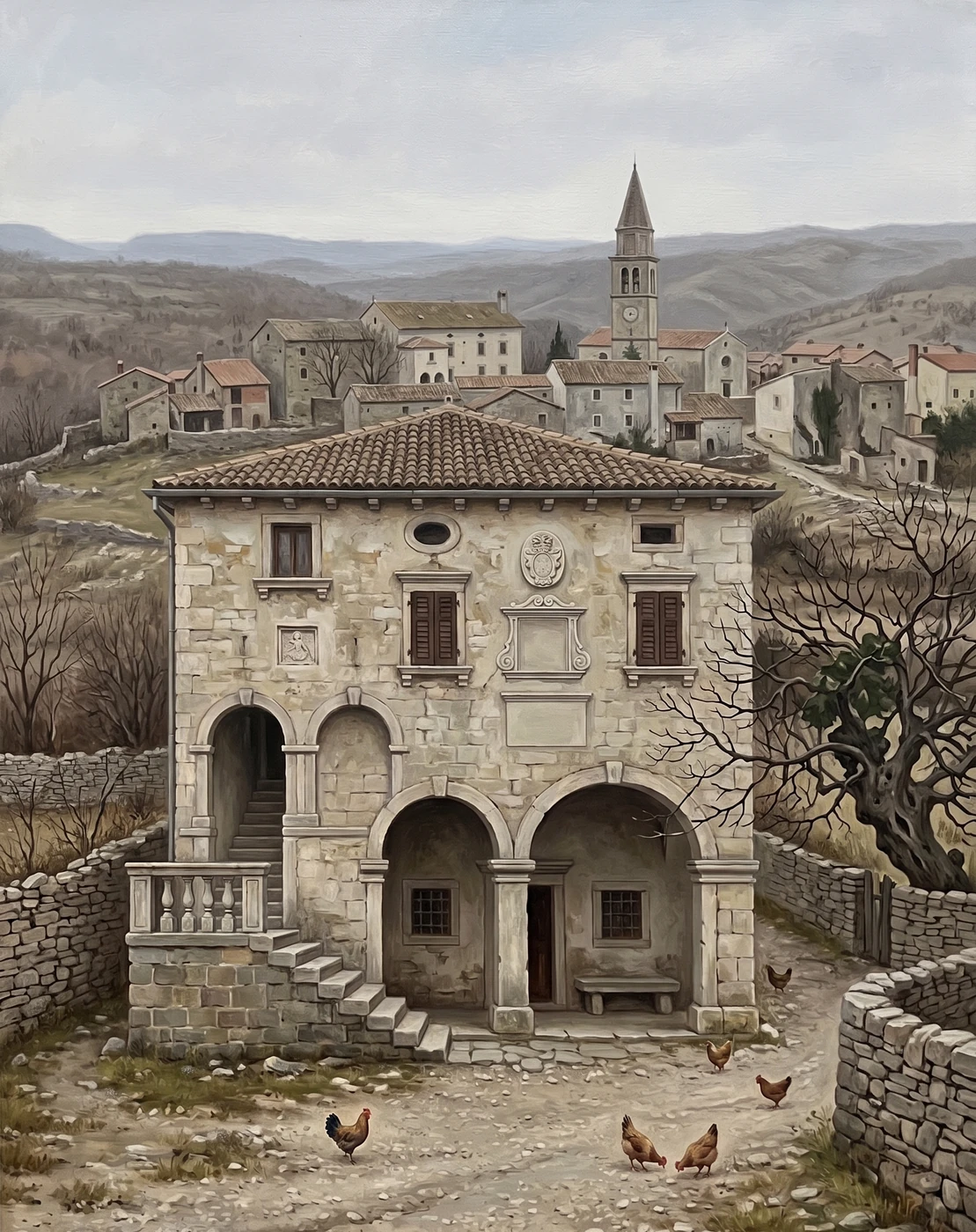
The tablet in it is blank, and that is on purpose. A first version came back with invented pseudo-Latin cut across it, and was withheld. The real tablet is the single most important stone this archive holds, read close and settled letter by letter: ANNO · DOMNI · 1711 / GION · BATISTA / DE · FRANCESCHI / FECCE · FARE · PE[R] · SE / ET · HEREDI · SVOI — in the year of the Lord 1711, Gion Batista de Franceschi had it made for himself and his heirs. A picture carrying anything else in that panel would be the one thing on this site capable of doing real damage, so the panel is empty. The oval cartouche above it is likewise left indistinct: the real arms are a cross crossed by two arrows over a pomegranate under a plumed helm, exactly as Carlo described them privately to Kobler in about 1873, with a Latin donor's legend running clockwise round the rim — and that carving is photographed, drawn and blazoned elsewhere on this site rather than guessed at here.
What the picture is good for is the shape of the thing: a long low house that is the biggest in a poor village, the loggia of two arches at one end with its steps up from the lane, the roof on projecting brackets, the dry-stone walls and the hens and the flat winter light. The house is number 22. The original file is in this project's source library.
A warning, kept here on purpose: the day an image model rewrote this stone
In September 2026 this archive began commissioning constructed illustrations from written briefs. One of them was asked, in good faith, to «enhance» the family's own photographs of the builder's tablet. What came back was not an enhancement. Image models do not enhance; they regenerate. It is being recorded here, in full, because it is the most instructive thing that has happened to this project all year.
Photographed close, in the wall, and read letter by letter: «ANNO · DOMNI · 1711 / GION · BATISTA / DE · FRANCESCHI / FECCE · FARE · PE[R] · SE / ET · HEREDI · SVOI». Italian. Arabic numerals. Five lines. And 1711 is the year Carlo De Franceschi gave Giovanni Kobler privately in about 1873 — that his great-great-grandfather Giambattista del fu Leonardo built the house in 1711. Two independent witnesses, a hundred and sixty years apart, agreeing on a year and a name.
A photorealistic marble tablet in a wall, in convincing raking light, with five lines of clean Roman capitals: «ANNO · DOMINI · MDCLXV / GLORIA · DEO · OMNIPOTENTI / DE · FRANCESCHI / PATERNO · ET · MATERNO / NOMINE · DEX · VOTO». Latin. Roman numerals. Five lines. It kept the shape of the real thing and replaced every word in it.
MDCLXV is 1665. Not 1711. A single plausible-looking image, circulated once, would put a rival date on the founding stone of this family and set it against the only two witnesses there are. It would not look like an error; it would look like a better photograph. And the Latin is not even sound — «DEX VOTO» is not a phrase; it is a machine's approximation of «ex voto».
The file is kept in this project's source library under a filename that says what it is: WITHHELD, FABRICATED, contradicts the verified 1711 reading, not a photograph, do not circulate. It is kept rather than deleted because the next person to try this — including a future version of this archive — should be able to see exactly how convincing the failure looked.
No image model is ever asked to render an inscription, a coat of arms, a signature, a document or any other carrying of text on this site. Where a real carved stone appears in a constructed illustration, its panel is left blank and the words are set in the caption underneath, where they can be footnoted. The drawn view of the house published above this section has an empty tablet for exactly that reason.
The verified reading is from the family's own close photographs of the tablet at Gologorica, 2026, checked against Carlo De Franceschi's letter to Giovanni Kobler printed in «Fiume» (1928). The fabricated version is a Gemini image generated September 2026 and archived unpublished.
Five people out of the family's own tree that this archive had nothing on
David's live MyHeritage tree was read directly in September 2026 — 459 individuals of the surname. Most of it agreed with what is published here. These did not, because this site had never heard of them.
Born at Gologorica on 31 January 1909. Died at Dachau on 7 August 1945. The camp was liberated on 29 April 1945, so a death there in August is a death among the thousands who did not survive being freed — typhus was still killing the liberated well into the summer. He was thirty-six. Nothing else about him is in this archive, and finding out how a man from this village came to be in that camp is now a piece of work in its own right.
Born at Gračišće on 12 March 1892, died in New York City on 26 April 1940, with six separate citations behind him in the tree. This site's Diaspora page has argued that the United States records held only one family it could trace back to Gračišće — Basilio and Dario, of Gallignana. Here is a second, and a much better documented one.
Born at Gologorica on 20 November 1942, died 15 January 2023. This archive has published that the surname is down to about ten people in Croatia and that the last of the Gologorica line left. A man born in that village in the middle of the war lived until two years ago.
Born at Gologorica 28 October 1860, married a Domazetovich, died at Trieste on 22 June 1941. One more of the quiet westward moves the archive keeps finding one at a time.
The tree carries a run of Gologorica deaths this site has never had: Francesco, died 13 September 1719. Gian Battista, born 1673, died 11 September 1743. Cattarina, died 28 September 1740. Gisanna, born 1684, died 20 April 1774. Antonius, born 1742, died 17 September 1802. Cattarina, born 1756, died 21 May 1792. Gian Battista, born 1753, died 23 January 1813. Set beside the 1711 tablet and Carlo's «il vecchio stipite» dead in November 1686, that is most of a century of the house filled in.
David Defranceski's live MyHeritage tree, read 7 September 2026. Dates as the tree gives them; the citations behind them, where they exist, are FamilySearch record links entered by the family.
The house and the ground, photographed
The family went to Gologorica in 2026 and came back with a hundred and seventy-five frames. Until now this archive has quoted from them and never shown them. These eleven are the ones that carry evidence: the tablet the house was built under, the arms Carlo described in a private letter, the same arms cut twice in the cemetery a century apart, and the building Radmila Matejčić described in 1979 from the outside without ever naming who lived in it.
Living people are in many of the other frames and are left out of this archive, as everywhere else on the site. What is published here is stone.
An architectural survey of the village — and a hard date for the lease
Krešimir Regan and Branko Nadilo's series on the Istrian castles ran in «Građevinar» in 2012, and the instalment on the fortified places north of the Čepić field takes Gologorica apart building by building. It is a civil-engineering journal rather than a genealogy, which is why it is useful: it has no interest in the family and describes the house as a structure. It also gives the benefice a date this archive did not have.
«Na trgu je pokraj crkve velika kamena palača obitelji De Franceschi, dvokatna građevina s balkonom i portalom iz 1711., ukrašena grbom i natpisom te reljefom s prikazom Isusa. Mnogi drže da je to jedan od najljepših primjera skromne palače seoskih posjednika, funkcionalna i jednostavna u svojim dimenzijama i ukrasima.» — On the square beside the church is the large stone palace of the De Franceschi family, a two-storey building with a balcony and a portal of 1711, ornamented with a coat of arms, an inscription, and a relief showing Jesus. Many hold it one of the finest examples of the modest palace of a rural landowner, functional and plain in its dimensions and its ornament.
When this archive first tried to have the house drawn, it said the relief panels above the door were invented by the image model, then corrected itself from the family's own photographs, which show an aedicule with scrolled volutes and a haloed figure. A published architectural survey now names it: a relief of Christ. The tablet, the arms and the figure are all real, all of 1711, and all still there.
This is the correction that matters. Gologorica changed hands until 1443, when the provost of Pazin, Andreas Schuel, bought it and with other property founded a benefice — an endowment to maintain priests bound to say Mass three times a week in St Nicholas's at Pazin. The Emperor Frederick III then took the right of appointment. The holders were, to the eighteenth century, mostly the captains of Pazin or the bishops of Pedena; then the Marquis de Prié; then Charles Antoine Biotz; and «naposljetku od 1772. obitelj De Franceschi koja je gologorički beneficij držala u zakupu do ukidanja feudalnih odnosa 1848. godine» — and finally, from 1772, the De Franceschi family, who held the Gologorica benefice on lease until the abolition of feudal relations in 1848.
This site has carried the lease from Carlo's own letter to Kobler — the «affitto fermo» of the bishop of Pedena, renewed by every bishop, which is why the village is missing from the 1498 urbarium: «perchè ne era Dominus il vescovo di Pedena». The two accounts fit together rather than contradict. The bishops were among the earlier holders of an endowment founded in 1443; the family took the lease of it in 1772 and kept it for seventy-six years, through the suppression of the see of Pedena in 1788 and out the other side, until feudal tenure itself was abolished. Seventy-six years is a long time to be the man who collects, and it is the economic fact behind everything else on this page.
The historic core sits on a narrow ridge running north to south. The walls were an elongated irregular quadrangle; only a small stretch survives with the north gate, the rest pulled down in the eighteenth and nineteenth centuries or built into the fronts of the houses. Deep ditches with drawbridges defended the north and south ends and were gradually filled in and turned into gardens and vineyards. The walls are thought to be sixteenth-century, put up after Gologorica had been taken and burned in 1463, 1508 and 1511.
The parish church of Sts Peter and Paul is a seventeenth-century single-nave baroque rebuilding of an older Gothic church, of which there survive a Glagolitic inscription of the priest Juraj Kaligarić, 1595, an Imago pietatis relief of 1446, and a fifteenth-century chalice. The bell tower was begun in late Gothic and finished in 1740 — twenty-four metres, three storeys, fine ashlar, biforate openings on the third. And above the north entrance, by the pond, the oldest building of all: the small Romanesque church of the Blessed Virgin Mary.
«Iz Gologorice potječe i plovan Mikula Gologorički, notar i pisac hrvatske glagoljaške verzije često spominjanoga Istarskog razvoda iz 1325.» — From Gologorica came the parish priest Mikula Gologorički, notary, and the writer of the Croatian Glagolitic version of the Istrian Boundary Settlement of 1325 — the great delimitation between the patriarch of Aquileia, the count of Gorizia and Pazin, and Venice. One of the foundation documents of Croatian literacy was written by the priest of this parish, three hundred and fifty years before the family reached it.
Krešimir Regan and Branko Nadilo, «Istarski kašteli: utvrđeni gradovi i naselja sjeverno od Čepićkog polja», in «Građevinar» 64 (2012) 6, pp. 515–522. Supplied by the family as a scan, September 2026, and now in this project's library. Its own first citation is Camillo De Franceschi, «I castelli della Val…» — Carlo's son, cited by the engineers as the authority on the castles of his own valley.
The Gologorica parish archive exists, and a 2024 paper has been reading it
Elvis Orbanić's study of the weeping Madonna of Sveti Petar u Šumi, in «Acta Histriae» 32 (2024), works from the Paulines' chronicle of the miracles. Two of its pilgrims come from this county, and one of them is the parish priest of Gologorica. But the thing that matters most for this archive is buried in the source list at the back.
«ŽAG, MKK – Župni arhiv Gologorice, Matična knjiga krštenih (1691–1763)» and «ŽAG, MKU – Župni arhiv Gologorice, Matična knjiga umrlih (1646–1777)». The parish archive at Gologorica — baptisms from 1691, deaths from 1646 — cited as a working source by a historian publishing in 2024. This site's Parish Books page says flatly that Gologorica has no film at all and that its registers are the great absence in every collection searched. They are not lost. They are in the parish, they are being used, and their dates are now known. Deaths from 1646 would reach a generation earlier than anything this archive holds for the village.
On 2 October 1722 the archpriest Petar Kruzila (Petrus Cruzilla), parish priest of Gologorica, walked the twenty-one kilometres to Sveti Petar u Šumi to discharge a vow. He had refused to believe the image wept. Then, riding, he came off his horse and was struck deaf where he fell, and kept his bed forty days; having made his vow to the Virgin he felt better at once, and «wished to tell everyone of his case and of his doubt». He stayed in the parish until he died there on 25 September 1731, entered in the Gologorica death register as «Reverendissimus dominus Petrus Cruzilla, protonotarius apostolicus, archipresbyter et parochus Gologoriziae».
He is the priest who was baptising at Gologorica in 1722 — the man whose hand wrote the entries for the household that had cut ANNO · DOMNI · 1711 over its door eleven years before. The paper cites him as the regular administrator of baptisms there in that year. Whoever of this family was born, married or buried at Gologorica between about 1720 and 1731 was written down by a deaf apostolic protonotary who had fallen off a horse for doubting a miracle.
The same paper, citing Camillo De Franceschi's «Storia documentata della Contea di Pisino», notes that Antonio Bartolomeo Bono, vice-captain and administrator of the County of Pazin in 1723–24, «porijeklom je bio iz riječke patricijske obitelji» — was of a Rijeka patrician family, and had read law at Padua in 1705–6. The traffic between Fiume's patriciate and the County of Pazin's administration ran both ways, and that is the same channel Kobler's «venuto da Pisino» household went along in 1740.
«Župa Gologorica spominje se 1324., a vjerojatno je postojala i ranije» — the parish is mentioned in 1324 and probably existed earlier, within the diocese of Pedena. Which is a year before Mikula Gologorički, priest of this same parish, wrote the Croatian Glagolitic version of the Istrian Boundary Settlement of 1325.
Elvis Orbanić, in «Acta Histriae» 32 (2024) 1, on the votive record of the lacrimating image at Sveti Petar u Šumi — read in full, 8 September 2026, from a scan supplied by the family. Its Gologorica citations are to the parish archive there (ŽAG), baptisms 1691–1763 and deaths 1646–1777.
Carlo, cited eleven times in 1979 — and a Roman road under the village
Mate Križman's «Antička svjedočanstva o Istri» (1979), the first volume of the «Istra kroz stoljeća» series, is an anthology of every Greek and Latin writer who mentions Istria, with philological commentary. It is a classicist's book and it has nothing to do with genealogy. It cites Carlo De Franceschi eleven times, and it puts Gologorica in the Roman period.
In the index: «FRANCESCHI C. de — 170, 189, 192, 193, 211, 263», with «L'Istria, note storiche, Poreč 1879» cited at pages 10–11, 38ff, 45 and 67. Križman uses him for the topography of the Istrian war of 177 BC, for the siege engines at Nesactium, for the identification of Livy's lost towns, and for the question of whether the Pontic Histri and the Adriatic Histri are one people. He sits in the text beside Kandler, Gnirs, Benussi, Zippel and Müller — which is the canon. Ninety-nine years after he published it, a professional classicist was still arguing with his book rather than around it.
«Najmanja je vjerojatnost da ćemo pogriješiti ako glede Mutile prihvatimo Kandlerovo, De Franceschijevo i Gnirsovo mišljenje koje na temelju sličnosti imena poistovjećuje Mutilu s Medulinom» — we are least likely to be wrong if, for Mutila, we accept Kandler's, De Franceschi's and Gnirs's view identifying it with Medulin; and for Faveria they propose Mutvoran. Two lost towns of Livy, placed by a man from Gologorica, still the best answer in 1979. And Medulin is one of the towns in the southern-Istrian cluster this archive has just opened.
Gnirs proposed that the ancient Alùon was a settlement of the Istrian interior, on the Veli potok between Pićan and Gologorica, at the place where the Roman inscriptions CIL V 322, 323, 424 and 425 were found. Križman indexes Gologorica at page 98 for it. This archive's story starts in 1644 with a baptism register. There were people writing on stone in that valley sixteen centuries earlier, and the stones have numbers.
The book is out of print and second-hand copies are scarce, but the full text is online, uploaded to both Scribd and idoc.pub. It was read there in September 2026. A proper library copy is still worth having, because the apparatus is the point of the book.
Mate Križman, «Antička svjedočanstva o Istri», Istra kroz stoljeća I/1, Pula–Rijeka 1979 — read in full text from the copy at idoc.pub, September 2026. Križman (1937–2015) taught classical philology at Zagreb.
The house, 12 August 1945 — an eyewitness, in full
An archivist walked into this house three months after the war ended and wrote down what he found. His report has been quoted at second hand on this site for a year. It is printed in full as an appendix to the 2022 Zagreb paper, and it is the last description of the De Franceschi library and archive standing in the building they were made in. It begins with a rumour about sabres.
«In the village of Gola Gorica (12 km from Pazin) the people's militia had, according to one report, armed itself with historic sabres. Inspection established, though too late, that the militia had been quartered in the country house of the De Franceschi family.» He adds why the name meant something to him: the family «gave good Istrian historians through two generations. Carlo (d.) and his son Camillo (aged 70), together with Benussi, have deserved most of the history of Istria.»
Camillo, the present owner, «was director of the library in Pula, and is now somewhere in Italy». The house had therefore been sequestered and put under the Administration of National Property for Istria. In 1943 the partisan hospital from Pazin was moved into it because of the bombing. After the German advance it was no longer kept up — the owners had stopped coming for the summer. After the German capitulation it served as a guardhouse for the people's militia, and the former District Committee of Čepić «carried off four cartloads of various things». Hauptmann compares it to the emptied castle of Baroness Hütterot on Sv. Andrija by Rovinj — except that here not even the thin list of removed items that Rovinj had was left behind. The Čepić committee listed only what remained, and did that post festum.
«Sorting the chaos in the house, I reassembled the library, in which all the scholarly works of the two men are now brought together.» «The library itself is, for Istrian questions, exemplary. I gave up any listing of the books, because one may safely assert that the library, as regards the historiographical questions of Istria, is complete.» He names the runs: Atti e memorie della Società Istriana di archeologia e storia patria, the Archeografo Triestino, Memorie storiche Forogiuliesi, the Archivio Veneto. Then great numbers of single issues of the most varied journals, kept for their Istrian content, and newspaper cuttings — their own and other people's. And an offprint collection sorted by subject into boxes on a register system, so that specialised literature on archaeology, or on the biographies of Istrians, or on folklore, could be found at once. The non-scholarly part: «old and new editions of Petrarch, Dante, Tasso, in general a great number of books of the most varied content — old editions of Machiavelli, bibles, the Venetian statutes.»
«The manuscripts of Carlo and Camillo are saved in fair number, though they were scattered everywhere.» He had too little time to separate published from unpublished — but a glance convinced him they all had to be kept, and his reason is a working historian's: «It happens, for instance, that in composing a work the writer used his own notes and those of his forebears, and of course did not carry the whole of that into the printed work.» He names Carlo's Gita a Cosgliaco and «a collection of biographies of famous Istrians which Pietro De Franceschi gathered fifty to a hundred years earlier» — an ancestor-collector this archive has never had a word about. And the Istrian travel accounts: Gita a Colmo, Bogliuno, Rovigno.
«The noble family De Franceschi has lived, according to the material found, at least from the beginning of the XVII century at Gola Gorica. Beside the modest manor — if the house may be called that — it possessed some land in the neighbourhood. An inventory from the beginning of the XVII century is preserved, which gives a fine insight into those circumstances.» This archive has cited that sentence at second hand for a year and treated it as a rival date to 1650 and 1700. Read whole, it is an archivist's inference from a box of papers in a house, in one afternoon, with a militia billeted in it — not a documented arrival. He is describing the same thing the Rijeka fond describes: a collecting family whose oldest paper is older than the family's presence.
Account books old and new; lists of dues from the Gola Gorica district, paid to the church or directly to the lordship, running down into Carlo's and Camillo's own correspondence. That correspondence had once been well ordered; he found it «all scattered» and could only roughly put it back. And then material from around Pazin that had strayed into the family's ownership through the historiographical enthusiasm of its two representatives: · Protocols of the circulars of the Pićan bishop Aldrago Antonio de Piccardi, about 1780 · «Atti di nomine e investiture dai parochi della Contea di Pisino», 1728–1776 · a copy of the Venetian–Istrian chronicle called the Barbara · a chronicle of Pula and its district written in 1726 by a Pula archdeacon · and «especially a complete population census of the town of Rovinj, 1650–1736» — which he calls a rich find · the urbarium of the castle of Momiano, 1584/5, in two volumes — «a small consolation for the destroyed urbarium in Pazin castle»
«The search for treasure written in Glagolitic was for the first time crowned with success. It is known that the Italians rooted out Glagolitic in stone and on paper. While some stone inscriptions are still found, on paper Glagolitic is very rare.» «For the church at Hum (Colmo) a parish register from the middle of the XVII century has now been found, written largely in Glagolitic — and likewise one for the confraternity of the church of St Roch near Hum.» So there was not one Glagolitic Hum book in this house but at least two, and the Rijeka fond's «income book of the parish church at Hum, 1610–1685» is a third description of the same small hoard. This is the answer to the question this archive asked yesterday about Vlahov's published Registro della chiesa parrocchiale di Colmo: the family had the Glagolitic books of Hum, more than one of them, and an archivist carried them out of the house in August 1945.
The last line of the inventory, and the largest claim in it: «A collection of charters — mostly parchment — rotuli, papal bulls… from the year 1201 onward, for various Istrian towns, completes the find at Gola Gorica.» Signed: Zagreb, 12. VIII. 1945. F. Hauptmann.
Three things. The house was emptied twice — by four cartloads to Čepić and then by the archivist, and only the second man wrote anything down. The «seventeenth century» date for the family at Gologorica is Hauptmann's reading of a collection, not a document, and it should never again be set against 1661 as though the two were rival records. And the family's own papers are the smaller half of what was in that house: the bishop's protocols, the Rovinj census, the Momiano urbarium and the Glagolitic books of Hum were other people's records, gathered by two historians, and they are the reason this family's archive begins two centuries before this family does.
Ferdinand Hauptmann, «Izvještaj o arhivima. Gola Gorica kod Pazina», Zagreb, 12 August 1945 — printed in full as Appendix 1 to Anita Marin, Martina Jurišić and Alena Matijaca, «Zbirka obitelji De Franceschi u Nacionalnoj i sveučilišnoj knjižnici u Zagrebu», «Libellarium» 13, 2 (2022), pp. 19–21, and published by Markus Leideck in «Arhivski vjesnik» 58 (2015). Translations here are this archive's own.
The 1610 problem, solved — and it was never a problem
The family's own archive survives, at the State Archive in Rijeka, as fond HR-DARI-254, «Obitelj De Franceschi iz Gologorice», and its catalogue dates run 1610–1934. That start date has sat awkwardly on this site for a year: every account of the family's arrival says the mid-seventeenth century or about 1700, and here was an archive apparently beginning ninety years before the earliest of them. The archive's own finding aid, read properly in September 2026, dissolves it in one sentence.
«Sadržajno je raznolika i značajna zbirka obitelji (1610-1874), u kojoj se nalazi najstarija knjiga u fondu, knjiga prihoda župne crkve u Humu (1610-1685), pisana glagoljicom, ujedno i jedina u fondu na hrvatskom jeziku.» The oldest book in the fond is the income book of the parish church at Hum — Colmo — for 1610 to 1685, written in Glagolitic, and it is the only item in the whole fond in Croatian. It sits in series 3, «Zbirka obitelji» — the family's collection, the things they gathered — not in series 1, the family's own papers.
A family archive's earliest date is the date of the earliest object in it, and this family produced a historian. The finding aid says as much: «Nema podataka tko je bio sakupljač gradiva, ali najvjerojatnije je to bio Carlo De Franceschi, a moguće je da je to činio ili nastavio sakupljati njegov sin Camillo» — no record of who assembled the material, but most probably Carlo De Franceschi, and possibly continued by his son Camillo. So 1610 is the year of a Glagolitic parish account book from a village eleven kilometres away, picked up by the man who wrote the history of Istria. It is evidence about Carlo's library, not about his ancestors' whereabouts. The four dates this archive has been juggling — 1610, the mid-seventeenth century, 1661, about 1700 — are now three, and 1610 was never one of them.
The arranged series say it plainly. 1.1 Family papers in the strict sense: probate 1794–1800, lawsuits between family members 1788–1801, papers on individual members 1791–1934. 1.2 Papers on the family's estates: 1703–1783 — contracts of sale and exchange, land let out, share-farming of livestock. 2. Miscellanea 1804–1926. 3.1 Religious bodies 1610–1805. 3.2 Secular bodies, economy and administration 1709–1874. The family's own earliest paper is therefore 1703 — three years after the arrival Carlo himself claimed, and eight years before the date cut over the door of the house.
The content note is the best short description of this family's economics anyone has written: «Kupoprodajni ugovori, ugovori o permutacijama, knjige kreditiranja i potraživanja svjedoče o intenzivnom bogaćenju obitelji tijekom 18. stoljeća, trgovačkom i financijskom aktivnošću, putem posuđivanja novca i otkupa dugova u gologoričkom kraju, ali i sve do Kastva, Mošćenica, Labina, Kranjske i drugih udaljenih mjesta.» Contracts of sale and exchange, and books of lending and of debts owed, witness the family's intensive enrichment through the eighteenth century by trade and finance — lending money and buying up debts — in the Gologorica country and as far as Kastav, Mošćenice, Labin and Carniola. That is not a farming family that prospered. It is a money-lending and debt-buying business, run out of a village, reaching a hundred kilometres. It explains the arcaded palazzetto, it explains six proprietor households by 1820, and it is exactly the Carnian merchant profile the migration literature describes.
The last sentence of the provenance note is the one this archive will be quoting for years: «Zbog nepoznavanja povijesti obitelji do sređivanja 1990. godine gradivo ovog fonda je bilo spojeno u jedan fond s gradivom jedne druge obitelji De Franceshi, onoj iz Šegeta kod Buja.» Through ignorance of the family's history, until the arrangement of 1990, this fond's material was joined into a single fond with that of another De Franceschi family — the one from Šeget near Buje. Before that there was only a temporary list, «superficial and inaccurate». The fond was separated and arranged by the archivist Ines Krota. So for forty-odd years the Carnian family and the Cretan family were one archival fond in one building, because nobody knew they were two families. This site has spent a year arguing that they are separate, against a monograph that calls them two branches of one house. The archive that holds both of them reached the same conclusion in 1990, and had to physically pull them apart to act on it.
The material was taken in in 1948, out of Pula or Poreč, with the rest of the Istrian holdings that had been prepared for evacuation, and entered in the general inventory at no. 92, page 142 — never entered in the accessions book at all. In 1950 one bundle was returned to the Naučna biblioteka in Pula along with three miscellanea fascicles, said to have come from the Financial Department of the Regional People's Committee for Istria. That bundle is somewhere in Pula, and this archive does not know what is in it. The whole fond is 0.70 metres, seven boxes, in Italian, Croatian and Latin — and open to the public.
HR-DARI-382, «Obitelj de Franceschi iz Šegeta», runs 1412–1943: 2.60 metres, twenty-six boxes and four folders, archivally arranged. Nearly four times the Gologorica fond and starting two centuries earlier — which is what an estate-owning house with a private library leaves behind, and a reminder that the two families are not comparable in anything but a surname. The 1412 start deserves the same scepticism as 1610 until somebody says what the document is.
One more thing about that Hum income book. In 1999 the State Archive in Pazin published «Glagoljski rukopis iz Huma (1608.–1639.): iz Registro della chiesa parrocchiale di Colmo», edited by Dražen Vlahov — a Glagolitic register of the parish church of Colmo, which is Hum, covering 1608 to 1639. The family's book runs 1610 to 1685. Same parish, same script, same kind of book, overlapping decades. They may be one manuscript, or two halves of one register that were separated when the family's papers went to Rijeka and the parish's stayed in Istria — or they may be two different books. The fond description and the printed edition do not cite each other, so nobody has said. The edition costs thirteen euro and is on the acquisitions list. Until then this is a question, not a claim.
Državni arhiv u Rijeci, finding aid to fond HR-DARI-254, «Obitelj De Franceschi iz Gologorice» (alt. RO-011), 1610–1934, arranged by Ines Krota, 1990; and the entry for HR-DARI-382, «Obitelj de Franceschi iz Šegeta» (alt. RO-023), 1412–1943. Read from the archive's published register of fonds, September 2026. Quotations are the register's own Croatian; the translations are this archive's.
Six households in 1820 — and one of them is «di Gallignana»
This archive has said, on this page and on three others, that nothing yet joins the Gologorica house to the Gallignana line of farmers and stonecutters two villages away. Both families believe the join exists; neither has the page. Dean Brhan, working the Catasto franceschino of 1820 in the state archive at Trieste, prints a list that puts a name in the gap.
«A Moncalvo di Pisino nel 1820 erano presenti 6 fuochi dei possidenti De Franceschi; Maria, Giuseppe, Giobatta (di Gallignana), Leonardo e Antonio. Erano la famiglia più influente dell'area in questione che comprendeva una decina di villaggi abitati compattamente da contadini croati.» At Moncalvo di Pisino in 1820 there were six hearths of De Franceschi proprietors — Maria, Giuseppe, Giobatta (of Gallignana), Leonardo and Antonio. They were the most influential family in a district of some ten villages inhabited solidly by Croatian peasants.
Every other proprietor in the list is given by first name alone, because they are of the place. One of them is qualified — «di Gallignana». The cadastral clerk needed to say which Giobatta he meant, and the way he distinguished him was by the village he came from. So in 1820 there is a Giovanni Battista De Franceschi, identified as a man of Gallignana, holding property at Moncalvo — the two villages this archive has never been able to join, in one line of one document.
It is not proof. It does not say he is our Joannes Baptista, the farmer of house 5 at Gračišće whom the register catches in 1787 and who would have been in his sixties in 1820; Giovanni Battista is the commonest name in both villages, and a De Franceschi of Gallignana holding land at Moncalvo could be a cousin, a purchaser or a son-in-law as easily as an ancestor. What it is, is the first object of any kind that puts the two names together — and it tells this archive exactly which sheet to order. The Catasto franceschino for the Comune di Gallignana, Distretto di Pisino, is at the Archivio di Stato di Trieste, and its Moncalvo counterpart with it. Brhan read them. So can we.
«The most influential family in an area of some ten villages inhabited solidly by Croatian peasants» is a much harder statement than «possidenti». Six proprietor households of one surname in one small village, in an Austrian cadastre made for taxation, is a local gentry — which is what the arcaded palazzetto with the shield on its façade was already saying, and what «da modesti possidenti» in Carlo's biography was quietly denying. Both can be true across a century: modest when they arrived, dominant by 1820, and the cadastre is the year the balance shows.
Dean Brhan, «“Stare cum loco et foco”. L'emigrazione verso l'Istria dalla Carnia e dal Friuli», published by the Amici dell'Orologeria Pesarina, Prato Carnico — read in full from the association's own open text, September 2026. Brhan's list is drawn from the Archivio di Stato di Trieste, Catasto franceschino, and his note on the family's origin cites Miroslav Bertoša, «Etos i etnos zavičaja» (Pola–Fiume, 1985).
The full bibliography, with what each source gave and where it is weak →